

John Preston
Safety Comes First
All about warning labels; pinned props on four-stroke engines; RC frequency flag problem; more.
Warning Labels
In the April 1986 issue of this magazine, I reprinted a letter from David Lewis which suggested that RC equipment should carry a warning label that, pictorially or otherwise, would identify whether its frequency was one of those assigned for aircraft models only or for surface (boat/car) models only. David felt that such labels would minimize the sales of radios on frequencies which are illegal for their intended use.
I forwarded David's suggestion to the chairman of the AMA Safety Committee, Jim McNeill, and enclosed a letter in which I stated that I felt that this suggestion should be pursued. I was pleased to see in Johnny Clemens' District VIII VP report (in the August 1986 issue) that such labels will soon appear on RC equipment, identifying its legal use.
I recently received a letter from a reader on the subject of warning labels that may be of interest. The writer believed that a recent FAA proposal to owners of certain Cessna aircraft was somewhat absurd. The FAA proposal would require, among other things, the posting of a warning label on the plane's instrument panel advising the pilot to be sure that his seat is latched properly before taxiing, taking off, or landing.
Perhaps such a label is absurd, but the proposal may have originated from Cessna, which presumably was aware of incidents in which pilots' seats were not latched properly prior to taxi, takeoff, or landing.
Failure to warn against a potential hazard has apparently been the grounds for a number of successful product liability suits against manufacturers. Even incorrect use of a product by its owner does not necessarily let the manufacturer off the hook should an injury-producing accident occur. Failure of the manufacturer to warn the user about the consequences of incorrect use may be the grounds for a lawsuit.
In my regular job with a federal regulatory agency (No, not the FAA!), I have recently been involved in the development of warning labels for several products. According to labeling experts, it isn't sufficient to rely on a mere statement that says "Don't do this" or "Don't do that." The consequences of not obeying the message on the label should also be present.
Very shortly, the American National Standards Institute will be publishing a voluntary standard (ANSI Z535.4) on Product Signs and Labels. Safety labels developed in accordance with the provisions in this standard must contain the following elements:
- Signal Word. Typical words are Danger, Warning, and Caution; the selection of the appropriate word depends on the seriousness of the hazard. Signal words should be on a colored background: red for Danger, orange for Warning, and yellow for Caution.
- Hazard Alert Symbol. This symbol is the internationally recognized exclamation mark (!) placed within a triangular border and located immediately in front of the signal word.
- Pictorial. Some hazards can be illustrated pictorially (fire, electrocution, radiation). Many modeling hazards may be difficult to identify pictorially; such a symbol is optional.
- Identification of the Hazard. A concise verbal message that identifies the hazard and is the first verbal message after the signal word.
- Result of Ignoring the Warning. This tells the reader what might happen if the warning is ignored (for example, "lacerations to hand and fingers" caused by contact with a rotating prop).
- Avoiding the Hazard. This part of the label tells the reader how to avoid the hazard.
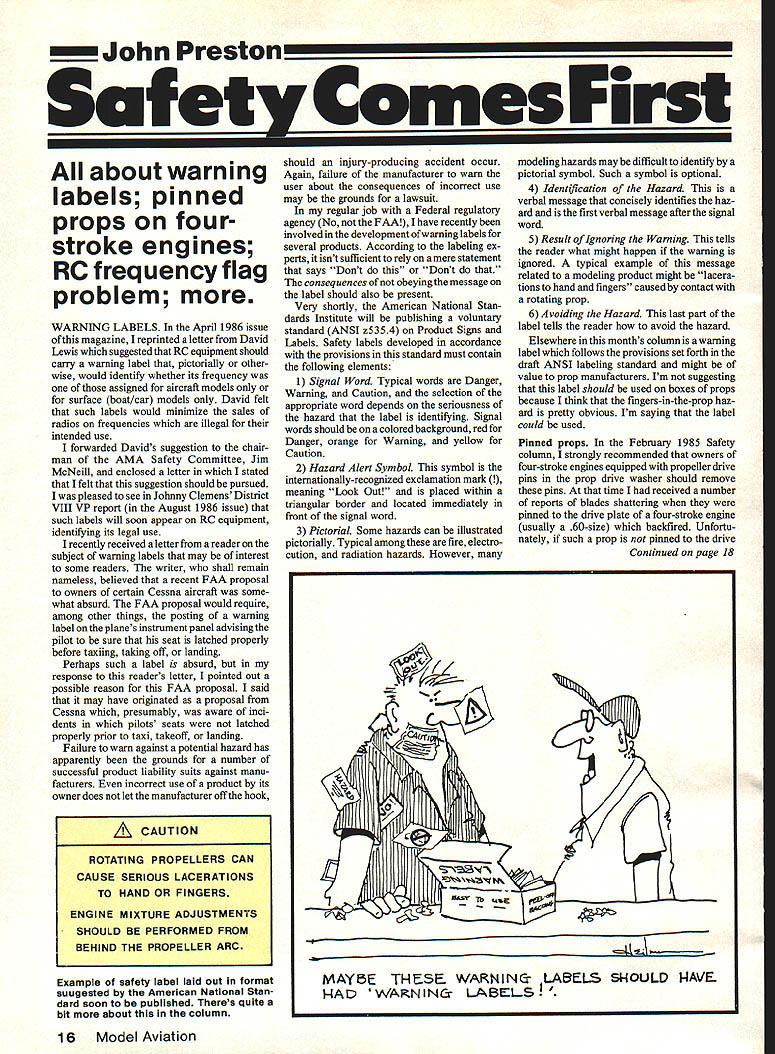
Elsewhere in this month's column is a warning label which follows the provisions set forth in the draft ANSI labeling standard and might be of value to prop manufacturers. I'm suggesting that this label should be used on boxes of props because the fingers-in-the-prop hazard is obvious.
CAUTION
ROTATING PROPELLERS CAN CAUSE SERIOUS LACERATIONS TO HAND OR FINGERS.
ENGINE MIXTURE ADJUSTMENTS SHOULD BE PERFORMED FROM BEHIND THE PROPELLER ARC.
Pinned Props
In the February 1985 Safety column, I strongly recommended that owners of four-stroke engines equipped with propeller drive pins in the prop drive washer should remove these pins. At that time I had received a number of reports of blades shattering when they were pinned to the drive plate of a four-stroke engine (usually a .60-size) which backfired.
If such a prop is not pinned to the drive plate and the engine backfires, it will generally cause the prop nut, prop washer, and prop itself to be thrown off. A solution to this latter problem (suggested by Bill Hoffmeister in the November 1985 Safety column) was to use a prop nut with a locking insert (Nylok or equivalent). There followed a controversy over whether such props should be pinned or not.
During this past month, I received a letter from Ern Milneberg, proprietor of Em's R/C Shop in Ft. Dodge, IA. Ern has a number of four-stroke engines, most of which he likes. However, he has a 1.2-cu.-in. engine that he says has some rather unpleasant traits. His letter related the following account.
"In one of your articles, it was suggested that those engines with pins in the prop hub should have the pins removed because they could split the prop. So I dutifully removed the pins when I got the engine.
"Late last summer, I was having trouble getting this engine started. It was fairly new then, so I thought I would use the starter on it. I have done this on many occasions with the other engines. The response was instantaneous; the spinner went flying, and the prop came off. It hit me in the upper part of my chest, cut my shirt and undershirt, put a welt on my chest, and broke the tip off the prop. Five or six inches higher would have gotten me in the neck. So much for using the starter on this critter. I used the engine several times last fall, and then again this spring I had another incident. I had taxied out to the runway and was checking the controls before taking off when the engine stopped. I had my Ni-Cd starter battery in my pocket, so I restarted the engine. As I was getting up, the prop came flying off and hit me twice in the leg. That was when I decided that the pins were going back in the prop hub.
"I had been having a terrible time trying to keep the prop tight on the hub. Almost every time I tried to start it, it would kick loose. At this same time, I thought I should check the valve tappet clearance on the engine. Both tappets were found to be too snug, so I adjusted the clearance and found that the engine behaved much better during starting. Even with the pins in, I could always turn the prop nut about five or six degrees to tighten it after a flight.
"Evidently with this engine, your first indication that the valve tappet adjustment is off is when you encounter excess detonation on starting and, for your own safety, these clearances should be checked. With many of the other engines, I encountered a loss of power when the tappets were out of adjustment. I would surmise that in the case of the 1.2, when the tappets get off it is coming on compression sooner than is supposed to; hence the detonation.
"There are several other brands of 1.2s in use locally, and they are not having any of the problems I have encountered with the one I'm using. I will probably buy another engine in this size, and it darn sure is not going to be the same brand as the last one. I would absolutely not recommend that the prop pins be removed from this brand of engine. If you do remove them, you are courting disaster. I am under the impression that even with the prop pins left in, it is just a matter of time before that engine gets me a good start.
"I do not like the idea of gasoline. However, this engine I've been telling you about is headed for the infield. The $125 it will cost me is not much for the loss; in the long run, going to be much cheaper and less painful than fooling around with the engine in its present form. I think that, to minimize the danger, the tappets on this engine should be checked every three or four runs, even when it seems to be running OK. And, by all means, leave the prop pins in."
If anyone with a 1.2 four-stroke engine has experienced similar problems to those of Ern and wishes to write me about their experiences, I would welcome the letters. (If you desire a response, please enclose a SASE.) Meanwhile, the controversy of pinned props versus non-pinned props on four-stroke engines remains. I am very receptive to mail on this subject—especially from manufacturers or importers of such engines.
Frequency Flags
Another letter received during the last month draws attention to what its author regards as a "very serious safety problem." Bob Cardone wrote:
"In the past month, I have seen at least five people come to the flying field with new radios (from one specific manufacturer) which did not display flags. When I questioned these people as to where the flags for their transmitters were, they said, 'The radios didn't come with them.' Last week we had three people without flags flying at the same time. I believe this manufacturer's policy will cause many accidents due to people's not having flags but flying anyway. I think a frequency flag should be required as part of the radio system."
I happen to agree with Bob. The very least that a radio manufacturer/importer can do to ensure safe flying operations is to supply an appropriate frequency flag. On the other hand, whose responsibility does safe operation really rest with—the manufacturer/importer, or with the ultimate owner/operator? Since I'm an engineer rather than a lawyer, I don't have a definitive answer.
Perhaps it is the responsibility of the vendor (mail-order house or hobby shop) of the RC equipment to supply—or at least point out the need for—frequency-identification flags. The FCC does not require frequency flags to be displayed on transmitter antennas in order for an operator to be in conformance with their regulations. This is an AMA rule.
On page 127 of the current (1986–87) AMA rule book, it states: "Figure 1 describes the frequencies and flags authorized for RC channels, and the PRS frequencies, and the old AMA chart of frequencies." On the same page, "Figure 2 describes the frequencies and flags for the new RC channels authorized for use in AMA-sanctioned competitions." My interpretation (again as an engineer rather than a lawyer) of these statements in the AMA rule book is that whoever is sponsoring flying operations at an AMA field is responsible for ensuring that frequency-identification flags are displayed by individual modelers.
I'd be interested to hear comments on that interpretation from modelers who are lawyers. I'd also like to know how an individual AMA member stands with regard to AMA insurance if he flies an RC model without displaying the appropriate frequency flag on his transmitter antenna. Is display of the flag a requirement for all RC operation? Are AMA-sanctioned events or club-sponsored flying fields required to enforce the flag display? Many letters on this subject will be discussed in a future Safety column.
Wing-Strut Failures
The following letter from William Page, a California modeler, on the subject of wing-strut attachment failures was received last month and needs no explanation.
"I would like to call your attention to something that, in my estimation, is a serious safety violation. This is the sale and use of electrical-equipment solder lugs as wing-strut fittings on R/C models. This practice is being followed by two kit manufacturers. The solder lugs are supplied in their kits and are advertised in their ads.
"In my club, we have had two such failures. We have been very fortunate in the cases since each one was noticed before there was an accident. In one case, two lugs failed on a sailplane while it was being flown during the first of two flights. We actually saw the wing move in flight.
"If you have done any electrical work, you know that solder lugs are made of copper. They are plated to make them easier to solder. One might think, from their appearance, that they are made of steel. As you are perhaps aware, copper work-hardens and breaks readily. I don't know if the lugs in that plane were work-hardened by the flexing of the wing or by vibration, but the failure would have been enough to cause the plane to crash. I am certain that anything made of tinned copper should not be used in this manner. I am not certain that the insurance underwriters would be pleased if they knew this was being done."
Bill's letter did identify the names of the two manufacturers who allegedly are supplying copper solder lugs as wing-strut fittings. Since I have not built kits from either manufacturer, I cannot comment on the adequacy of the strut fittings. However, I intend to send copies of Bill's letter to the identified manufacturers and ask for their comments.
Safety Equipment
A few days ago, I received a sample of a new product being marketed by Pelican Enterprises, Inc., of Bloomingdale, IL. I've mentioned this company previously because they supply a variety of safety-related products. The new product (which I haven't had a chance to try) is called #202 After Flight Exhaust Cleaner. It comes in a 14-oz. aerosol can and is intended to remove the exhaust goo which collects on most glow-engine-powered models during flight.
You may be wondering how this product relates to safety. Let me remind you of an incident described in Bill Winter's "Just for the Fun of It" column. Bill was attempting to hand-launch his Old-Timer Sniffer model when his hand slipped on the gooey fuselage and he folded his fingers through the prop. After this incident, Bill added high-friction panels on either side of the fuselage to aid his grip when launching the model. Pelican's #202 might be another solution to this problem.
Have a safe month.
John Preston c/o AMA, 1810 Samuel Morse Dr., Reston, VA 22090
Transcribed from original scans by AI. Minor OCR errors may remain.

