

John Preston
Safety Comes First
Choosing a flight-box fire extinguisher. Use caution with high-tech materials. An old flying-safety problem strikes again.
Follow-up on explosions and fire
In the October 1986 issue this column carried reports of explosions and fires associated with glow fuel cans. Several readers sent letters offering explanations of these hazards and advice on how to minimize the possibility of it happening to you.
First, a letter from Jim Marble, a modeler from Aurora, IN, commented on a fuel-can fire in a basement. In that incident an almost-empty fuel can ignited when the modeler attempted to unscrew the cap to refill it in his basement workshop, causing severe second-degree burns to his hand. Jim wrote:
"Nothing will burn unless it is first vaporized. Any organic substance that will vaporize at 100°F or less is classified as flammable. Above 100°F it is called combustible, such as wood. An empty or nearly-empty gas can is more likely to explode than a full one. This is because the larger air space allows fuel vapors to accumulate. The carpet (on which the victim was standing) was the key culprit to the explosion. The modeler moved his rubber-soled shoes on the carpet, built up a static charge in his body, and then discharged himself at the top of the metal can, triggering the explosion. The thunderstorm should have prevented the accident by increasing the humidity and reducing the possibility of a static discharge. The carpet must have been very dry.
"The remaining fuel in the can did not burn because the explosion removed most of the oxygen from the can. In order for fuel vapor to burn, you must have a mixture of 15% fuel vapor to 85% air, give or take 5%. Did you ever see the John Wayne movie 'Hellfighters' where he used dynamite to extinguish a gas well fire? This is an example of a controlled explosion being used to remove oxygen to fight a fire."
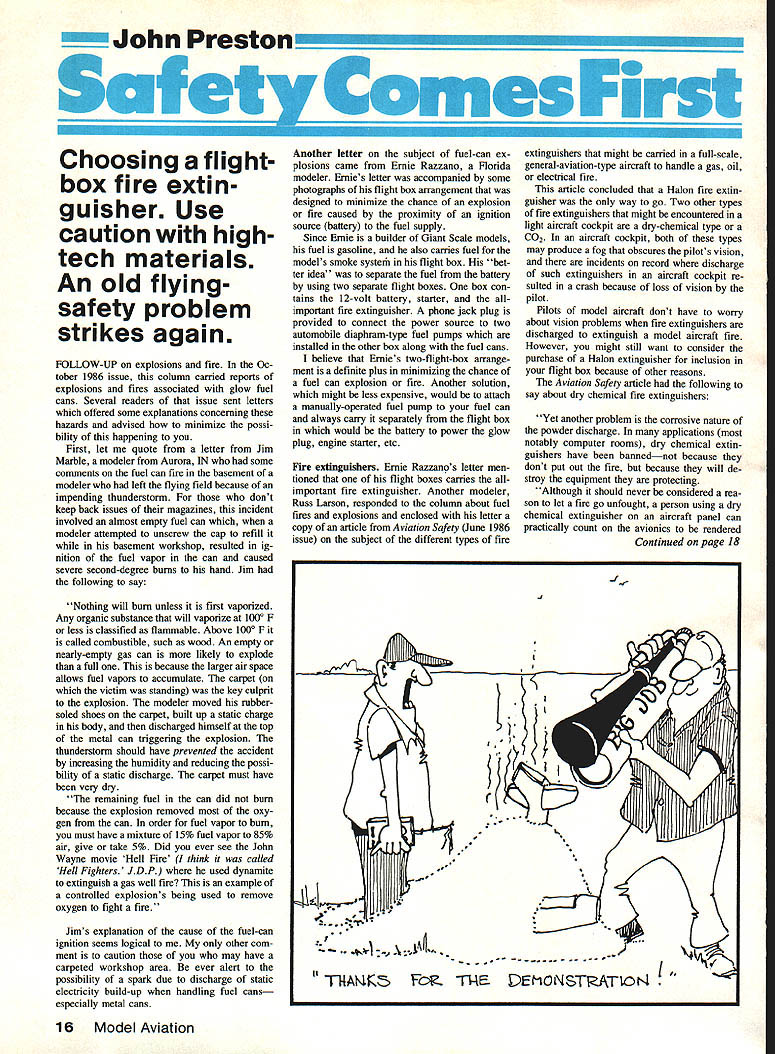
Jim's explanation seems logical. My additional caution to those with carpeted workshop areas: be alert to the possibility of a spark from static electricity when handling fuel cans—especially metal cans.
Flight-box arrangements (Ernie Razzano)
Ernie Razzano of Florida sent photos and a description of his flight-box arrangement designed to minimize the chance of explosion or fire caused by placing an ignition source (battery) near fuel. As a Giant Scale builder, Ernie carries gasoline for engines and fuel for smoke systems. His solution is to use two separate flight boxes:
- One box contains the 12-volt battery, starter, and a fire extinguisher.
- The other box contains the fuel cans and two automobile diaphragm-type fuel pumps. A phone-jack plug connects the power source to the pumps.
I think Ernie's two-box arrangement is a definite plus for reducing the chance of a fuel-can explosion or fire. A less expensive alternative is to attach a manually operated fuel pump to your fuel can and always carry the can separately from the flight box that carries the battery and starter.
Fire extinguishers
Ernie noted that one of his flight boxes carries a fire extinguisher. Russ Larson responded to the column and enclosed an article from Aviation Safety (June 1986) about extinguishers suitable for full-scale general-aviation aircraft facing gas, oil, or electrical fires. The article concluded that a Halon extinguisher was the best choice. Two other common types are dry-chemical and CO2.
Key points from the Aviation Safety article:
- Dry-chemical extinguishers produce a corrosive powder discharge. In many applications (most notably computer rooms) dry-chemical extinguishers have been banned—not because they don't put out fires, but because they will destroy the equipment they are protecting.
- Quote: "Although one should never consider a reason to let a fire go unfought, a person using a dry chemical extinguisher on an aircraft panel can practically count on the avionics to be rendered useless."
- Using dry chemical on a model fire may put the fire out but could corrode and ruin radio equipment.
- CO2 extinguishers can produce a fog that obscures vision in a cockpit and have reported incidents of reducing pilot visibility. CO2 units also have a special hazard: explosions if cylinders get too hot, or due to cylinder defects or improper installation of safety discs. NAFED cited cases where CO2 cylinders have exploded with destructive force.
- Halon extinguishers:
- Are noncorrosive and leave no residue.
- Industry sources and manufacturers (e.g., Amerex) report that Halon containers are tested to about four times expected pressures. To reach explosive pressures would require temperatures around 280°F—unlikely in normal storage conditions.
- For modelers, Halon is recommended because it puts fires out quickly, leaves no residue to damage electronics, and is less likely to suffer storage-related failures.
Russ Larson tested his Halon extinguisher on a mock fuselage, burning about 10 ounces of glow fuel. One short burst of Halon extinguished the two-foot flames instantly and left no residue. He concluded a small Halon extinguisher is the best choice for inclusion in the flight box.
Recommendation: If you don't already have one, consider purchasing a Halon-type fire extinguisher for your flight box. It can also serve at home for electrical or chemical fires.
Carbon fiber
I have previously warned about the hazards of high-tech materials (boron filament and carbon fiber). Bill Warner sent a clipping from the Otis Flyer that reinforces the warning and adds a cautionary household angle.
A club member's wife had a suspected wart removed from the bottom of her foot; it turned out to be a 1/4-inch sliver of carbon fiber embedded straight into her foot. The surgeon removed the sliver. After some follow-up visits and pain, the wife recovered and harmony returned at home. The moral: vacuum the floor after sanding carbon fiber. Tiny slivers can work into skin, cause pain, and lead to costly doctor visits.
Additional notes:
- Using carbon fiber in spinners and small parts can make balancing more difficult.
- Disturbing carbon fiber during cutting or sanding tends to spread tiny fragments widely—another good reason to clean thoroughly and be cautious.
A previous column related an incident in which a modeler accidentally burned his wife's finger with CA glue while she was assisting with an undercarriage job. It's hard enough to keep family support for our hobby—avoid injuring family members through carelessness.
Propeller/engine torque
Sir Isaac Newton's third law—every action has an equal and opposite reaction—applies to our models. A letter from Henry Thomas (Little Rock, AR) relayed an incident at a 1/4-scale fly-in illustrating the danger.
A P-47 that had been flown well came in a bit hot on landing. The pilot gunned the engine to go around; the big Sachs engine returned to full throttle, and the torque twisted the airplane left (when viewed from behind), sending it off the runway toward the crowd. The pilot cut throttle but the model continued into chairs and debris about 10 feet away—fortunately without injuring anyone. The pilot was shaken and left the field.
Most model engines rotate counterclockwise when viewed from the front; when you add power, engine/prop torque tries to roll the model to the left (viewed from behind). We often remember to correct for torque on takeoff, especially with tail-draggers, but we may forget it during a go-around. Generous aileron and/or rudder corrections may be required to prevent overrunning or flying into spectator areas.
You, the pilot, are responsible for the flight safety of your model. Don't forget Newton's third law.
Have a safe month.
— John Preston
Transcribed from original scans by AI. Minor OCR errors may remain.

