
John Preston
Safety Comes First
Pilot Protection
A couple of weeks ago I had an interesting telephone conversation with J.R. Griffith, down in Texas, who is an executive committee member of the Austin RC Club. J.R. called to seek my opinion concerning a controversial issue that has divided the club's members into two camps. I would like to ask readers if they agree with my response to J.R.
Here's the story: The Austin club flies from a runway that is 300 feet long by 50 feet wide. The RC pilots are located some 60 feet from the edge of the runway. Recently, the club installed concrete pads for the pilots to stand on which project about three inches above the ground. Apparently these pads have caused some damage to out-of-control models when the models ran into them. Some club members want to surround the concrete pads with dirt ramps so that, instead of colliding with the edge of the pad, an out-of-control model will merely run up the ramp and across the pad.
The controversy is: Which is better, to have a model strike the edge of a pad and stop — perhaps suffering some damage in the process — or to have a model run up a dirt ramp surrounding the pad but, in so doing, create a hazard to a pilot who may be standing on the pad?
You can probably guess the opinion I expressed to J.R. I'd rather see a model damaged by a concrete pad than a pilot damaged by an errant model! What's your opinion? I'd appreciate it if any respondents describe any pilot-protection barriers that exist at their club field.
More on pinned props
Following publication of the November 1986 issue of MA, in which I quoted from a letter on the subject of pinning props to the drive washer of four-stroke engines, I received several additional letters on this subject. As one might expect, the writers were divided in their opinions as to whether props should be pinned or not. There was also divided opinion on whether a self-locking nut (Nylok or other brand) should be used to minimize the possibility that, when the engine backfires, it will kick the prop entirely off the shaft and possibly have it strike the pilot or a bystander in the process.
It was on this latter subject that Al Evans chose to write. Al is from Apex, N.C., and stated that the use of nuts with nylon inserts to retain props on model engines "is a No-No." To support his position, Al enclosed material from the Airframe & Powerplant Mechanics General Handbook and an article from a special issue on Fasteners that was published by Machine Design magazine on November 14, 1985.
The A&P handbook states: "Do not use self-locking nuts at joints which subject either the nut or bolts to rotation." Machine Design recommends the use of an anaerobic locking adhesive. In regard to this latter, Al suggests using Loctite 242, which is color-coded blue and is available from auto parts stores. He points out that this product will not function properly unless the threads of the prop shaft and nut are cleaned prior to its application.
In my opinion, while a self-locking nut may not be proof-positive in preventing a prop from kicking loose, it should provide protection against having the prop spinning entirely off the shaft.
A letter from Lyman Slack described a prop-throwing experience with a first-generation (exposed valves) .75 cu. in. four-stroke engine. Ever since that incident Lyman has pinned his props to the drive washer and used Loctite (blue) to secure the prop nut. I found the most interesting part of Lyman's letter to be an incident that had nothing to do with pinning props or locking nuts but left him with a shortened right thumb. He describes it as follows:
"In your November 1986 article you show the safety label referring to adjusting the needle valve from behind. That is what I was doing one day with a friend during a routine engine run for the purpose of setting up everything just right in a new Scale model before going to the field for a test flight.
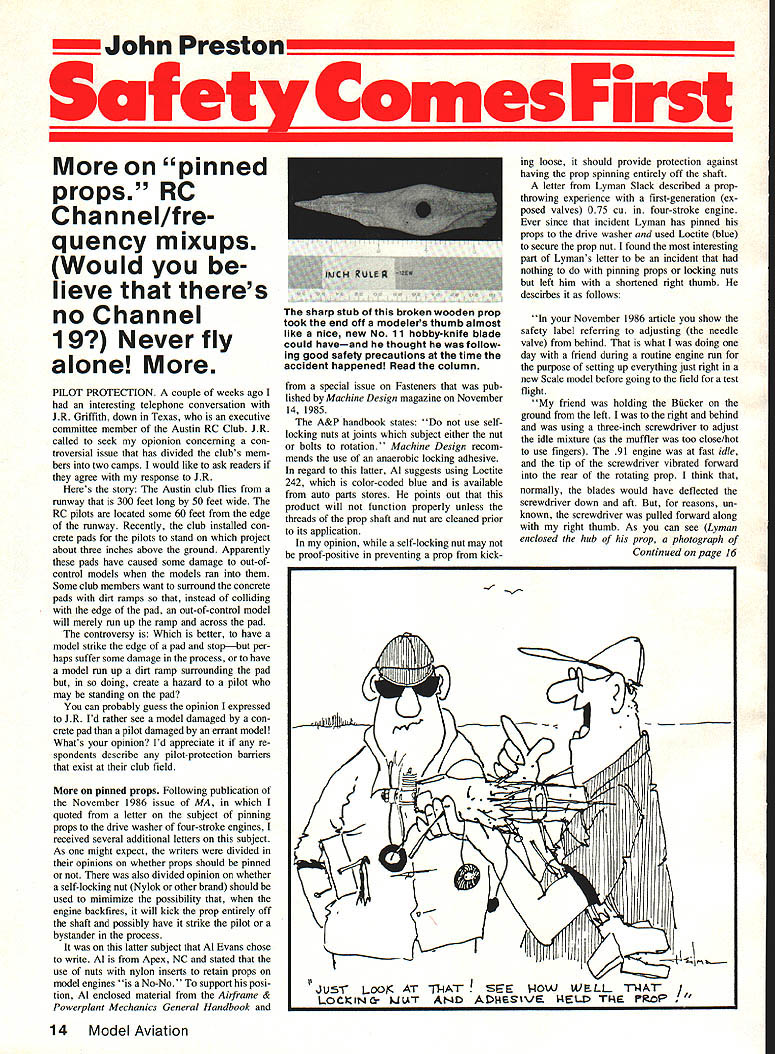
My friend was holding the Bücker on the ground from the left. I was to the right and behind and was using a three-inch screwdriver to adjust the idle mixture as the muffler was too close/hot to use fingers. The .91 engine was at fast idle, and the tip of the screwdriver vibrated forward into the rear of the rotating prop. I think that normally the blades would have deflected the screwdriver down and aft; for reasons unknown, the screwdriver pulled forward along my right thumb. As can be seen (Lyman enclosed the hub of his prop; a photograph appears elsewhere in this column), the prop transformed itself into a #11 (X-Acto) blade which proceeded to cut almost through my thumb (it took half the bone).
I instinctively grabbed for the transmitter and shut down the engine. My buddy loaded the field box and the model into my van while I was pumping water to flush my thumb (the van has a sink). He helped me to wrap up my thumb and drove me to an emergency room near my home.
After X-rays, a bone man was called in and gave me options. Either I could come in for a series of operations and grafts from my groin area, or he could complete an amputation on the spot. I opted for the latter. So now my right thumb stops where the fingernail would normally start.
As I said, the odds were with me. I was doing everything by the book, but the accident still happened. Another case for the buddy system here, too. Even if you are just going out for an engine test run. One good thing, though, I get a 10% discount from my manicurist!"
On the subject of doing things "by the book" and adjusting the mixture from behind the prop, a letter came from Scott Reed of Greenfield, MO. Scott drew my attention to an ad for a tach that appeared right in the middle of the Safety column in the December 1986 issue. A sketch in the ad shows a person holding an engine's rpm from in front of the model. The person's left arm is shown just fractions of an inch from the rotating prop as the person holds the model. Scott asks: "How come the ad is right in the middle of your column?"
Since I have nothing to do with the layout of the magazine I cannot provide an answer to Scott's question. I would have to attribute the location of the tach ad to Murphy's Law!
One last letter on the subject of pinning props and using self-locking prop nuts came from a Missouri modeler who wishes to remain anonymous. This modeler experienced shearing of a pinned prop on his first .90 four-stroke, so he removed the pins. This eliminated the problem of the shearing props but did result in slippage of the prop with respect to the drive washer. The modeler described an unusual experience as follows:
"I was running the engine at dusk one evening with a friend. We both noticed static electricity sparks jumping around the drive washer and crankshaft. The length of these sparks was 1/2 to 3/4 of an inch. I assume that they were from static electricity developed by the propeller slipping and turning on the drive washer and/or the prop washer. I have never seen this described before."
The teeth on the drive washer also ground a depression in the back side of the wood propeller. The engine was being run on the block at the time. It would be interesting to hear from readers who would or could comment on this as a possible cause of radio interference.
Our anonymous Missouri modeler also uses a Nylok nut to stop the prop from spinning off the shaft. He commented on the AMA safety requirement for either a spinner or retaining nut to cover the exposed end of the shaft. He glues the nut to the rear of the spinner backplate to minimize slippage problems.
RC channel number versus RC frequency
A letter from a West Coast modeler (also requesting anonymity) contained an interesting tale of frequency conflict/shot-down incident that occurred at an AMA-sanctioned contest. In his own words, this is what happened:
"When I checked in at the contest, I was asked what frequency I would be flying on, and I responded '72.080, Brown & White.' Midway through the day I was called to fly, so I grabbed my plane and went to get my transmitter. But there was no 72.080 MHz frequency pin on the board. With the transmitter off, I went to the pilot's box where I found the contest director, and I asked what to do. We shouted to the other three fliers: 'Anyone on Brown & White?' and we received no reply (it was very windy and conversation was difficult). The contest director asked if I had looked for the pin in the pit area, and I told him I had but to no avail.
I frankly believed that maybe I had lost the pin the last time I used it. I didn't think there was anyone else on 72.080. My plane was very old and tail heavy, and I was willing to risk being shot down. The contest director said, 'Go ahead and fly.'
The other fliers turned on and launched, and I turned on prior to launching my plane. I heard a cry: 'I've been shot down!' Fortunately for me, I hadn't yet launched. It was obvious that I had turned on to this other flier's frequency and had hit him. But why?
As it turned out, when she checked in that morning she said she was on Channel 19. The frequency-control person was new and did not connect 72.080 (Brown & White) with Channel 19. It was just a matter of time before our cards would come up in the same hat. Now for my questions:
'I was told that all frequencies are now referred to by channel numbers. There is no more "72.080." Is this correct? My local contest director says that this isn't so. When I register for a contest, what is the correct nomenclature for my frequency?'
The following was my response to Mr. West Coast's questions.
In order to respond to the questions you asked in your letter I consulted my AMA rule book (page 127) and talked with Bob Underwood, AMA Technical Director. The result is, in both cases, that there is no Channel 19! In other words, an RC frequency of 72.080 MHz (the one you were using) should be referred to as "72.080." It has no designated channel number.
The first flier whom you shot down was in error if he stated that he was on Channel 19 when he registered for the contest. The new frequency-control person was also in error in logging a transmitter on the non-existent Channel 19.
Similarly, the contest director was in error in permitting you to fly without performing his own check to determine why the pin was not there; if 72.080 (Brown & White) was missing. Merely shouting "Anyone on Brown & White?" was not, in my opinion, a satisfactory check.
Bob Underwood related another incident that had been brought to his attention that was similar to yours. In this case, one flier (an experienced modeler) referred to his frequency by its channel number. It was a new frequency that did have a channel number. Another flier (on the same frequency) stated the actual frequency in MHz. They then proceeded to fly simultaneously, and a shoot-down occurred.
The experienced modeler blamed the other flier (a relative newcomer) for not knowing his channel number. However, it appears that the experienced modeler was equally to blame for not knowing the actual frequency (in MHz) that corresponded to his channel number.
Before leaving the subject of frequency control, I would like to draw your attention to the frequency control board (clipboard) that is illustrated on page 128 of the current (1986/1987) AMA rule book. The frequency control board design was published in the January 1984 issue of RCM magazine, and it was created by Jack E. Duff. Use of such a board at the club field or at a contest should eliminate hot-dogging incidents. In addition, use of frequency flags (pages 127 and 128 of the rule book) on the transmitter antenna should be a mandatory requirement both at the club field and at a contest.
Range checking and other safety notes
In the December issue I mentioned incidents in which engines went to full throttle when transmitters were removed from the field. A letter from Lewis Woodward (West Palm Beach, FL) had some interesting comments on this subject. Lewis said:
"Somewhere along the course of this hobby I was told to check the transmitter range with the engine idling. On several occasions, with the engine idling, I walked away from the plane to check the transmitter range. When I was about 10 feet from the plane the engine accelerated, and the plane headed for the blue yonder. On one occasion I had to nose the plane over in order to stop it. I discovered that if I ran toward the plane, the engine would return to idle. This is a dangerous procedure. You must be alert when you check transmitter range with the engine idling. The safe way is to have someone else hold the plane while making the range check."
Lewis added a P.S. to his letter in which he noted that engines which accelerate to full throttle during a range check (performed with the transmitter antenna collapsed) can be returned to idle simply by pulling up the antenna. However, in the heat of the situation, modelers might not think to do this! Better to have a buddy to hold the model or otherwise secure it to prevent motion.
One last tip to those of you who fly control-line (CL) models comes from Steve Zwieidler (Elkins Park, PA), who is a Junior member. Steve stated that he is "very into" CL flying, and he drew attention to the hazard of bystanders who may not understand the injury that could result by being struck by a flying model. To use Steve's words:
"My Dad (very important pit-crew) and I go flying together. We picked a clear park away from houses and used a basketball court as a runway. We set up, started flying, and a few moments later a group of youngsters (avg. age five or eight years old) started to play games with the airplanes and chase them. My Dad scolded them and they left. But they could still have gotten seriously hurt."
The sound of a running model airplane engine seems to draw children like a magnet. While it is possible to launch and fly a CL model (using a stooge) by oneself, I don't recommend it. Even with a helper it is sometimes difficult to keep people from straying into the circle.
I recall another letter I received on this subject that related an episode in which a CL modeler, flying in a public park, had a lady walk her dog straight through the circle, totally oblivious to the fact that there was a model flying overhead. I've frequently told RC modelers not to fly alone. This message applies equally to CL modelers.
Have a safe month.
John Preston 2812 Northampton St., N.W. Washington, D.C. 20015.
Transcribed from original scans by AI. Minor OCR errors may remain.

