


John Preston
Safety Comes First
Chemical hazards
Most of you will be reading this column during the first weeks of April. However, as I write it on January 31, my backyard still has most of the two feet of snow that was dumped on the Washington, DC area just a week ago. Even if you have a ski-equipped model, a trip to the flying field would probably require the use of a four-wheel-drive vehicle. Let's just say it's good building weather!
I have a filing cabinet in my office that contains all of the letters from readers of this column and other material that I've accumulated since I first started writing for MA back in January 1980. For the most part, my files are arranged by subject, and the fattest one of the bunch by far is titled "Chemical Hazards." Under this category goes all the material concerning the effect on health that may occur from use of glues, paints, etc.
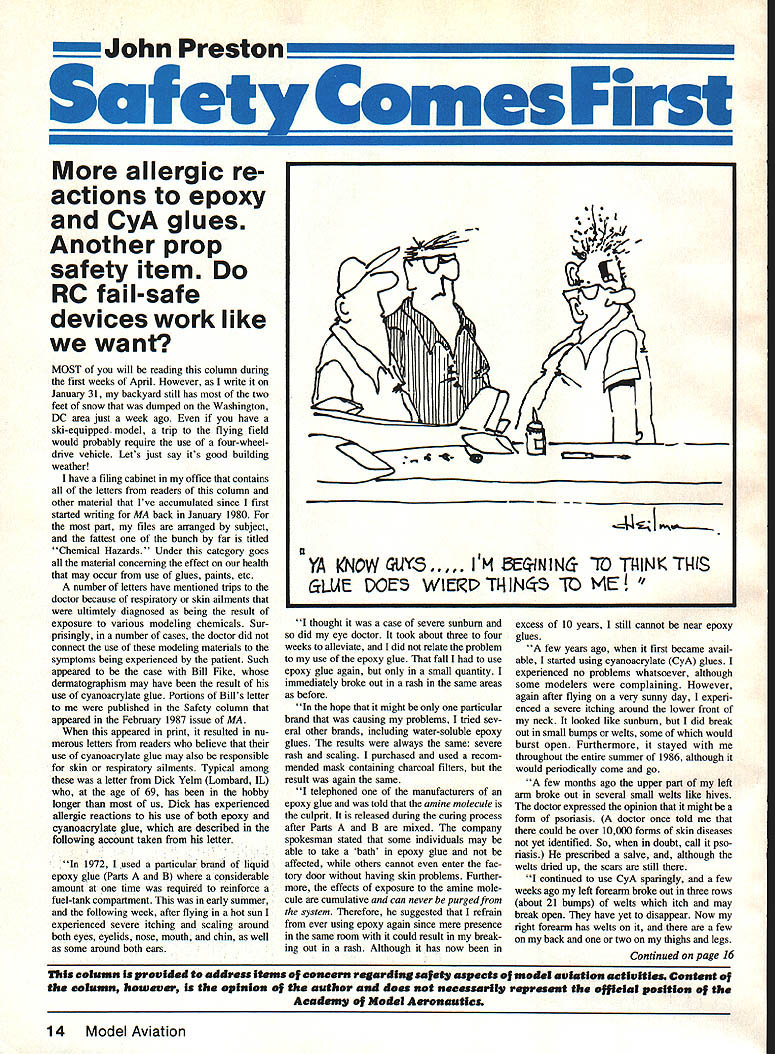
A number of letters have mentioned trips to the doctor because of respiratory or skin ailments that were ultimately diagnosed as being the result of exposure to various modeling chemicals. Surprisingly, in a number of cases the doctor did not connect the use of these modeling materials to the symptoms being experienced by the patient. Such appeared to be the case with Bill Fike, whose dermatitis apparently may have been the result of the use of cyanoacrylate glue. Portions of Bill's letter were published in the Safety column that appeared in the February 1987 issue of MA, and that item resulted in numerous letters from readers who believe that their use of cyanoacrylate glue may also be responsible for skin or respiratory ailments.
Typical among these responses was a letter from Dick Yelm, Lombard, IL, age 69, who has been in the hobby longer than most of us. Dick has experienced allergic reactions to the use of both epoxy and cyanoacrylate glues. His account follows.
Epoxy reactions (Dick Yelm)
"In 1972 I used a particular brand of liquid epoxy glue (Parts A and B) where a considerable amount of time was required to reinforce a fuel-tank compartment. The following week, after flying in the hot sun, I experienced severe itching and scaling around both eyes, eyelids, nose, mouth, and chin, as well as some around both ears.
"I thought it was a case of severe sunburn and so did my eye doctor. It took about three to four weeks to alleviate, and I did not relate the problem to my use of the epoxy glue. That fall I had to use epoxy glue again, but only in a small quantity. I immediately broke out in a rash in the same areas as before.
"In the hope that it might be only one particular brand that was causing my problems, I tried several other brands, including water-soluble epoxy glues. The results were always the same: severe rash and scaling. I purchased and used a recommended mask containing charcoal filters, but the results were again the same.
"I telephoned one of the manufacturers of an epoxy glue and was told that the amine molecule is the culprit. It is released during the curing process after Parts A and B are mixed. The company spokesman stated that some individuals may be able to take a 'bath' in epoxy glue and not be affected, while others cannot even enter the factory door without having skin problems. Furthermore, the effects of exposure to the amine molecule are cumulative and can never be purged from the system. Therefore, he suggested that I refrain from ever using epoxy again since mere presence in the same room could result in my breaking out in a rash. Although it has now been in excess of 10 years, I still cannot be near epoxy glues."
Dick told me that he recently spoke with two people who, 14 years ago, did not believe his warning concerning epoxy glue. Recently they both broke out in severe rashes and, like him, cannot be exposed anymore to epoxy glue.
Cyanoacrylate (CyA) reactions (Dick Yelm continued)
"A few years ago, when it first became available, I started using cyanoacrylate (CyA) glues. I experienced no problems whatsoever, although some modelers complained. However, again after flying on a very sunny day, I experienced severe itching around the lower front of my neck which looked like sunburn. I did break out in small bumps; some would burst open. Furthermore, it stayed throughout the entire summer of 1986, although it would periodically come and go.
"A few months ago the upper part of my left arm broke out in several small welts like hives. The doctor expressed the opinion that it might be a form of psoriasis. He prescribed a salve, and although the welts dried up, scarring still continued. I continued to use CyA sparingly, and a few weeks ago my left forearm broke out in three rows (about 21 bumps) of welts which itch and may break open. They have yet to disappear. Now my right forearm has welts and a few on my back and one or two on my thighs and legs.
"In addition, my left foot sometimes itches like crazy in a very small area but, so far, has no evidence of any welts. I believe I am now allergic to cyanoacrylate glue; and, from recent articles I have read, it may be dermatographism.
"I believe that the majority of modelers who use the above glues will sooner or later experience some degree of an allergic reaction. It's just that some individuals are more resistant than others."
Heating cured epoxy
Also in the February 1987 Safety column I included a warning from Graham Hicks about placing epoxy in a microwave oven in order to heat it and make it easier to spread. In response to Graham's warning, I received a letter from Maxwell Todd (Columbus, GA) who also had a bad experience when heating cured epoxy. Maxwell had the following to say:
"In the winter of 1982, shortly after building my first R/C model airplane, I decided to loosen up some cured epoxy by heating it with a propane torch. I heated it until the epoxy softened and could be scraped off. While doing this I noticed some black smoke and inhaled some of the fumes. Within an hour I developed nausea, vomiting and a severe headache. I also had trouble breathing and my eyes burned. I was ill for several days and finally went to a doctor who told me I had inhaled toxic fumes and should never heat epoxy again."
CyA accelerators and carriers
I have had letters reporting allergic reactions not just to CyA itself but to the accelerators used with CyA. Dennis Weatherly reported that he reacted to an accelerator and later discovered the carrier used in that product was Freon TF. He checked several brands of accelerators and found only two that did not use Freon TF as the carrier:
- Satellite City's Hot Shot (uses Freon TA as carrier)
- Pacer Technology & Resources' Zap ZF-P Foam Primer (uses alcohol as carrier)
Dennis can use these two without problem. He noted that all the brands he checked use amines as the chemical to set off the glue, so he believes his symptoms were due to the Freon TF carrier rather than the amine. He wondered why Freon TF bothered him but Freon TA did not — could it be the combination of Freon and amine?
I have also had reports of modelers who are not allergic to CyA glue fumes unless they use an accelerator. If anyone has an answer to Dennis' question, I'd be interested in hearing from them.
Monthly prop incident
While my file on chemical hazards is the fattest of all, the one captioned "Propellers" is the second most bulky. The letter from Dennis Weatherly concerning the allergy to CyA accelerators also contained an account of a serious prop incident that occurred several years ago. Dennis' narrative follows.
"I was getting set for a practice flight and had just started the .40 on my Super Kaos. My flying buddy was behind me holding the plane above his knee as I held the plane on the landing-gear blocks the club has built into the field benches. I was running up the engine at full throttle to check the needle setting, when my buddy noticed that my coat was unzipped. The bottom edge of the coat was getting pulled toward the prop. He came around the wing tip to warn me just as I leaned forward to tweak the needle. I felt a tug, and my friend fell to the ground.
"The zipper on my jacket had been pulled into the prop, which ripped the zipper side off and threw it into my friend's face, hitting him in the corner of one eye. The wife of one of the club members is a nurse, and she bandaged up the eye before he was rushed to a hospital. The accident cost my buddy the sight in that eye."
In previous Safety columns I've mentioned the potential hazard of getting jacket drawstrings and transmitter neck-straps caught in rotating props. Dennis' account of the zipper incident is one I've not heard before. Be aware that any loose clothing may get sucked into the prop arc and thereby result in an eye or face injury to those who are close by.
Fail-safe devices — pro and con
Several times in previous Safety columns I've discussed fail-safe devices that are intended to minimize or eliminate the loss of control of an RC model in the event of radio interference or equipment failure. These devices come in many forms. Many are add-on accessories, but some are built into the radio itself. A recent letter from Antonis Papadopoulos of Athens, Greece, questions the merits of such devices.
Antonis described an incident with a helicopter flier using a top-line radio system with a built-in fail-safe feature. The pilot was adjusting the engine of his new Hirobo Shuttle while the model sat on the ground. After getting the engine running perfectly, he throttled back. All of a sudden the helicopter engine started to rev up, and in seconds it was hovering without any boom deviation. Moments later it started climbing. What had happened?
It turned out that the battery voltage had dropped below the safe level, and the fail-safe device took control. The helicopter climbed to a point and eventually came down; after an autorotation it landed with only minor damage. Antonis asked: What is the reason for all these fail-safe switches and devices, since we don't know the time and the attitude of the model when the fail-safe takes over?
I am not familiar with the radio system involved, but it seems to me that the fail-safe device on the throttle was reversed. A drop in battery voltage to an unsafe level should have closed the throttle rather than opened it.
That said, the larger question is whether preset positions for control surfaces (neutral for flying controls) are beneficial if the transmitter signal is lost. Certainly this isn't going to help an aerobatic flier save his model if the controls suddenly go to neutral while the transmitter is still on. On the other hand, preset positions can be advantageous in certain types of flying where a neutral or specific safe position would reduce the chance of immediate loss.
On balance, I'm in favor of having the throttle return to idle on loss of transmitter signal or when receiver battery voltage drops to an unsafe level. If any readers wish to express their opinions, I'd welcome their letters.
Have a safe month.
John Preston 2812 Northampton St., N.W., Washington, DC 20015.
Transcribed from original scans by AI. Minor OCR errors may remain.

