
John Preston
Safety Comes First
Enter Safety-logo contest! Anatomy of an accident. Jokers have no place at the flying field.
Safety logo / Safety-logo contest
Prior to the February 1985 issue of Model Aviation, this Safety column was headed by a logo that depicted a hand with a severed finger. The purpose of the logo was to remind readers that the most commonly reported accident in model aviation results from getting one's fingers into the prop arc. Fortunately, severed-finger accidents are less common than finger-laceration injuries, but I've received several letters from readers who are now missing part of a finger due to contact with a turning propeller.
The cut-finger logo was discontinued after a complaint was lodged by a major distributor of hobby supplies who believed it was not in good taste. At the time I was asked by the editor to come up with a new symbol to head the Safety column, but not being artistic, I could not. So I'm asking readers to submit ideas for a new safety symbol to appear at the head of this column. I cannot offer a prize, but full credit will be given to the creator if a suitable design is used. Fancy artwork is not necessary — a pen or pencil sketch on the back of an envelope will suffice. Send submissions to the address at the end of this column.
For the record, the cut-finger logo was created by the U.S. Consumer Product Safety Commission as part of its "Spot the Danger" public-awareness campaign. Decals were intended to be placed near hazard areas on blade-type products (power mowers, snow-throwers, hedge-trimmers, chain saws, etc.). If you purchased a walk-behind mower manufactured after December 31, 1979, you may have recognized the similarity between that warning label and the Safety Comes First logo — the mower warning label is required by CPSC regulation.
Hazards to young children
Several previous Safety columns have included accounts of accidents involving young children who gained access to modelers' workshops. Last month I received a letter from Paul Forrette, Ben Lomond, CA, describing another such incident that fortunately did not result in injury but did cause the child distress:
"Just now my two-year-old daughter put a charger jack in her mouth while it was plugged in. She didn't scream, but she cried hard for quite a while. Just imagine 10 volts at 50 mA across your tongue! It's a very sensitive part of the body. I'm at fault for leaving the charger where she could reach it. I had delayed getting the transmitter, so only the receiver battery was on charge. The lesson is obvious: keep all potentially dangerous modeling gear out of the reach of small children. My little girl appears all right — no burns or scars. Now I'm wondering if the average charger supplied with a radio could seriously hurt a person. Can you comment?"
Answer: No. It is not possible to receive a lethal shock or sustain burns from contacting a 10-volt power source. The 50 mA current that flows during normal charging has no bearing on the current that will flow when a person contacts the 10-volt source. The human body has substantially higher resistance than the batteries in your radio. For example, touching the positive terminal of a 9.6-volt transmitter battery pack with one hand and the negative terminal with the other will produce current flow below the perception level — about one milliampere. Wetting the hands will lower skin resistance and might result in a sensation for some people.
Controlled tests have shown that a person grasping a conductor may be unable to let go when the current reaches around 15 mA (the lowest "let-go" current recorded was about 7.2 mA, and the highest about 21.6 mA). In animal tests, the current required to cause ventricular fibrillation depends on body weight, shock duration, and AC frequency. A current of 50 mA, if sustained for more than a second or so, could be sufficient to result in death for most humans. (Voltage was varied in tests to obtain those current levels.)
The practical lesson: keep chargers, batteries, and other potentially hazardous gear out of the reach of children.
Flying field courtesy
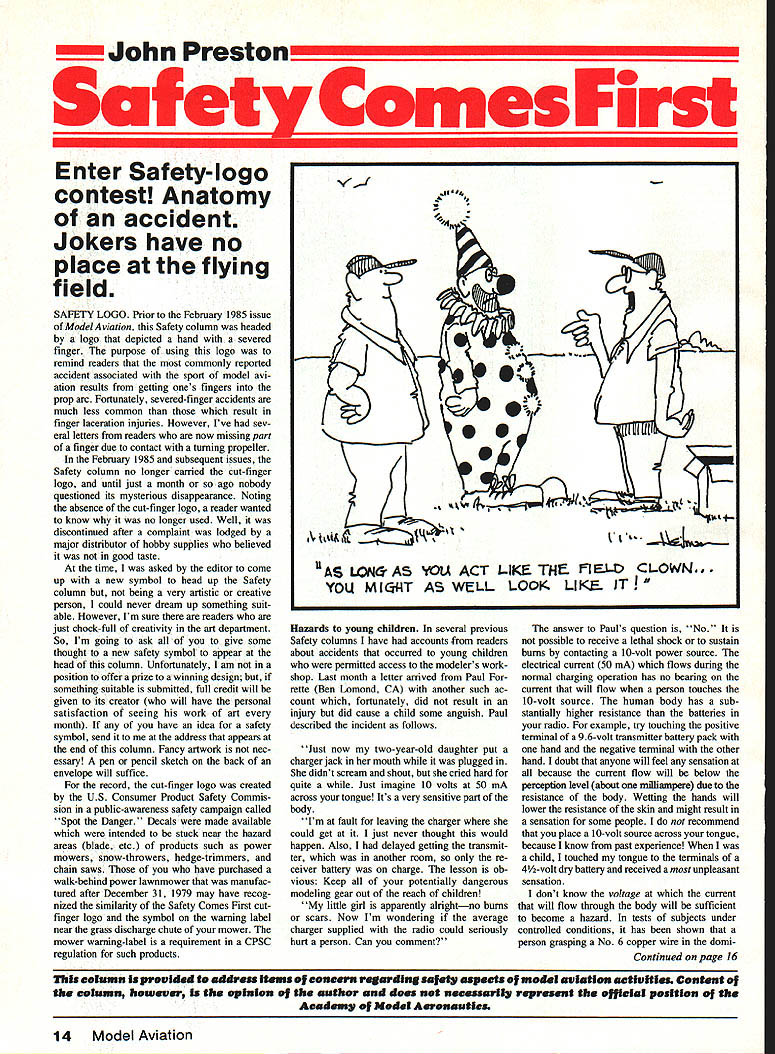
Courtesy and safety go hand-in-hand at the club flying field. Recently I received a letter (author requested anonymity) concerning a club "joker" whose pranks could have caused serious harm:
"My 11-year-old son and I arrived at the field. After his first flight, he landed, taxied to the pit area, and handed the plane to his helper to place on the workbench. While doing so, a joker picked up the transmitter and advanced the throttle. My son had his hand on the workbench and, when the throttle was opened, the model took off with his fingers under the wing. Fortunately, the airplane clipped a soft spot in the grass and the landing gear collapsed, or things would have been worse. My son suffered bruises and scrapes but was frightened and upset. This kind of practical joke has no place at the flying field and should be discouraged."
I agree. Practical jokes that could cause injury are not funny and are dangerous. Club officials should make it clear that such pranks are unacceptable and that repeat offenders will be asked to leave.
Another letter described similar antics: starter leads were switched so the spinner was pulled off when the electric starter was engaged, and trims on a transmitter were pushed to one side. The writer's pencil-reference marks and preflight checks prevented a crash. These are further examples of why clowning around with other people's equipment is unacceptable.
Anatomy of an accident
My version of Webster's defines accident as "an event occurring by chance or from unknown causes." Even when all rules are followed, accidents can still occur by chance. A club newsletter described an incident in which an RC model struck a bystander:
- Pilot No. 3, an experienced flier, made a touch-and-go in a slight gusting crosswind. As the model lifted, the wind got under the wing, causing a sharp right bank toward the pilot pads and pits. Two fliers on pad No. 2 saw it pass in front of them in a knife-edge attitude.
- The airplane struck Al on the right side of the head near his ear. He was knocked unconscious for about a minute and bled profusely. Club members administered first aid and called 911. They were fortunate to find someone at home nearby to place the call; otherwise they would have had to go much further.
- Al's injuries — lacerated ear and shoulder, swollen and bruised jaw — could easily have been more severe or fatal.
What we can learn from this unfortunate incident:
- Provide emergency communication at the field. Several members said the event happened instantly and without warning; they had no time to respond defensively. Consider again the installation of a telephone at the flying field, or ensure rapid access to a phone.
- Even when all pilots follow AMA Safety Code and club rules, accidents can still occur. This should make us all more alert and safety-conscious.
Emergency procedures and recommendations
- Clubs should draft a procedure to follow if medical assistance is needed. Identify the nearest telephone, rescue squad, and hospital.
- Post emergency contact information prominently on any field bulletin board.
- Consider the feasibility and cost of installing a telephone at the field or providing other reliable means of emergency communication.
Have a safe month.
John Preston 2812 Northampton St., N.W. Washington, D.C. 20015
Transcribed from original scans by AI. Minor OCR errors may remain.

