


Safety Comes First
John Preston
Epoxy allergies
In several previous Safety columns I've discussed allergic reactions readers have experienced after using epoxy glues or paints. A few weeks ago I received a note from Virgil Pollock (McHenry, IL) attaching a copy of a letter that recently appeared in EAA Magazine, Sport Aviation. The letter, written by EAA member Allen Kennedy, claims he has found a solution to an epoxy-allergy problem. Allen's letter follows.
"I am writing because I may have run into something of importance. I have been building a Dragonfly for the past 4½ years and have been fighting an epoxy allergy. After the first few months my hands (only below the elbow) would blister and peel as though they had been burned. Because this was not an immediate reaction and because I had other factors to consider at the time, I did not blame it on the epoxy—particularly as Safe-T-Poxy had been advertised as 'absolutely safe.'
"After I determined my problem was the epoxy, I wrote an inquiry to Sport Aviation about an herbal tea that was supposed to give 'immediate relief.' It turned out to be an ad for a high-cost 'lifetime' program. That left me cold, as I kept thinking the EAA is a 'help each other' fellowship of airmen.
"I recalled reading about a method of increasing the oils in your body to help correct the effects of exposure and long, dry winters. The article stated, 'If you have a need for this oil, it will actually taste good. If you do not require it, it may not.' Because part of the effect of epoxy allergy is extremely dry and cracking skin after the 'burn' heals, I tried a tablespoon of cold‑pressed safflower oil. The effect was overnight. I took a tablespoon each day for a while and now do it only occasionally.
"I had not worked with epoxy for nearly two weeks, but my hands were still itching, cracking, and extremely sensitive. The next day after taking the oil the itching stopped and I began a gradual improvement. With care I can now work with epoxy again. After three or four months I have all my fingerprints back and can work in the garden without my skin cracking open each time I move.
"Part of the reason I retired from carpentry work in 1983 was because my hands were so messed up from epoxy. As I am already middle‑aged (65) I also take vitamins E, B, and C in moderate doses. None of these had any effect until I tried the unsaturated oil.
"Good luck—and if this helps anyone it would be nice to hear from you."
Staying on the subject of epoxy and its health effects, a recent letter from Jim Turner (Mountainside, NJ) described what sounds like a much more serious reaction that may have resulted from his use of adhesives. Jim's description follows.
"As an R/C modeler I have used epoxy glues in model construction for more than 18 years. A few years ago I started using cyanoacrylate (C/A) glues and began having severe bouts of sinus drainage that can last from a few days to a week. Also, red spots or blotches that last a day or so appear around my nose and mouth.
"Over the 1984 Christmas holiday my vacation afforded many good days of building. During that vacation I encountered an irregular heartbeat. My doctor did an EKG and the printout was so irregular it would frighten anyone. My doctor gave me medication and scheduled an echogram and a stress test. In a two‑week period I spent about $1,000 on doctor bills and treatment.
"Within a short time everything was back to normal until the 1985–86 Christmas holiday. It crossed my mind that the problem might have been the cyanoacrylate glue I used previously. After a few days, however, I mixed about three small batches of five‑minute epoxy glue one night. The next day my heartbeat was irregular. It seems to me, without proof, that epoxy glue—especially the five‑minute kind—and I do not get along. One problem here is working over the winter in a basement with the windows closed and no ventilation.
"I hope this may help some readers with similar symptoms to be aware of a potential problem."
I have no proof that Jim's symptoms were caused by his use of epoxy glue. I have seen one other account in which an airline pilot alleged a similar experience, but that was later believed to be false. I would be very interested in hearing from any readers who may have more information on this subject.
I have two additional questions for readers in the hope someone can provide answers. First, regarding heating epoxy in a microwave oven to make it flow more easily: in the February 1987 column I mentioned a letter from Graham Hicks, who said he had seen this tip in another model magazine and described ill effects he had suffered when he followed that procedure. According to Graham's doctor, "Certain types of epoxies, when heated in this manner, give off lethal fumes." I have not been able to verify this statement and would appreciate any verification or refutation.
Meanwhile, if you must warm epoxy to make it more runny, I suggest placing the two bottles containing the unmixed components in a warm‑water bath prior to mixing. I have used this procedure without ill effects, but be aware that warm epoxy may begin to cure sooner than when mixed at room temperature.
Second, a club newsletter recently stated that "The Health and Safety Division of the 3‑M Company warns that hazardous isocyanate vapors are formed when epoxy paint is mixed with its catalyst." While 3‑M hazard warnings do result when certain multi‑component polyurethane paints (such as DuPont Imron) are mixed, I am not aware of any epoxy paint that produces isocyanate vapors. If any reader has information linking isocyanate vapors with epoxy paint, I'd like to hear from you.
Meanwhile, as this column has previously stated, be sure you use an effective respirator (one having a prefiltered fresh‑air supply) if you insist on using polyurethane paints containing isocyanates.
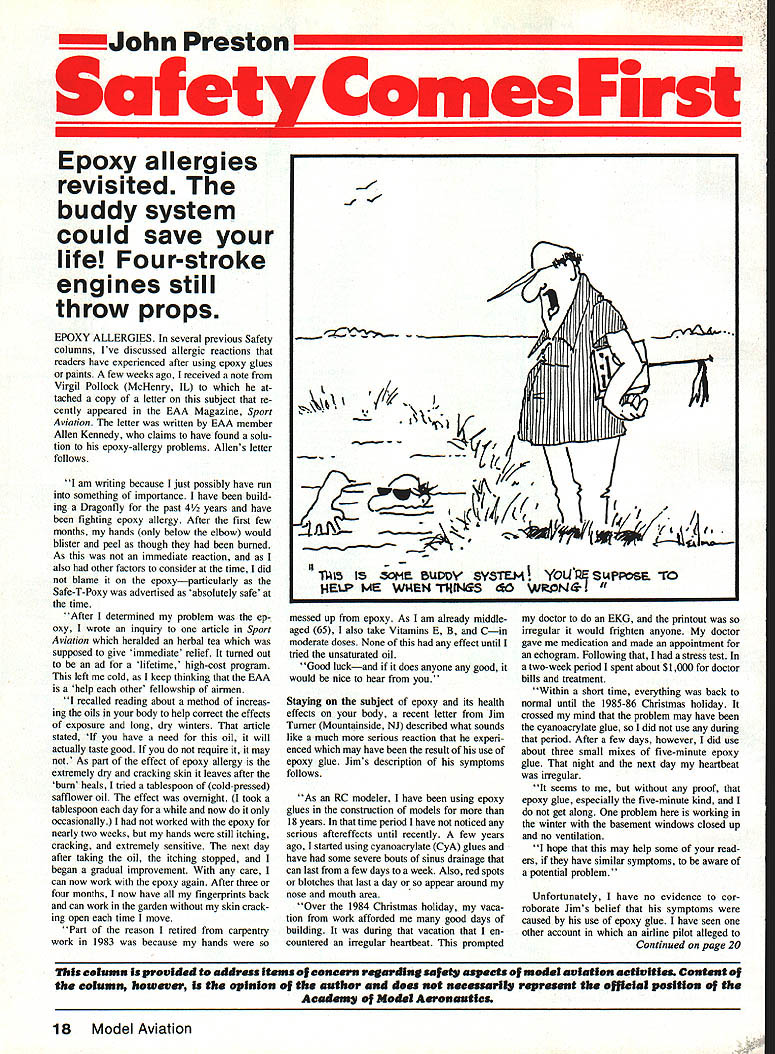
The buddy system
Back in 1980 this column published a list of suggested rules for the safe operation of an R/C flying field. One suggestion was a rule that would stipulate: NEVER FLY ALONE. Some readers objected, arguing that when flying alone it is impossible to revive a fellow club member. They did not consider that injuries at the flying field are more likely to be self‑inflicted. Letters received over the eight years I've written this column show that self‑inflicted injuries are by far the most common. In a number of cases when a self‑inflicted injury occurred, had the modeler been alone at the field he may not have been able to summon help. Hence my suggestion: never fly—or even attempt to start your engine—if you are alone at the flying field.
Several months ago I received a letter that illustrated the value of having a buddy at the field. George Weber sent the following account.
"In August 1985 my son Bill was flying my H. Ray .25‑powered plane. At the north end of our flying field in Westford, Massachusetts, is an enormous swamp at least a mile long by one‑half mile wide. As he was flying over it I said, 'Please don't fly over the swamp area.' He made a sharp turn to come back and, sure enough, the 'Swamp Monster' got us. The wing snapped in the turn, and I knew it was going to be a bad day.
"The swamp reeds are way over your head, and you normally sink into the muck somewhere between your knees and your waist. It's slow going and you can't see very far. I wore an old pair of pants and old sneakers, one of which is still in the goo someplace. When the sun went down we quit, and when I returned home and showered I found all kinds of little animal critters between my toes.
"The next day (Sunday) the weather was foul and I was at the field all alone. Slowly working my way through the swamp in a grid pattern, I saw a round area with nothing growing in it—perhaps nine feet in diameter. Since my mind was focused on looking for the plane I didn't think much of it. But I soon found out what it was when I sank up to my chest. Yup—quicksand. It took me 20 minutes to struggle out of that spot. At 56 years of age I'm no spring chicken anymore, and that was enough. I quit and went home, deciding it wasn't worth taking those kinds of risks.
"A buddy system is the safest way to go instead of doing it alone. But this isn't the end of the story. Six months later, in mid‑February 1986, my phone rang; it was the president of our club, Art Cormier. He said he was flying at the field with skis on his plane when a couple of snowmobilers came out of the swamp area and told him they had seen a plane's tail in the ice. They had marked the spot with a stove pipe. My friend and I were back out there at noon, and at 10:00 p.m. my son and I were back in the swamp (pitch black and 10°F).
"This time, walking on top of the ice, it was much simpler. Sure enough, we found the tail and the plane cut out the ice. Since the ice was 18 in. thick, it was quite a job. To make sure we didn't hit the plane with the axe and shovel, we cut an extra‑large hole. The police usually patrol the area about once an hour, and we hoped they wouldn't spot us. Let's face it: we were cutting a coffin‑sized hole in the swamp in the middle of the night. They would have put handcuffs on us real quick, and we could have spent the rest of the night in the pokey!
"We finally dragged the big chunk of ice to the car and let it thaw out in the basement. After thoroughly washing and drying the engine, radio, and servos, we found everything to be OK except for one burned‑out servo and the outer surface of the engine, which was uniformly dull. I call it a special swamp finish!
"Conclusion: We never, never fly over the swamp area anymore, and we will always use the buddy system for safety."
Four‑stroke engines
I continue to receive reports of incidents where props on four‑stroke engines either shatter or are thrown when the shaft bends. Just a month ago Bob Hundemer, a friend of mine, was breaking in an OS .90 on a test stand and experienced a pop‑and‑run incident during the run‑in period. He had previously run the engine and had consumed about 24 oz. of four‑stroke fuel with no problems. The 14 x 6 prop had been drilled to accept pins in the hub in accordance with the manufacturer's instructions.
The engine was being run with a rich mixture producing 8,800 rpm at full throttle, and a battery had been left connected to the glow plug. Just before the prop exploded, a slight tickling sound was heard from the back of the engine. Then the prop came off the shaft and the hub assembly flew about 30 ft. from the engine.
It appears that if props are pinned to the drive washer of four‑stroke engines, there is a possibility of blade shedding. On the other hand, if no pins are used there is a distinct likelihood that the entire prop will be thrown off the shaft should the engine backfire for any reason. Previously published letters have suggested using a prop nut with a locking insert to prevent the prop from being ejected entirely off the shaft.
Other possible solutions:
- Drill a small hole through the end of the prop shaft so a cotter pin can be inserted to prevent the regular prop nut from spinning entirely off the shaft. Note: if the shaft has been hardened, such a hole cannot be drilled with a conventional drill.
- Use an electric‑arc etching process (described by a reader) to make a hole through a hardened shaft.
- Four‑stroke engine manufacturers might consider drilling holes in the ends of prop shafts to accept cotter pins.
Have a safe month.
John Preston 2812 Northampton St., N.W. Washington, DC 20015
Transcribed from original scans by AI. Minor OCR errors may remain.

