

Safety Comes First
John Preston
Preflight checks are vital
Preflight checks are essential. One recommendation repeated throughout this column is to take a little extra time for a thorough preflight inspection before attempting any flight. Practice some emergency flight procedures and keep safety foremost in your planning.
Helicopter incident (Patrick O'Connell)
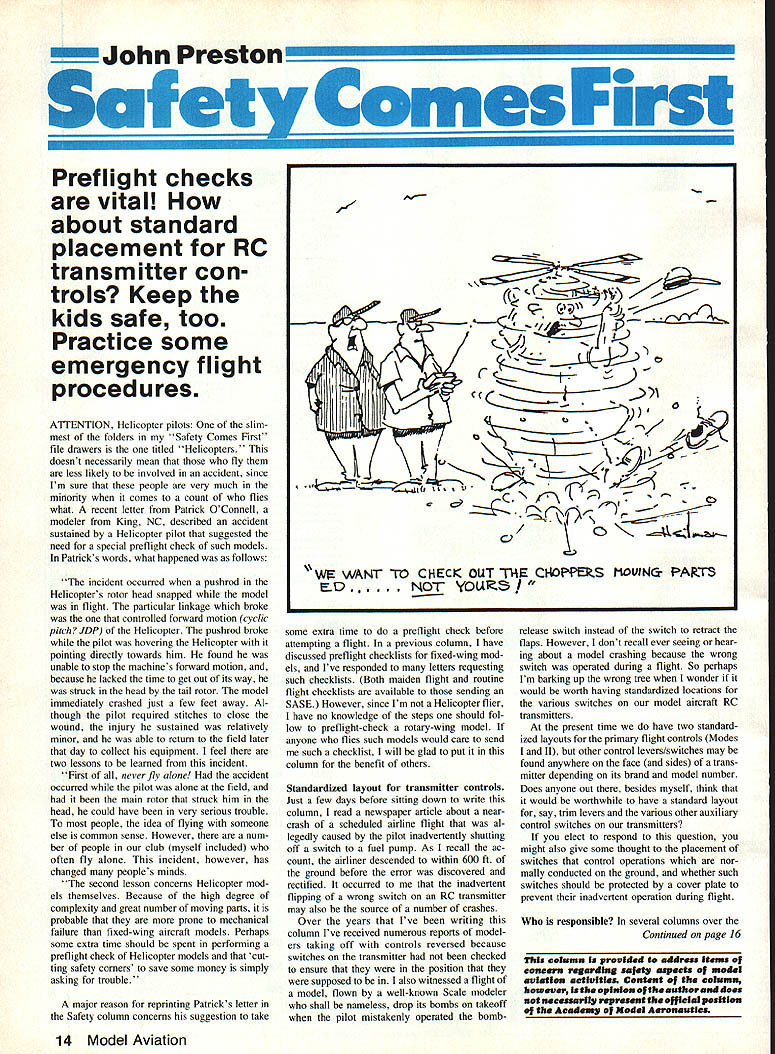
ATTENTION, helicopter pilots: A recent letter from Patrick O'Connell, a modeler from King, N.C., described an accident that suggests the need for special preflight checks for rotary-wing models. Patrick's account follows:
The incident occurred when a pushrod in the helicopter's rotor head snapped while the model was in flight. The particular linkage that broke controlled forward motion (cyclic pitch) of the helicopter. The pushrod broke while the pilot was hovering with the helicopter pointing directly toward him. He was unable to stop the machine's forward motion because he lacked time to get out of its way. He was struck in the head by the tail rotor. The model immediately crashed just a few feet away. Although the pilot required stitches to close the wound, the injury was relatively minor, and he was able to return to the field later that day to collect his equipment.
I feel there are two lessons learned from this incident:
- Never fly alone. Had the accident occurred while the pilot was alone at the field and had it been the main rotor that struck him, the consequences could have been much more serious. Flying with someone else nearby is common sense.
- Rotary-wing models are complex and have many moving parts, making them more prone to mechanical failure than fixed-wing models. Spend extra time performing a preflight check; cutting safety corners to save money is asking for trouble.
Because of Patrick's suggestion, I am reprinting his letter to urge modelers to take extra time for preflight checks. In a previous column I discussed preflight checklists for fixed-wing models and replied to many requests for such checklists (both maiden-flight and routine-flight checklists are available to those sending an SASE). However, since I am not a helicopter flier, I do not have detailed knowledge of the steps for a rotary-wing preflight check. If anyone who flies helicopters would send me a checklist, I will gladly publish it for the benefit of others.
Standardized layout for transmitter controls
A newspaper article about a near-crash of a scheduled airliner, allegedly caused by an inadvertent switch operation, prompted me to consider whether inadvertent flipping of the wrong switch on an R/C transmitter may be the source of many model crashes.
Over the years I've received numerous reports of modelers taking off with controls reversed because a switch on the transmitter was not checked. I also witnessed a scale modeler drop his bombs on takeoff when he mistakenly operated the bomb-release switch instead of the switch to retract the flaps. Although I can't recall a crash caused specifically by operating the wrong switch in flight, these incidents can create embarrassing and dangerous moments.
At present there are two standardized layouts for the primary flight controls (Mode II and Mode I), but other levers and switches are located differently on many transmitters depending on brand and model. Would it be worthwhile to have a standardized layout for trim levers and auxiliary switches? Consider also the placement of switches used only on the ground and whether such switches should be protected by a cover plate to prevent inadvertent operation during flight.
Responsible transmitter layout and protection of critical switches could prevent some of these problems. If readers have opinions or proposals, the AMA might consider them.
Children and workshop safety (Gerald Rudisill)
Over the past year I've described incidents in which the children of modelers were injured, generally because they had access to the workshop. A letter from Gerald Rudisill (his son flies with the Western Carolina Skyhawks) raises important points:
"I have been an R/C flier for about four years now, and I enjoy your column very much. However, I feel that I must address a very serious point that I see more and more daily. Where is the responsibility of parents? Where is the responsibility of modelers?
"Time and time again I see letters about children—and even babies—being injured by modeling tools and supplies. Don't these parents, and the modelers in particular, have any sense of responsibility? Why don't they keep their tools and supplies locked up? If they can't close the workshop, can't they watch their children more carefully? We have instant glues, instant finishes, instant battery charging, even instant (ARF) flying. It only takes an instant to lose a life, or to maim or to cripple.
"Please, parents and modelers, these are not Cabbage Patch dolls in your house and workshop, they are children. Please treat them as such. Realize that they can—and will—go anywhere and do anything unless stopped. Most of the 'accidents' I have seen reported in this column have been so preventable by just a little more responsibility and supervision—and some common sense. Lock your shop, put up your tools, install childproof latches and chain latches. A model can be rebuilt, a child can't. Thank you."
Gerald's letter addresses the same children's-safety issues I regularly cover. Parents sometimes underestimate their children's abilities, and accidents can result in seconds. Install locks, use childproofing, and supervise carefully. A model can be replaced; a child cannot.
Mistakes and misreading the clues
Not all accidents result from carelessness; sometimes we simply misread the clues and make genuine mistakes. A story from a friend who piloted a WWII-era military aircraft illustrates this:
Early in his career he was flying an aircraft that was difficult—or impossible—to recover from a conventional spin but could be recovered from an inverted spin. Instructors warned students that if a spin developed they should bail out unless it was inverted, in which case a specific recovery technique applied.
He got the aircraft into a spin and, after a brief recovery attempt, decided to bail out. He slid back the canopy and released his harness to climb out—only to be automatically ejected from the cockpit the moment the harness was freed. He had been in an inverted spin and could have recovered the aircraft; the mistake cost Uncle Sam a perfectly good airplane. We can all relate to mistakes that lead to unwanted consequences. Follow the AMA Safety Code (never fly over spectators) and hope that if you make an error, only your pride will be hurt.
Emergency procedures — practice and planning
"Emergency Procedures—Practice and Planning" was the headline of an article in Accident Prevention, an FAA brochure describing a private pilot training course in emergency procedures. The brochure (sent to me by John Huntoon of AMA HQ) recommends practicing emergency procedures until they become almost automatic—because when an emergency occurs there is little time to think. The same applies to model flying.
Practice emergency procedures regularly so responses become instinctive. This includes simulated engine failures, control-surface failures, and other scenarios you might encounter.
Training: dead-stick approaches and climbout decisions
When teaching a student to handle an engine failure, practice dead-stick approaches until they become routine. If the student is inexperienced, consider having him deliberately start the dead-stick approach a little high—treat the first "dead-stick" as a pass down the runway centerline at about 50 ft rather than a full landing. Repeat approaches until the student is comfortable with how the model will behave.
Regarding an engine failure on climbout, my recommendation is to avoid attempting a turn back to the runway if at all possible. Many models break up ("re-kit" themselves) when that maneuver is attempted. Know the glide performance of your model in order to make the best decision in such circumstances.
Have another safe month.
John Preston 2812 Northampton St., N.W. Washington, DC 20015
This column addresses safety aspects of model aviation activities. The content is the author's opinion and does not necessarily represent the official position of the Academy of Model Aeronautics.
Transcribed from original scans by AI. Minor OCR errors may remain.

