
John Preston
Safety Comes First
Precautions when using CyA glue. Flying field rules violations. More.
Safety logo
In the August 1987 issue of MA, I mentioned the reason for the disappearance of the safety logo from the head of this column and asked readers to submit suggestions for a new design. The response was good, but I haven't yet had a chance to visit AMA HQ to consult with the full-time magazine staff on which to choose. So, for those who submitted designs for a new logo, I thank you and ask for your patience.
Last month a week of my time was consumed by an unscheduled business trip to San Francisco; I'm scheduled to take a week's vacation this month (August); and next month I'm scheduled to go to the Orient (Hong Kong, Beijing, and Bangkok) for a two-week business trip. Life is anything but dull!
Meanwhile, my weekends, which used to be partially devoted to keeping up with mail to this column, are being spent at the office trying to keep my head above water on the tasks that earn me my bread and butter. If you are wondering why I haven't responded to your letters, you now know — I'm temporarily having an acute shortage of spare time.
Mistaken identity (CyA glue)
I wonder how many readers have been confused in restaurants where salt and pepper are in identical opaque shakers. I have, in dim light, applied the wrong condiment because I failed to notice that the shaker I was using had only one hole.
A few days ago I received a letter from Richard Lin (Pacific Palisades, CA), who told of a lady (a friend of his father's) who experienced a more unpleasant case of mistaken identity while eating in a restaurant. The lady carried a bottle of cyanoacrylate (CyA) glue in her purse to repair false fingernails — and it was shaped exactly like a bottle of eyedrops she also carried. She squirted some of the glue into her eye by mistake and ended up in the hospital. Richard said this mistake is not uncommon; the lady had several friends who had experienced the same incident.
Regular readers may recall that several years ago I reported a similar incident caused by keeping both eyedrops and CyA glue in a bathroom medicine cabinet. In that case the lady repeated the incident a second time before she removed the glue from the cabinet. I had been under the impression that distributors of instant glues had changed bottle designs, but from Richard Lin's letter it seems that may not have occurred.
A few related cautions: men generally don't wear false fingernails, so they are less likely to carry CyA glue in a purse. I have also heard of cases where, after attaching false fingernails with instant glue, excess residual glue caused body parts to become bonded together.
If you get a drop of instant (CyA) glue in your eye, don't panic. I know of no incidents of permanent vision impairment due to such accidents. Your eyelids may become bonded together and the blob of polymerized glue trapped in the eyelid will cause discomfort. Unlike methyl ethyl ketone peroxide (MEKP), used as a catalyst for polyester resins, CyA does not cause the instant blindness that has been reported for MEKP.
CyA glue safety literature advises that if you bond an eyelid shut you should wash the eye thoroughly with warm water and apply a protective gauze patch. The eyelids will usually open within four days with no residual damage. Do not try to force the eyelid open by manipulation. If you are involved in such an accident, visit an ophthalmologist to be on the safe side.
Flying field rules violations
In previous Safety columns I've published letters asking what a club should do when a member breaks a major flying field rule. There is no simple answer.
Just a few days ago I received a letter about a situation that the writer (an officer in a club with 170 members) suggested could be titled "Cancer of a Club of Excellence," or "The Demise of an AMA Club." From the material he sent, those titles seemed appropriate. He allowed me to use the material but asked that I omit all names, which I have done.
The alleged rules violations, described in a letter from the club's safety committee chairman to the offender (who was the club's chief flying instructor and was instructing a student at the time), were:
- Rule No. 5 — Drinking beer on the flight line.
- Rule No. 10 — Taking off and flying in a pattern not permitted by this rule, and using the N-S runway for other than an emergency.
- Rule No. 13 — Allowing an airplane with its engine running to be carried through the parking lot.
After investigation, the safety officer concluded:
- Rule No. 13 — Clearly violated, per witnesses and by admission of the offender.
- Rule No. 10 — Witnesses were quite sure of takeoff, flight pattern, direction, and distance of violation.
- Rule No. 5 — Offender admitted carrying beer to the flight line but stated he did not drink it; witnesses were unsure. The safety officer concluded there was some question whether this rule was violated.
The safety committee chairman imposed a two-week suspension of flying privileges on the offending member. The member was informed by letter and told he could appeal to the membership at the next meeting. The suspension apparently never took place: upon being informed of the penalty, the offender became very abusive to the safety committee chairman and later to other club officers, even threatening to destroy the club. Despite the club president's initial promise to support the safety committee's findings and penalty, the president later elected to settle the matter differently for the perceived good of the club.
No action was taken against the offending flier for either the safety infractions or for his unsportsmanlike reactions. As a result, the safety committee chairman resigned and the treasurer is seriously considering resigning.
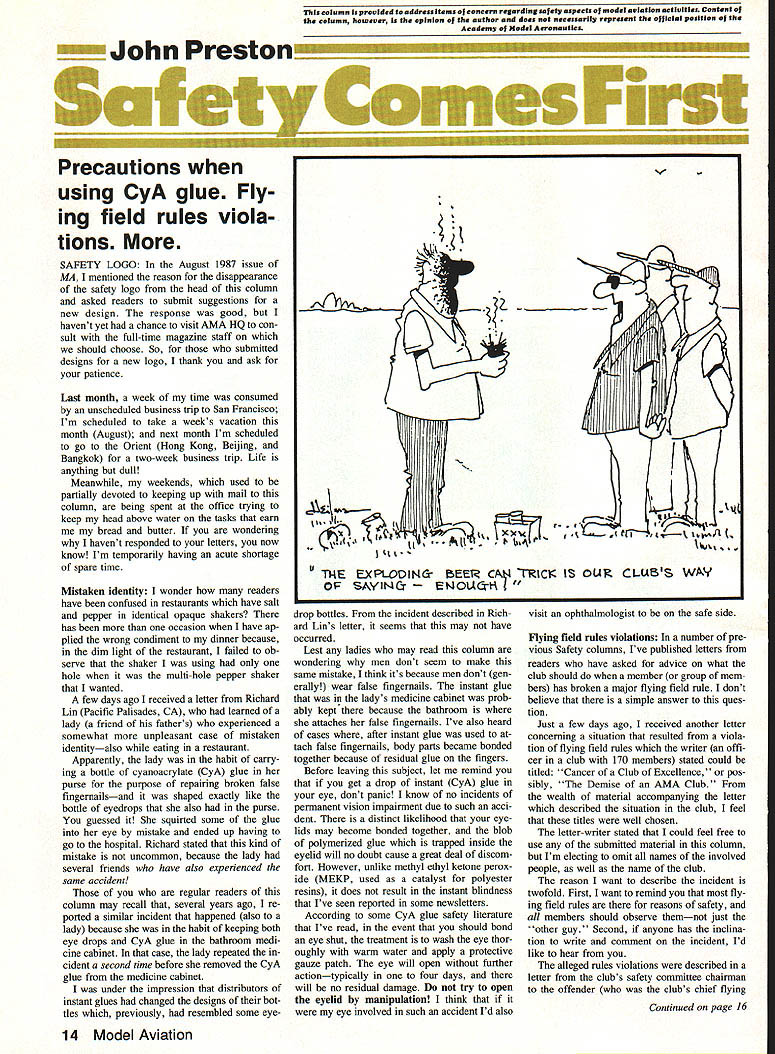
I will not take sides or say precisely how the matter should have been handled. I cannot judge the gravity of the Rule No. 10 violation (use of unauthorized pattern and runway) without knowing the club's field layout and how serious the safety hazard was. In the case of Rule No. 5 (no beer on the flight line), had an accident occurred the club would have been in a compromising position in any lawsuit.
Most letters I have received oppose drinking while flying models, but a prohibition on alcohol at the field may be unpopular with spectators or those who have finished flying and want a beer before going home. On the other hand, these people are likely to get behind the wheel, and most states now have strict blood-alcohol limits for drivers. If a club allows drinking at the field and someone leaves and is involved in an automobile accident as a result of being under the influence, the club could be named in a lawsuit for permitting an unsafe condition. For that reason alone I recommend strictly enforcing Rule No. 5 or any regulation prohibiting consumption of alcoholic beverages while participating in club activities or while on club property.
Clubs are well advised to have clear by-laws and field regulations that state prohibited conduct and the penalties for violations. Enforcement should include a system of hearings and appeals for those charged. Too often the most bitter disputes result from failure to provide an orderly method of enforcing rules. The writer's description suggests this club had not established firm procedures and allowed the situation to get out of hand. Clubs should also have methods of dealing with persons who threaten the club or its officers, including suspension of membership while charges are being investigated.
Some clubs specify penalties in their rules; I know of one that levies a small monetary fine ($2, as I recall) for each violation. That helps the treasury when people get lax. But how do you collect if violators refuse to pay? It helps if more than one club member politely approaches a person after an infraction; a flier is much less likely to become abusive if several members calmly say, "We don't like the way you are flying."
As I stated previously, I'd welcome comments on this incident or input on how others have handled similar incidents in their clubs.
Interference by the police
I received an interesting letter from hobby store owner Josh Winkelstein describing a situation that, were it not so dangerous, would be quite humorous.
Josh had an inquiry from an officer in the Willits, CA police department who wished to purchase some Airtronics servos to expand a shooting-range targeting system. The system has air-activated targets that jump up briefly so officers can sharpen their skills in recognizing criminals versus non-threats (for example, children playing). The air valves controlling the targets are operated by a range controller via an Airtronics SR-4 transmitter, which Josh said happens to be on Channel 56. That channel is reserved for airplane use only, so using it for ground-based targets is, I would have to say, illegal.
I forwarded Josh's letter to AMA Technical Director Bob Underwood with a request that he check whether the Willits police have an illegal operation at their range.
Wind revisited
Some articles on wind's effect on model flight may have given modelers "gas pains." I recently read an article on flying RC aerobatics in a club newsletter. The author suggested performing a Stall Turn in a cross or quartering wind because, he said, if you Stall Turn toward the wind the drift will push the airplane away from you and there is little danger of hitting the pilot.
I disagree. A Stall Turn performed toward the wind is much more likely to turn onto the pilot than one performed away from the pilot. I believe the author confused wind effects on a half-roll or a spin with those on a Stall Turn. My feeling is that a Stall Turn should be started upwind of the pilot and the turn should be made so that when the airplane drops its nose to dive out of the turn it will be moving away from the pilot.
I recall an air show demonstration where a pilot attempted a High-Alpha Stall Turn toward the audience and ended up with a model whose tail boom was broken and the model ended up on the pilot's lap. I think we should teach novice aerobatic pilots to perform Stall Turns so the dive-out is always away from the pilots.
I also once saw a modeler perform a spin recovery over the pits with the model diving into the pit area due to misjudged wind. The key is to always consider wind direction when performing high-angle maneuvers.
Do you agree with the above statement concerning the Stall Turn in a crosswind? If I get any responses I'll discuss them in a future column. Meanwhile, fly safely, and watch out for the other guy.
John Preston 2812 Northampton St., N.W. Washington, DC 20015
Transcribed from original scans by AI. Minor OCR errors may remain.

