

John Preston
Safety Comes First
ENGINES
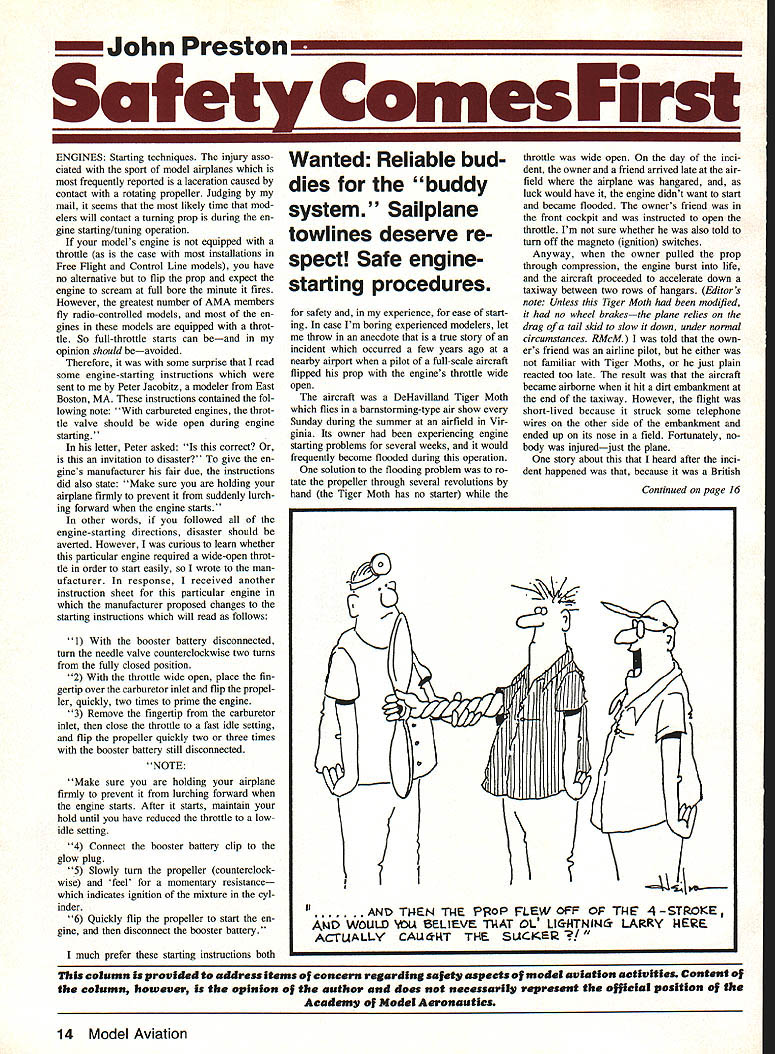
Injuries associated with sport model airplanes are frequently reported; the most common is a laceration caused by contact with a rotating propeller. Judging from mail, many modelers make contact with a turning prop during engine starting or tuning operations.
If your model's engine has no throttle (as with most Free Flight and Control Line installations), you must flip the prop and expect the engine to run at full power the moment it fires. However, most AMA members fly radio-controlled models, and most of those engines are equipped with throttles. Full-throttle starts can — and, in my opinion, should — be avoided.
I was surprised to receive engine-starting instructions sent by Peter Jacobitz (East Boston, MA) that included the note: "With carbureted engines, the throttle valve should be wide open during engine starting." Peter asked whether this was correct or "an invitation to disaster." The original instructions did add, "Make sure you are holding your airplane firmly to prevent it from suddenly lurching forward when the engine starts," which should avert disaster if followed. Still, I wrote to the engine manufacturer to clarify. The manufacturer supplied a revised starting procedure as follows:
- With the booster battery disconnected, turn the needle valve counterclockwise two turns from the fully closed position.
- With the throttle wide open, place a fingertip over the carburetor inlet and flip the propeller quickly two times to prime the engine.
- Remove the fingertip from the carburetor inlet, then close the throttle to a fast-idle setting and flip the propeller quickly two or three times with the booster battery still disconnected.
- NOTE: Make sure you are holding your airplane firmly to prevent it from lurching forward when the engine starts. After it starts, maintain your hold until you have reduced the throttle to a low-idle setting.
- Connect the booster battery clip to the glow plug.
- Slowly turn the propeller (counterclockwise) and feel for a momentary resistance — this indicates ignition of the mixture in the cylinder.
- Quickly flip the propeller to start the engine, then disconnect the booster battery.
I much prefer these instructions both for safety and ease of starting.
Anecdote (full-scale): A few years ago at a nearby airport a DeHavilland Tiger Moth owner had been having repeated flooding problems. To clear the engine he or an assistant would rotate the prop several revolutions by hand with the throttle wide open. On one day the engine burst to life while someone was turning the prop, the aircraft accelerated down a taxiway, became airborne when it hit a dirt embankment, struck telephone wires, and ended up on its nose in a field. Fortunately no one was injured — just airplane parts.
(Editor's note: Unless modified, a Tiger Moth has no wheel brakes and relies on a tail skid to slow down.)
Before leaving engine-starting injuries, a club newsletter (The Buddy Box, Cloud Busters, CA) reported a member who got his arm in the arc of an 18-inch prop turned by a Big Banger. The model started moving when the engine came to life; the owner instinctively moved a hand to stop it and sustained arm lacerations requiring 100 stitches.
One possible way to avert such incidents is to use an airplane-restraining device. Considerations:
- They help prevent the model from moving when the engine starts.
- Some designs double as restraining devices for transport, keeping the model from taxiing around in the back of a vehicle.
- They are another item to carry to the flying field, but worth considering if you don't already have one.
Hi-start hazard
A hi-start can also injure the unwary. (Editor’s note: a hi-start is a long length of elastic surgical tubing (perhaps 100 ft.) attached to a stake at one end and to a length of monofilament or braided nylon line (perhaps 400 ft.) at the other. The free end of the towline is attached to the sailplane’s tow-hook. The flier pulls the plane back to stretch the rubber tube, then releases the model; the rubber’s return launches the sailplane.)
Joshua Fiero (East Lyme, CT) described an incident in which a Gentle Lady sailplane was being prepared for launch. An assistant helping to tension the nylon launch line was struck in the face when the rubber suddenly broke loose; the handle end of the line snapped back and caused a severe cut over the eye that required stitches. This happened quickly and could have been avoided if the assistant had been properly briefed and if a carrying strap or other restraint had been used.
Another reported incident involved a person holding tension on a nylon launch line when it broke at the parachute attachment point. The handle or line snapped back and produced a burn-cut groove across three or four fingers. Amazingly, there was virtually no bleeding — likely because the high-speed friction of the line cauterized the wound as it cut.
I had a near-miss years ago: while pulling a hi-start line at a public field, a vehicle drove into the stretched nylon line despite shouted warnings. I dropped the line immediately; had I not seen the vehicle, I might have had my fingers cut or severed. Whether you use a hi-start or a winch to launch your sailplane, treat the line with extreme caution and brief any assistants.
Four-stroke backfire solution
Duke Ide described an incident in which a prop was thrown from a four-stroke engine, resulting in a hospital trip. Afterward he fitted a zero-to-five-ohm, wire-wound rheostat capable of handling 25 amps (found at a surplus outlet) and a toggle switch to his field power panel. The toggle switch serves as a kill switch to the glow plug so he can cut heat quickly. After these additions he reported no further problems.
I haven't personally tried Duke's fix, but if it worked for him it may help others. I also wonder when engine manufacturers will provide positive means to retain the prop nut on the shaft; readers have suggested several methods over time.
Buddy system
The "buddy system" is not infallible. Joe Wagner (New Wilmington, PA) shared an experience from 1942: while building a model at night he badly cut his hand and turned to his buddy for help, only to find him collapsed on the floor — the buddy fainted at the sight of blood despite Boy Scout first-aid training. Joe tended to his buddy before seeking medical care himself. His lesson: make sure your buddy can handle emergencies; consider asking them, tactfully, how they react to blood or injuries before relying on them in an emergency.
Have another safe month.
John Preston 2812 Northampton St., N.W. Washington, DC 20015
Disclaimer
This column addresses items of concern regarding safety aspects of model aviation activities. The content of the column is the opinion of the author and does not necessarily represent the official position of the Academy of Model Aeronautics.
Transcribed from original scans by AI. Minor OCR errors may remain.

