
Safety Comes First
John Preston
I'm recovering from jet lag after a two-week visit to Hong Kong, Beijing, and Bangkok. The 12-hour time difference was about as much as one can get. The trip was business-related; I had no time to check out hobby stores during my stay in Hong Kong, but I did visit a factory that produces R/C cars. I also managed a brief walk on the Great Wall of China and visited Wat Phra Kaeo and the Grand Palace in Bangkok. It's no fun being back at work.
Battery warning
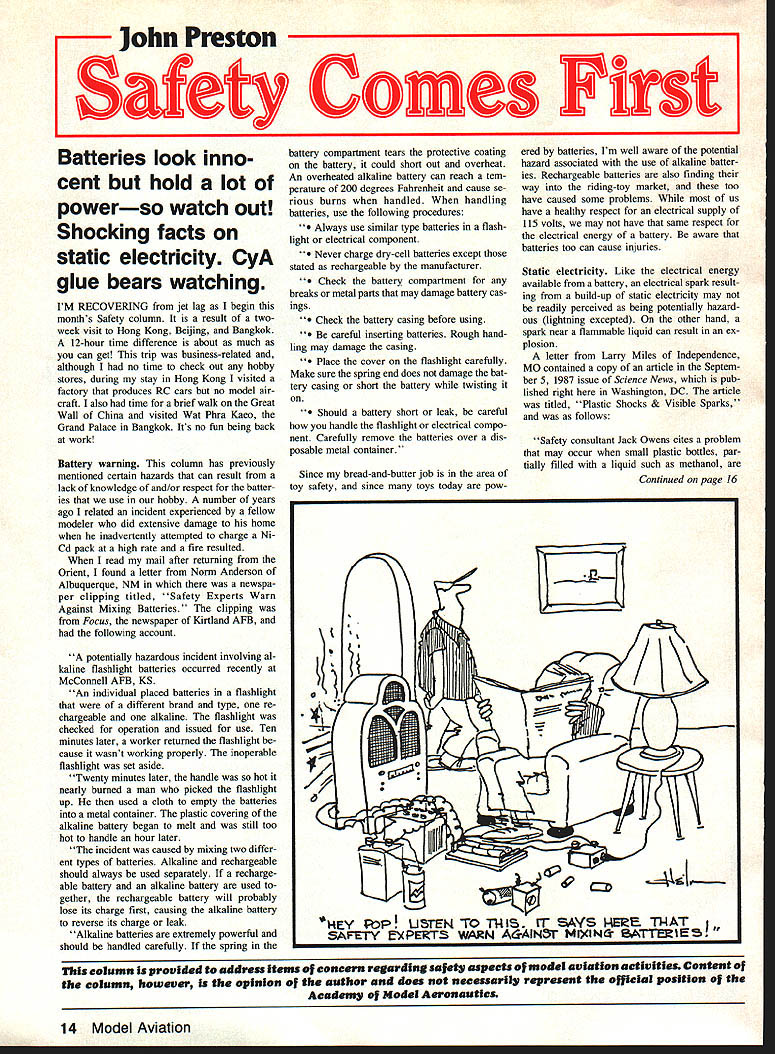
This column has previously mentioned hazards that can result from a lack of knowledge of or respect for the batteries we use in our hobby. Years ago I reported an incident in which a modeler did extensive damage to his home when he inadvertently attempted to charge a NiCd pack at too high a rate and a fire resulted.
After returning from the Orient I found a letter from Norm Anderson of Albuquerque, N.M., including a newspaper clipping titled "Safety Experts Warn Against Mixing Batteries" (Focus, Kirtland AFB). The clipping recounted a potentially hazardous incident involving alkaline flashlight batteries at McConnell AFB, Kans.:
An individual placed batteries in a flashlight that were of different brands and types—one rechargeable and one alkaline. The flashlight was checked for operation and issued for use. Ten minutes later a worker returned the flashlight because it wasn't working properly; the inoperable flashlight was set aside. Twenty minutes later the handle was so hot it nearly burned the man who picked it up. He used a cloth to remove the batteries into a metal container. The plastic covering of the alkaline battery began to melt and was still too hot to handle an hour later.
The incident was caused by mixing two different types of batteries. Alkaline and rechargeable batteries should always be used separately. If a rechargeable battery and an alkaline battery are used together, the rechargeable battery will probably lose its charge first, causing the alkaline battery to be reverse-charged or to leak. Alkaline batteries are extremely powerful and should be handled carefully. If the spring in the battery compartment tears the protective coating on the battery, it could short out and overheat. An overheated alkaline battery can reach a temperature of 200°F and cause serious burns when handled.
When handling batteries, follow these procedures:
- Always use similar-type batteries in a flashlight or electrical component.
- Never charge dry-cell batteries except those stated as rechargeable by the manufacturer.
- Check the battery compartment for any breaks or metal parts that may damage battery casings.
- Be careful inserting batteries. Rough handling may damage the casing.
- Place the cover on the flashlight carefully. Make sure the spring end does not damage the battery casing or short the battery while twisting it on.
- Should a battery short or leak, be careful how you handle the flashlight or electrical component. Remove the batteries over a disposable metal container.
My day job is in toy safety, and because many toys today are powered by batteries, I'm well aware of the potential hazards associated with alkaline batteries. Rechargeable batteries are also appearing in the riding-toy market and have caused problems. While most of us respect household electrical supplies (115 volts), we should have the same respect for the electrical energy in batteries. Batteries too can cause injuries.
Static electricity
Like battery energy, an electrical spark resulting from a build-up of static electricity may not be readily perceived as hazardous (lightning excepted). Yet a spark near a flammable liquid can cause an explosion.
A letter from Larry Miles of Independence, Mo., included a copy of a September 5, 1987 Science News article titled "Plastic Shocks & Visible Sparks." The article described an incident in which a small fire occurred when a technician attempted to pour methanol from a one-liter plastic bottle (carried in a plastic bag) into a metal can. A spark jumped from the liquid to the can and ignited methanol fumes.
The bottle had been charged by contact with the plastic bag. The accumulated charge on the bottle's outside surface induced an opposite charge in the conductive liquid inside the bottle. The induced charge was large enough to generate a spark when the liquid came near a metal object. "People haven't considered small bottles as being a problem," said Jack Owens, the safety consultant who presented his findings at a symposium on electrostatic hazards.
The article went on to mention similar hazards when metal drums or cans are lined with plastic (such as plastic trash bags) and filled with conductive—and presumably flammable—liquids. Likewise, rags soaked with a conductive solvent tossed into a plastic-lined trash can can present a fire hazard.
A year or so ago I reported an account of a control-line model flier who experienced a fire in his workshop while emptying his model's fuel tank back into its fuel storage can. He suspected that static electricity from a storm may have been involved. Perhaps it was, but a more likely culprit is a conductive solvent on a rag that contacted a plastic-lined container in the manner described above. Small plastic bottles and lined containers can accumulate charge and create dangerous sparks when conductive liquids or vapors are present.
Cyanoacrylate (CyA) glue
Why do I keep publishing warnings about CyA (instant) glue? Because I keep getting letters about experiences that could—or did—cause injuries.
Don Thornley of Peshtigo, Wis., described an incident while building a new model. He had run out of accelerator (used with CyA glues) in his little plastic spray bottle applicator. He had placed a small glass bottle of accelerator nearby and, because glass is slippery and breakable, was going to transfer the accelerator into the plastic bottle. While attempting to do this he mistakenly reached for his instant glue instead of the empty applicator.
He immediately realized the mistake, but it was already too late. As he pulled the glass bottle of accelerator away, the bottle of instant glue exploded—"popcorned"—in his hand, blowing spots of glue onto the ceiling (looking like icicles), floor, balsa, and plans. He received blisters on his left hand and leg. Fortunately, nothing more serious occurred. Don's lesson: safety starts long before you get into the air. Make your moves one at a time and think them through.
To those who use accelerator with CyA glue: be careful not to mix these in any quantity.
An ophthalmologist, Dr. Paul Bonds, also wrote about CyA glue after my November 1987 Safety column on the subject. He reported that he has seen patients who inadvertently put CyA glue in their eyes instead of eye drops. The glue forms, on contact with the eye, a small jagged-edged cup that causes extreme discomfort. The natural reaction is to close the lids tightly, which can glue the lids and lashes shut.
Treatment consists of trying to relax the eyelids to allow for adequate local anesthesia, then trimming the glued lashes and eyelid margins. The lashes are usually tightly glued together; cutting the lashes at their base beneath the glue can free both lids. The glue is insoluble in water and generally must be left until it sloughs away or is removed surgically. Due to moisture, it forms a surface contact lens that is difficult to dislodge.
If someone gets CyA glue in the eye, the prudent course is to see an ophthalmologist as soon as possible and inform the surgeon that the damage is mechanical rather than chemical so the best method of relief can be chosen.
Another recent letter reported that a writer became asthmatic whenever he used CyA glue and was convinced the product and its vapors were the cause. Be aware that some people may have respiratory sensitivities to these adhesives.
Closing note
Batteries, static electricity, and adhesives like CyA glue are common in our hobbies but can be hazardous. Respect the materials, follow sensible procedures, and seek medical attention promptly when accidents occur.
Transcribed from original scans by AI. Minor OCR errors may remain.

