

Safety Comes First
John Preston
This column addresses safety aspects of model aviation activities. The content is the author’s opinion and does not necessarily represent the official position of the Academy of Model Aeronautics.
RCers beware — a receiver antenna dragging in wet grass can result in loss of control. Plane bites man.
More on props
A recent letter from Jim Newman (Hints & Kinks editor, Model Airplane News) enclosed an article from another model magazine describing how to make a four‑bladed prop from a pair of glass‑reinforced two‑bladed props. Neither Jim nor I feel this is a safe practice; in fact, I strongly recommend you not attempt it. The described procedure can produce a prop hub of questionable strength that could allow blades to fly off when the engine is running.
The article described cutting away half the thickness of each two‑bladed prop hub (cutting one prop from the front and the other from the rear) to create a lap joint so the hub thickness equals that of the original props. Slow‑curing epoxy is used to secure the joint, and the new four‑bladed prop hub is then wrapped with carbon fiber soaked in epoxy for reinforcement. After curing, the author dresses the hub with files and sandpaper; an illustration even shows a Moto‑Tool with a sanding drum. That suggests much of the carbon‑fiber reinforcement would be removed by this operation, leaving a prop whose blades could become projectiles.
Jim included numbers from a technical college exercise he was involved in, calculating hub loading for a 10‑ft‑diameter Rotol prop turning at 3,000 rpm. The centrifugal force produced a hub loading of 66 tons. I can’t say what the force would be on a model prop without blade weight and blade CG location. The Handbook for Mechanical Engineers gives centrifugal force as:
Force = (w * N^2 * r) / (900 * g)
where:
- w = weight of one prop blade
- N = rpm
- r = distance of blade CG from center of hub
- g = gravitational constant
If anyone wants to sacrifice a prop in the interest of safety, send the necessary numbers and I’ll calculate it. Meanwhile, homemade four‑bladed props should be used only for static display.
Prop nuts on four‑stroke engines
A letter from Peter Fynn (Wooster, OH) offered a theory about prop nuts loosening on single‑cylinder four‑stroke engines. His points:
- Props used on four‑strokes are larger than on equivalent two‑strokes, so they have more inertia (flywheel effect).
- Four‑strokes require the prop to swing the engine through 720° of rotation between each firing, rather than 360°.
- Each firing produces a torque reversal (an impulse) on the prop nut and prop; over time this can loosen the nut.
On two‑strokes the firing frequency is higher and prop inertia is less, so the problem is less prevalent. Unless torsional dampers or some crankshaft/prop‑driver coupling are used, single‑cylinder four‑strokes will likely continue to have prop‑throwing problems.
Regarding pinning the prop to the drive washer: pinning has, in some cases, resulted in single blades being thrown off during a backfire. From a safety standpoint, I recommend that for four‑stroke engines up to about .90 cu. in., do not use prop pins. The prop nut, however, should be locked in some manner to prevent the entire prop and nut from being kicked off the shaft.
Epoxy allergies
A letter from Fred Hacke (Bethalto, IL) enclosed a clipping from the November 1987 issue of Sport Aviation titled “Epoxy Allergy Info Needed.” As composites have become common, some builders have had allergic reactions to resin systems — skin and respiratory problems ranging from mild to severe. Various home remedies (herbal teas, vegetable oils, food substances) have been reported with some success.
What is needed is a compilation of measures builders have used successfully to reduce or cure epoxy allergy reactions. EAA member Allen R. Kennedy has volunteered to be the collection point for such information. If you have remedies that worked, please send them to EAA Headquarters to be forwarded to Mr. Kennedy. I plan to contact Mr. Kennedy and request that any information he receives be shared with modelers.
To date, I have no reliable cures to pass on. If any readers have successful remedies, please write to Mr. Kennedy.
Field safety: tennis nets and layout
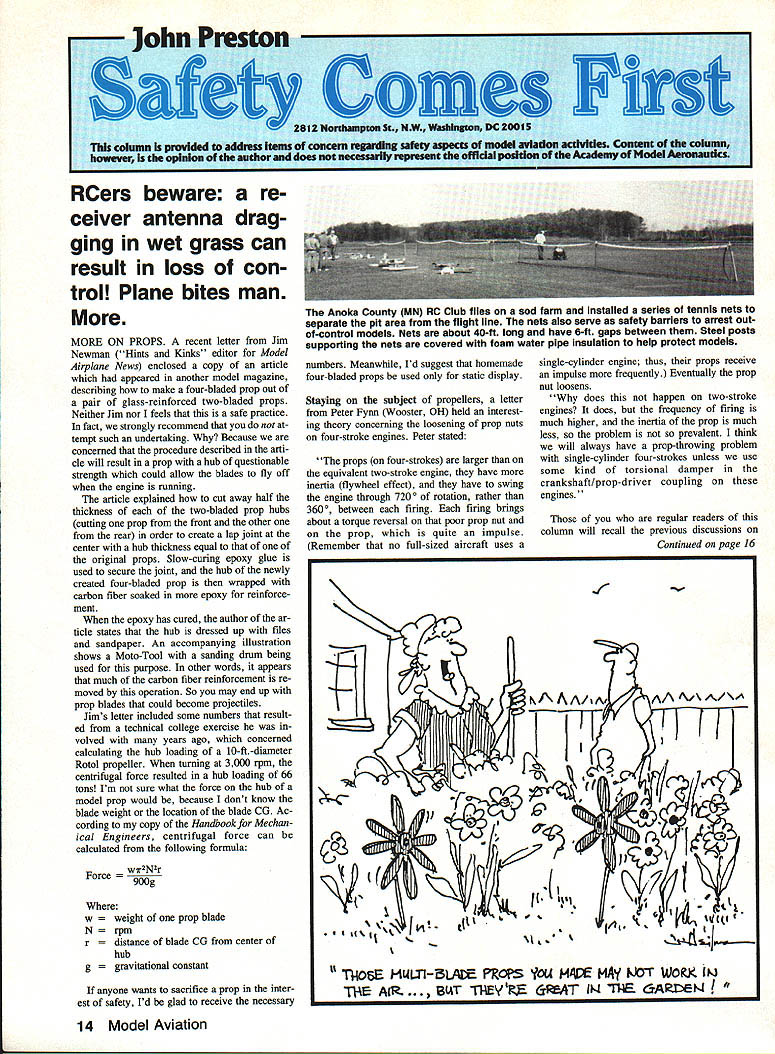
A photo of the Anoka County (MN) RC Club flying field (sent by club safety officer Stan Zdon) shows tennis nets placed at the pit area edge to serve as barriers for out‑of‑control models. Details:
- Nets are about 40 ft long.
- Erected with six‑foot access gaps between them.
- Supporting posts are surrounded by foam pipe insulation to minimize damage to models that strike them.
- The field is in the middle of a 160‑acre sod farm; the owner mows a 200 x 400 ft area that serves as the runway.
- A shelter, picnic tables, and sandbox were constructed away from the pit area so wives and children (spectators) are not in the pits.
All in all, Anoka County RCers have a neat, safety‑conscious flying field.
Wet antennas
A letter from Ralph Pearson (Falconer, NY) described an experience I had not heard before. Ralph’s account:
"I was flying one day after a hard rain. The field was so wet that I decided to land and go home. After landing, the plane suddenly took off on its own. Once airborne, the engine quickly went to idle, and (in shock) I was able to flare out for another landing, only to have the plane take off again. The third takeoff was into some tall grass at the end of the field, which killed the engine.
"I was ready to send my radio to the repair shop, but on further examination I noticed that the receiver antenna could easily reach the wet ground. I wrote to George Myers, and he confirmed my suspicions. The antenna had grounded the receiver, and everything had gone positive: Full throttle, Up elevator, and Right rudder resulted in all takeoffs being dead ahead. Luckily, I was flying a .14A, so it couldn't have done too much damage. I can imagine what would happen with a .40 or .60 taxiing back from the flight line and having its antenna drag through a puddle!"
If any readers have experienced antenna‑grounding problems, or if you fly off water, please share any precautions you take to keep the receiver antenna dry.
Plane bites man
Some photos sent by Andy McNew (Sturgis, SD) included one showing the small of his back a few weeks after being struck by his own .61‑powered Panther. Andy’s first‑person account:
"The horror of running from a six‑pound plane doing 50 mph is unbelievable. I could hear it coming and thought, 'If this thing hits me I'm done for.' It hit me in the center of the small of my back—and I mean full force! As I was falling, I wondered if I would ever pick up my son again or even be able to walk.
"I was lying on the ground some 12–15 ft from where the plane had struck me and found I could still move my toes. However, the fuel tank had opened and poured fuel into the wound. Take my word for it, that hurt!
"At the hospital they dug chunks out of my back. My wife said she could see my vertebrae. The unbreakable prop had broken when it chopped the back top off my L‑4 vertebra, and my smaller left hip bone was also broken. The wound was so deep they feared my kidney might have been damaged; fortunately, it was not.
"A week‑and‑a‑half later I am walking and can even carry my son slowly, but it might be a while before I can wrestle hay bales.
"The cause of the crash was receiver failure. I am a ham radio operator and performed some tests on the transmitter. When I turned the transmitter on first and then the receiver, all four servos would swing 10° right—and that was all the response I got. The only moral I can think of is:
- When you fly on the wide‑open prairie, bring a pickup truck to hide behind.
- Never, ever fly alone! If you do and you get hit, you're finished. Think of your family!"
The remaining photos showed what was left of the model; it was subsequently trashed. I don’t need to add more to Andy’s account other than to echo his message:
NEVER FLY ALONE!
Transcribed from original scans by AI. Minor OCR errors may remain.

