



John Preston
Safety Comes First
This column addresses items of concern regarding safety aspects of model aviation activities. The content is the opinion of the author and does not necessarily represent the official position of the Academy of Model Aeronautics.
Topics in this issue include:
- Training RC flight instructors: an idea whose time has come?
- The "wet antenna" situation
- Safe battery charging
- Danger in wood dust
- Can engine vibration switch your RC off?
- Flying alone
- Untested Scale models
Safety campaign / Training RC flight instructors
A couple of weeks ago I received a letter from Martin Dilly, public relations officer for the Society of Model Aeronautical Engineers (SMAE), the British counterpart of the AMA. In a manner similar to the AMA plan, SMAE provides its members with insurance coverage. Martin's letter stated that during the last three years they had received 81 claims on their policy, and they had two fatalities in 1987 attributed to model flying activities. One of those fatalities was the collision between a hang glider and an RC sailplane (previously reported in my February 1988 column). The other involved a model flier struck in the head by a three-pound model coming in for a dead-stick landing.
As a consequence of these accidents, SMAE has launched a major safety campaign focused on RC power fliers. As part of that campaign, SMAE will shortly publish a manual for use by RC flight instructors. According to the SMAE press release, the author is John Long, a retired RAF flight instructor and WWII fighter pilot. After 30 years' service in the RAF, John worked as a consultant and trained overseas air force personnel to fly remotely piloted vehicles (RPVs). He is eminently qualified to write an instructors' manual aimed at instructors but also valuable to newcomers to RC flying.
Some previous columns have discussed the subject of formal flight training programs, which some RC clubs have implemented. I am strongly in favor of such programs, and in light of the steps taken by SMAE I wonder whether we should have a similar instructors' manual available from the AMA. Our technical director, Bob Underwood, is now a member of the four-man AMA Safety Committee (other members: Lee Webster, Bob Brown, Jim Sears). I have forwarded a copy of Martin Dilly's letter and attachments to Bob with a suggestion that the committee consider making an instructors' manual available to the membership.
Battery chargers
A recent letter from modeler John Forbes (Bordentown, NJ) called my attention to an article in Art Schroeder's "RC News" column (Model Airplane News, February 1988) that reported a Ni-Cd battery pack catching fire while being charged. In that reported case the battery pack had been removed from the model prior to charging and the owner was alerted by a loud "pop." Others have not been so lucky—I'm aware of at least two modelers who lost their homes because of battery-charging fires.
Considered against the large number of battery packs charged routinely, these fires may seem rare. However, electrically powered models (both cars and aircraft) have become much more popular in the last decade and fast charging is commonplace. I've heard that some battery manufacturers are horrified at the high charge/discharge rates imposed on their products and that chargers and charging practices are often at fault. The likelihood of a battery-related fire appears to be increasing, so be conscious of this potential hazard.
Practical advice:
- Charge packs in a fire-safe area (non-flammable surfaces, away from combustibles).
- Use chargers and settings appropriate for the battery type and capacity.
- Never leave charging batteries unattended when using fast charge modes.
- If you have experienced or know of a battery-charging fire, please report the details—especially the suspected cause.
Wood dust
Al Knight, editor of the Clayton RC Club newsletter, forwarded a reprint from the January 1978 issue of Woodshop News by Tom Frazer. Tom, then hospitalized with idiopathic pulmonary fibrosis, attributed his disease to breathing dust from machine operations on spalted wood.
Spalting is a natural phenomenon in some woods caused by fungi decomposing the core wood, producing attractive patterns and colors. When spalted wood is cut or machined, the dust is impregnated with fungal spores and fragments of decaying material. Long-term exposure to such dust may be hazardous.
Some woods (for example, western red cedar, teak, mahogany) can cause allergic reactions in sensitive individuals; others may contain toxic compounds. Spalted wood may be particularly hazardous because of its fungal content.
Practical advice:
- Work in a well-ventilated area.
- Wear a suitable dust mask or respirator when sanding or machining.
- Minimize skin contact and clean up dust carefully.
Wet antennas
In the March 1988 column I published excerpts from a reader's letter alleging radio glitches caused by a receiver antenna contacting wet grass and grounding the radio. After publication I received four letters, three disputing that it could happen and one supporting it.
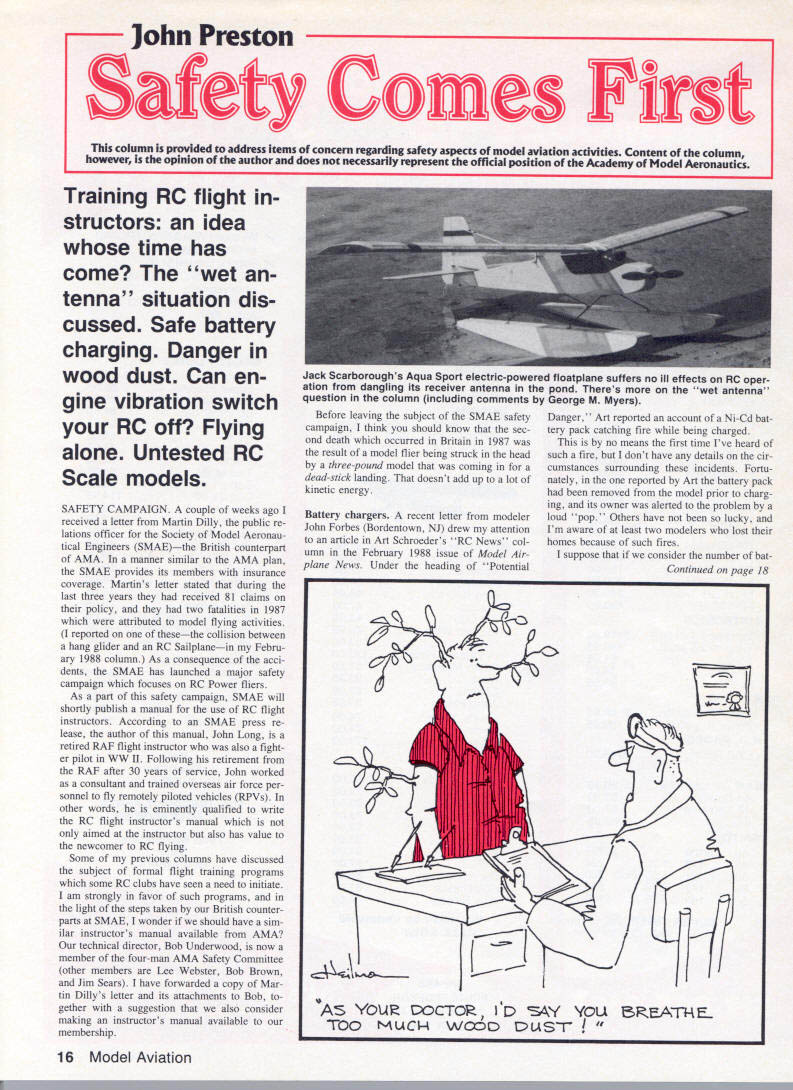
Jack Scarborough sent a color photograph of his Aqua Sport electric floatplane (geared Leisure LT-50 motor, seven-cell 800‑mAh pack) showing the receiver antenna dangling into a New England lake. Jack has not experienced any glitches from this setup.
George M. Myers wrote with background from his experience flying helicopters, where it was common practice to let the antenna dangle below the machine. He confirmed the phenomenon is rare: hundreds of helicopters may operate that way without problems, but a few RC systems can be adversely affected. He emphasized that the arrangement of servo and battery leads inside the fuselage has a strong effect on whether a problem will appear and advised rearranging wires before blaming the radio manufacturer.
A caution when rearranging equipment inside the fuselage: ensure connectors and batteries are secure. In my own experience, stuffing the battery pack rearward under the servo tray to shift the CG resulted—during flight at about 200 ft—in a sudden loss of control and a left-hand spiral dive. The model impacted the runway, destroying the airframe and the pilot figure. After the crash the radio functioned normally; other than stripped servo gears, the radio worked. My theory is that engine vibration partially disconnected the receiver battery pack because I hadn't taped or otherwise secured the connectors. Lesson learned: always secure radio connectors (tape or locking devices) and properly stow wiring to avoid intermittent connections.
To fly alone or not to fly alone?
Following the "Plane bites man" story in March, which described a modeler being struck and seriously injured by his own plane, my advice remains: never fly alone. Many readers disagree, feeling that if you are the only person at the flying site you won't be injured by someone else's mistake, and your mistakes won't jeopardize others. While that may be largely true, there are many common hazards when flying solo—feeding your fingers through your own prop is a frequent cause of injury. If you suffer a serious hand injury while alone, you may be unable to summon assistance or even manage basic tasks like stopping blood flow. Whenever possible, fly with at least one other person present.
Flying untested Scale models
Del Ryker (Batavia, NY) expressed concern that some contest directors enter Scale contests with models that haven't been test-flown for airworthiness. Del believes some Scale modelers avoid test flights to "save it for static judging" and suggested reversing the order so flying occurs before static judging.
I don't have a good feel for how prevalent this problem is, so I'm asking for input from Scale modelers: Do untested models present a real safety problem at contests? If so, what solutions would you propose? Possible options include:
- Require a documented test flight prior to contest entry.
- Change contest order to fly before static judging.
- Implement an inspection and handling procedure ensuring models are flight-ready.
Send your experiences and suggestions so we can assess whether a rule or rule change is warranted.
Transcribed from original scans by AI. Minor OCR errors may remain.

