
SAFETY NET
Graham Hicks
THE IDEA came out of one of those brainstorming sessions where you throw out rhyme and reason and let your imagination freewheel. When you hit the goal you're looking for, you backtrack and figure out how to do it.
We had a fun-fly coming up, and it looked like most of our families would be at the field. Question: how to effectively protect wives and junior birdmen from the occasional errant model on takeoff or landing?
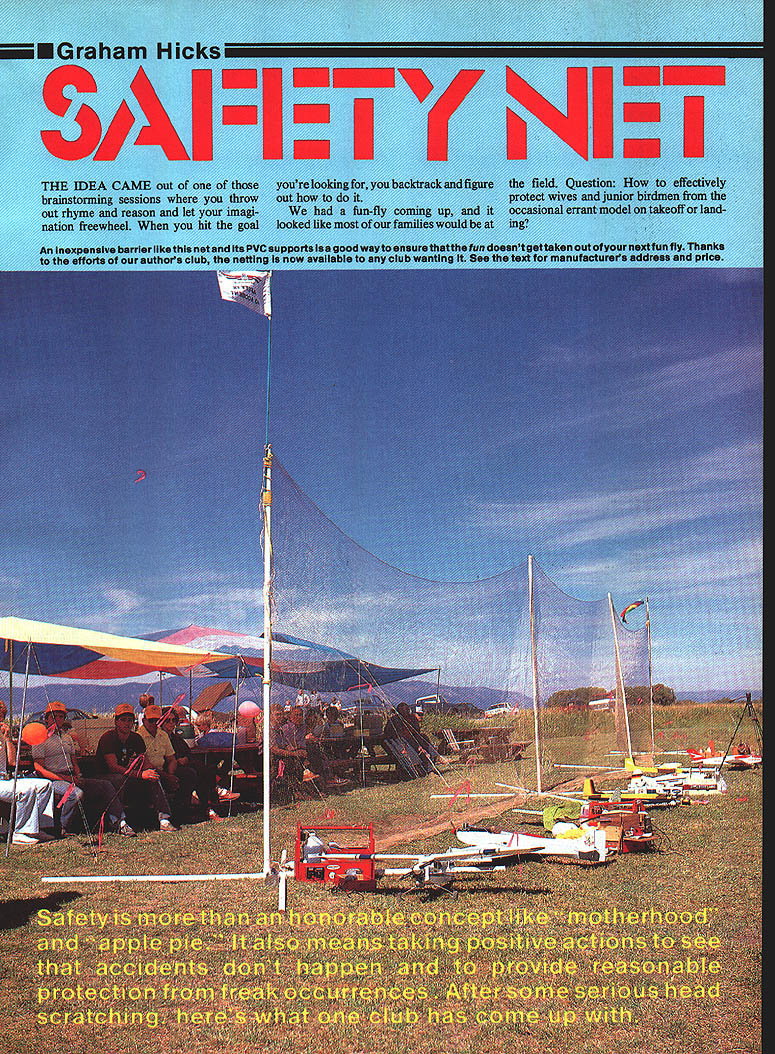
An inexpensive barrier—this net and its PVC supports—is a good way to ensure that the fun doesn't get taken out of your next fun fly. Thanks to the efforts of our author's club, the netting is now available to any club wanting it. See the Ordering Information section for the manufacturer's address and price.
Safety is more than an honorable concept like motherhood and apple pie. It also means taking positive actions to see that accidents don't happen, and to provide reasonable protection from freak occurrences. After some serious head scratching, here's what one club has come up with.
Somebody snickered and suggested, "Hey, how 'bout a big net around 10 feet high and 70 feet long?" Somebody else said, "That's a good idea! Let's figure out how to do it." And so the chip-net safety barrier was born.
It so happens that several of our newer members (including our current president, Ben Davison) are engineers or brakemen, or work in some other capacity for the Union Pacific Railroad. One of them, Joe Wise, approached UPRR's mechanical foreman, Mr. G. A. Reams, and told him what we needed and why.
The Union Pacific Railroad has always had an eye out for ways to help the community, and here was an avenue to assist whereby even a life might be saved. They came up with an item called a "chip-net," which is a woven net used to cover railroad cars loaded with wood chips or sawdust. It keeps the load from blowing all over the county. Our current operations officer, Ron Tincher, donated the necessary lengths and joints of two-inch PVC pipe; Joe Wise donated the fittings and cement—and within a day or two was born a 10-ft.-high, 64-ft.-long field safety net that, in our experience, is unequalled in its capacity to protect spectators.
Design and materials
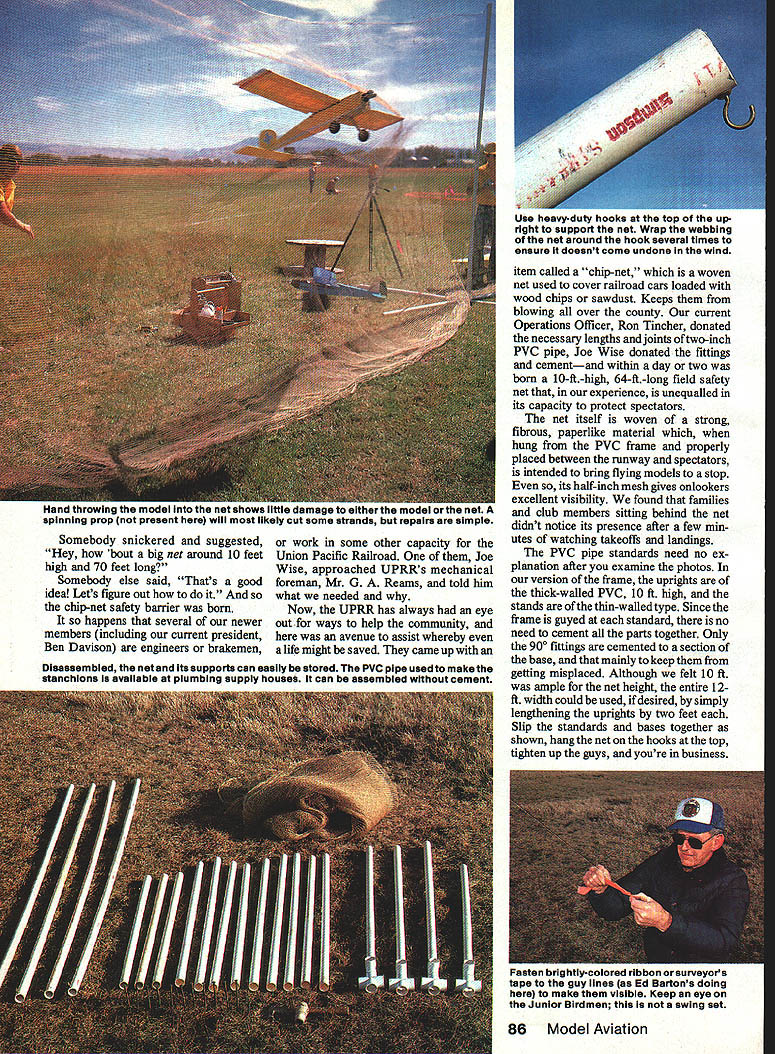
- Net: chip-net woven of a strong, fibrous, paperlike material. Mesh is approximately 1/2 inch, allowing excellent visibility for onlookers.
- PVC frame:
- Uprights: thick-walled PVC, 10 ft high (you can use full 12 ft width by lengthening the uprights two feet each).
- Bases/stands: thin-walled PVC.
- Fittings: 90° fittings (cemented to a section of the base to keep them from getting misplaced).
- Two-inch nominal PVC pipe lengths and joints were used in our frame.
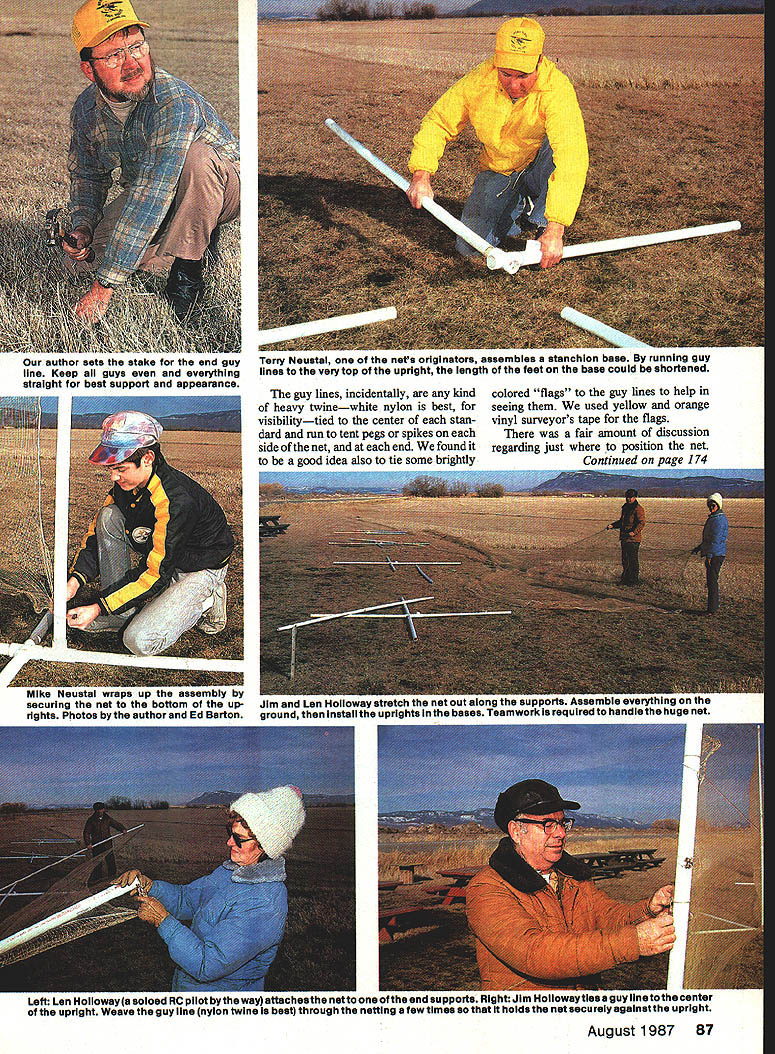
- Guy lines: any heavy twine; white nylon is best for visibility.
- Ground anchors: tent pegs or spikes.
- Visibility flags: brightly colored flags tied to guy lines; yellow and orange vinyl surveyor's tape was used.
Assembly
- Slip the standards (uprights) into their bases as shown in the photos (uprights are 10 ft thick-walled PVC; stands are thin-walled).
- Cement only the 90° fittings to a section of the base to prevent loss; the remainder of the frame need not be cemented because each standard is guyed.
- Hang the chip-net from hooks at the top of the uprights and let it drape to the ground.
- Attach guy lines to the center of each standard and run them to tent pegs or spikes on each side of the net and at each end.
- Tie brightly colored flags (surveyor's tape) to the guy lines to improve visibility.
- Tighten the guys until the net is taut and properly positioned.
Placement considerations
There was considerable discussion about where to position the net. Options included placing it adjacent to the runway to catch wandering models early, or further back toward the spectator area. We decided to position the net about six feet from the spectators' picnic tables. At this distance, a model would have to dive almost straight into it to hit an onlooker. If general safety rules are obeyed, no model should ever be flying from a position that could endanger spectators.
We don't claim the net protects against every potential hazard. More than anything else, it is intended to catch student flyers' or just-soloed pilots' models that go astray on takeoff or landing, and to compensate for occasional runway-heading carelessness.
Testing and performance
We have not subjected our net to destructive testing—i.e., intentionally flying a model at full power into it to wreck it. However, we did loop a .40-size model to flying weight and threw it as hard as we could into the net several times. The net showed absolutely no damage; the model simply slid down the net to the ground without so much as a ruffled tail feather.
In an actual accident, with the engine running, the net would likely stop the engine by winding around the prop. Expect a broken prop; the airplane might hang in the net; and you might have a small repair job to mend the net. But consider the trade-off: a relatively inexpensive repair versus a potentially life-threatening situation.
Ordering information
A call to Mr. Dave Beighley at UPRR offices in Omaha produced the ordering information about the net. He put me in touch with the manufacturer, the Chase Bag Company, of Portland, OR. Mr. J. Dickey at Chase Bag was delighted to hear of the new application for his product and offered a special ordering arrangement for clubs that want to assemble their own safety net.
Send your order with a check for $20.00 for each net desired to:
Chase Bag Co. P.O. Box 10192 Portland, OR 97210
Mark your order "Attention: Mr. Harry Gage." The nets are shipped FOB Portland. Net nomenclature: "Chip-net, 12 x 64 ft., paper woven mesh, yellow coded."
Acknowledgments
The Grande Ronde Bush Pilots express their sincere appreciation to the Union Pacific Railroad for its generosity, and to the Chase Bag Company for making special shipping arrangements for other clubs desirous of their own nets.
Conclusion
There may be a better way to protect ourselves against model-aircraft accidents—but until it comes along, this one's a winner.
I doubt that the safety net is going to reduce our AMA insurance premiums. But of one thing you may be sure: when your club has a serious accident, one of the first things the insurance carrier will examine with the greatest of care in evaluating your claim is, "What measures did you take before the accident to prevent this kind of tragedy?"
And how will your club answer?
Transcribed from original scans by AI. Minor OCR errors may remain.

