
Sal Taibi: A Living Legend
Fred Lehmberg
Van Cortlandt Park and the early days
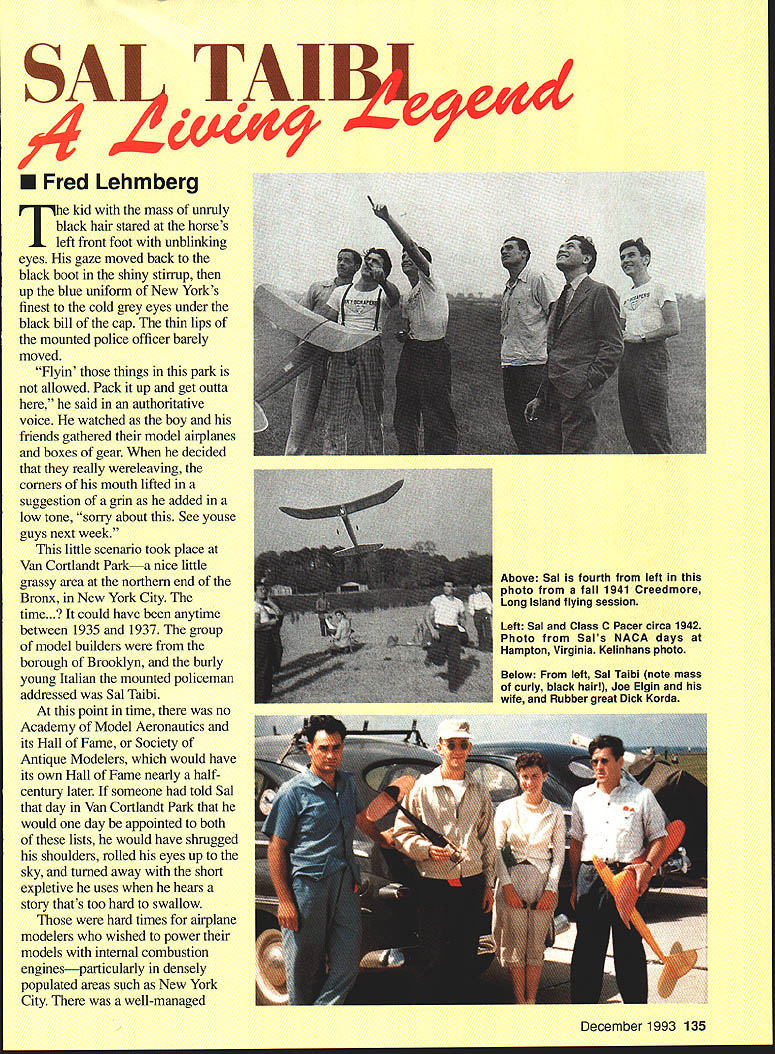
The kid with the mass of unruly black hair stared at the horse's left front foot with unblinking eyes. His gaze moved back to the black boot in the shiny stirrup, then up the blue uniform of New York's finest to the cold grey eyes under the black bill of the cap. The thin lips of the mounted police officer barely moved.
"Flyin' those things in this park is not allowed. Pack it up and get outta here," he said in an authoritative voice. He watched as the boy and his friends gathered their model airplanes and boxes of gear. When he decided that they really were leaving, the corners of his mouth lifted in a suggestion of a grin as he added in a low tone, "sorry about this. See youse guys next week."
This scene took place at Van Cortlandt Park, a grassy area at the northern end of the Bronx in New York City. The time could have been anytime between 1935 and 1937. The group of model builders were from Brooklyn, and the burly young Italian the mounted policeman addressed was Sal Taibi.
Those were hard times for airplane modelers who wished to power their models with internal combustion engines—particularly in densely populated areas such as New York City. A movement nearly succeeded in outlawing the flying of such models; several states, Massachusetts for instance, already had legislation in effect. Van Cortlandt Park was used by modelers from the New York boroughs, Connecticut and Long Island. An ordinance prohibiting flying these types of model aircraft was on the books, and the mounted police enforcing the ban generally looked the other way for early arrivals. As the day wore on and picnickers or players arrived, the police would chase off the modelers.
It took the efforts of the National Aeronautic Association and the Academy of Model Aeronautics to combat this movement and allow the hobby to develop to its current status. We owe a lot to the early modelers who flew in public areas like Van Cortlandt Park over 50 years ago.
How Sal got started
Sal's start in model aviation was almost accidental. At about 13, he visited a friend, Louis Canava, on his way home from school. Louis was building a built-up scale model Bellanca and wanted to show Sal. As Louis took the model off its shelf, he noticed his mother had dropped it, breaking a couple of longerons. Angered, Louis was going to stomp the remains on the floor until restrained. Sal asked if he could have the model; Louis gave Sal the plans, pins, glue—everything. Sal repaired the damage and completed the model. He and the neighborhood kids glided it off the roof of Sal's three-story home in Brooklyn.
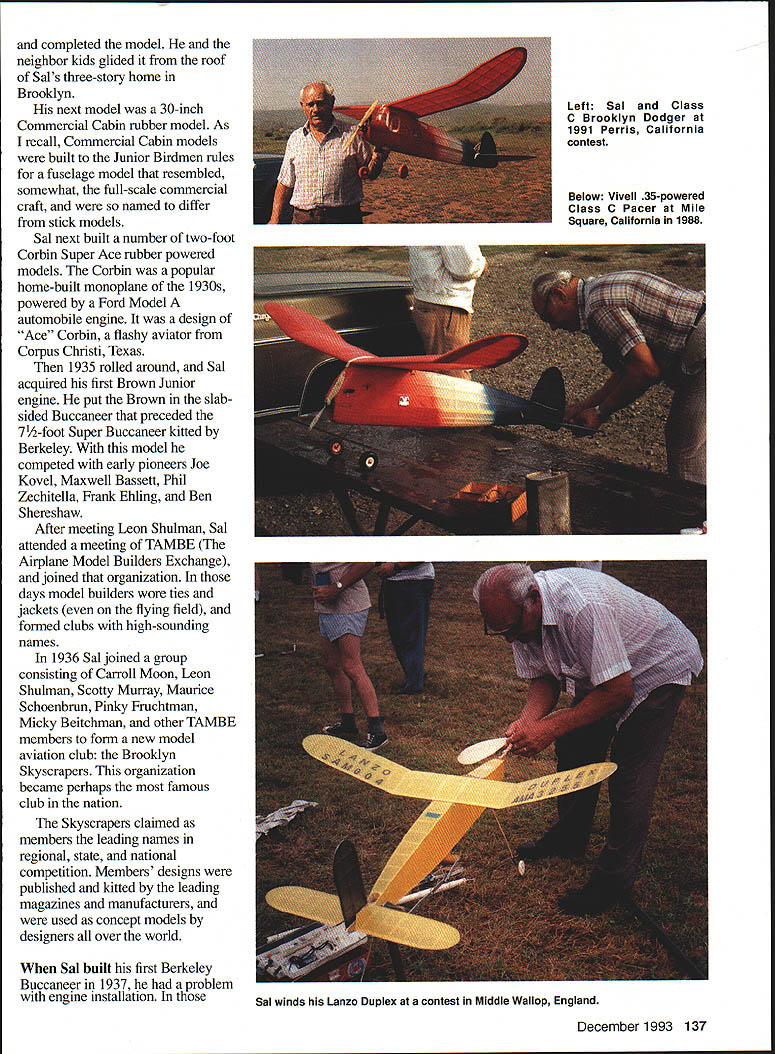
His next model was a 30-inch Commercial Cabin rubber model, built to the Junior Birdmen rules and resembling a full-scale commercial fuselage rather than a stick model. He then built a number of two-foot Corbin Super Ace rubber-powered models—the Corbin being a popular home-built monoplane design of the 1930s, full-scale sometimes powered by a Ford Model A engine.
By 1935 Sal acquired his first Brown Junior engine and installed it on a slabsided Buccaneer, followed by a 7½-foot Super Buccaneer kitted by Berkeley. He competed with early pioneers such as Joe Kovel, Maxwell Bassett, Phil Zechitella, Frank Ehling and Ben Shereshaw.
Clubs and the Brooklyn Skyscrapers
After meeting Leon Shulman, Sal attended a meeting of TAMBE (The Airplane Model Builders Exchange) and joined. In those days model builders often wore ties and jackets to the flying field and formed clubs with high-sounding names. In 1936 Sal joined a group that included:
- Carroll Moon
- Leon Shulman
- Scotty Murray
- Maurice Schoenbrun
- Pinky Fruchtman
- Mickey Beitchman
- Others from TAMBE
These members formed a new model aviation club, the Brooklyn Skyscrapers, an organization that became perhaps the most famous club in the nation. The Skyscrapers claimed many leading names in regional, state, and national competition; members' designs were published and kitted by leading magazines and manufacturers and influenced designers around the world.
Innovative engine installation
When Sal built his first Berkeley Buccaneer in 1937, he faced an engine-installation problem. In those days the Brown Jr. engine was delivered mounted on maple bearers with coil and condenser neatly soldered in place. Since the plans were of little help, Sal simply screwed the entire assembly into the nose of the aircraft.
He refined the idea into a clever style of engine and wiring installation he used on later models—Powerhouse, Pacer, Brooklyn Dodger, etc. He mounted engines, with wiring, compactly on a hardwood sub-mount similar to the Brown factory setup. This sub-mount was then screwed to permanently mounted engine bearers built into the fuselage. The technique avoided the wiring mess common among modelers and contributed to Sal's reputation for fine-running engines.
Competition and records
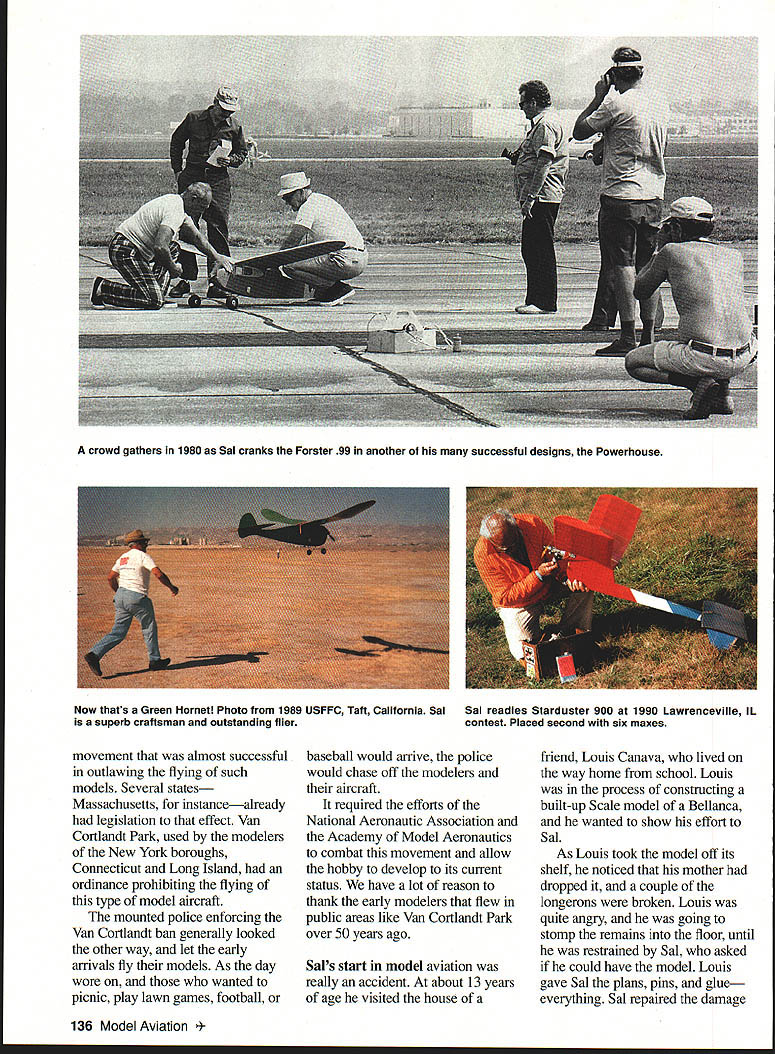
Sal built his expertise over the next several years, attending six to eight meets per season as the Skyscrapers sustained their reputation. In the fall of 1938 he developed a seven-footer for a Forster .99. In February 1939 he won his first contest at Creedmoor, Long Island, with this aircraft, which he named Powerhouse.
Two months later he won another first, this time in Class B, with an Ohlsson .23 in a Bay Ridge Diamond Demon, and set his first national record. That season he also won first place in the First Eastern R.O.W. (Rise-Off-Water) Contest at Lake Hopatcong, New Jersey, with his Powerhouse.
Highlights of his competitive career include:
- Over 15 first places at the AMA Nationals since 1941.
- Among the nation's leading competitors continuously since 1936—57 years of continuous competition, a claim unmatched by other pioneer model builders.
NACA, wartime contributions and toolmaking
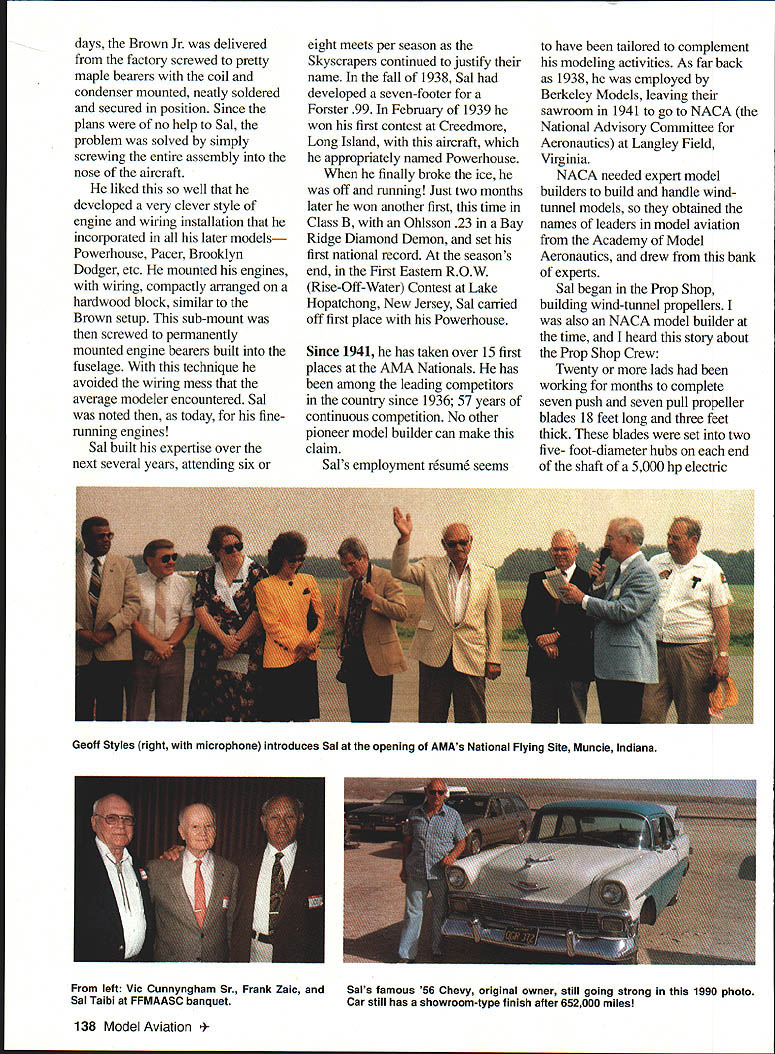
Sal's employment history complemented his modeling activities. By 1938 he was employed by Berkeley Models, leaving in 1941 to join NACA (the National Advisory Committee for Aeronautics) at Langley Field, Virginia. NACA needed expert model builders to build and handle wind-tunnel models, so they recruited leaders in model aviation.
Sal began in the Prop Shop, building wind-tunnel propellers, and contributed to many critical projects. One notable story: a propeller assembly for the large-diameter section of a 16-foot plenum wind tunnel was fouled by tools left inside. Management feared a three-week delay for repair, but the Prop Shop supervisor—a model builder—pointed out that hard balsa had a similar density to spruce and could be glued and lathe-shaped in place. The repair was completed quickly, the blades balanced the next morning, and the A-20 oil-cooling duct tests passed. The model builders at NACA routinely supplemented the engineering staff and significantly contributed to the war effort.
After Prop Shop work, Sal became a toolmaker apprentice and later worked on advanced projects such as the all-flying stabilizer/elevator used on jet aircraft.
Personal life and later career
I met Sal in 1942 when we both belonged to a local model club, The Brainbusters. During the war Sal discovered a new interest, a girl named Nan. After a wartime courtship of three weeks, Sal married Nan on March 4, 1944. Later in 1944 Sal left NACA to enter the Air Force’s 862nd Engineer Aviation Battalion.
After his wartime service, discharged in 1945, Sal worked as a toolmaker for the Naval Ordnance Plant in Indianapolis until 1946. He then worked for the Federal Aviation Agency, where he was involved with flight-safety improvements such as the first lightweight (two-and-a-half-pound) radio receiver for light planes and the first Ground-Control Approach System.
In February 1951 Sal and Nan vacationed in California. It was an exceptionally cold February in Indianapolis and warm in Burbank. Sal applied for and received a job as a toolmaker with the Naval Ordnance Test Station in Pasadena and bought a house in Lakewood. They returned briefly to Indianapolis to pack and then moved to California, moving into their new home on April 10, 1951, where they still lived.
Legacy
Sal Taibi's long and distinguished career as a model builder, competitor, NACA craftsman and innovator earned him a place among the pioneers of model aviation. His practical engineering solutions, competition successes, and contributions to wartime and postwar aeronautics exemplify a life dedicated to flight in both scale and full size.
Transcribed from original scans by AI. Minor OCR errors may remain.

