
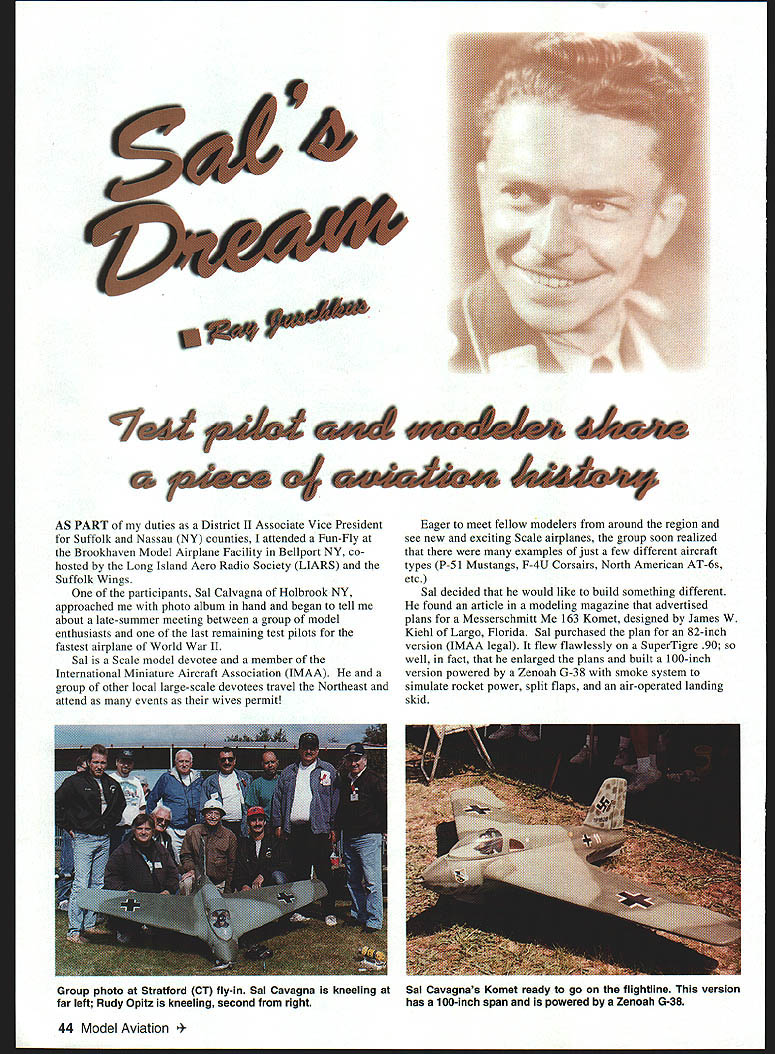
Sal's Dream: Test pilot and modeler share a piece of aviation history
As part of my duties as a District II Associate Vice President for Suffolk and Nassau counties (NY), I attended a Fun‑Fly at the Brookhaven Model Airplane Facility in Bellport, NY, co‑hosted by the Long Island Aero Radio Society (LIARS) and the Suffolk Wings.
One of the participants, Sal Calvagna of Holbrook, NY, approached me with a photo album in hand and began to tell me about a late‑summer meeting between a group of model enthusiasts and one of the last remaining test pilots for the fastest airplane of World War II.
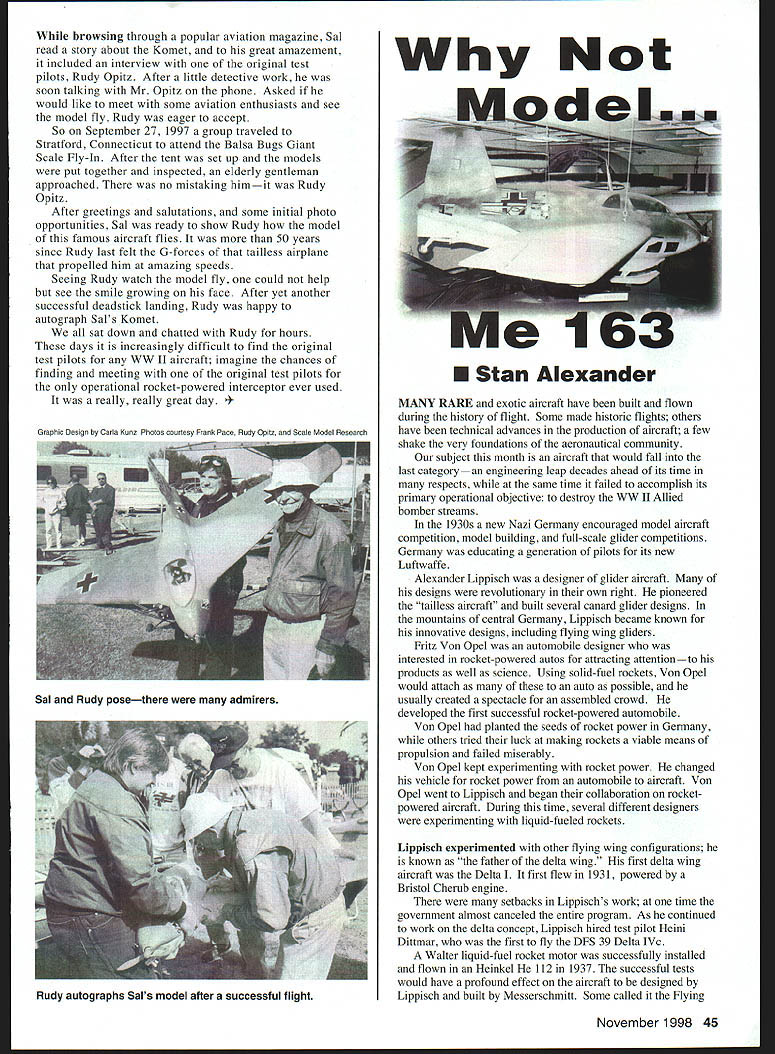
Sal is a scale‑model devotee and a member of the International Miniature Aircraft Association (IMAA). He and a group of other local large‑scale devotees travel the Northeast and attend as many events as their wives permit. Eager to meet fellow modelers and see new scale airplanes, the group soon realized many examples were of just a few different aircraft types (P‑51 Mustangs, F‑4U Corsairs, North American AT‑6s, etc.).
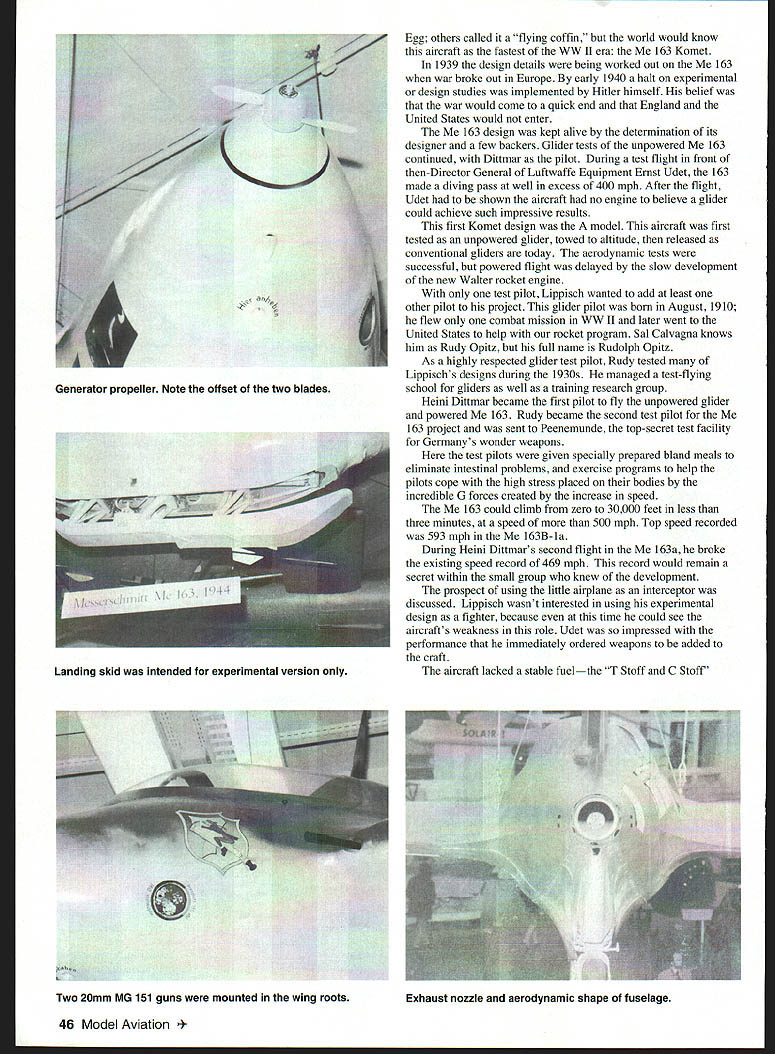
Sal decided to build something different. He found an article in a modeling magazine that advertised plans for a Messerschmitt Me 163 Komet designed by James W. Kiehl of Largo, Florida. Sal purchased the plan for an 82‑inch version (IMAA legal). It flew flawlessly on a SuperTiger .90; so well, in fact, that he enlarged the plans and built a 100‑inch version powered by a Zenoah G‑38 with a smoke system to simulate rocket power, split flaps, and an air‑operated landing skid.
While browsing through a popular aviation magazine, Sal read the story about the Komet and was amazed to find an interview with one of the original test pilots, Rudy Opitz (Rudolph Opitz). After a little detective work he was soon talking with Mr. Opitz on the phone. Sal asked if Rudy would like to meet some aviation enthusiasts and see the model fly; Rudy was eager to accept.
So, on September 27, 1997, the group traveled to Stratford, Connecticut, to attend the Balsa Bugs Giant Scale Fly‑In. After the tent was set up and the models assembled and inspected, an elderly gentleman approached. There was no mistaking him—it was Rudy Opitz.
After greetings, salutations, and some initial photos, Sal was ready to show Rudy his model of the famous aircraft that Rudy had flown more than 50 years earlier. Seeing Rudy watch the model fly, you could see the smile grow on his face. After another successful deadstick landing, Rudy happily autographed Sal's Komet and sat down to chat. Rudy talked for hours. These days it is increasingly difficult to find original test pilots of World War II aircraft; imagine the chances of finding and meeting an original test pilot of the only operational rocket‑powered interceptor ever used. It was a really, really great day.
Design and development
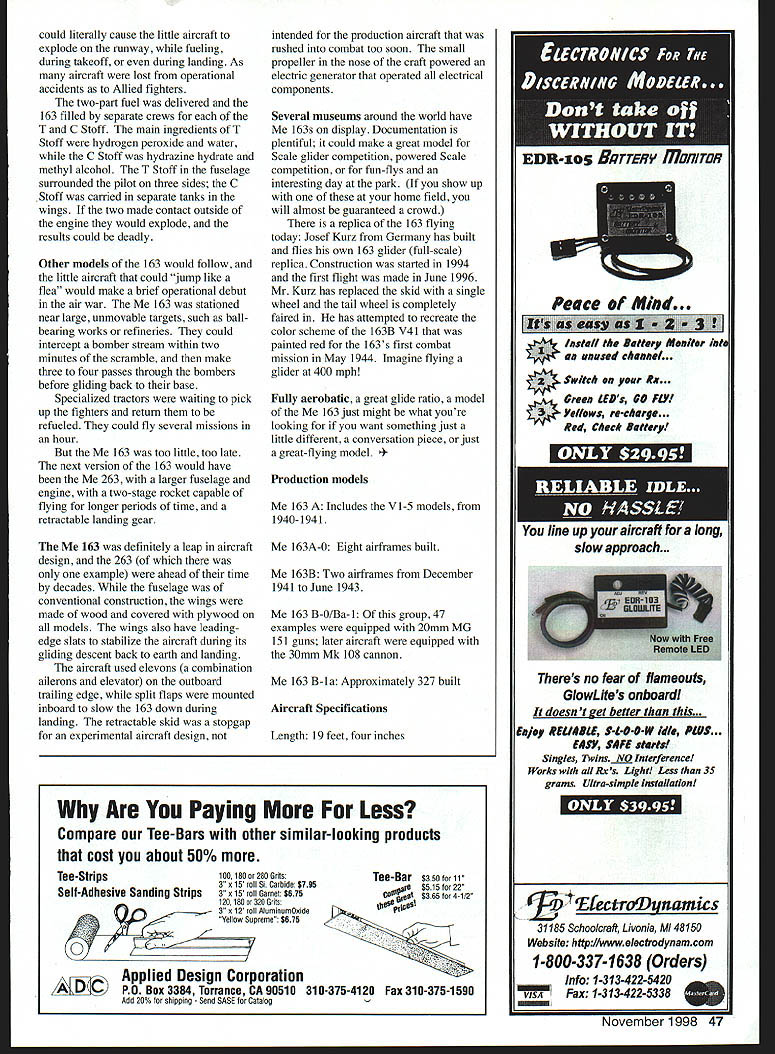
Many rare, exotic aircraft have been built and flown during the history of flight. Some made historic flights; others made technical advances in production aircraft; a few shook the very foundations of the aeronautical community. The subject of this article falls in that last category—an engineering leap decades ahead of its time that nevertheless failed to accomplish its primary operational objective: destroy Allied bomber streams in World War II.
In the 1930s, Nazi Germany encouraged model aircraft competition and glider building, educating a generation of pilots for the Luftwaffe. Alexander Lippisch, a designer of glider aircraft whose designs were revolutionary, pioneered tailless aircraft and built several canard and flying‑wing glider designs. Lippisch became known as a father of the delta wing; his first delta‑wing aircraft first flew in 1931 powered by a Bristol Cherub.
Fritz von Opel, an automobile designer interested in rocket propulsion, used solid‑fuel rockets on automobiles to create spectacles and public interest. Von Opel and Lippisch collaborated on rocket‑powered aircraft experiments. During that period several designers experimented with liquid‑fueled rockets.
The first Komet design was the Me 163 A model, initially tested as an unpowered glider towed to altitude and released for aerodynamic testing. Heini Dittmar became the first pilot to fly the unpowered glider and the powered Me 163. Rudy Opitz, born August 1910, was a highly respected glider test pilot who tested many of Lippisch's designs in the 1930s and later became the second test pilot for the Me 163 project. Rudy was sent to Peenemünde, the top‑secret test facility for Germany's wonder weapons, to continue testing.
Glider tests were impressive: during a demonstration in front of Ernst Udet, the unpowered 163 made a diving pass well in excess of 400 mph, prompting disbelief that the aircraft had no engine. Powered flight awaited development of the Walter rocket engine.
Performance and operational use
The Me 163 could climb from zero to 30,000 feet in less than three minutes at speeds in excess of 500 mph. A top speed of 593 mph was recorded in the Me 163B‑1a. During Heini Dittmar's second powered flight in the Me 163A he broke the existing speed record of 469 mph; this record remained secret within the small development group.
The prospect of using the little airplane as an interceptor was discussed. Lippisch was reluctant to see his experimental design used as a fighter because he recognized its limitations. Nevertheless, Udet ordered weapons added to the craft.
The aircraft used a dangerous two‑component propellant system. The fuel components—known as T‑Stoff and C‑Stoff—were highly reactive. T‑Stoff (primarily concentrated hydrogen peroxide and water) and C‑Stoff (hydrazine hydrate and methyl alcohol) were loaded by separate crews into separate tanks. If the two made contact outside the engine they could detonate, and many aircraft were lost to fueling accidents, takeoff mishaps, or landing incidents as well as to enemy action.
Operationally, the Me 163 was staged near large, immovable targets such as ball‑bearing works or refineries. It could intercept a bomber stream within two minutes of scramble and make three to four passes through the formation before gliding back to base to be refueled. Specialized tractors waited to retrieve the fighters and return them for refueling so several missions could be flown in an hour. Despite its performance, the Me 163 proved too little, too late.
The intended successor, the Me 263, featured a larger fuselage and a two‑stage rocket for longer flight time, plus retractable landing gear. Only one example was completed; the 163/263 series were decades ahead of their time.
Construction details and handling
The fuselage of the Me 163 was of conventional construction, but the wings were made of wood and covered with plywood on all models. Leading‑edge slats stabilized the aircraft during its gliding descent and landing. Control surfaces included elevons (combined ailerons and elevators) on the outboard trailing edges and split flaps mounted inboard to slow the aircraft for landing. The retractable skid served as a stopgap landing arrangement for this experimental design. A small nose‑mounted propeller powered an electric generator for the aircraft's electrical systems.
Some called the Me 163 an "egg"; others dubbed it a "flying coffin," but the world would know it as the fastest airplane of the World War II era.
Replica and modeling
Several museums around the world have Me 163s on display and documentation is plentiful. The Me 163 makes a great subject for scale glider competition, powered scale competition, fun‑flys, or a crowd‑pleasing day at the park.
A full‑scale replica flies today: Josef Kunz of Germany built and flies his own Me 163 glider replica. Construction began in 1994 and the first flight was in June 1996. Kunz replaced the skid with a single wheel and faired the tailwheel; he has attempted to recreate the color scheme of the Me 163B V41 that was painted red for the Komet's first combat mission in May 1944. Imagine flying a glider at 400 mph!
Fully aerobatic with a great glide ratio, a model of the Me 163 is a distinctive choice if you want something different—a conversation piece or just a great‑flying model.
Production models
- Me 163 A: Includes the V1‑V5 models, from 1940–1941.
- Me 163A‑0: Eight airframes built.
- Me 163B: Two airframes from December 1941 to June 1943.
- Me 163 B‑0/Ba‑1: Of this group, 47 examples were equipped with 20 mm MG 151 guns; later aircraft were equipped with the 30 mm Mk 108 cannon.
- Me 163 B‑1a: Approximately 327 built.
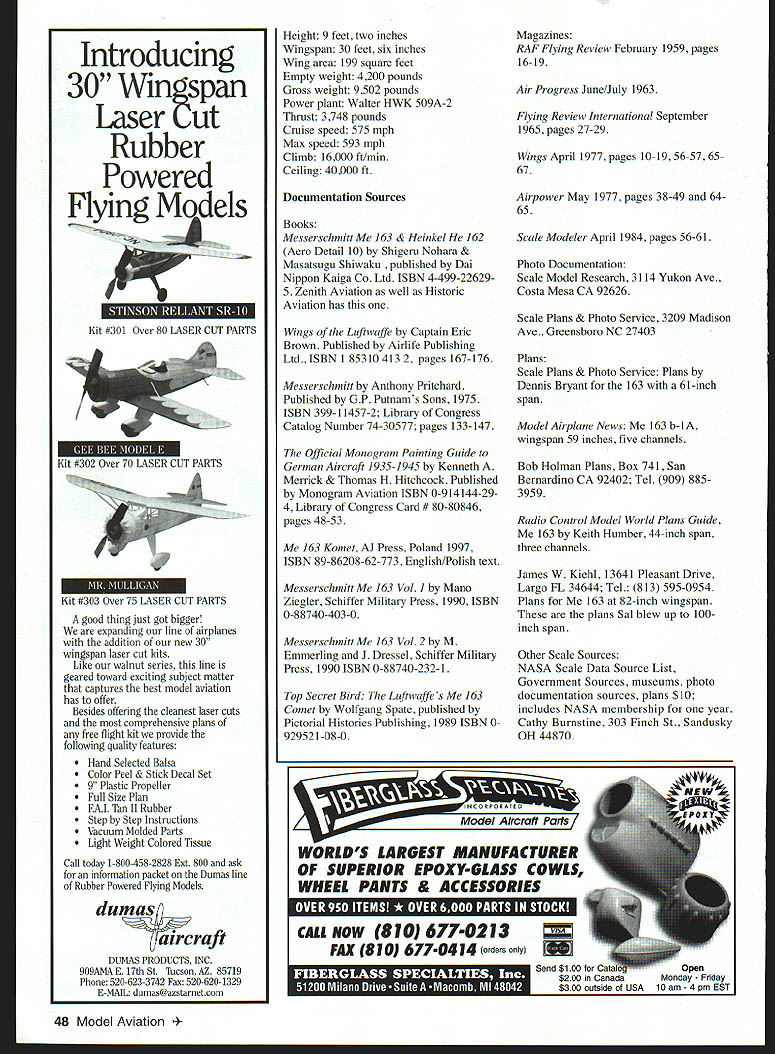
Aircraft Specifications
- Length: 19 feet, 4 inches
- Height: 9 feet, 2 inches
- Wingspan: 30 feet, 6 inches
- Wing area: 199 square feet
- Empty weight: 4,200 pounds
- Gross weight: 9,502 pounds
- Power plant: Walter HWK 509A‑2
- Thrust: 3,748 pounds
- Cruise speed: 575 mph
- Max speed: 593 mph
- Climb: 16,000 ft/min
- Service ceiling: 40,000 ft
Documentation Sources
Books
- Messerschmitt Me 163 & Heinkel He 162 (Aero Detail 10) by Shigeru Nohara & Masatsugu Shiwaku. Dai Nippon Kaiga Co. Ltd. ISBN 4-499-22629-5.
- Wings of the Luftwaffe by Captain Eric Brown. Airlife Publishing Ltd. ISBN 1-85310-413-2. Pages 167–176.
- Messerschmitt by Anthony Pritchard. G.P. Putnam's Sons, 1975. ISBN 399-11457-2. Library of Congress Catalog Number 74-30577. Pages 133–147.
- The Official Monogram Painting Guide to German Aircraft 1935–1945 by Kenneth A. Merrick & Thomas H. Hitchcock. Monogram Aviation. ISBN 0-914144-29-4. Library of Congress Card # 80-80846. Pages 48–53.
- Me 163 Komet, AJ Press, Poland, 1997. ISBN 89-86208-62-773. English/Polish text.
- Messerschmitt Me 163 Vol. 1 by Mano Ziegler. Schiffer Military Press, 1990. ISBN 0-88740-403-0.
- Messerschmitt Me 163 Vol. 2 by M. Emmerling and J. Dressel. Schiffer Military Press, 1990. ISBN 0-88740-322-1.
- Top Secret Bird: The Luftwaffe's Me 163 Komet by Wolfgang Späte. Pictorial Histories Publishing, 1989. ISBN 0-929521-08-0.
Magazines
- RAF Flying Review, February 1959, pages 16–19.
- Air Progress, June/July 1963.
- Flying Review International, September 1965, pages 27–29.
- Wings, April 1977, pages 10–19, 56–57, 65–67.
- Airpower, May 1977, pages 38–49 and 64–65.
- Scale Modeler, April 1984, pages 56–61.
Photo Documentation
- Scale Model Research, 3114 Yukon Ave., Costa Mesa, CA 92626.
- Scale Plans & Photo Service, 3209 Madison Ave., Greensboro, NC 27403.
Plans
- Scale Plans & Photo Service: Plans by Dennis Bryant for the Me 163 with a 61‑inch span.
- Model Airplane News: Me 163 B‑1A, wingspan 59 inches, five channels.
- Bob Holman Plans, Box 741, San Bernardino, CA 92402; Tel. (909) 885‑3959.
- Radio Control Model World Plans Guide: Me 163 by Keith Humber, 44‑inch span, three channels.
- James W. Kiehl, 13641 Pleasant Drive, Largo, FL 34644; Tel. (813) 595‑0954. Plans for Me 163 at 82‑inch wingspan (these are the plans Sal enlarged to a 100‑inch span).
Other Scale Sources
- NASA Scale Data Source List: Government sources, museums, photo documentation sources, plans $10; includes NASA membership for one year. Cathy Burnstine, 303 Finch St., Sandusky, OH 44870.
Transcribed from original scans by AI. Minor OCR errors may remain.

