
SALT MINE SAGA
Bud Romak
Arrival and first impressions
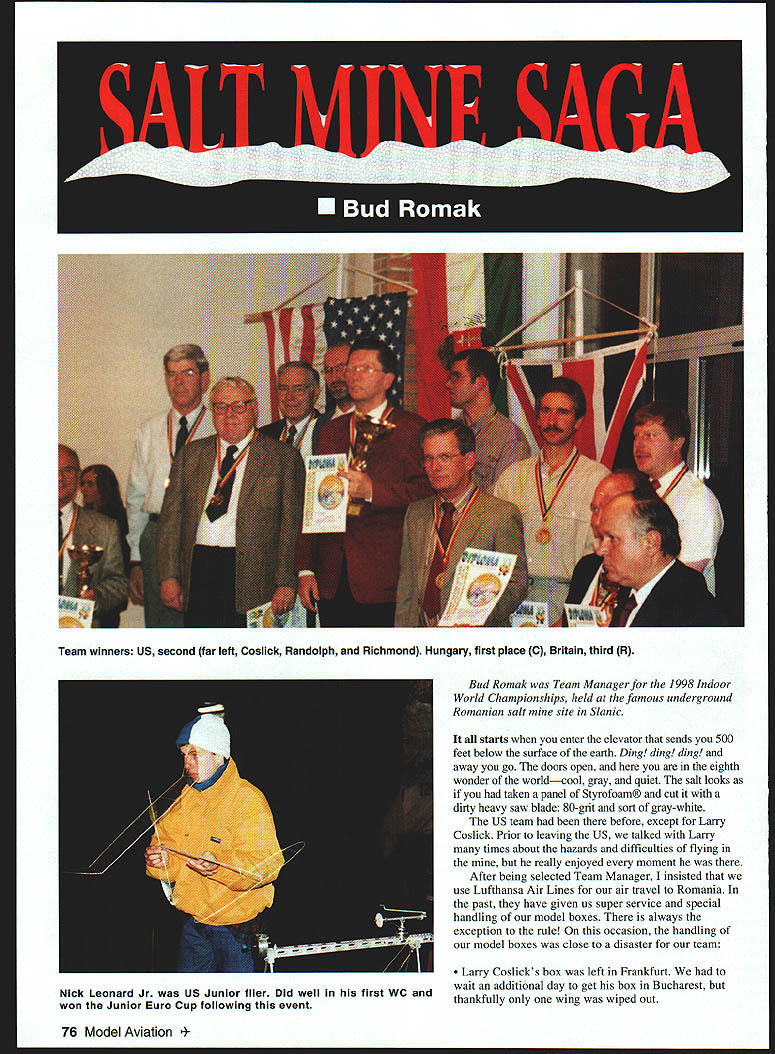
Bud Romak was Team Manager for the 1998 Indoor World Championships, held at the famous underground Romanian salt mine site in Slănic.
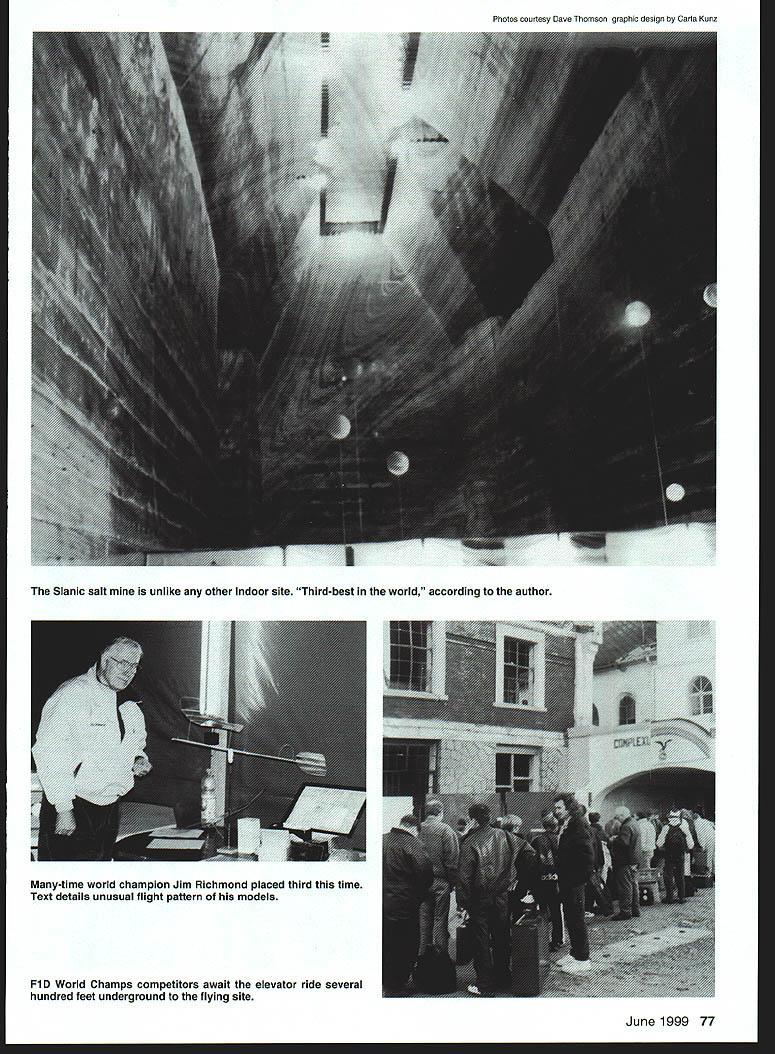
It all starts when you enter the elevator that sends you 500 feet below the surface of the earth. Ding! ding! ding! and away you go. The doors open, and here you are in the eighth wonder of the world — cool, gray, and quiet. The salt looks as if you had taken a panel of Styrofoam and cut it with a dirty heavy saw blade: 80-grit and sort of gray-white.
The US team had been there before, except for Larry Coslick. Prior to leaving the US, we talked with Larry many times about the hazards and difficulties of flying in the mine, but he really enjoyed every moment he was there.
Travel and gear problems
After being selected Team Manager, I insisted that we use Lufthansa Air Lines for our air travel to Romania. In the past, they have given us super service and special handling of our model boxes. There is always the exception to the rule! On this occasion, the handling of our model boxes was close to a disaster for our team:
- Larry Coslick's box was left in Frankfurt. We had to wait an additional day to get his box in Bucharest; thankfully only one wing was wiped out.
- Bob Randolph's box had been used for football-field goal attempts. I think four or five models in the box were severely damaged; it took hours of repair work to get at least two or three ready to fly, thanks to Aurel Morar (1982 World Champ) and the rest of the team.
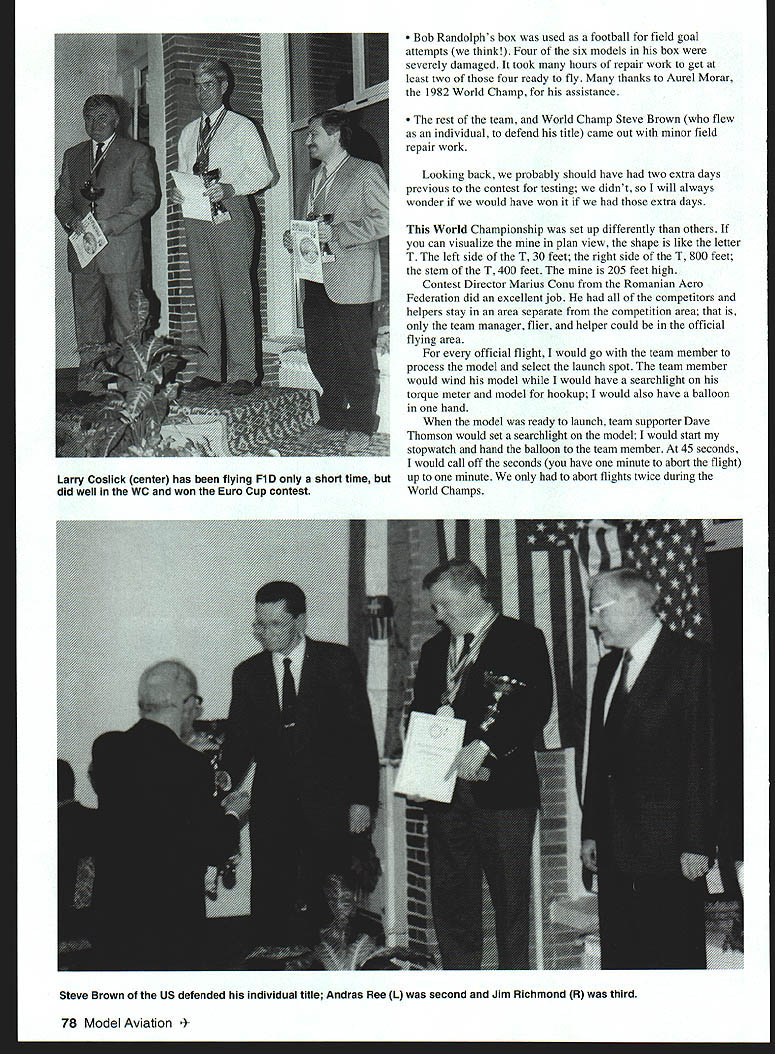
World Champ Steve Brown flew to defend his individual title and came out with only minor field repair work. Looking back, we probably should have had two extra days for prior contest testing; I will always wonder if we would have won with the extra days.
Site layout and competition procedure
The World Championship site was set up differently than others. If you visualize a plan view, the shape was like the letter T: the left side of the T was 30 feet, the right side 800 feet, the stem 400 feet, and 205 feet high. Contest Director Marius Conu of the Romanian Aero Federation did an excellent job.
Competitors and helpers stayed in an area separate from the competition area. A team manager, flier, and helper could enter the official flying area only for an official flight. An official flight went like this:
- A team member would process the model and select the launch spot.
- A team member would wind the model and hook up the torque meter to the model.
- Someone would have the searchlight and a balloon in hand and have the model ready to launch.
- Team supporter Dave Thomson would set the searchlight. The model would start; the stopwatch and hand-balloon team member had 45 seconds. They would call off seconds; there was a one-minute abort. We had one-minute abort flights twice during the World Champs.
Once the model was off, we would remove boxes and equipment from the flying area and go to the next wall. Dave stationed the system we used; teams made great flying conditions — little drift, minimal ballooning.
Equipment and team support
Aurel Popa purchased two 12-volt batteries for us. Aurel Morar fabricated two battery carts. The team worked out perfectly. We purchased three one-million-candlepower searchlights — the best; the WC needed them like having eyes. Repair work went on; testing proceeded. Everyone seemed to be doing fine except Bob Randolph, whose models were completely retested and rebuilt.
Competition rounds
#### Day One — Round One Coslick went off in great shape; hung up on salt, 14:37. Jim Richmond went next. Jim's model had a very scary launch — it crabbed right after two minutes, then resumed circling left and got off center. Jim flew through-T flights because of the large circle launch. The model went up about 190 feet, hit the wall, bounced off, and slid down, breaking a wingtip and tailboom, 13:24. Randolph went off with enough torque — best of us, 23:35.
#### Day One — Round Two Jim's model flew super close to the wall; once again it touched three times, hanging up, then climbed about 175 feet, 41:37. Coslick's flight was fine but needed more power and a lower-pitch prop, 30:29. Randolph used the same model; turns were easy and the flight stayed centered — nice, 37:17. We knew the first two rounds would be a real test; the team knew we would have to put together the next four rounds.
Going into the next day it was a time battle for the World Championship between Steve Brown and Andras Ree; full competition put on a real show for the entire WC.
#### Day Two — Round Three This was the best round — the longest flights were made. Jim's wing folded aft but he was able to save the remainder of the model. His next attempt got off to a super flight: 43:07.
It was a pleasure to be able to help a six-time World Champ. He is so patient and knows his models in every respect. Jim had to balloon his model once — a great steering job.
Larry wound his model with more torque and it flew the way Larry's models always fly: great. Cracking the 40-minute barrier by our second team was a real pleasure — that meant we were in the race for the gold (41:01).
Randolph's model flew again for a steady 37:11. Bob's repaired models were really straining to get to the 40-minute mark. We knew Bob had his hands full; we helped him as much as we could. Bob is a great competitor and has held eight indoor world records, but flying a wounded model makes it quite difficult.
#### Day Two — Round Four Coslick flew first in this round. He got his model off with no fanfare — smooth and slow. It climbed to about 170 feet. I really expected a 44-minute flight; he had a good team flight of 40:00.
Richmond was chosen to fly second because Randolph had to rebrace a wing and do some test flying. Jim's model turned right at first into the T, then made a big circle centered in the right side of the T, climbed to the top, and hung up on the catwalk at 200 feet for 12:22.
Randolph's model did not climb; it flew around for several circles without rising until the torque diminished, 17:03.
#### Day Three — Round Five Richmond said, "I'll back off a little because the last flights went a little too high." I think he backed off just a little too much; the model reached about 120 feet but still did a fine 39:33.
Coslick had to steer his model a few times and reduced his altitude quite a bit, 34:04.
Randolph's first-attempt model had been wound heavily to get a 40-minute gold flight. It started out fine, but at about 40 seconds out we decided it had too much torque. Bob ballooned the model and caught it for an attempt. He rewound and got it off again, only to fold a wing.
#### Day Three — Round Six Our last chance to grab the gold. Larry went off and did the best he could — not quite enough torque. We really don't know, because he wound his model up more than before. It did not do what it was supposed to do; 37:48.
Richmond went for it. Another launch from the throat of the T; off he went with a huge circle to the start, then it climbed right to the ceiling and centered. I really thought this was going to be the longest flight of the WC. The bronze medal was in Jim's hand: 44:21.
Randolph got his model off — patched, broken, and weak — but away it went with all of our prayers for a good flight. It didn't happen: 28:33.
Results and reflections
Second place (team) is not the end of the world. We did the best we could and had lots of fun doing it. The English team was nipping at our heels, and the Hungarians were superb. This was the closest WC finals since 1966 in Hungary.
Steve Brown and Andras Ree were standouts; consistent and smooth. Steve has ice in his veins — so competent, cool, and collected. He is a great indoor flier and is good for the hobby, always available to answer questions and help. He has great models and knows how they work. He reminds me of watching Fred Astaire dance effortlessly but under control at all times.
Andras Ree has been a competitor for many years and deserved a lot of credit for the team gold medal. He had the longest flight of the WC at 45:13, two seconds longer than Steve. Ree was only 23 seconds out of first place.
The US also had a Junior flying in the Junior World Championships competition: Nick Leonard Jr. He did an outstanding job flying and making friends with the large contingent of Junior fliers. His dad was there to help him, and they had a great time.
In the past, the salt mine was the Frankenstein of indoor sites. I think everyone has a different outlook about this site now; I would say it's the third-best site in the world, behind Santa Ana, California, and Cardington, England.
Acknowledgments
Congratulations and thanks, from our hearts, must go to our very good friends in Romania: Aurel Morar, Aurel Popa, Nicoara Vasile, and Manolea Cornel. They gave us the red-carpet treatment.
Many thanks also to the timekeepers and officials for this memorable World Championship.
Our team had the best supporters of the WC. "Lighthouse Dave" Thomson managed the searchlight for every official flight the team made. Herb Robbins was everywhere; he helped us in so many ways and was on call 24 hours a day. Without them, we would have been handicapped.
Euro Indoor Cup
The day after the WC, the Euro Indoor Cup was held. The winner was Larry Coslick with 66:07, and Nick Leonard Jr. was the Junior winner. Larry has been flying F1D for only two years. Everyone should watch out for this guy!
Bud Romak 85 Sullivan Dr. Moraga, CA 94556
Transcribed from original scans by AI. Minor OCR errors may remain.

