
SAM CHAMPS
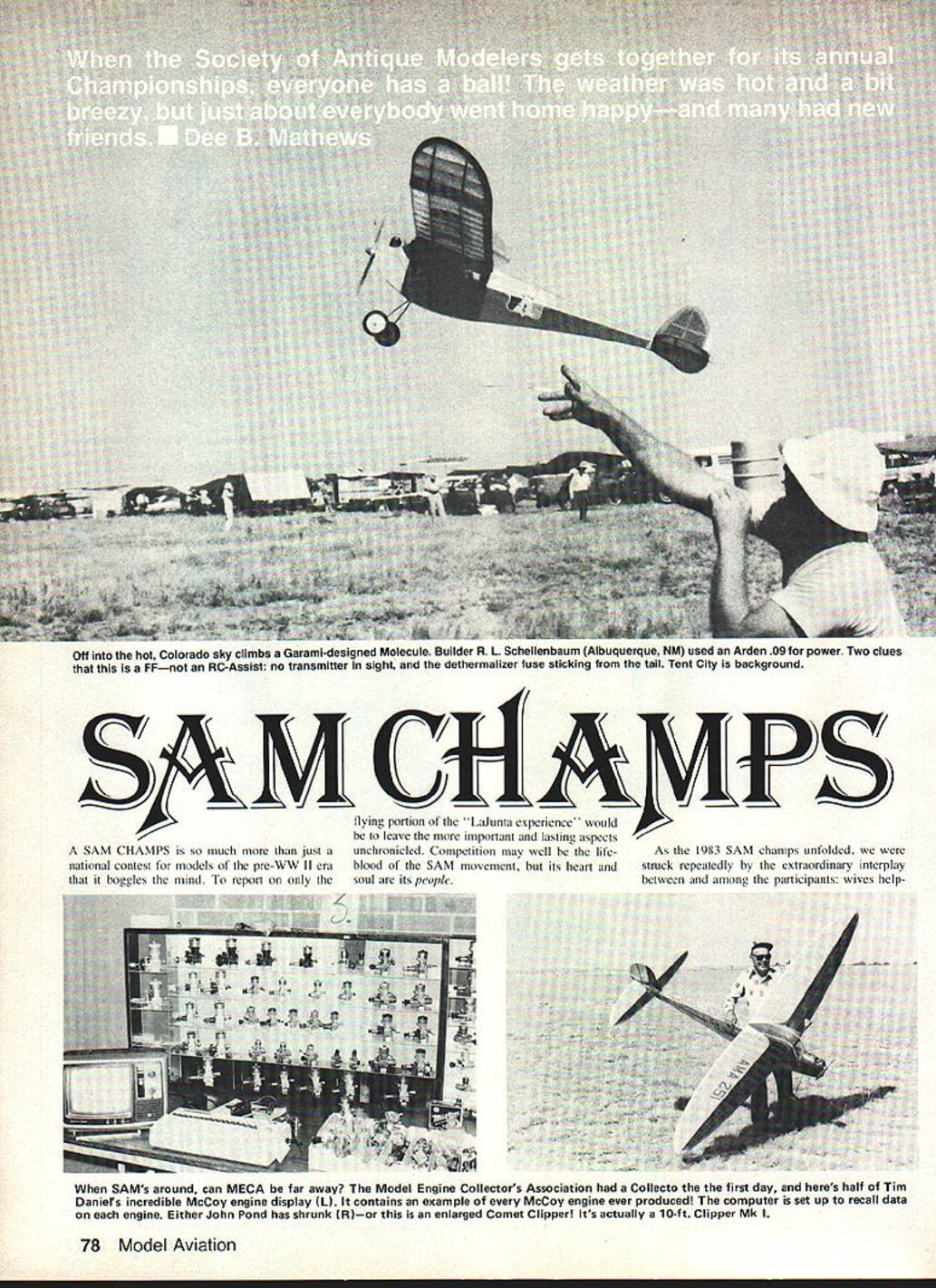
A SAM Champs is so much more than just a national contest for models of the pre‑WWII era. To report only the flying portion of the "La Junta experience" would be to leave the more important and lasting aspects unchronicled. Competition may well be the life‑blood of the SAM movement, but its heart and soul are its people.
As the 1983 SAM Champs unfolded, we were repeatedly struck by the extraordinary interplay among the participants: helping husbands prepare and repair, resisting the obvious comforts of air‑conditioned rooms and campers, and sticking it out in the heat and wind. Friends whose only contact for years had been letters and phone calls displayed the pure joys of face‑to‑face contact. Total strangers quickly learned to delight in common interests and established new bonds of friendship. The hospitality extended by the citizens of La Junta, Colorado, and their honest appreciation for the financial impact the SAM Champs brought to them was notable. Above all, the everlasting good humor displayed by everyone — laughter was the predominant human sound everywhere one went.
SAM people are truly extraordinary: friendly, outgoing, mature, and happy. These interplays are what make the event such a delightful experience. The models and competition are only the stage; the actors make the play.
For some reason, my memories of the 1983 SAM Championships group themselves together and are associated with lines from songs and ditties: "Too pooped to pop, just sitting here frying."
Hot? You'd better believe it. The local cable TV weather channel displayed highs of 117°F on Monday, 107°F on Tuesday and Wednesday, and a “cool” 103°F on Thursday. Fortunately, the relative humidity was only in the teens, and 10–20 knot winds helped keep body surface temperatures within safe limits — the wind was so dry that sweat often evaporated before it could drip. Common sense about drinking plenty of liquids and restraining excessive exertion prevented any really serious heat problems. There were few related illnesses, although several contestants complained of muscle cramps (most likely associated with loss of calcium). The prevailing reaction to the heat was concern for one another and a continuing sense of good humor: "Hey! You look hot! Come sit under our shade and have a drink of water."
"Home on the Range." The La Junta Municipal Airport turned out to be a different facility than some had anticipated. The contest site was surrounded by miles of open pasture, and — as confirmed by photos — no obstructions of any kind were within the normal retrieval area. Prevailing southerly winds on Tuesday and Wednesday didn't quite fit the site layout, since the flight line was located on the far northern boundary of the airport. Fortunately, the pasture to the north was adequate for foot retrieval (no bikes were allowed). On Thursday the winds shifted to the north and moderated considerably.
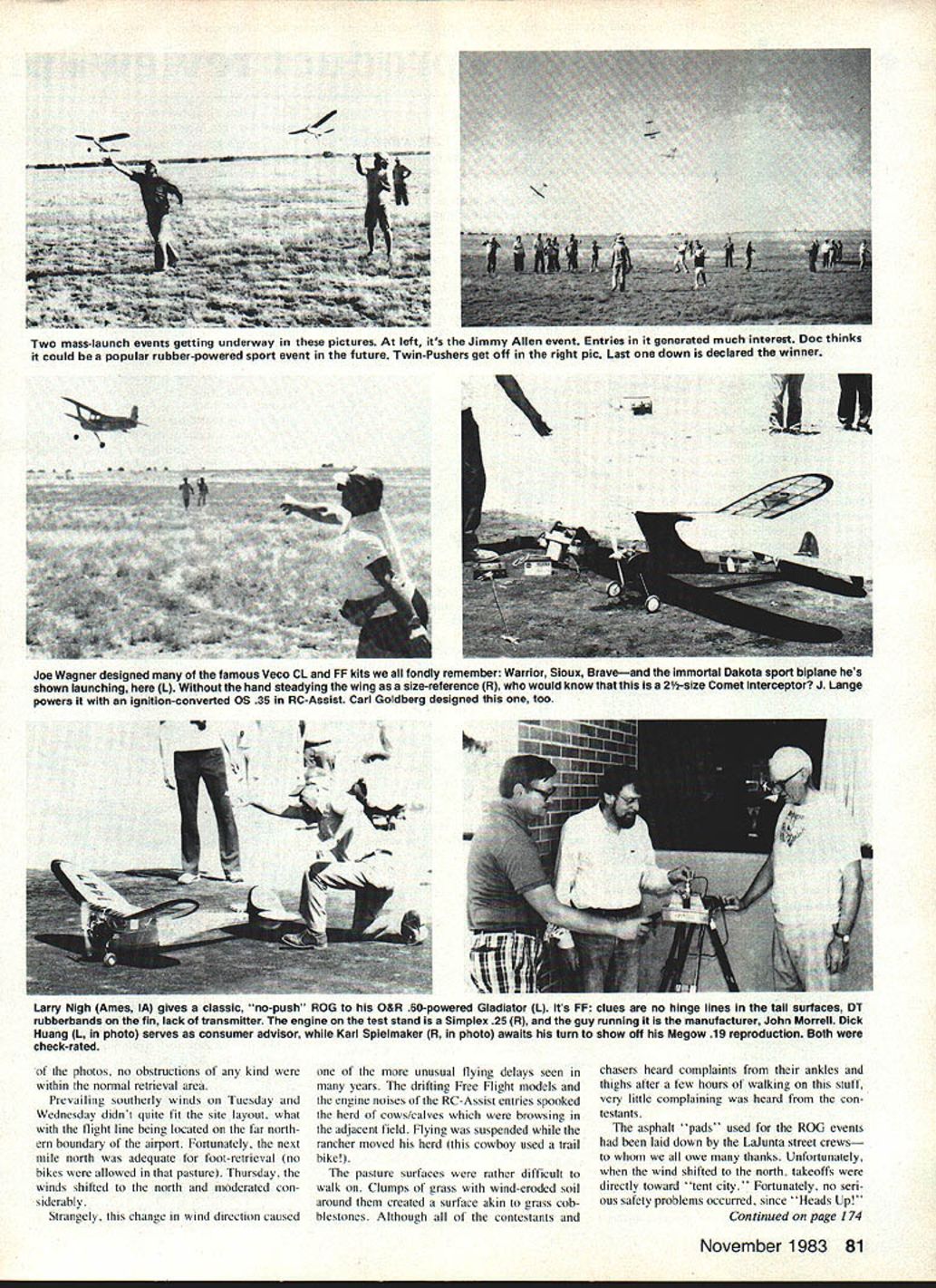
Strangely, the wind shift caused one of the more unusual flying delays in many years: drifting free‑flight models and the engine noises of RC‑Assist entries spooked a herd of cows and calves in the adjacent field. Flying was suspended while the rancher moved his herd (he used a trail bike). The pasture surfaces were rather difficult to walk on; clumps of grass with wind‑eroded soil created a surface akin to grass cobblestones. Although ankles and thighs felt the strain after a few hours, very little complaining was heard from contestants.
The asphalt pads used for the ROG events had been laid down by the La Junta street crews, to whom we all owe many thanks. Unfortunately, when the wind shifted to the north, takeoffs were directly toward "Tent City." Fortunately no serious safety problems occurred — "Heads up!" really means something to SAM types.
The host chapter (SAM No. 1) and Contest Director Jim Thomas had obviously done their homework. For example, when someone mentioned it would be nice to water down the dusty access road, a water truck arrived and did just that — several times daily. Although no hookups were available for campers and motor homes at the contest site, several self‑contained vehicles, tenters, and campers stayed overnight. Motel arrangements were well handled by Tanya Baird at the Chamber of Commerce; every room in La Junta had been reserved by mid‑April, but many attendees found accommodations in nearby towns. Rates were reasonable. Additional rooms were available at Otero Junior College; those who stayed there reported clean, air‑conditioned facilities and lively bull sessions in the lounge.
A concessionaire provided food and drink at the flying field at reasonable prices. However, breakfast in La Junta proved a bit of a hassle: the sudden influx of hungry modelers at 6:00 a.m. overtaxed local restaurants and made for slow service; some eateries didn't open until 7:00 a.m. The problem stemmed partly from contest management's decision to start flying at 8:00 a.m. rather than the originally announced 9:00 a.m., to get the competition over earlier and avoid the worst heat. Since La Junta is near the eastern edge of the Mountain time zone, flying could even have been scheduled to start at 6:00 a.m., allowing the contest day to end as early as 3:00 p.m.
"They Go Up, Up, Up..." Problems from high altitude on engine power and model glides didn't seem as severe as anticipated. Power loss was a factor, but the peculiar distribution of lift in the atmosphere was the real oddity. Lift often existed in strata: one model could be riding a large boomer while another immediately above or below it would be in sink. Thermal patterns were more like those seen at Lake Charles, LA, than typical Great Plains thermals. Competitors who had flown previously at La Junta or Lake Charles felt at an advantage because they could recognize flight patterns and make better decisions.
A common sight was RC‑Assist pilots facing in different directions at once — some in lift, others out of it. Normally, lift generates from the ground in columns so a modeller can "piggyback" beneath another in lift. Not so at La Junta during those days. Winds may have broken thermals into bubbles; most fliers encountered as much bad air as good. Nonetheless, those who locked onto boomers got great rides. RC Events Director Woody Woodard imposed a 30‑minute max for Texaco to keep frequency pins moving; this resulted in a five‑way flyoff with reduced fuel allotments. Several max flights had to be forced out of lift, and at least one pilot deliberately popped a wing to extract his plane from a near‑vertical ascent.
"A Million‑Dollar Baby from a Five‑and‑Ten‑Cent Store." Although the Model Engine Collectors Association (MECA) is separate from SAM, the overlap of interests and members is obvious. Monday's MECA Collector, held in the Otero Junior College Union, was a joyful opener for the SAM Champs. Host David Janson added well‑received innovations, such as an antique‑engine trivia quiz with prizes and hourly drawings that kept the room lively. Table after table of displays — from the exotic to the mundane — resulted in head‑scratching and bargain‑hunting. Many engines and kits were available for swap or sale.
Good‑quality "runners" such as O&R, Torpedo, Atwood, and Spitfire were readily available at compatible prices. Brand‑new reproduction engines like the Forster, Super Cyclone, Simplex, and Megow are now available, so there is virtually no reason for anyone who wants to fly SAM events not to find a suitable engine. A handful of collectors posted inflated prices, but the majority of MECA members were honest and willing to help potential fliers find what they needed.
"East Side, West Side." The La Junta Tribune‑Democrat gave extensive coverage of the SAM Champs before, during, and after the event. For some reason they referred to us as "SAMS," but many photos and articles ran, and the editor promised to continue printing appeals to aid in recovering lost models. A Tuesday edition counted car tags from many states and Canada; attendees came from California, Texas, Colorado, Florida, Wyoming, Washington, Utah, Arizona, Nevada, Michigan, Indiana, Illinois, Oregon, Oklahoma, Kansas, Georgia, North Dakota, Ohio, Nebraska, Louisiana, Pennsylvania, New Mexico, New Jersey, New York — and even from Suffolk, England.
"Ah, Sweet Mystery of Life." For those unfamiliar with SAM events, a quick reference to the SAM rules in the 1982‑83 AMA rule book (starting on page 127) will help. All Free Flight Power events require spark‑ignition engines. Cabin models are loosely defined as those with windows in the fuselage; A, B, and C refer to engine‑displacement classes. Antique models are those designed prior to 1938. Texaco and fuel‑allotment events use a specified quantity of fuel based on model weight.
Compressed Air is exactly that: the engine runs off a tank of compressed air carried aloft by the model. It is refilled from a ground‑based tank or by using a tire pump. The motors run much like modern CO2 units but predate the earliest model internal‑combustion engines by many years. The event is extremely challenging — the power system has a poor power‑to‑weight ratio, so models must be built very light, almost like indoor models. The wind tore Tim Banzacak's plane (a scale version of a WWII target drone) apart in his hands. Tim has campaigned this event for years, and it is slowly gaining popularity.
The Jimmy Allen event was added this year under the guidance of Roger Maves. The models are designs kitted for the Skelly Oil Co. in the 1930s and distributed at service stations as a national promotion. The entry was large enough to encourage development of these rubber‑powered sport models as a separate event. These models are also eligible for Peanut, A, B, or C events if they meet specifications.
Radio Control Assist — Class Glow
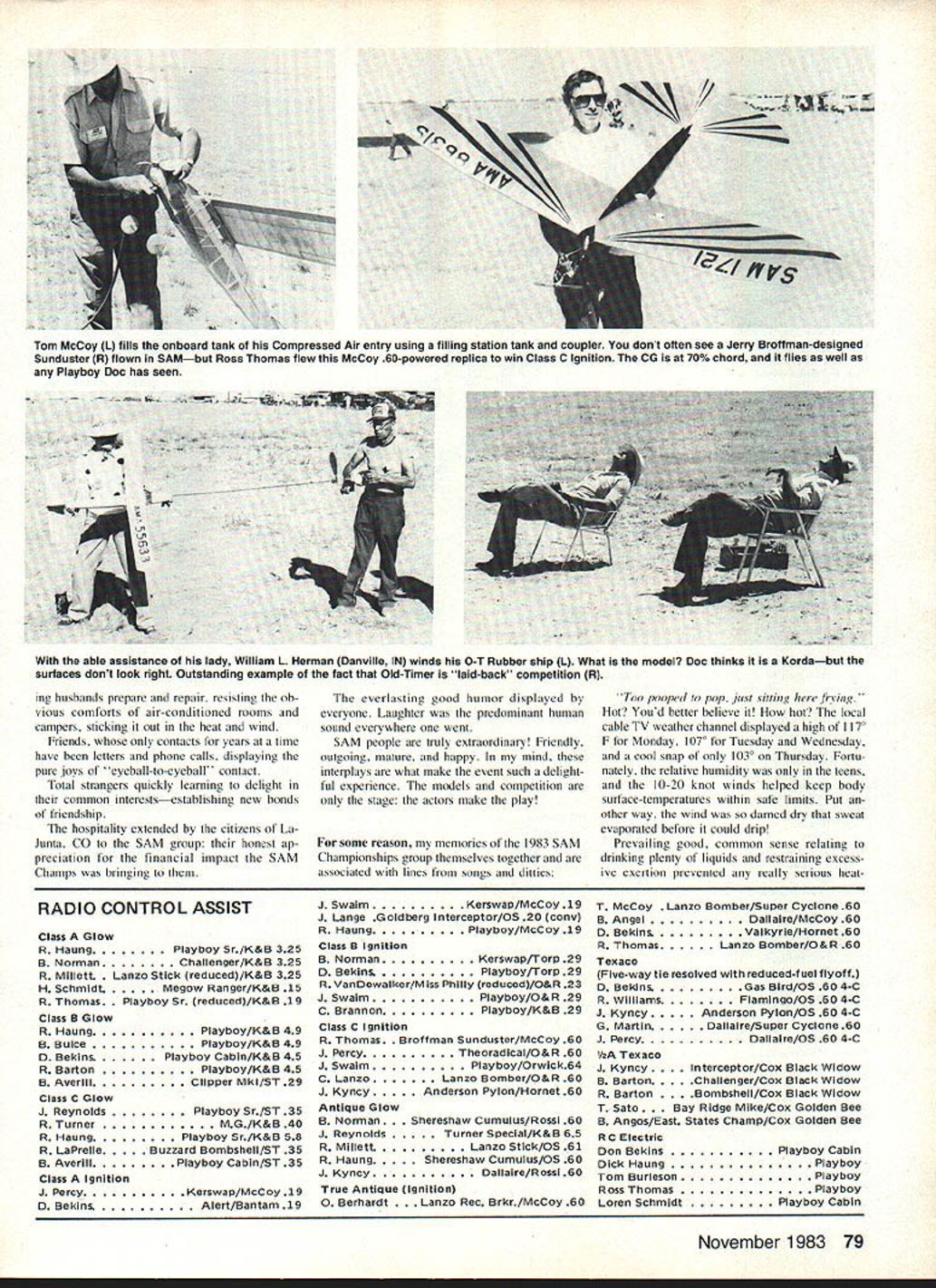
- R. Huang — Playboy Sr / K&B 3.25
- B. Norman — Challenger / K&B 3.25
- R. Millett — Stick reduced / K&B 3.25
- H. Schmidt — Megow Ranger / K&B .15
- R. Thomas — Playboy Sr reduced / K&B .19
Radio Control Assist — Class B Glow
- R. Huang — Playboy / K&B .49
- B. Butce — Playboy / K&B .49
- D. Bekins — Playboy Cabin / K&B .45
- R. Barton — Playboy / K&B .45
- B. Averill — Clipper Mk I / ST .29
Radio Control Assist — Class C Glow
- J. Reynolds — Playboy Sr / ST .35
- R. Turner — MG / K&B .40
- R. Huang — Playboy Sr / K&B .58
- R. LaPrelle — Buzzard Bombshell / ST .35
- B. Averitt — Playboy Cabin / ST .35
Radio Control Assist — Class Ignition
- J. Percy — Kerswap / McCoy .19
- D. Bekins — Alert / Bantam .19
- J. Swaim — Kerswap / McCoy .19
- J. Lange — Gottberg Interceptor / OS .20
- R. Huang — Playboy / McCoy .19
Radio Control Assist — Class B Ignition
- B. Norman — Kerswap / Torp .29
- D. Bekins — Playboy / Torp .29
- R. VanDewalker — Miss Philly reduced / O&R .23
- J. Swaim — Playboy / O&R .29
- C. Brannon — Playboy / K&B .29
Radio Control Assist — Class C Ignition
- R. Thomas — Sunduster / McCoy .60
- J. Percy — Theoradical / O&R .60
- J. Swaim — Playboy / Orwick .64
- C. Lanzo — Lanzo Bomber / O&R .60
- Kincy Anderson — Pylon / Hornet .60
Antique Glow
- B. Norman — Renshaw Cumulus / Rossi .60
- J. Reynolds — Turner Special / K&B .65
- R. Millett — Lanzo Stick / OS .61
- R. Huang — Shereshaw Cumulus / OS .60
- J. Kincy — Dallaire / Rossi .60
True Antique Ignition
- O. Berhardt — Lanzo Rec Brkr / McCoy .60
SAM Champs / Mathews (continued)
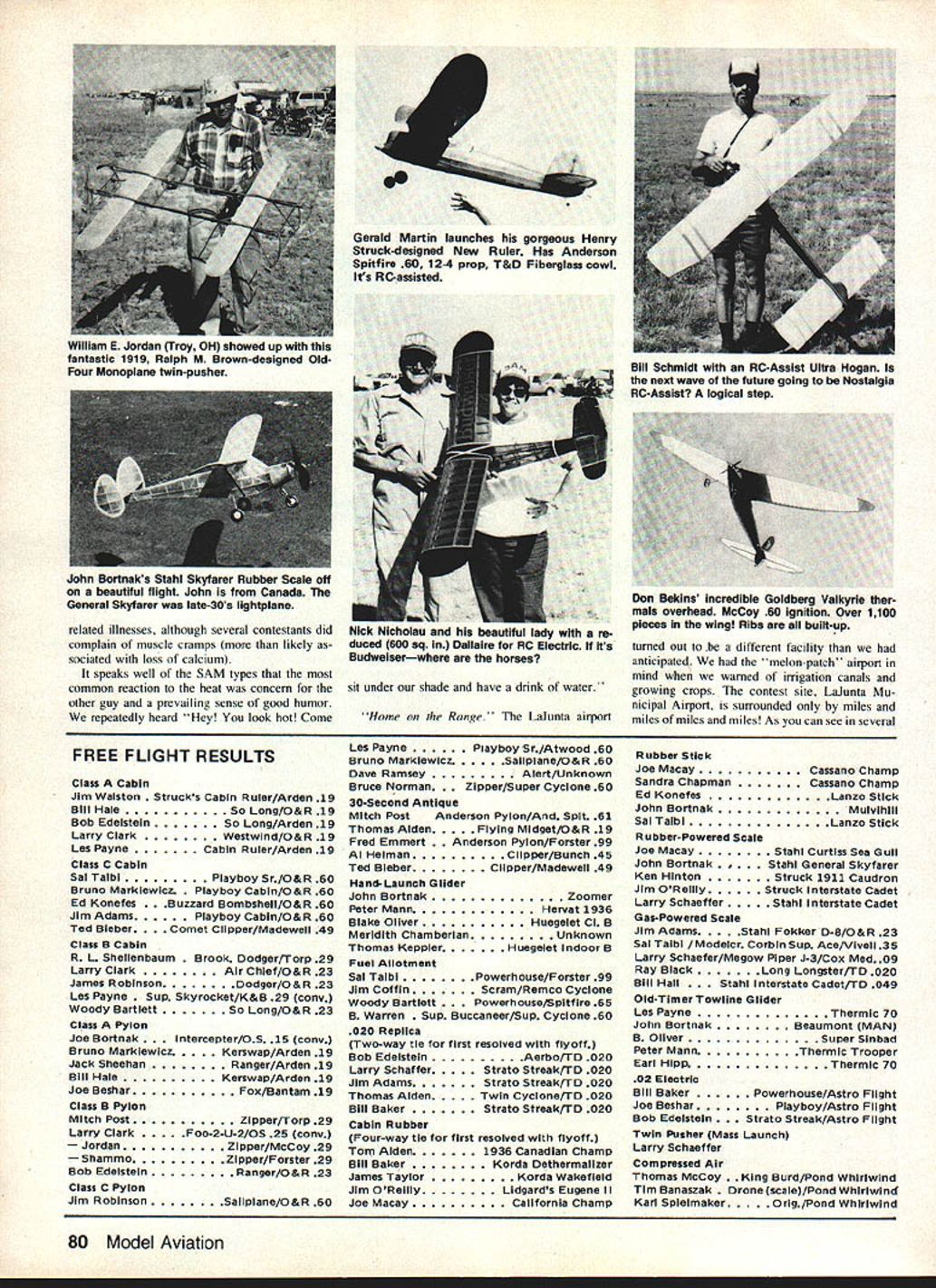
Competition was flown as a mass‑launch event in some classes, which made for lots of fun. Twin‑Pusher was also flown as a mass launch; this event featured very ancient designs, some dating back to 1910. Though mostly canards with strange outlines in the air, they flew surprisingly well. If Twin‑Pusher enthusiasts continue to develop these 60‑ and 70‑year‑old relics much further, they may someday need dethermalizers!
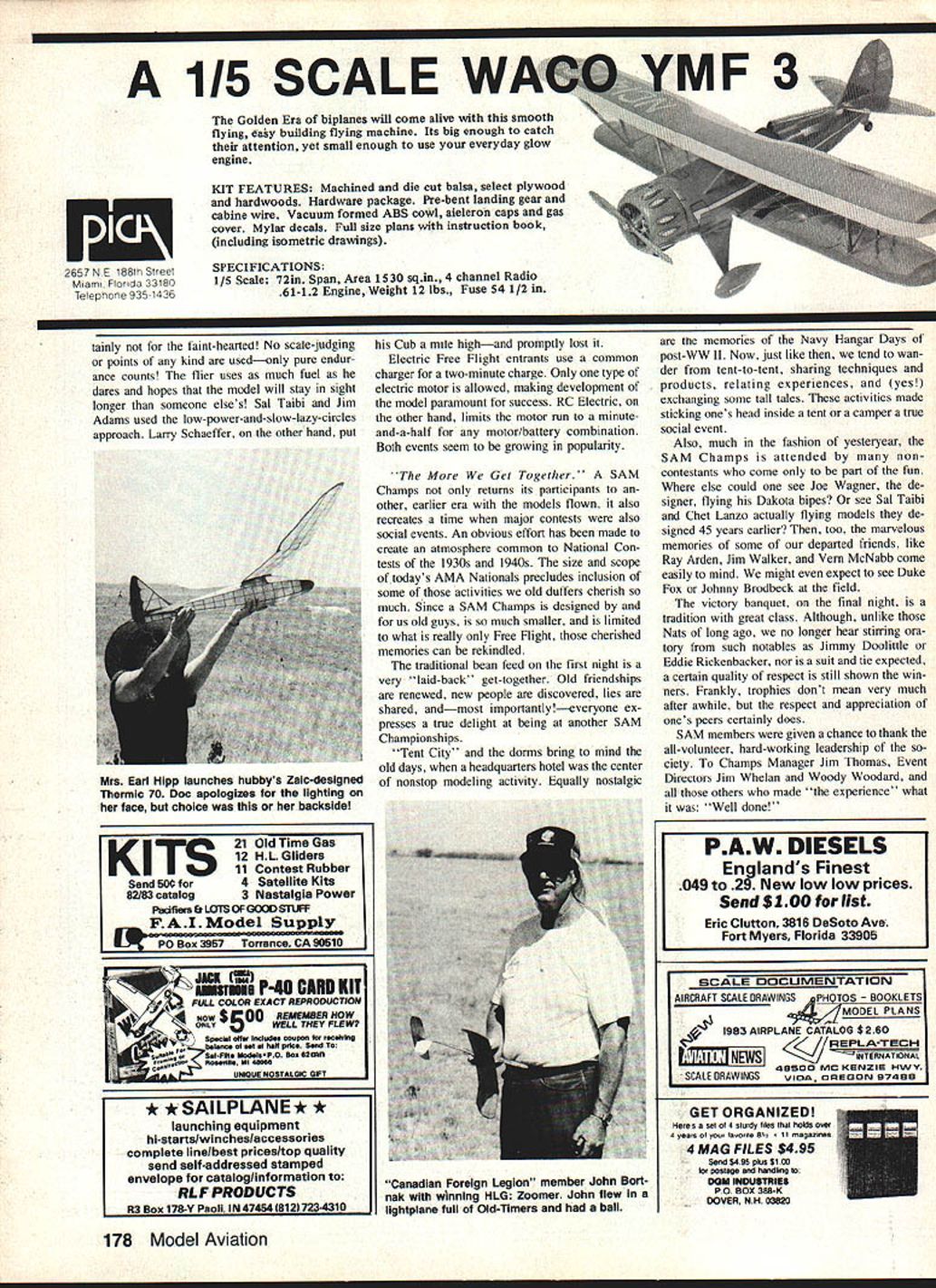
Power Scale is a Free Flight event and attracted many pilots — the models were subjects of conversation all week. This event will likely continue to develop. Scale judging was handled well by a small group of dedicated judges in a difficult class. Power Scale is certainly not for the faint‑hearted: no scale judging points are used — only pure endurance counts. The flier uses as much fuel as he dares and hopes the model stays in sight longer than someone else's. Sal Taibi and Jim Adams used a low‑power, slow‑circle approach; Larry Schaeffer put his Cub a mile high and promptly lost it.
Electric Free Flight entrants use a common charger for a two‑minute charge and only one type of electric motor is allowed, making model development paramount. RC Electric limits the motor run to a minute‑and‑a‑half for any motor/battery combination. Both events seem to be growing in popularity.
"The More We Get Together."
A SAM Champs not only returns participants to an earlier era with the models flown, it also recreates a time when major contests were social events. An effort was made to create an atmosphere common to National Contests of the 1930s and 1940s. Today's AMA Nationals are too large to include some activities we old duffers cherish; because SAM Champs is designed by and for us and is limited to free flight, those cherished memories can be rekindled.
The traditional bean feed on the first night is a laid‑back get‑together: old friendships are renewed, new people discovered, lies are shared, and everyone expresses true delight at being at another SAM Championships. "Tent City" and the dorms bring to mind the old days when a headquarters hotel was the center of nonstop modeling activity. Now, as then, we wander from tent to tent, share techniques and products, relate experiences, and exchange tall tales. Sticking one's head inside a tent or camper remains a true social event.
Many non‑contestants attend simply to be part of the fun. Where else could one see Joe Wagner flying his Dakota bipes, or Sal Taibi and Chet Lanzo flying models they designed 45 years earlier? The memories of departed friends like Ray Arden, Jim Walker, and Vern McNabb come easily to mind.
The victory banquet on the final night is a tradition with great class. While we no longer hear stirring oratory from figures like Jimmy Doolittle or Eddie Rickenbacker, a quality of respect is still shown to winners. Trophies may mean little after a while, but the respect and appreciation of one's peers certainly do.
SAM members had a chance to thank the all‑volunteer leadership. To Champs Manager Jim Thomas, Event Directors Jim Whelan and Woody Woodard, and all others who made the experience what it was: well done!
Texaco
- Texaco was resolved by a five‑way tie and a reduced‑fuel flyoff.
- D. Bekins — Gas Bird / OS .60
- R. Williams — Flamingo / OS .60 (4‑C)
- J. Kincy — Anderson Pylon / OS .60 (4‑C)
Open Results and Notables
- McCoy entries and Lanzo Bombers were prominent across several classes.
- B. Angel — Dallaire / McCoy .60
- D. Bekins — Valkyrie / Hornet .60
- R. Thomas — Lanzo Bomber / O&R .60
[End of article]
Transcribed from original scans by AI. Minor OCR errors may remain.

