
SAM Old-Timer Championships
Clarence Haught
It was 100-degrees-plus at Taft, CA for the Fifteenth Annual SAM Championships, and the hardy souls who braved the climate to fly really earned the steak dinner they got on Thursday, whether they won a trophy or not.
It had been a good day for Sal Taibi and Don Bekins. A steak dinner, the company of old friends, trophies on the table in front of them, and the contest manager had just named them Sweepstakes winners in Free Flight and Radio Control, respectively. It had been a long time from Monday evening's bean feed to Thursday night's awards banquet. Sal had told me, a few hours before, how Tuesday and Wednesday had been full of little problems and frustrations. Thursday morning, finally, his first flight in Gas Scale (a Corbin) had performed beautifully and set the tone for the day.
The RC side of the field had their problems too. There had been a couple of crashes due to frequency conflicts, and there were some initial procedural problems. A good meal and some good conversation (even some griping) settles the nerves and mellows the soul. Such is the advantage of an awards banquet over a conventional "pass out the trophy at the field" thing; it's a more gentlemanly approach.
Traditions and schedule
The SAM Champs are steeped in tradition. Contests are begun with a bean feed and general information meeting the evening before the flying begins. Awards are given at the victory banquet held on the evening of the last day of competition. SAM Champs are scheduled for three days: Tuesday, Wednesday and Thursday. This rather unusual schedule was developed to allow competitors traveling long distances sufficient traveling time on both ends of the contest to allow everything to be fitted into a single week of vacation time.
Conditions at Taft
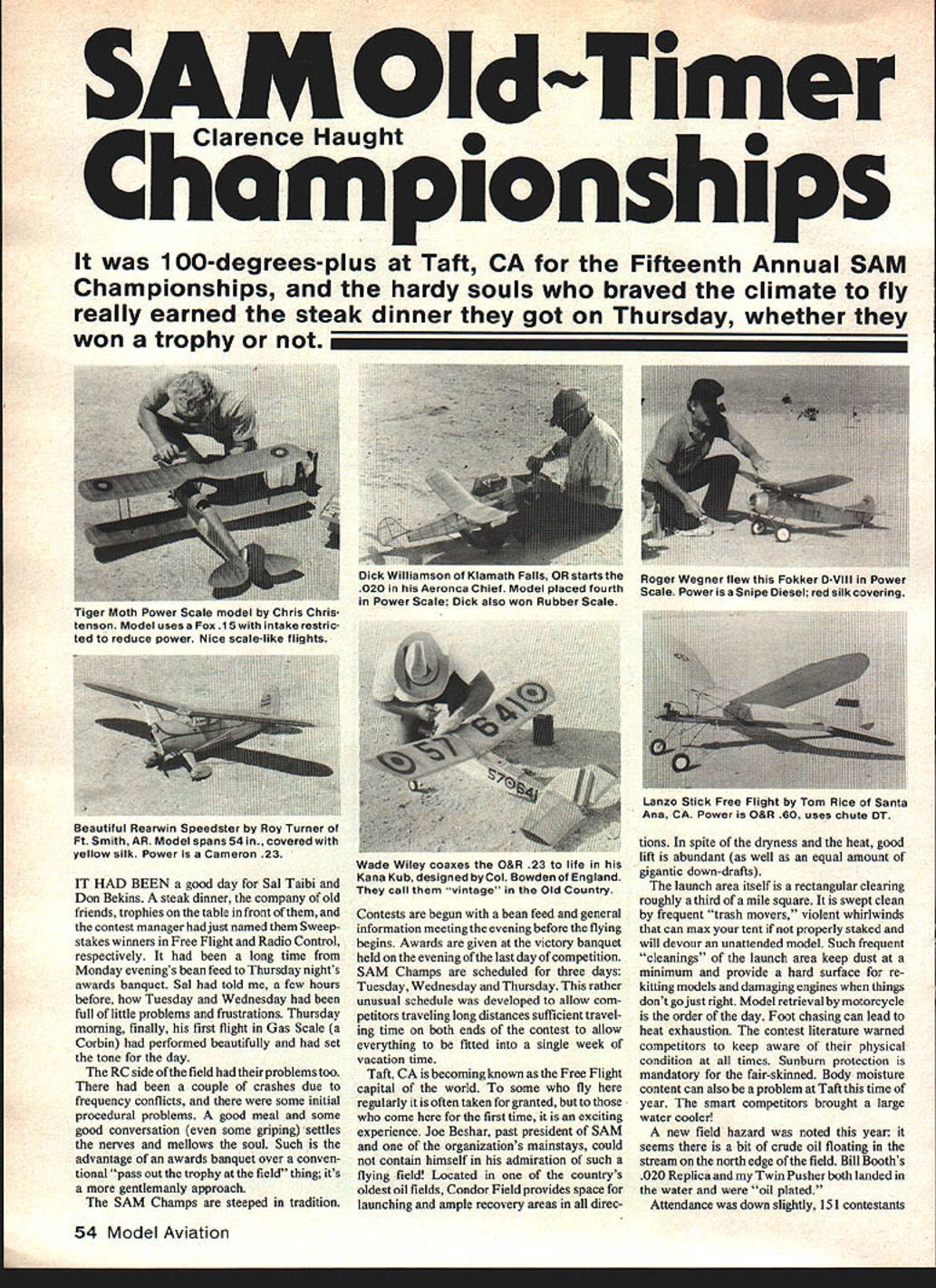
Taft, CA is becoming known as the Free Flight capital of the world. To some who fly here regularly it is often taken for granted, but to those who come here for the first time, it is an exciting experience. Joe Beshar, past president of SAM and one of the organization's mainstays, could not contain himself in his admiration of such a flying field. Located in one of the country's oldest oil fields, Condor Field provides space for launching and ample recovery areas in all directions. In spite of the dryness and the heat, good lift is abundant (as well as an equal amount of gigantic downdrafts).
The launch area itself is a rectangular clearing roughly a third of a mile square. It is swept clean by frequent "trash movers," violent whirlwinds that can max your tent if not properly staked and will devour an unattended model. Such frequent "cleanings" of the launch area keep dust at a minimum and provide a hard surface for re-kitting models and damaging engines when things don't go just right. Model retrieval by motorcycle is the order of the day. Foot chasing can lead to heat exhaustion.
The contest literature warned competitors to keep aware of their physical condition at all times. Sunburn protection is mandatory for the fair-skinned. Body moisture content can also be a problem at Taft this time of year. The smart competitors brought a large water cooler.
A new field hazard was noted this year: it seems there is a bit of crude oil floating in the stream on the north edge of the field. Bill Booth's .020 Replica and my Twin Pusher both landed in the water and were "oiled."
Attendance and representation
Attendance was down slightly, 151 contestants as opposed to 170 last year. It's difficult to pin down the exact number of active fliers in SAM, but the official publication, SAM Speaks, has a circulation of 1,650. If we assume one thousand recipients are fliers, then 15% membership attendance at the national contest is very good. Illness kept some familiar faces away. Russ Oliver, one of the greatest Old-Timer Free Flight boosters in Phoenix, who couldn't come due to a heart attack, died suddenly on Tuesday.
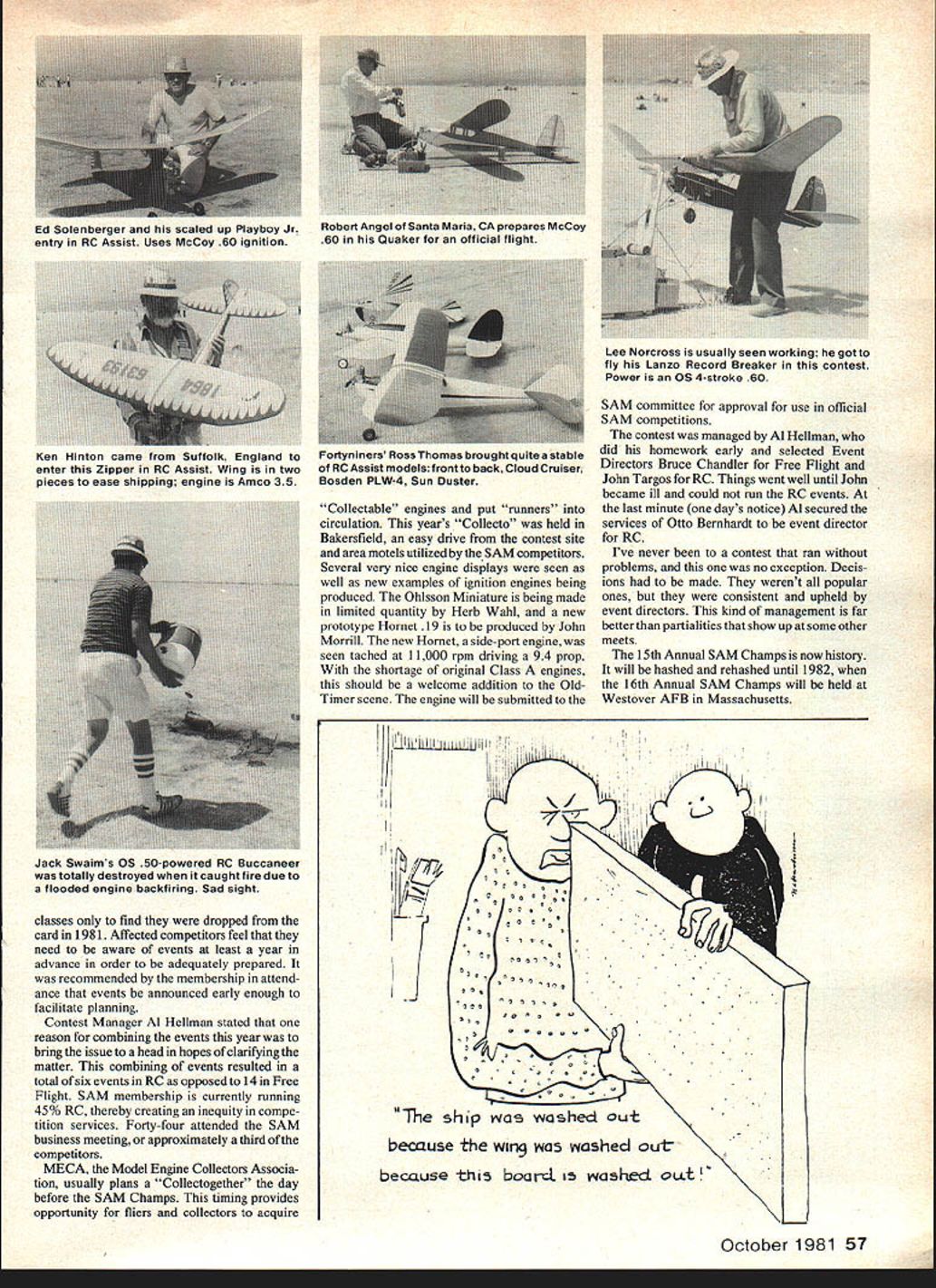
Travel costs always have an impact on attendance at a national meet. The largest attendance was from the West. There was, however, good representation from the South, Midwest, Northwest and East Coast. There was one contestant from South Africa, two from Canada, and three from England. Ken Hinton from Suffolk, England brought a well-executed Zipper in a unique shipping box that had one side made of clear plastic. Ken says this gets him through customs fast. Customs agents are so interested in the model that they don't bother to conduct a time-consuming inspection.
Notable attendees and equipment
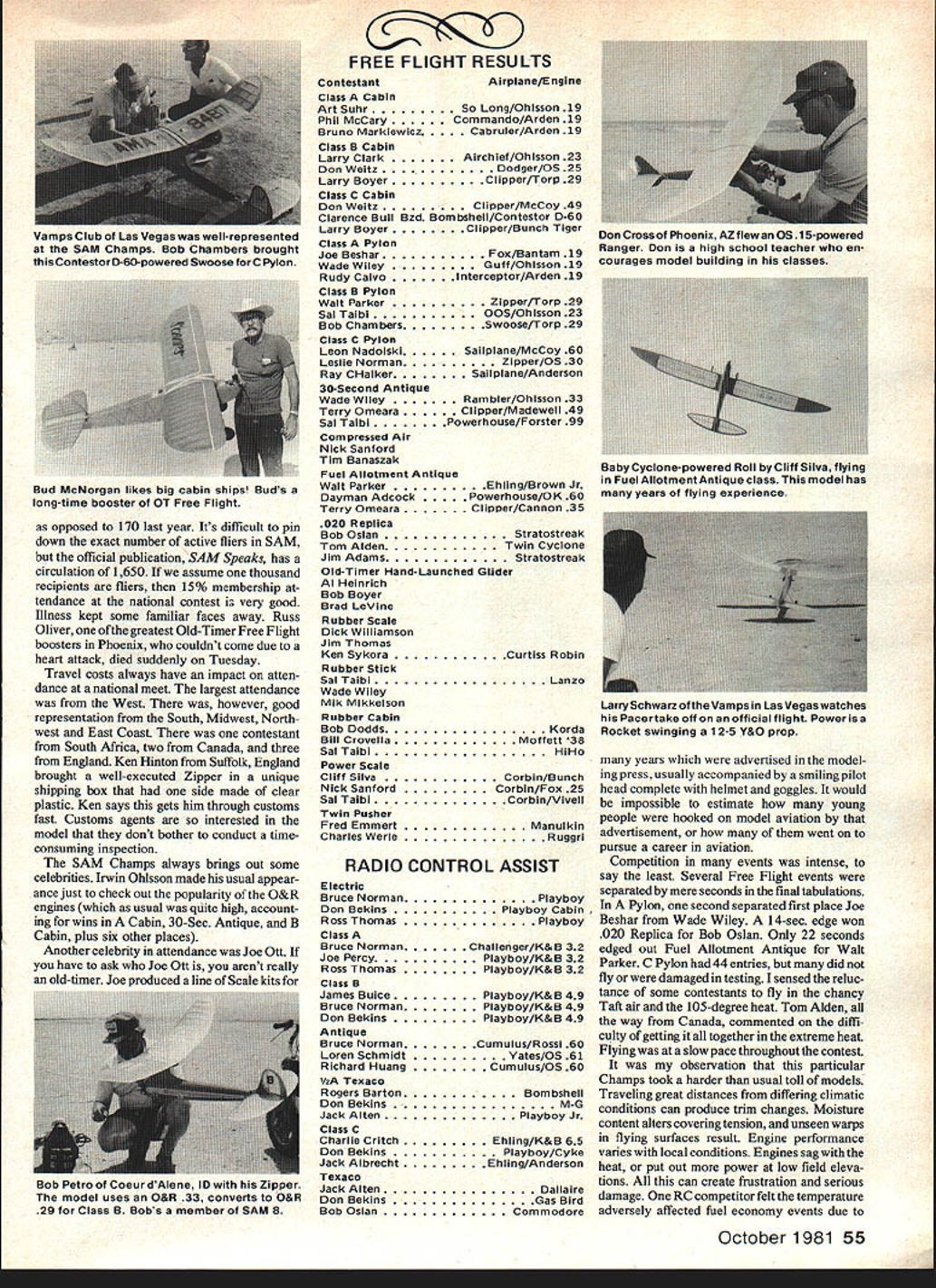
The SAM Champs always brings out some celebrities. Irwin Ohlsson made his usual appearance just to check out the popularity of the O&R engines (which, as usual, was quite high, accounting for wins in A Cabin, 30-Sec. Antique, and B Cabin, plus six other places). Another celebrity in attendance was Joe Ott. If you have to ask who Joe Ott is, you aren't really an old-timer. Joe produced a line of Scale kits for many years which were advertised in the modeling press, usually accompanied by a smiling pilot head complete with helmet and goggles. It would be impossible to estimate how many young people were hooked on model aviation by that advertisement, or how many of them went on to pursue a career in aviation.
Competition and performance
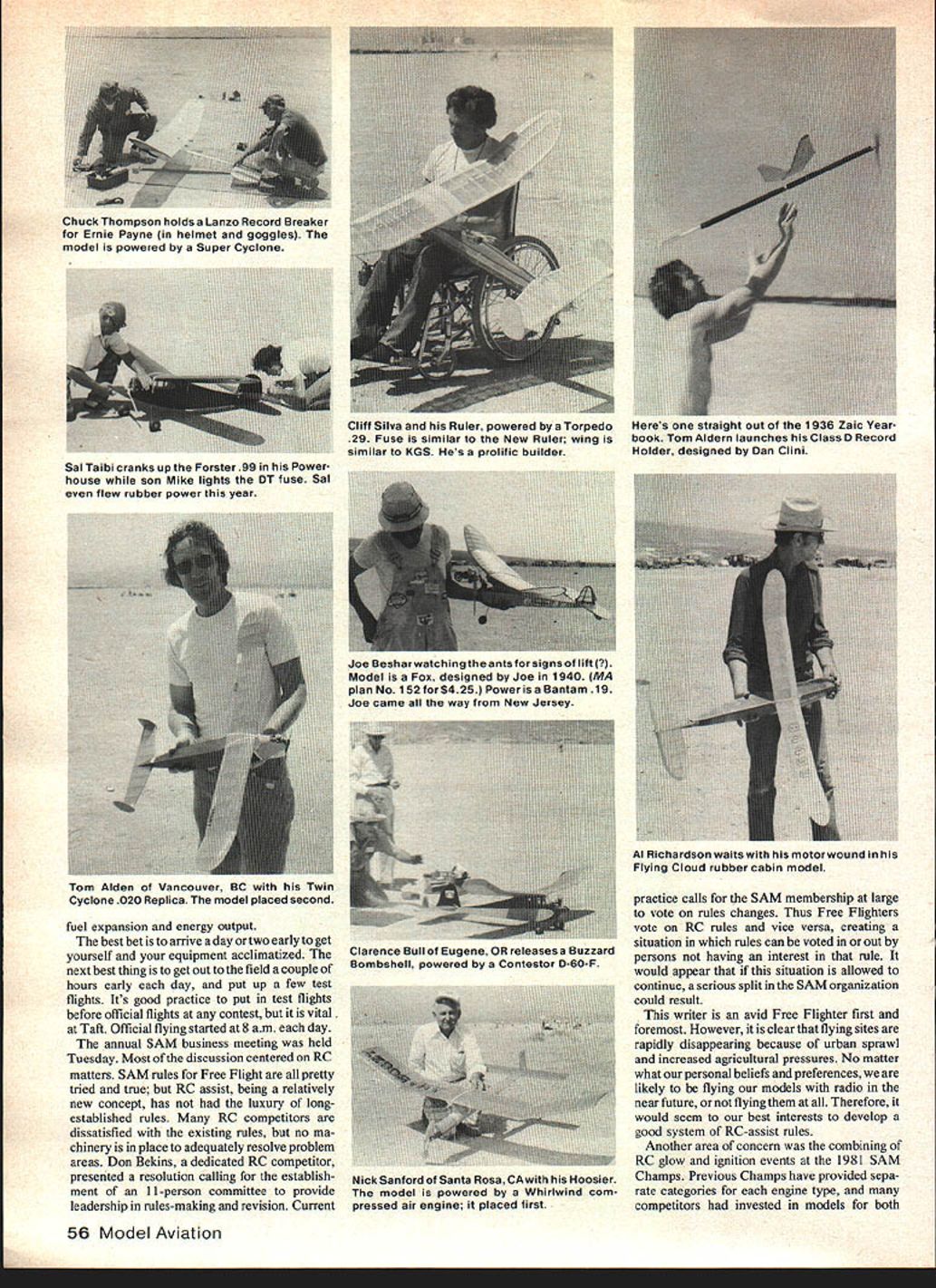
Competition in many events was intense, to say the least. Several Free Flight events were separated by mere seconds in the final tabulations. In A Pylon, one second separated first place Joe Beshar from Wade Wiley. A 14-second edge won the .020 Replica for Bob Oslan. Only 22 seconds edged out Fuel Allotment Antique for Walt Parker. C Pylon had 44 entries, but many did not fly or were damaged in testing. I sensed the reluctance of some contestants to fly in the chancy Taft air and the 105-degree heat. Tom Alden, all the way from Canada, commented on the difficulty of getting it all together in the extreme heat. Flying was at a slow pace throughout the contest.
It was my observation that this particular Champs took a harder than usual toll of models. Traveling great distances from differing climatic conditions can produce trim changes. Moisture content alters covering tension, and unseen warps in flying surfaces result. Engine performance varies with local conditions. Engines sag with the heat, or put out more power at low field elevations. All this can create frustration and serious damage. One RC competitor felt the temperature adversely affected fuel economy events due to fuel expansion and energy output.
The best bet is to arrive a day or two early to get yourself and your equipment acclimatized. The next best thing is to get out to the field a couple of hours early each day, and put up a few test flights. It's good practice to put in test flights before official flights at any contest, but it is vital at Taft. Official flying started at 8 a.m. each day.
SAM business meeting and RC issues
The annual SAM business meeting was held Tuesday. Most of the discussion centered on RC matters. SAM rules for Free Flight are all pretty tried and true, but RC-assist, being a relatively new concept, has not had the luxury of long-established rules. Many RC competitors are dissatisfied with the existing rules, but no machinery is in place to adequately resolve problem areas.
Don Bekins, a dedicated RC competitor, presented a resolution calling for the establishment of an 11-person committee to provide leadership in rules-making and revision. Current practice calls for the SAM membership at large to vote on rules changes. Thus Free Fighters vote on RC rules and vice versa, creating a situation in which rules can be voted in or out by persons not having an interest in that rule. It would appear that if this situation is allowed to continue, a serious split in the SAM organization could result.
This writer is an avid Free Flighter first and foremost. However, it is clear that flying sites are rapidly disappearing because of urban sprawl and increased agricultural pressures. No matter what our personal beliefs and preferences, we are likely to be flying our models with radio in the near future, or not flying them at all. Therefore, it would seem to our best interests to develop a good system of RC-assist rules.
Another area of concern was the combining of RC glow and ignition events at the 1981 SAM Champs. Previous Champs have provided separate categories for each engine type, and many competitors had invested in models for both classes only to find they were dropped from the card in 1981. Affected competitors feel that they need to be aware of events at least a year in advance in order to be adequately prepared. It was recommended by the membership in attendance that events be announced early enough to facilitate planning.
Contest Manager Al Hellman stated that one reason for combining the events this year was to bring the issue to a head in hopes of clarifying the matter. This combining of events resulted in a total of six events in RC as opposed to 14 in Free Flight. SAM membership is currently running 45% RC, thereby creating an inequity in competition services. Forty-four attended the SAM business meeting, or approximately a third of the competitors.
MECA Collectogether
MECA, the Model Engine Collectors Association, usually plans a "Collectogether" the day before the SAM Champs. This timing provides opportunity for fliers and collectors to acquire "collectable" engines and put "runners" into circulation. This year's "Collecto" was held in Bakersfield, an easy drive from the contest site and area motels utilized by the SAM competitors. Several very nice engine displays were seen as well as new examples of ignition engines being produced.
The Ohlsson Miniature is being made in limited quantity by Herb Wahl, and a new prototype Hornet .19 is to be produced by John Mornill. The new Hornet, a side-port engine, was seen turning 11,000 rpm, driving a 9.4 prop. With the shortage of original Class A engines, this should be a welcome addition to the Old-Timer scene. The engine will be submitted to the SAM committee for approval for use in official SAM competitions.
Management and wrap-up
The contest was managed by Al Hellman, who did his homework early and selected Event Directors Bruce Chandler for Free Flight and John Targos for RC. Things went well until John became ill and could not run the RC events. At the last minute (one day's notice) Al secured the services of Otto Bernhardt to be event director for RC.
I've never been to a contest that ran without problems, and this one was no exception. Decisions had to be made. They weren't all popular ones, but they were consistent and upheld by event directors. This kind of management is far better than partialities that show up at some other meets.
The 15th Annual SAM Champs is now history. It will be hashed and rehashed until 1982, when the 16th Annual SAM Champs will be held at Westover AFB in Massachusetts.
Transcribed from original scans by AI. Minor OCR errors may remain.

