
SAM Old-Timer Champs
— Dick Stouffer
Introduction
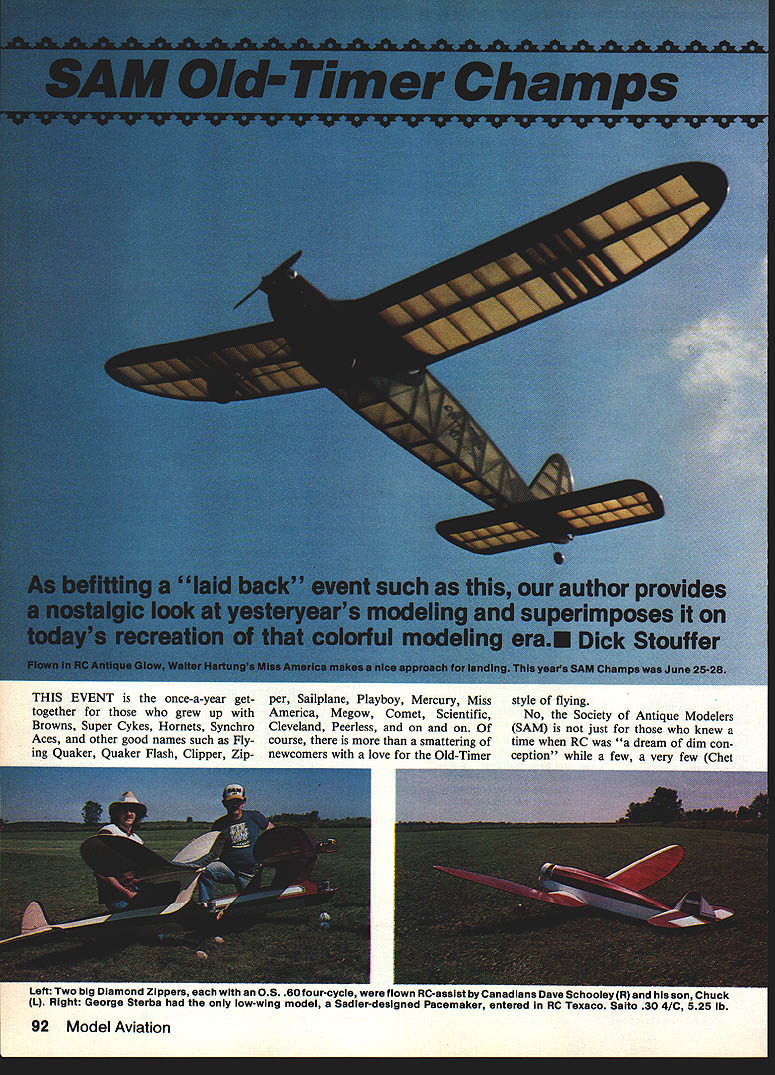
This once-a-year get-together celebrates the Old-Timer style of model aviation — a nostalgic reunion of people and machines from the era of Browns, Super Cyclones, Hornets, Synchro Aces, and many other classic designs. While many attendees remember the early days, a surprising number of newcomers share a love for the craft and its history.
Classic names and nostalgia
Typical names from the era include:
- Brown
- Super Cyclone
- Hornet
- Synchro Ace
- Flying Quaker
- Quaker Flash
- Clipper
- Zipper
- Sailplane
- Playboy
- Mercury
- Miss America
- Megow
- Comet
- Scientific
- Cleveland
- Peerless
These names evoke an era when model builders worked with limited materials and primitive electronics, relying on ingenuity and hands-on skills to fly.
Early RC and electronics
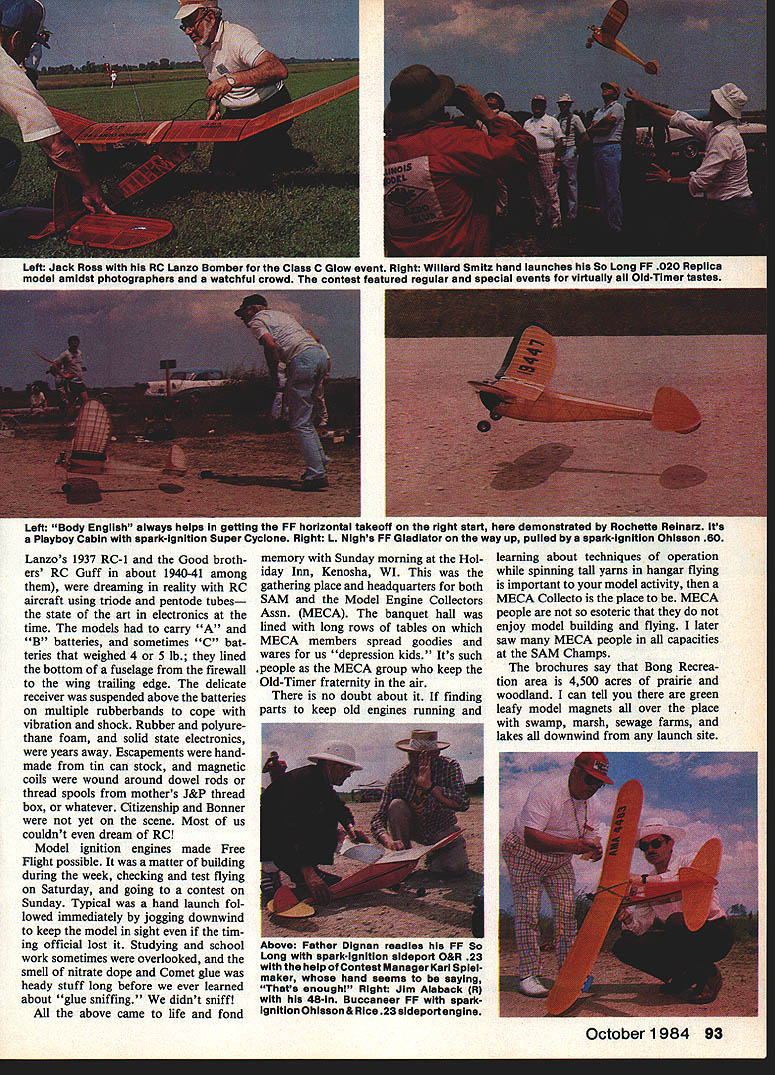
Early RC was largely experimental and rare. A very few pioneers — for example, Chet Lanzo’s 1937 RC-1 and the Good brothers’ RC Guff (around 1940–41) — built working RC aircraft using triode and pentode vacuum tubes, the state of the art at the time. These models often carried heavy "A" and "B" batteries (and sometimes "C" batteries) weighing four or five pounds, which lined the bottom of the fuselage from firewall to wing trailing edge. The delicate receivers were suspended above the batteries on multiple rubber bands to cope with vibration and shock.
Materials we take for granted today — rubber foam, polyurethane foam, and solid-state electronics — were years away. Escapements were handmade from tin-can stock, and magnetic coils were wound on dowel rods or thread spools. Commercial support and manufacturers were limited; most builders simply couldn’t dream of today’s technology.
Free Flight and ignition engines
Model ignition engines made free flight popular. Typical practice was to build during the week, test-fly on Saturday, and attend contests on Sunday. Hand launches followed by a sprint downwind to keep the model in sight were common. The smell of nitrate dope and Comet glue is a vivid memory for many who grew up in that era.
MECA and the collector community
The Model Engine Collectors Association (MECA) is integral to preserving this heritage. At the SAM Champs the MECA members display parts, engines, and memorabilia — essential resources for those who keep old engines running and who enjoy the techniques and stories that hangar flying produces. MECA members are not merely esoteric collectors; they also build and fly, and many participate in SAM events.
The venue: Bong Recreation Area
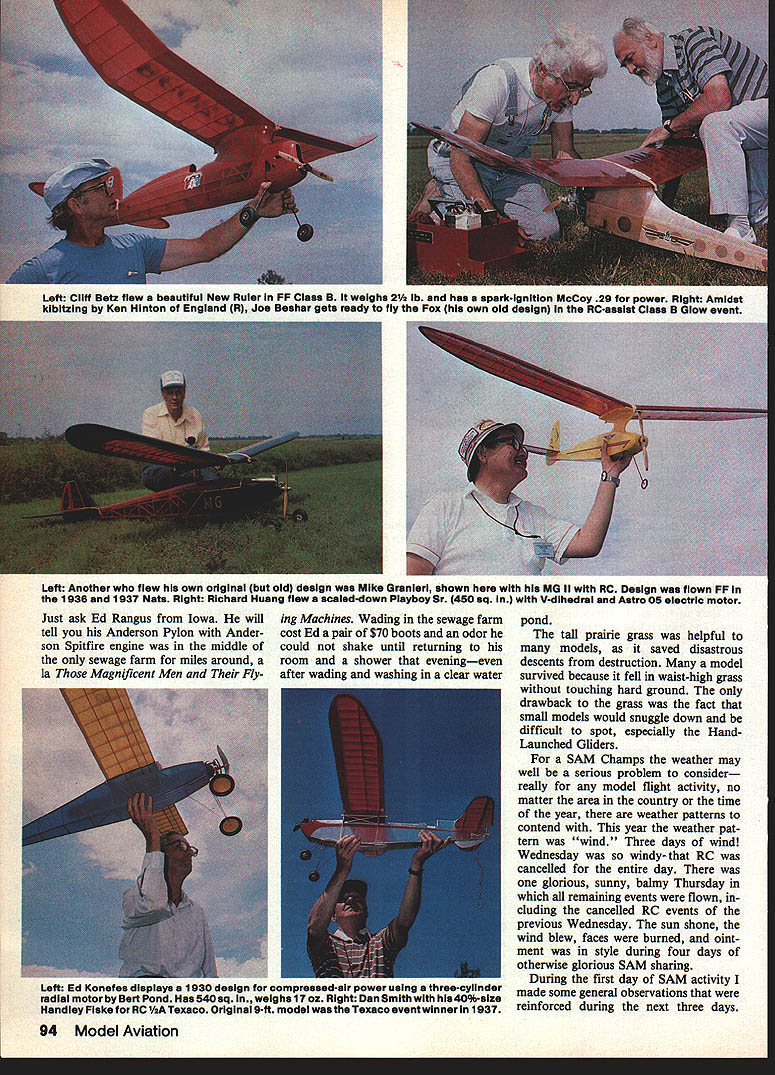
The SAM Champs are held at Bong Recreation Area — about 4,500 acres of prairie and woodland. The site offers many launch areas but also features swamp, marsh, sewage farms, and lakes, often downwind from launch sites. Tall prairie grass sometimes saves models from disaster by cushioning falls, but it can also hide small models, making recovery difficult, especially for hand-launched gliders.
Notable field incident:
- Ed Rangus from Iowa waded into a sewage farm to retrieve an Anderson Pylon with an Anderson Spitfire engine. He lost a pair of boots and endured a persistent odor until he could shower that evening.
Weather and flying conditions
Weather is always a factor. At this particular meet the dominant pattern was wind. Wednesday was so windy that all RC events were cancelled; Thursday was a calm, sunny day when the postponed events were flown. Across four days there was a mix of sun, wind, and sunburns, but overall spirits were high.
Community and inclusiveness
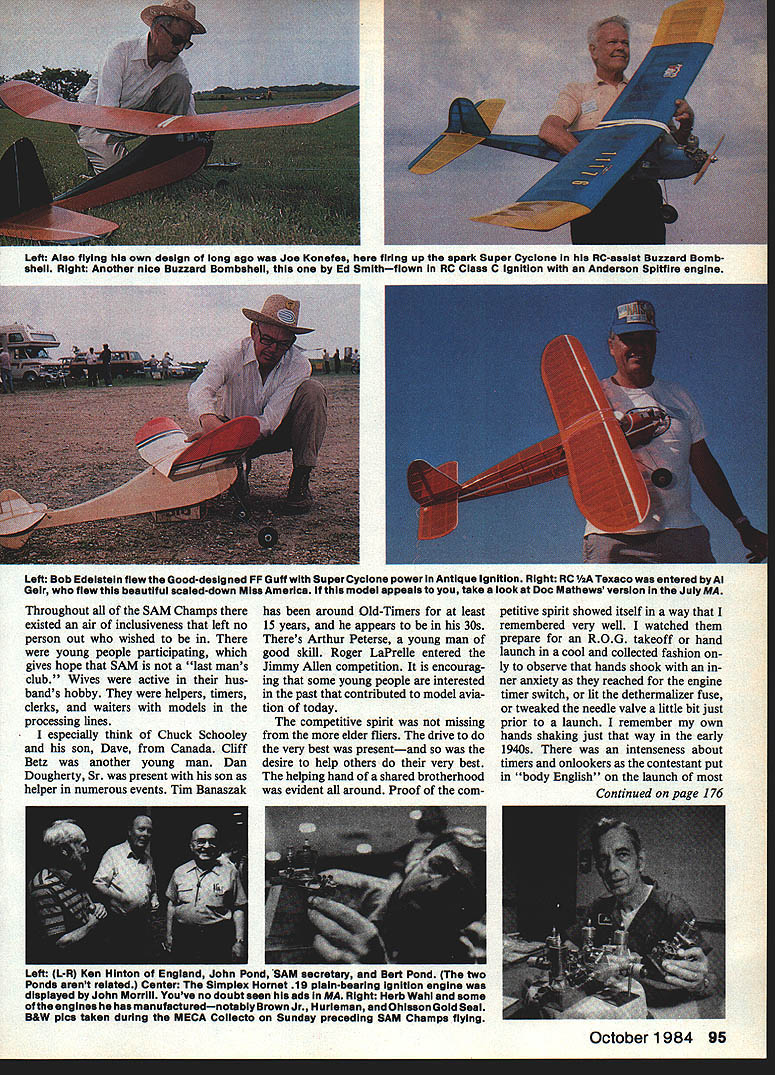
One of the most striking aspects of the SAM Champs is the air of inclusiveness. Young people participate alongside veterans, and wives and family members help as timers, clerks, and support crew. Examples of younger participants included:
- Chuck Schooley and his son, Dave (Canada)
- Cliff Betz
- Tim Banaszak (an active Old-Timer flyer for many years)
- Arthur Petersen
- Roger LaPrelle (entered in the Jimmy Allen competition)
The competitive spirit is alive, but so is mutual assistance. Contestants routinely time each other and offer help. Nerves and concentration are visible at launches — hands may shake as a pilot reaches for the timer switch or sets a needle valve — but the shared enthusiasm and camaraderie are strong.
Events and engine types
Many contestants enter multiple events. A few event highlights and engine notes:
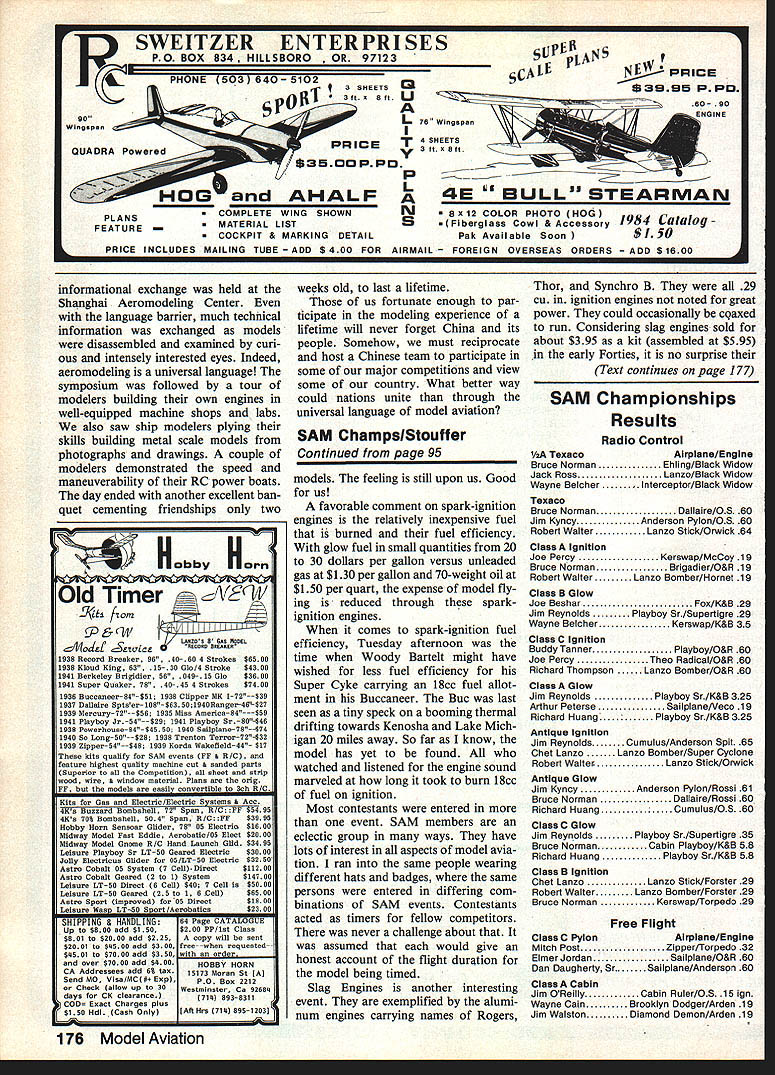
- Spark-ignition engines: Notable for fuel efficiency and lower running cost compared with glow fuel. Typical comparisons cited were glow fuel at $20–$30 per gallon versus unleaded gas at roughly $1.30 per gallon and 70-weight oil at about $1.50 per quart.
- Slag engines: Examples include aluminum engines branded Rogers, Thor, and Synchro B, commonly around .29 cu. in. These engines were powerful for their day and were affordable — marketed in the early 1940s for roughly $3.95 as a kit (about $5.95 assembled), contributing to their popularity.
Notable flights and losses
An example of extreme fuel efficiency: Woody Bartlett’s Super Cyclone with an 18 cc fuel load on his Buccaneer burned its allotment so slowly that the model drifted away on a large thermal and was last seen as a tiny speck heading toward Kenosha and Lake Michigan. The model had not been recovered at the time of reporting.
Conclusion
The SAM Old-Timer Champs celebrate both the machines and the people who cherish the history of model aviation. Whether through collecting, flying, restoring, or mentoring, the community preserves techniques and memories while welcoming new participants. The event is equal parts competition, reminiscence, and fellowship — a living tribute to the colorful era that shaped modern model flying.
Transcribed from original scans by AI. Minor OCR errors may remain.

