

San Diego Aero Space Museum
Museum: an institution devoted to the procurement, care, study, and display of objects of lasting interest or value. A great loss was felt when the one in San Diego was destroyed by fire, but it has been rebuilt with tender, loving care. — Dale Willoughby
The 1983 Fire and Loss
In February 1983 a disastrous fire destroyed the Electric Building in Balboa Park, which housed the museum. The blaze began when a wisp of smoke passed through a door left open; it was noticed only after a sound of crackling and the shout “Fire! Fire!” The structure—fed by seasoned old pine and decades-old doped linen—was soon engulfed. By the time fire engines arrived there was little hope of extinguishing the inferno. Smoldering for nearly three days, museum staff sifted through still-hot ruins and recovered some old, valuable reference books thought lost.
The building had previously been condemned and negotiations were already underway to acquire a newer city-owned structure. Staff were given ten days to salvage what they could and to clean up the wreckage. Irreplaceable original aircraft (and some replicas) were lost and will never be seen or flown again.
Rebirth: The Aerospace Historical Center
From the ashes the museum rose again. Donations and offers of aircraft and artifacts poured in from aviation enthusiasts across the United States and around the world. The response was so strong that some older aircraft remained stored in outlying hangars awaiting restoration.
Negotiations proceeded to acquire an unused hangar at Gillespie Field for active fly-ins and commemorative aviation gatherings. A new building was established across from the U.S. Naval Regional Medical Center in Balboa Park. Shaped like the infinity symbol to represent humankind’s never-ending desire to fly and explore, the facility was named the Aerospace Historical Center. It comprises two parts:
- the International Aerospace Hall of Fame
- the San Diego Aerospace Museum
Southern California and the city of San Diego have long been closely linked to the aerospace industry, from the Ryan Spirit of St. Louis to Reuben H. Fleet’s Consolidated Aircraft, which produced more than 18,000 B-24 Liberators and countless PBY Catalina flying boats.
International Aerospace Hall of Fame
The Hall of Fame features portraits and biographical panels of aviation pioneers and heroes, including:
- Charles Lindbergh
- Glenn H. Curtiss
- T. Claude Ryan
- Reuben H. Fleet
- Amelia Earhart
- Neil Armstrong
- Yuri Gagarin
- Sir Geoffrey de Havilland
It also honors inventors, industrialists, pilots, explorers, and astronauts who have distinguished themselves in various aspects of flight.
Museum Exhibits and Sections
The museum’s display is organized by eras and themes to trace the progress of flight from its earliest beginnings through the space age. Major sections include:
- Breaking Earth’s Bonds
- The Dawn of Powered Flight
- World War I
- The Golden Age of Flight
- World War II
- The Jet Age
- Man in Space
- Women in Aviation
- The Model Collection
Breaking Earth’s Bonds
This area covers early efforts to understand and achieve flight. Exhibits include:
- a full-size composite aircraft built around Leonardo da Vinci’s drawings (largely experimental and unlikely to fly)
- replicas of designs by Sir George Cayley, Octave Chanute, and Otto Lilienthal—all capable of man-carrying, stable, sustained, unpowered flight
- Octave Chanute’s Progress in Flying Machines (1884), a work that influenced the Wright brothers
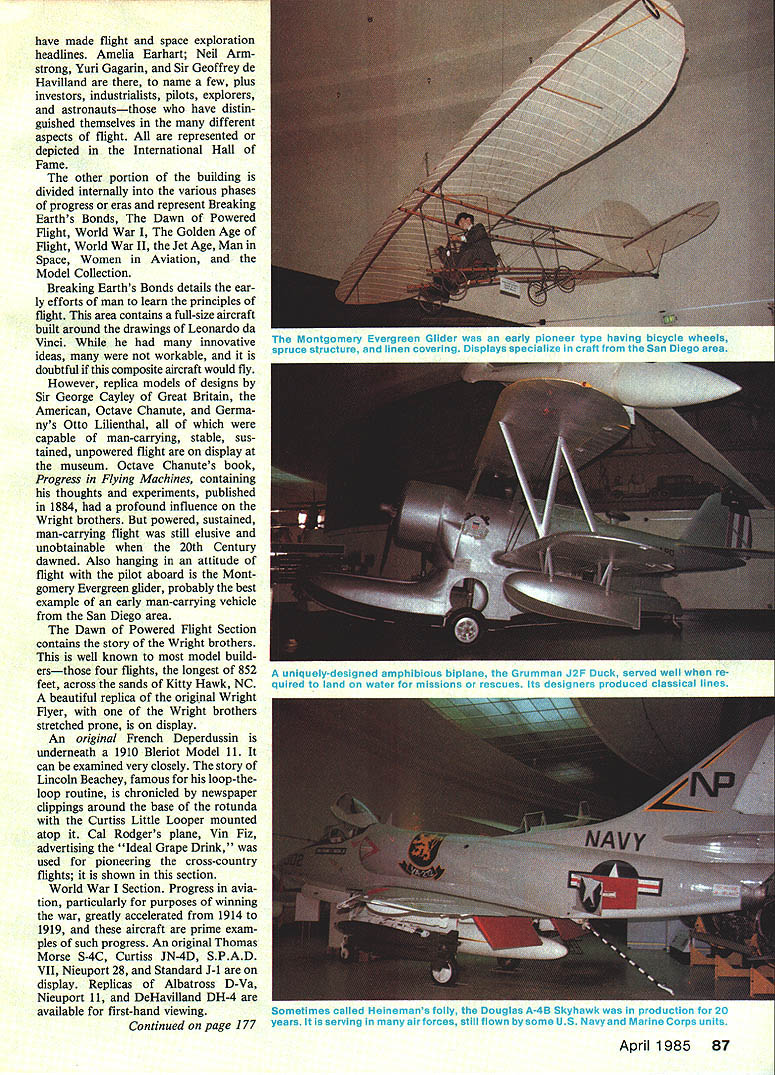
- the Montgomery Evergreen glider, an example of early man-carrying craft from the San Diego area
The Dawn of Powered Flight
This section tells the story of the Wright brothers and early powered flight. Highlights include:
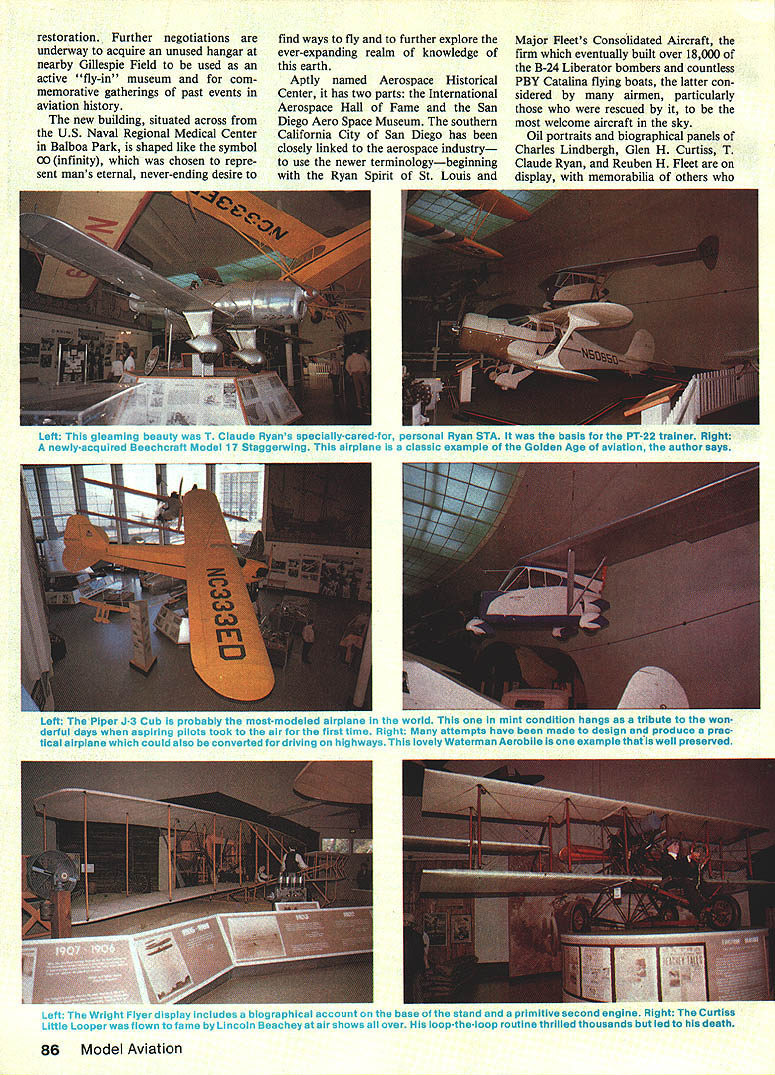
- a replica of the original Wright Flyer, with one of the brothers shown prone in the craft
- an original French Deperdussin displayed beneath a 1910 Bleriot Model 11
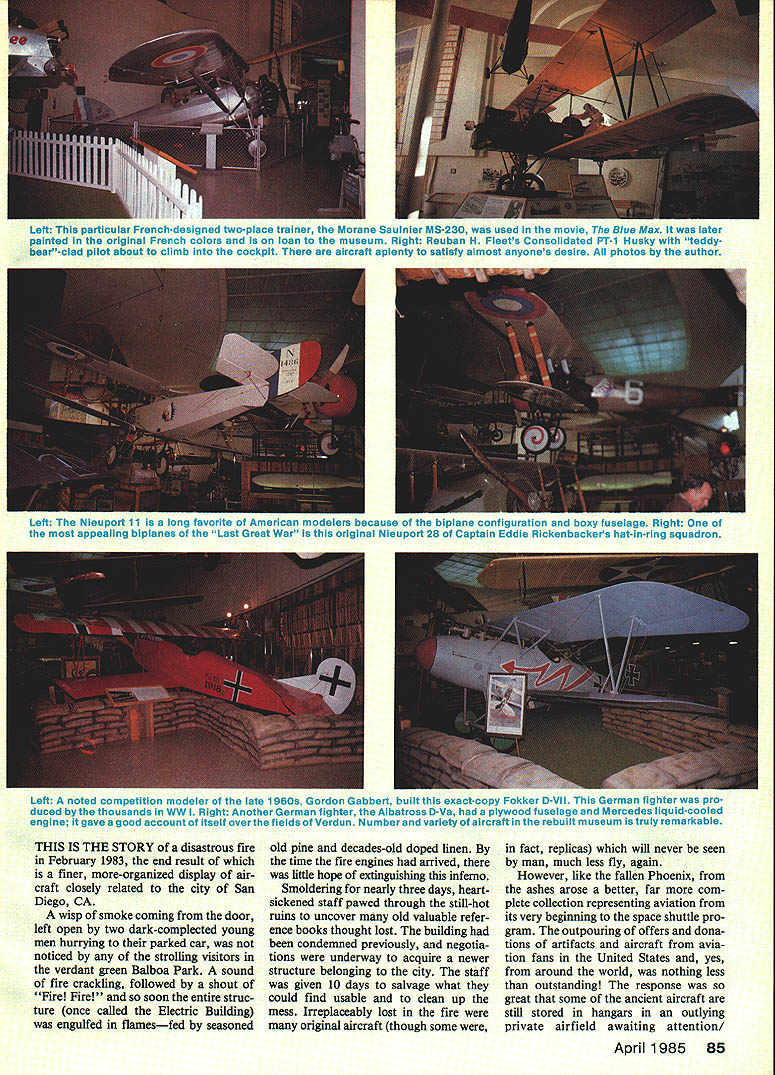
- artifacts and clippings relating to Lincoln Beachey, including the Curtiss “Little Looper”
- Cal Rodgers’ Vin Fiz, used in pioneering cross-country attempts and advertising the “Ideal Grape Drink”
World War I
A period of rapid aviation progress, represented by originals and replicas such as:
- Thomas-Morse S-4C (original)
- Curtiss JN-4D (original)
- S.P.A.D. VII (original)
- Nieuport 28 (original)
- Standard J-1 (original)
- replicas of Albatros D.Va, Nieuport 11, and DeHavilland DH-4
The Golden Age of Flight
The museum cares for representative Golden Age aircraft, including:
- Ryan M-1, Brougham, ST, and Ryan STA (basis for later trainers)
- Beechcraft Model 17 Staggerwing
- Piper J-3 Cub (in mint condition)
- Curtiss B-1 Robin
- Aeronca C-3
- American Eagle A-1
- Morane-Saulnier MS-230
- Gee Bee Model Z
- Rearwin Cloudster
- Waterman Aerobile
World War II
As the world entered war, aircraft development accelerated. Representative aircraft on display include:
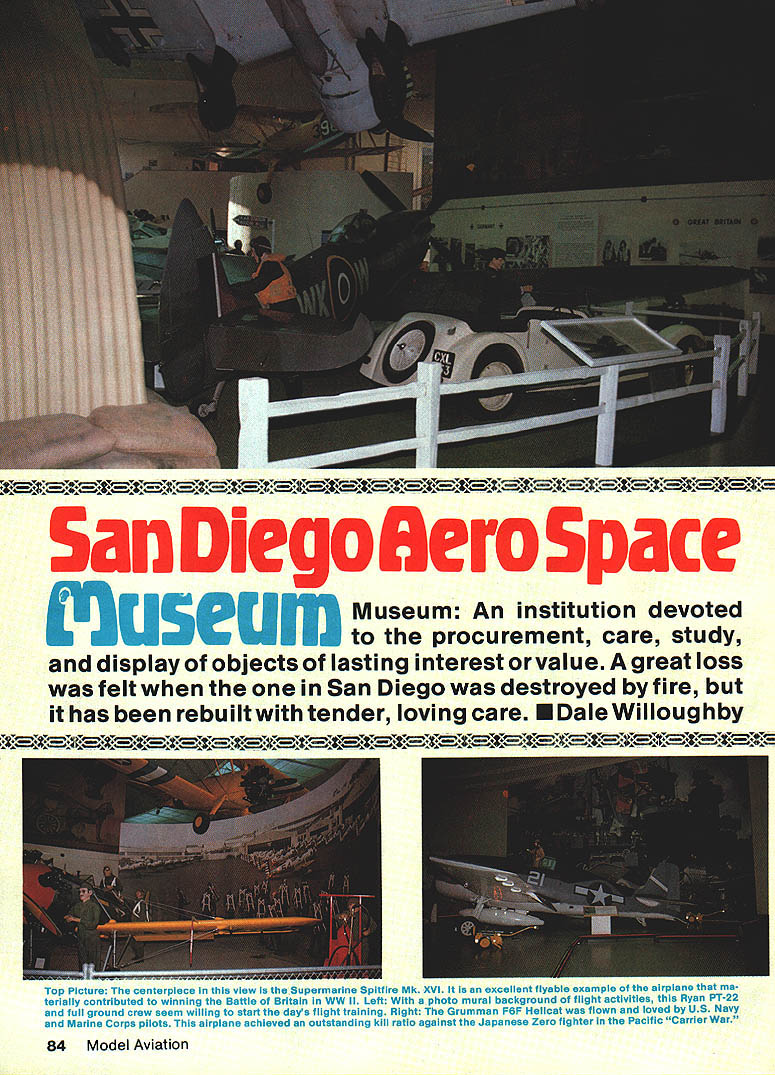
- Ryan PT-22
- Stearman N2S-3
- a 7/8-scale Junkers Ju-87 dive bomber replica
- Supermarine Spitfire Mk XVI
- Grumman F6F Hellcat
- Grumman J2F Duck
Postwar Civil Aviation
Postwar civil aircraft on display include:
- Smith DSA-1 Miniplane
- Jungster VI
- Pitts Special
- Wee Bee
- Mercury Air Shoe String
- Glasflugel Libelle sailplane
The Jet Age
Jet technology transformed both military and civil aviation. Notable jets at the museum:
- Ryan X-13 Vertijet (one of only two built; developed under an Air Force contract to study vertical takeoff and landing)
- Douglas A-4 Skyhawk (a small, durable Navy jet, capable of carrier operations)
The exhibit also notes the role of the British de Havilland Comet in initiating commercial jet travel (first long-range passenger service in May 1952).
Man in Space
This section contains a Space Shuttle cockpit mock-up with information panels and controls, and an encased lunar rock. Museum staff emphasize that the space exhibit is still growing and likely will expand as manned and unmanned space exploration continues.
Women in Aviation
The Women in Aviation area features Amelia Earhart’s likeness and life story alongside uniforms and artifacts of military women. The exhibit highlights many other women who made vital contributions to aviation.
Model Collection
Under glass, the museum houses top-quality scale models that provide a composite visual history of aviation.
Visiting Information
The San Diego Aero Space Museum is open daily except holidays. Many displays include audio-visual podiums that present narration and images to enhance the visitor’s understanding and memories of aviation history. A visit offers a comprehensive journey through the development of flight.
Note
Photographs and captions in the original publication were representative of the varied collection. Some aircraft donated after the 1983 fire remain in outlying hangars awaiting restoration.
Transcribed from original scans by AI. Minor OCR errors may remain.

