
Sandpaper: The Most Important Tool
Red Costlow
Has anyone told you that the most important tool in your shop is sandpaper? Unfortunately, it is true. I say unfortunately because I hate sanding, and over the years I have tried to find some miracle to eliminate it. I haven't found the miracle, but I have learned something about sandpaper and sanding techniques.
What I will cover here pertains to hand sanding for models. This may not give you a Scale Masters finish, but it can make the job a lot easier.
Abrasives
- Aluminum oxide
Aluminum oxide is an artificial abrasive. It is reddish brown and one of the most popular types of sandpaper used. It is tough and sharp and will outlast most natural abrasives.
- Garnet
Garnet is a natural abrasive with very sharp edges. It is red (like the stone), cuts fast and stands up well. This is a very good low-cost paper.
- Flint
Flint is another natural abrasive that is probably the oldest of the sandpapers. It is grayish white, has poor cutting, and a shorter life than garnet. Low cost is its main feature.
- Silicon carbide
Silicon carbide is a blackish artificial abrasive that is almost as hard as diamond. It has extremely sharp edges. Most of you are familiar with it in the fine wet-or-dry papers. Coarse silicon carbide is great for rough-sanding fiberglass. (Note: When sanding fiberglass, use a mask. In fact, it is a good idea to wear a mask when doing all sanding.)
Coarseness and coating
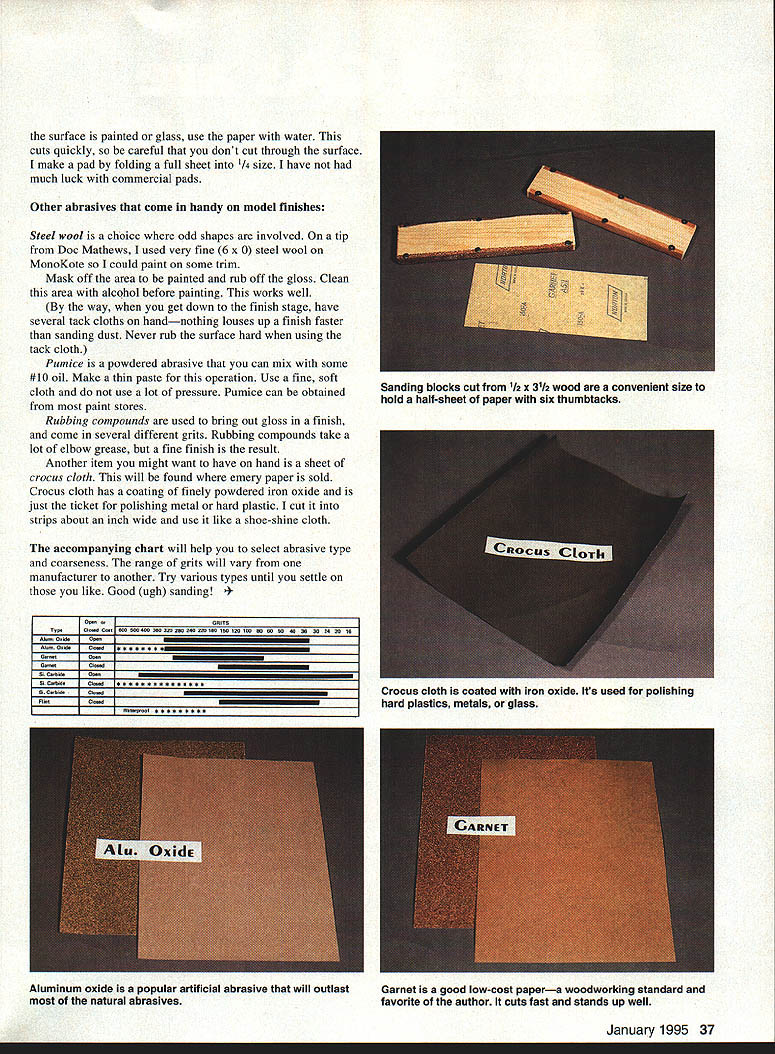
Coarseness is usually determined by the size of the grains that will pass through a specific size sieve. This may range from 16 (coarse) to 600 (extra fine). The grit size is printed on the back of the sheet.
Open and closed coat is determined by how closely packed the grains are on the paper. On open coat, the grains cover about 60% of the paper. Open coat is slower to clog than closed coat.
A great finish takes the right kind of papers, time, and practice.
Sanding techniques and recommendations
The following ideas may be of some help:
- Always use a sanding block. For curved surfaces use a pad. I make up a half-dozen blocks 1/2 inch x 3 1/2 inches. A half sheet fits this size block nicely and is held on with six thumbtacks.
- For rough sanding of balsa, foam, or fiberglass, use 40 or 50 grit open coat. I tend to stay with open coat until I get to the wet-or-dry stage; there is much less chance of clogging.
- Once the shaping is done, move up to 100 grit. As a rule it is a good idea to skip no more than one grit when changing papers (though I tend to cheat here). The purpose of the next grit is to remove the cutting marks from the previous sanding. Continue to 150 grit.
- At this point you should have no bumps or waves and a level surface. From here on it depends on what finishing technique you are going to use: paint, paper, cloth, or one of the heat-shrink coverings. A big help here is Harry Higley's book There Are No Secrets. It's one of the best books I have seen on how to finish models.
- When you get to the point of using wet-or-dry paper, remember that this is a closed coat paper and clogs quickly. If the surface is painted or glass, use the paper with water. This cuts quickly, so be careful that you don't cut through the surface. I make a pad by folding a full sheet into 1/4 size. I have not had much luck with commercial pads.
Other abrasives that come in handy on model finishes
Steel wool
Steel wool is a choice where odd shapes are involved. On a tip from Doc Mathews, I used very fine (6/0) steel wool on MonoKote so I could paint on some trim. Mask off the area to be painted and rub off the gloss. Clean this area with alcohol before painting. This works well.
(By the way, when you get down to the finish stage, have several tack cloths on hand—nothing louses up a finish faster than sanding dust. Never rub the surface hard when using the tack cloth.)
Pumice
Pumice is a powdered abrasive that you can mix with some #10 oil. Make a thin paste for this operation. Use a fine, soft cloth and do not use a lot of pressure. Pumice can be obtained from most paint stores.
Rubbing compounds
Rubbing compounds are used to bring out gloss in a finish, and come in several different grits. Rubbing compounds take a lot of elbow grease, but a fine finish is the result.
Crocus cloth
Another item you might want to have on hand is a sheet of crocus cloth. This will be found where emery paper is sold. Crocus cloth has a coating of finely powdered iron oxide and is just the ticket for polishing metal or hard plastic. I cut it into strips about an inch wide and use it like a shoe-shine cloth.
The accompanying chart will help you to select abrasive type and coarseness. The range of grits will vary from one manufacturer to another. Try various types until you settle on those you like. Good (ugh) sanding!
Transcribed from original scans by AI. Minor OCR errors may remain.

