
Al Scidmore
Sanity in 1/2A: Pylon Racing
Introduction
Working within the framework of the new AMA rules book (Provisional Event), a sizeable group of clubs established a circuit which stressed their own modified rules to encourage the average flier, thus to bring in new blood for this mushrooming event. The effort was a whopping success—this is how they did it.
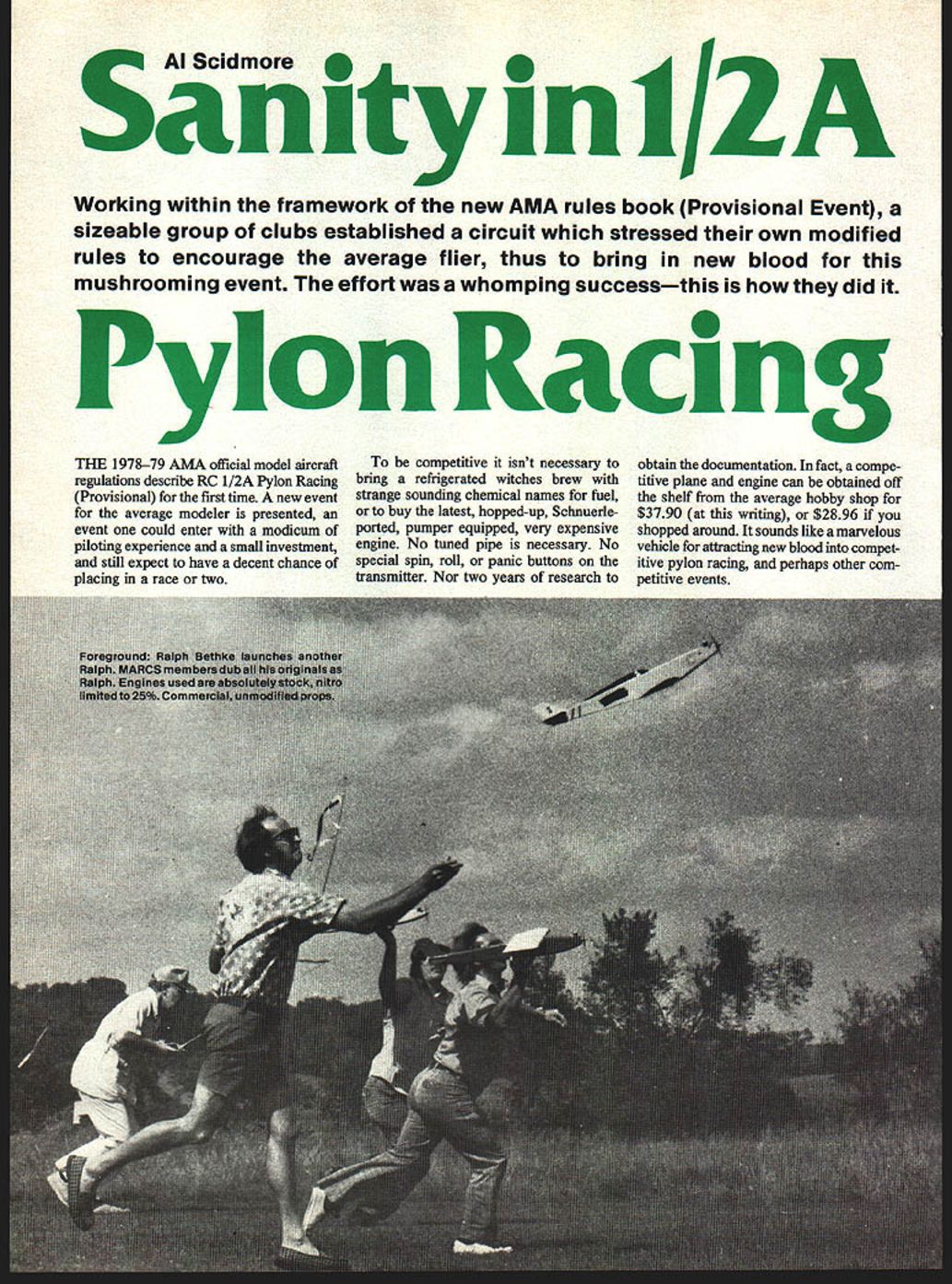
The 1978–79 AMA official model aircraft regulations describe RC 1/2A Pylon Racing (Provisional) for the first time. A new event for the average modeler is presented—an event one could enter with a modicum of piloting experience and a small investment, and still expect to have a decent chance of placing in a race or two.
To be competitive it isn't necessary to buy exotic fuels or the latest, very expensive, highly tuned engines. No tuned pipe is necessary. No special spin, roll, or panic buttons on the transmitter. Nor two years of research to obtain the documentation. In fact, a competitive plane and engine can be obtained off the shelf from the average hobby shop for a modest sum. It sounds like a marvelous vehicle for attracting new blood into competitive pylon racing, and perhaps other competitive events.
This racing event can be a training ground for other competitive activities. After cutting his teeth in 1/2A pylon and getting bitten by either the racing bug or the competition bug, a modeler may go on to Quarter Midget, Formula 1, Pattern, or other classes. There was a big upsurge of interest in 1/2A pylon in 1978. My bet is that 1979 will see even more activity. Below I describe the 1/2A pylon activities a group of fliers from the upper Midwest experienced during the 1978 flying season.
Formation of the WILLI Circuit
On a frigid February day in 1978 the Madison Area Radio Control Society (MARCS) hosted a meeting of representatives from the RC clubs of Appleton, Fond du Lac, and Madison, Wisconsin, plus Rockford, Illinois, to discuss forming a 1/2A pylon racing circuit. The concept was to establish a sequence of 1/2A pylon racing events to be held during the 1978 flying season and to formulate a uniform set of rules for these events. Each club felt that it would like to have a number of pylon races available for club members, but did not feel that their own club could sponsor more than two or three without a revolt from members who wanted to use the field for other activities.
Our clubs seem to have a broad diversity of members and interests, and to encourage these we schedule a variety of events. MARCS, for example, in 1978 sponsored three 1/2A pylon events, two slope-soars, a thermal sailplane event, one biplane event, one combat event, one water-fly, two sport fun-fly events, plus a picnic and two static displays, as well as judging events at local shopping centers, plus RC car racing in the winter. Adding more 1/2A pylon events to this schedule was unreasonable; consequently the formation of a racing circuit with several adjacent clubs hosting the races was an attractive solution.
It was the consensus of the club representatives at the first WILLI meeting that this event should be very appealing to the average modeler—the sport flier. Our members felt there should be some sanity in the rules and regulations: let the winner be the one who is consistent, comes prepared, and flies the best course. These factors are under a pilot’s direct control and come without cost price tags. Consistency, preparation, and practice are a result of personal effort. We felt the 1978–79 AMA provisional rules for 1/2A pylon were fairly reasonable and we could live within them. The 1978 WILLI circuit rules were, in fact, more restrictive than the AMA rules rather than less.
Concerns about Fuel and Competition
The maximum allowable nitro content of the fuel was a major concern. In 1977 we ran 1/2A pylon racing with stock engines but without a maximum nitro specification. Some fliers used 10%, some 15%, and some 25%. I once found a dusty pint can of Fox 40% at a local shop; during our first race that year there was no contest as to which plane was fastest. By my 8th or 9th lap I had lapped some fliers twice—and used up all the fuel in the tank as well. I thought the secret to winning was more nitro and a bigger tank. Club members brought me back to earth: without limitations on fuel, everyone who wished to be competitive would have to use 50–60% or higher nitro fuels. These fuels are more costly, less available locally, and very hard on engines. Some less-devoted average fliers would bail out and leave 1/2A RC pylon to the “hot-shots.”
We offer the basic features of our 1978 WILLI rules to any group hoping to conduct safe and sane 1/2A RC pylon events, along with comments on the reasoning and some personal opinions.
WILLI Circuit Rules (1978) and Rationale
- Stock engines—absolutely stock.
- Engines must be available everywhere at low cost.
- No special heads, carburetors, back plates, or internal modifications allowed.
- Fuel supplied by the local club to be used by all participants (25% max nitro).
- 25% nitro is not tricky to needle and provides plenty of rpm.
- Higher-nitro fuels are more expensive, less available, and harder on engines.
- Use of commercial, unmodified propellers.
- Allows the average modeler to compete without being a propeller specialist.
- No pressurized fuel systems.
- Not necessary if a stock venturi is used.
- Problems arise when the venturi is bored out, jets are oversized, tank is poorly located or vented, or a glow plug needs replacement.
- A pressure system adds unnecessary complication and expense.
- Wing requirements: minimum 200 sq. in. wing area, constant chord, and minimum 3/16" thickness.
- This is an easy-to-enforce wing-area rule.
- I would favor dropping the constant-chord requirement but keeping the 3/16" minimum thickness (though that would be harder to supervise).
- Fuselage minimum: 8 sq. in. cross section or minimum height 4" and width 2".
- This tends to equalize fuselage drag, keeps aircraft resembling real racers, and provides enough space for receivers, servos, and batteries without needing ultraminiature components.
- Canopies or cheek extensions were allowed if their base width was at least 1".
- I would enlarge the minimum width to 2¼" to allow larger servos side-by-side; this would increase frontal area by only about 2–3%.
- Minimum weight: 20 ounces.
- Reducing the weight limit would reduce induced drag, increase speed and kinetic energy, require faster reaction times of pilots and spectators, encourage expensive ultraminiature components, and promote weaker construction—detrimental to safety.
- Minimum personnel and simple cut procedure.
- Minimum crew: a judge at each pylon and one person manning the start-finish line.
- To minimize confusion, cuts are announced at the conclusion of the race.
- Scoring: one cut = 1 point; two or more cuts = score of zero. First, second, and third places are awarded only to pilots scoring no cuts.
- Any scheme allowing a flier to make up a cut by flying another lap implies communication from the pylon judge to the pilot, which requires additional personnel or signaling equipment.
- No landing gear required.
- Landing gear and small wheels are operationally unnecessary on grass/dirt fields and often lead to damaged aircraft during landings.
- While landing gear might make aircraft look more authentic, it is not practical for our fields.
The remaining WILLI circuit rules generally agreed with the AMA provisional rules, which seemed reasonable.
Participation and Event Structure
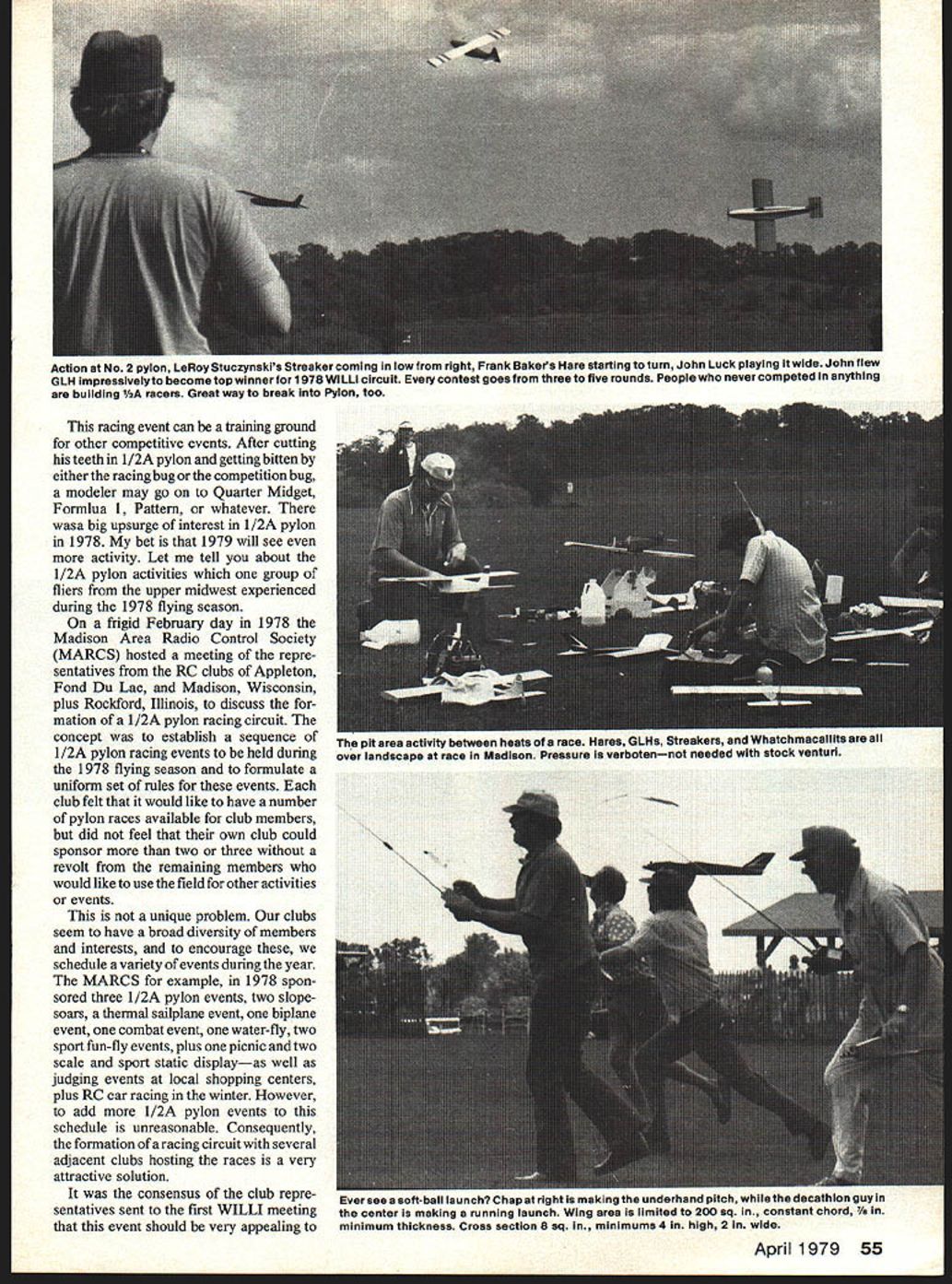
The success of the WILLI circuit, as measured by flier participation, was good. In each race we held three, four, or five rounds which kept participants busy from about 11 a.m. to 4 p.m. with pre-race checkout, adjustments, practice flying, racing, and the usual chatter and interchange between members of different clubs.
Measured by the growth of interest among MARCS members, the season was a phenomenal success. Many modelers who seldom, if ever, entered club contests either built a racer for next year, already acquired one, or flew pylon this year. At the annual MARCS club auction the prices paid for some used 1/2A pylon racers were about equal to the price of a 1/2A pylon racer kit. We already are planning the WILLI circuit events for next year and interest seems to remain high in the other WILLI circuit clubs as well.
Equipment, Engines, and Props
I feel the high interest and appeal of 1/2A pylon racing is partly due to the accessibility of competitive equipment and the ease with which one can get started. Equipment is available in local hobby stores. The airplane must be built, but good kits and plans for scratch-building are available. The engine is typically the same TD.051 that competitors use—no modifications. In our contests the same fuel is used by all. There are things to be learned about fuel tanks, break-in, propellers, launching, and flying the course, but that's to be expected. Our average flier has a fair chance to finish in the money, especially if a consistently good competitor stumbles.
After eight formal races and a number of informal events, here are observations and entry data:
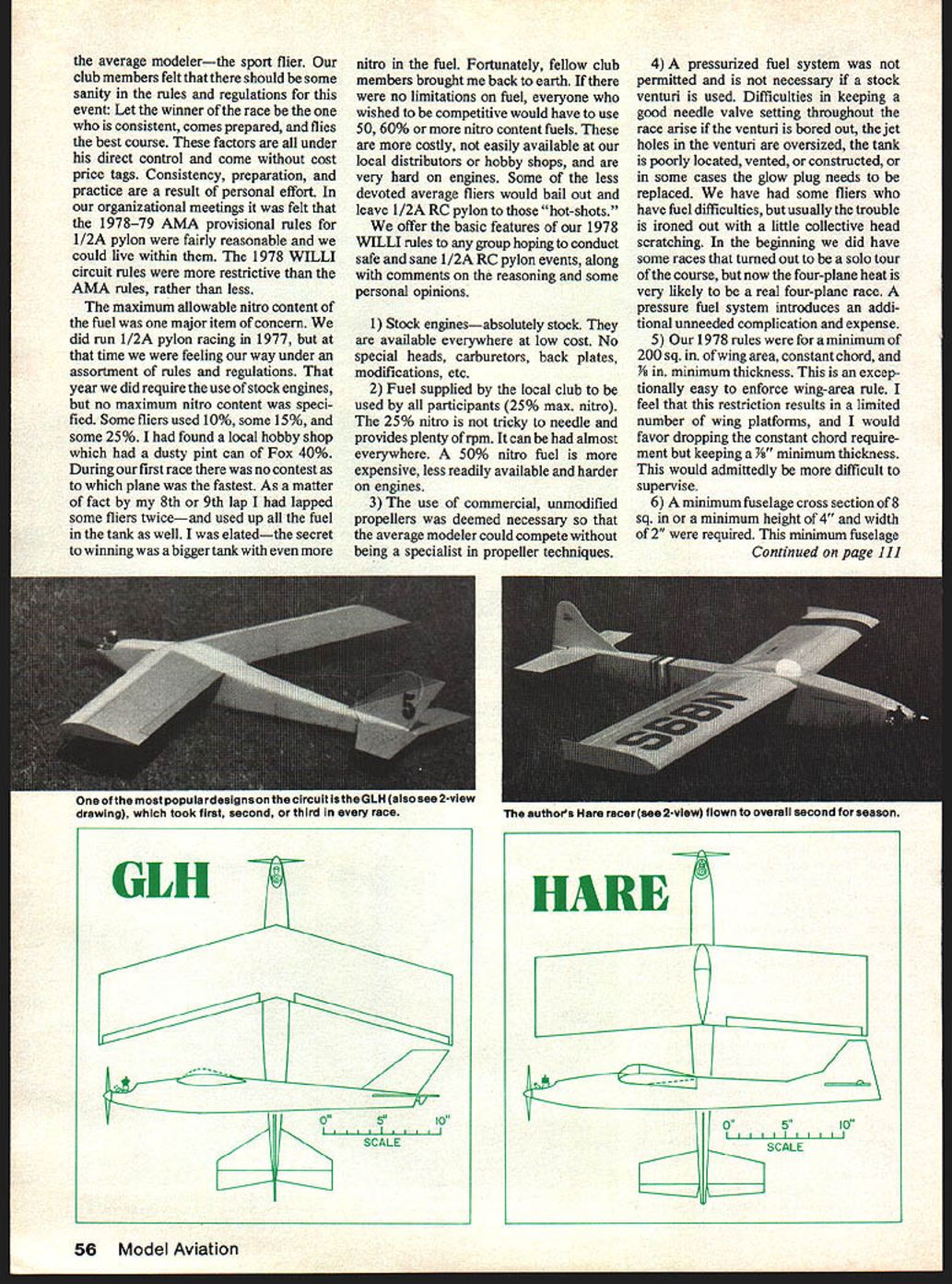
- After eight races John Lusk of Madison emerged the clear leader. John's GLH was fast, but many were faster. John's engine wasn't the hottest at any contest, but he consistently flew an excellent course.
- Given reasonably even aircraft, engines, and fuels, many fliers have the capability to place in any race. However, the flier who consistently gets his engine started, launches well, and flies a consistently tight course will win the most races.
- Race times on 25% fuel were around the 2-minute mark, with a few down at 110 seconds. Generally, races were not timed because officials were busy.
- A majority of the aircraft were kits, but a large number (47%) were original designs. The kitted planes were largely the modified GLH kitted by ACE (about 39%).
- Our records indicated the average aircraft weight was about 22.3 oz. Some relatively light ships did place well—one finished first in one race and second in another.
- Bob Johnson of Fond du Lac often flew a new original design at each race, and this sometimes gave him trouble.
Prop and needle valve notes:
- We allowed the use of the Kim-Kraft needle valve with a stock venturi; 65% of the fliers used them. However, many top finishers felt the stock Cox needle valve was perfectly adequate.
- The Cox 5x4 black plastic propeller was used by 60% of entrants. No other prop was used frequently enough to mention.
- Propeller balancing is an absolute must.
Engine notes:
- The TD.051 wasn't the only engine flown; a few TD.049s appeared.
- Not all TDs are created equal: some run well out of the box, many improve after running time, but a few never perform adequately.
- Borrow a tachometer and compare numbers with fellow fliers. On my tachometer, using a Cox black 5x4 and 25% nitro Cool Power fuel, most racing-quality stock engines provided a steady static reading between about 18,000 and 20,000 rpm. These figures vary with temperature and humidity.
Launching
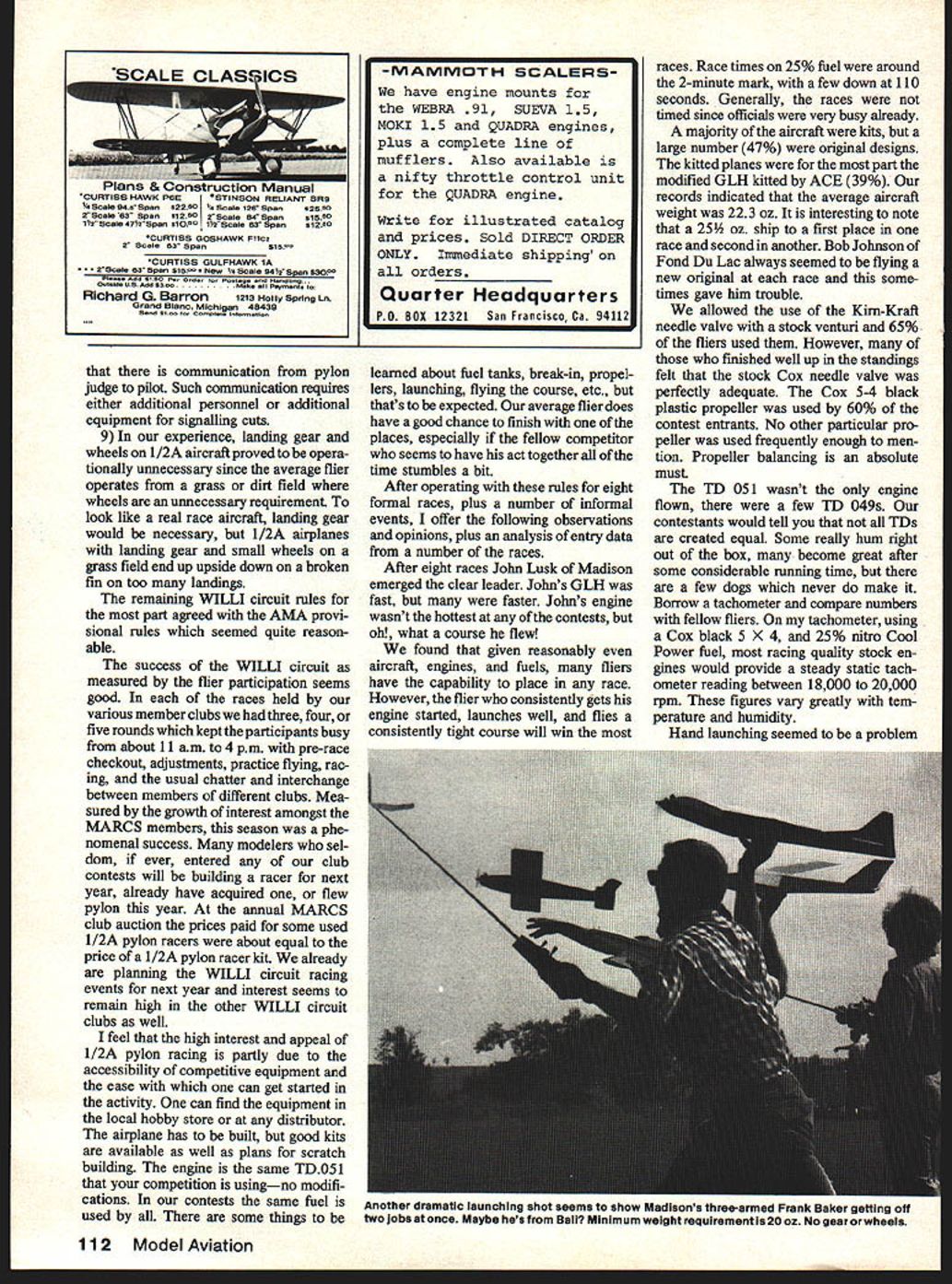
Hand launching seemed to be a problem for some new fliers. We permitted a running launch by an assistant, which greatly helped those experiencing difficulty. Two problems arise on launch:
- Torque reaction to the left.
- The engine leaning out or quitting on a hard launch.
The solution to the first is a hard javelin-type launch; the second is eased by a softer launch. Experimentation with air pickup position and tank height usually helped us solve the problem. If the airplane nose is dropped just prior to launch, the engine can be made to load up somewhat, allowing a hard throw that sometimes makes the first pylon on sheer momentum.
Summary and Caution
In summary, we operated largely within the framework provided by the AMA 1978–79 Provisional Rules for 1/2A Pylon and had lots of fun, a successful season, and enticed a number of average fliers into a competitive event. We now have another vehicle for getting average modelers interested in competitive racing. We should jealously guard against attempts to substantially change its essential nature.
A lesson from history: many present AMA events evolved from simple ideas into highly specialized events with only a small elite of participants. If permitted, specialists will refine this event around their capabilities and interests. The average modeler typically lacks a machine shop, extra dollars, access to special parts and fuels, or the skill and experience to construct a highly specialized racer. In larger communities there will still be enough fliers for a race, but in smaller communities interest will dwindle until the spark goes out. The name of the game is racing, but let us keep the original objectives in mind and keep this an event for the average modeler with inexpensive and easily constructed planes.
Transcribed from original scans by AI. Minor OCR errors may remain.

