
SAVING AIRCRAFT
Scott Kean
How to escape from some tough situations
EACH ISSUE of this magazine has many fascinating articles that cover a wide range of topics. But I've never seen an article on how to save an aircraft in trouble.
I decided to share a few tips on how to "save" your aircraft. While helping many people learn to fly over the years, I've come up with some special techniques for getting out of the following situations.
Crosswind Taxiing
Most of the time you're not able to taxi directly into the wind — you have to taxi in a crosswind.
How many times have you seen this happen?
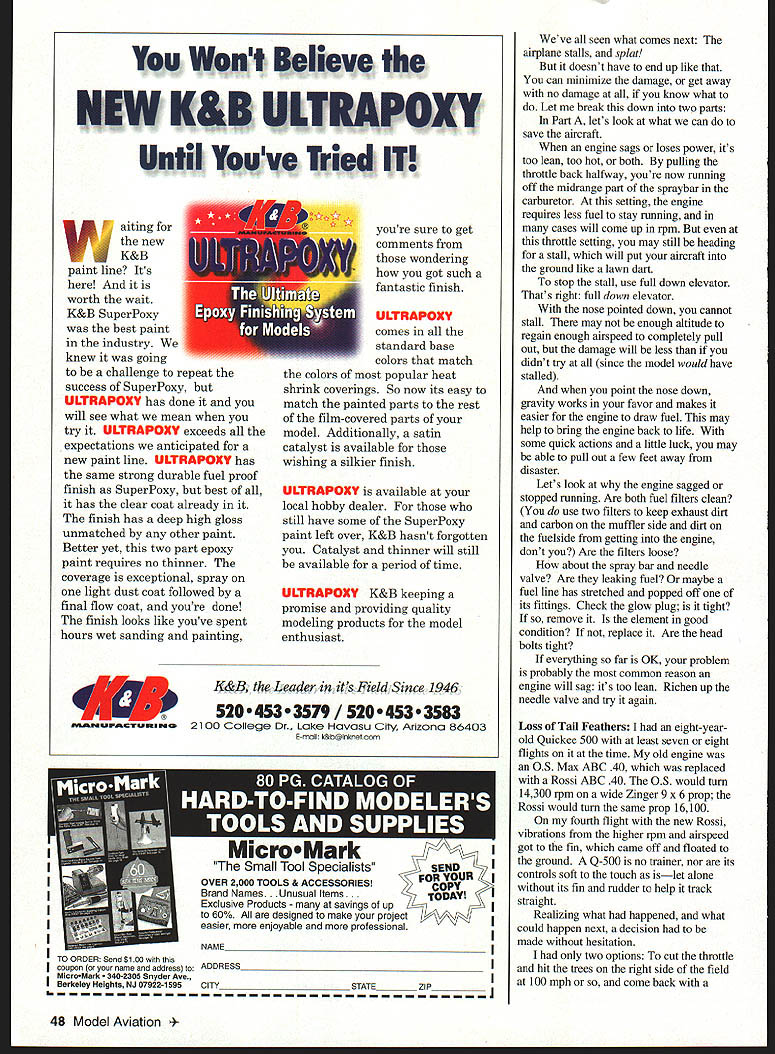
You're trying to taxi in a crosswind when one wing starts to dip. Then the prop chews up the ground, and sometimes the airplane flips over. This is no fun, and can cause damage — especially if you are flying from pavement.
What actually happens is that the crosswind gets under the wing that is pointed upwind and lifts it. This is why the opposite wing dips and the prop digs into the ground. Use opposite aileron to help keep the wing level. You can also use your rudder by turning in the direction of the low wing. But for the rudder to be effective the airplane must be moving — centrifugal force will help keep it tracking. Caution: with a taildragger setup, excessive rudder can cause a ground loop.
Crosswind Takeoffs
From time to time I'm asked, "Why does one wing dip when I try to take off into a crosswind?"
As the model's ground speed increases, the wing starts to carry more and more of the aircraft's weight. At the same time, less weight is on the landing gear, so the model loses its ground stability. When this happens, the wind lifts the upwind wing half.
During crosswind takeoffs, the same technique used for crosswind taxiing — using opposite aileron — will help keep your pride and joy from rolling over. This works for both tricycle and taildragger landing gear.
(Of course, the best way to stop this is to avoid the situation completely by taking off directly into the wind. But when you must take off into a crosswind, the less time you spend on the ground the better. Start off by bringing the engine up to half power and keep your takeoff run as short as possible.)
Here's what I do: if the wind is blowing from right to left and the left wing starts to drop, use some right aileron. Use care not to overcontrol and roll the airplane over. The wing may also rock a bit; each airplane is different and will require more or less aileron input. The timing of the release of aileron input will also vary from one model to another.
Flameout on Takeoff
It happens to everyone — even the best fliers — at some point. You set the top-speed needle, the engine sounds great, you take off and start your climb. At 20 feet or so the engine sags and the nose comes up.
This is no time to panic. Here's a practical procedure that has saved aircraft:
- If the engine sags or loses power, pull the throttle back about halfway. At mid-throttle the engine runs on the midrange of the spraybar/carburetor and often requires less fuel to keep running. The rpm may come back up.
- If you're still heading toward a stall, put the aircraft in full down elevator. With the nose pointed down you cannot stall. Even if there isn't enough altitude to recover completely, the damage will be far less than a stalled, vertical impact.
- Pointing the nose down also helps gravity feed fuel and may make it easier for the engine to restart.
Troubleshooting after you land: check fuel and fuel delivery components.
- Are both fuel filters clean and properly installed? (I recommend using two filters so exhaust residue and carbon on the muffler side are separated from dirt on the fuel side.)
- Are the filters or fittings loose?
- Is the spraybar or needle valve leaking fuel?
- Has a fuel line stretched or popped off a fitting?
- Is the glow plug tight and in good condition? Are the head bolts tight?
If everything else checks out, the most common cause of a sagging engine is that the mixture is too lean. Richen the needle valve and try again.
Loss of Tail Feathers
I had an eight-year-old Quickee 500 with several flights on it. My old O.S. Max ABC .40 engine was replaced with a Rossi ABC .40. The O.S. would turn a wide Zinger 9 x 6 prop at 14,300 rpm; the Rossi turned the same prop at 16,100 rpm.
On my fourth flight with the Rossi, vibrations from the higher rpm and different prop pitch loosened the fin, which came off and floated to the ground. A Q-500 is no trainer, nor are its controls soft — and losing the fin made the airplane very difficult to keep straight.
Realizing what had happened and what could happen next, a decision had to be made quickly. I had only a couple of options: shut down and accept a hard impact or try to fly it back without the fin. I chose to try to fly it back.
At first the controls felt strange. When I gave up elevator the airplane pitched down even more. I immediately chopped the throttle, released the up elevator, and tried again. The elevator was sluggish but responded well enough. At about 15 feet the Quickee leveled out and I was able to land; my heart was pounding.
After landing, we identified two factors that nearly ruined my aircraft:
- I should never have used a "push" linkage for up elevator at the control horn. If you can help it, use a "pull" linkage for up elevator.
- When using Nyrods, replace the yellow inner sleeve every two to three years. Fuel, sun, heat, cold, and stress degrade it. Alternatively, use .055 or .062 piano wire inside the yellow rod: make a Z bend in one end, solder a brass threaded coupler on the other end for your clevis, and secure with 2-56 nuts or lock nuts. This helps prevent bending and failure.
Retrieval of a Distant Aircraft
Several times each year I hear cries at the flying field: "Where's your airplane?" "Way out there!"
When the model is so small it can hardly be seen or heard, how do you know which way it's going?
Simple: rock the wings left and right on the transmitter.
- If the wings respond in the same direction as your inputs, the model is heading away from you — turn around fast.
- If the wings respond in the opposite direction, the model is heading toward you.
Be careful not to overcontrol and roll the model, and keep as much altitude as possible. If the engine quits, you'll need altitude to glide the model back.
Scott Kean 15 Romney Rd. Bound Brook, NJ 08805
Transcribed from original scans by AI. Minor OCR errors may remain.

