
Scale: 1980 World Championships
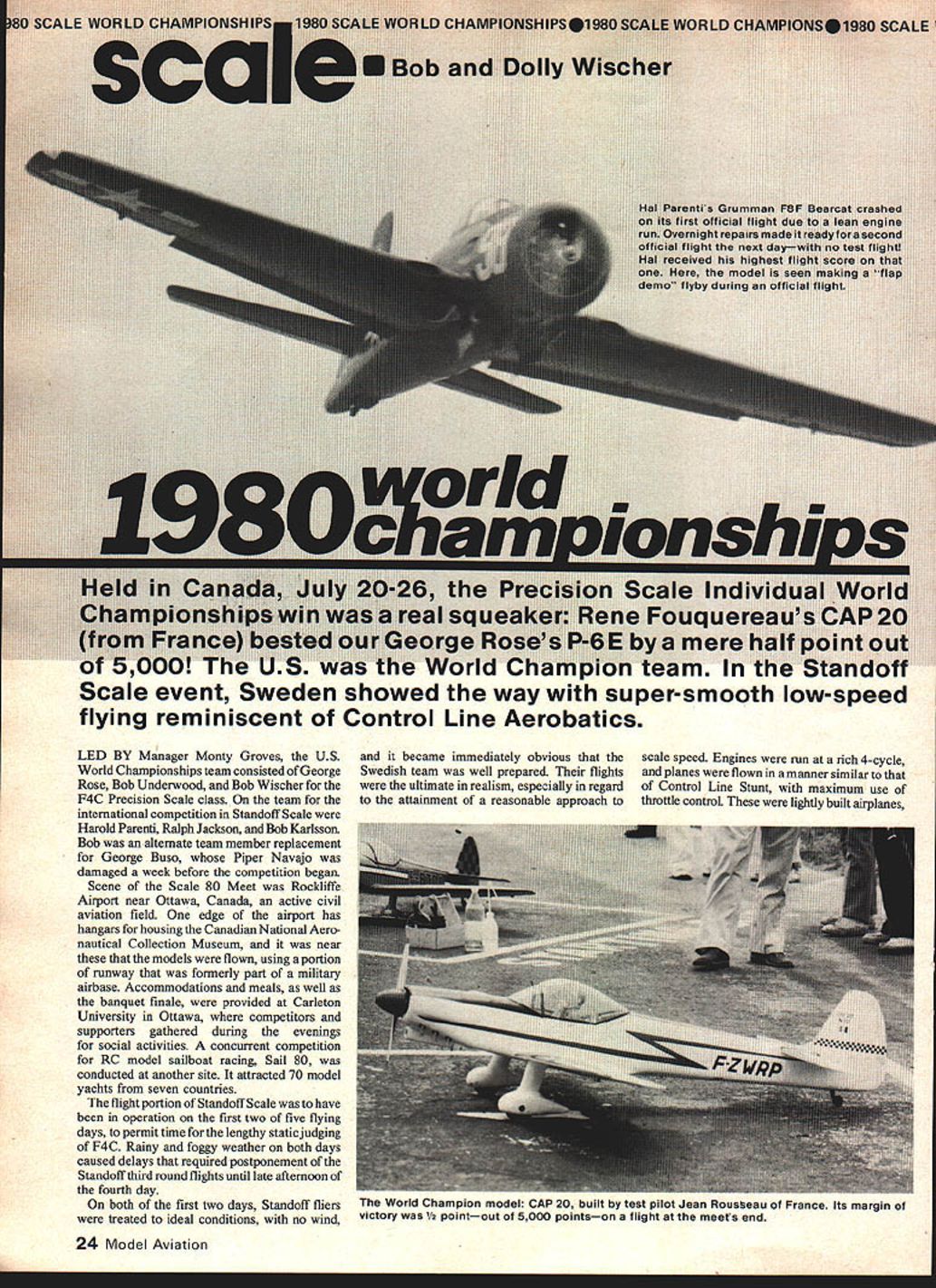
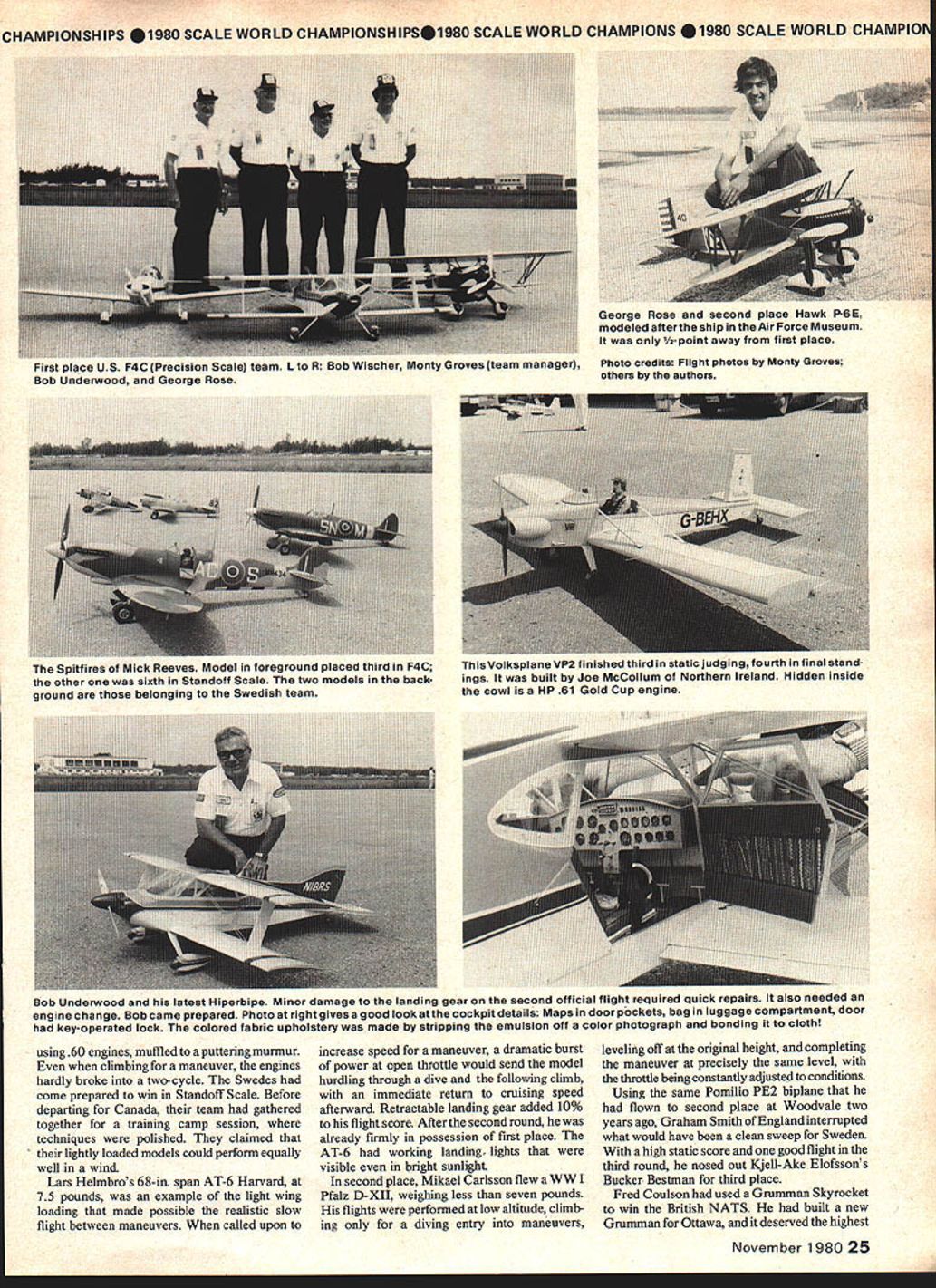
Held in Canada, July 20–26, the Precision Scale (F4C) Individual World Championship was decided by a razor-thin margin: Jean Rousseau's CAP 20 (France) bested George Rose's Curtiss Hawk P-6E (U.S.) by one-half point out of 5,000. The United States won the World Champion team title. In the Standoff Scale event, Sweden showed the way with super-smooth low-speed flying reminiscent of Control Line Aerobatics.
U.S. Teams and Management
- Team Manager: Monty Groves
- F4C (Precision Scale) team: George Rose, Bob Underwood, Bob Wischer
- Standoff Scale team: Harold (Hal) Parenti, Ralph Jackson, Bob Karlsson (Bob was an alternate replacement for George Buso after Buso's Piper Navajo was damaged a week before the competition)
Venue and schedule
The meet was held at Rockliffe Airport near Ottawa, Ontario — an active civil field adjacent to hangars housing the Canadian National Aeronautical Collection Museum. Models were flown using a portion of runway that was formerly part of a military airbase. Competitors stayed at Carleton University, where accommodations, meals, and the banquet were provided. A concurrent RC model sailboat event, Sail '80, attracted 70 model yachts from seven countries.
The lengthy static judging for F4C complicated the flight schedule. Standoff Scale flights were originally planned for the first two of five flying days to allow time for static judging, but rain and fog on those days postponed the Standoff third-round flights until late afternoon of the fourth day.
F4C (Precision) Scale — summary and results
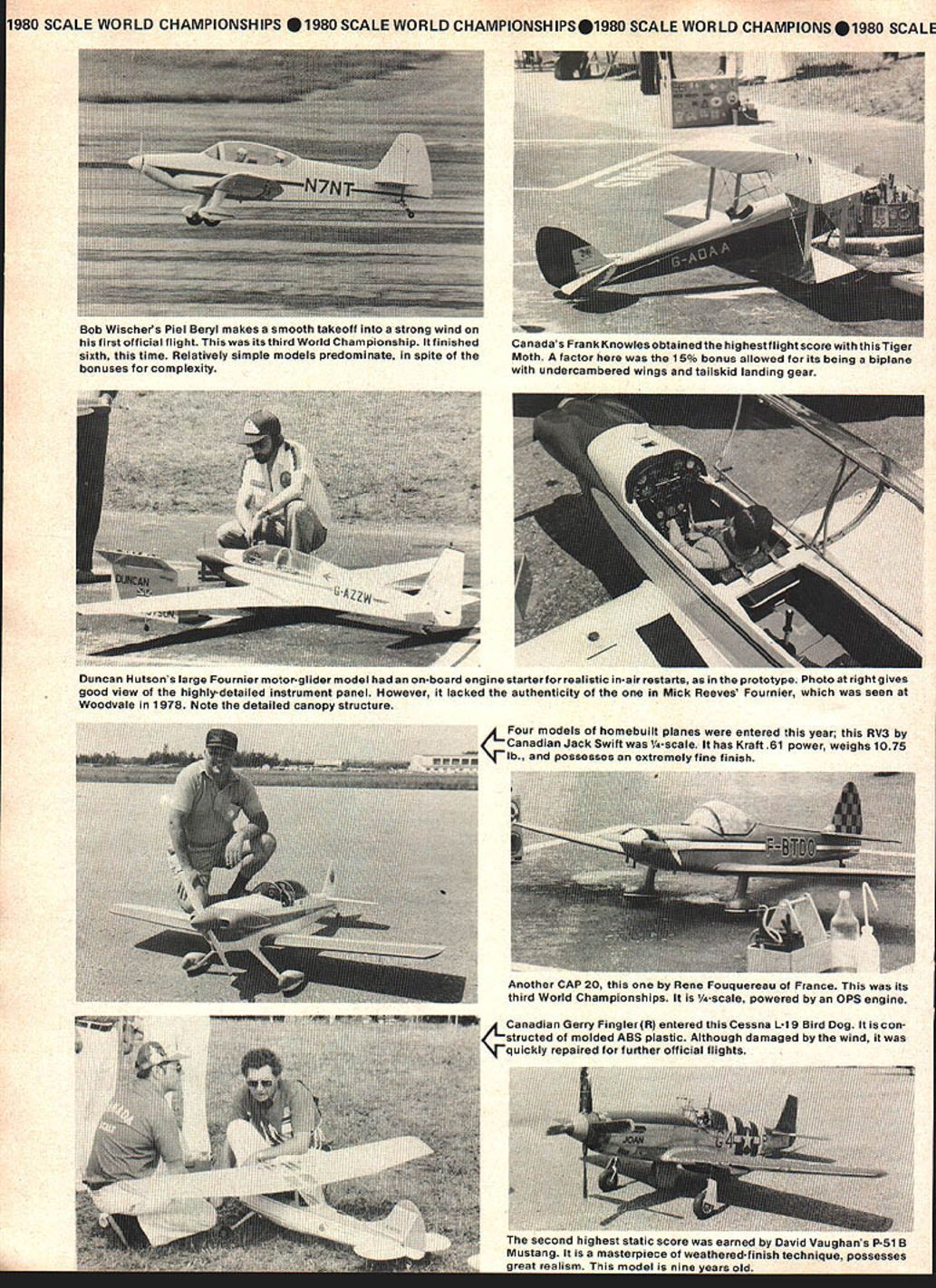
Static judging took place before the flight rounds. Once flying began the F4C portion encountered gusty, turbulent winds and the threat of rain, a contrast to the calm the Standoff competitors had enjoyed earlier. Several of the 20 F4C entries made no flights or were damaged during takeoff. Highest single flight score of the F4C flying days was recorded by Frank Knowles with his Tiger Moth.
Jean Rousseau's CAP 20 received the highest static score, a key factor in his overall victory. On the final day, George Rose flew early in calm conditions and posted a high score that put him temporarily in first; when Rousseau's score was posted at meet's end Rousseau emerged the winner by 0.5 point over Rose — a climactic finish.
Notable entries and incidents (F4C)
- Joe McCollum’s Volksplane VP-2 ("Wee-Joe") earned high ingenuity points: a model pilot with a striking resemblance to Joe (including beard and moustache) sat in the cockpit, and servos inside operated stick and rudder pedals connected by wires to elevator and rudder — the pilot "flew" the plane.
- CAP 20 (Rousseau): only competitor to use gear reduction on a Webra engine. Cooling problems led to removal of a dummy engine after static judging (discovered by the judges) and his first flight score was lost. A partial dummy engine was later refitted to satisfy rules, but the engine overheated on the crucial third flight and the model landed short of the circle. Despite this, Rousseau’s high static score and performance earned the title.
- Bob Underwood’s new Hiperbipe suffered landing-gear damage on its second official flight and required quick repairs and an engine change; Bob came prepared and resumed flying.
- Mick Reeves’ Spitfire lost its lower cowl shortly after takeoff; rules requiring the model to be flown as judged gave him a zero for that flight. His cowling had been part of a novel engine cooling scheme for a fully cowled HP .61 engine. Reeves entered two Spitfires, one in each class.
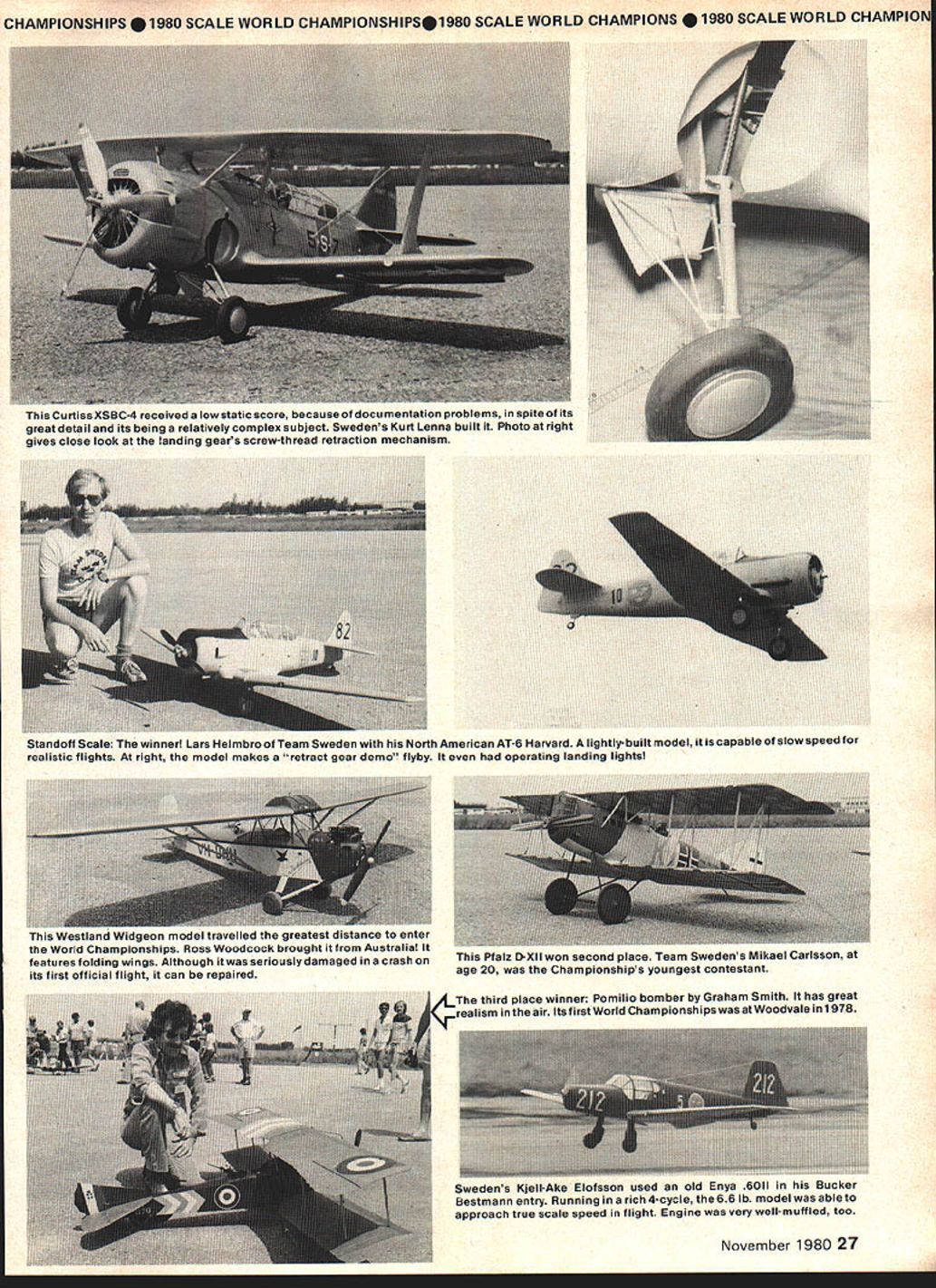
- Several wind-related damages: a folding-wing Westland Widgeon (Australia, Ross Woodcock) and a Cessna Bird Dog L-19 (Gerry Fingler) were severely damaged; the Bird Dog’s molded ABS exterior—complete with rivets—was later flown again with no visible blemishes.
- Notable craftsmanship: David Vaughan’s nine-year-old P-51B displayed exceptional weathering; Duncan Hutson’s Fournier featured a homemade retract mechanism, folding wings, and an on-board starter for in-flight restarts; four entries represented homebuilt aircraft.
Judges (F4C)
- Johnnie Carroll (Ireland)
- Paul Jones (Canada)
- Herbert Steinhauser (West Germany)
- Serge Zwahlich (France)
- John Preston (U.S.)
Memorial
There was a ceremony in memory of G. N. Sigutorese on the day of his funeral; his death was a shock to attendees. The modeling fraternity owes a debt of gratitude to the Sig family — shirts worn by the F4C team and shirts given to other World Championships participants were gifts from Sig.
Standoff Scale
Sweden dominated the Standoff Scale event with exceptionally smooth low-speed flying that resembled Control Line Aerobatics. Their team had held training-camp sessions prior to departing for Canada to polish techniques, and the results showed.
Conditions and flying style
- The first two flying days for Standoff were nearly ideal (no wind), allowing pilots to demonstrate precise throttle control and slow, realistic scale speeds.
- Many 4-cycle engines were run rich so that models would putter rather than break into a two-cycle roar; throttle was used extensively to manage speed during maneuvers.
- Models were lightly built for low wing loading, enabling realistic slow flight between maneuvers. When a higher speed was needed, an open throttle produced a dramatic burst of power, sending the model into a dive and subsequent climb, then back to cruising speed.
- Retractable landing gear earned a 10% flight score bonus.
Results and notable competitors (Standoff)
- 1st: Lars Helmbros — 68-in. span AT-6 Harvard (~7.5 lb). Light wing loading and working retractable landing lights (visible even in bright sun) were key to his score. Retractable landing gear added a 10% bonus.
- 2nd: Mikael Carlsson — WWI Pfalz D.XII (under 7 lb). His flights featured low-altitude climbing, diving-entry maneuvers, and careful throttle control to complete maneuvers at the original height.
- 3rd: Graham Smith (England) — Pomilio PE.2 biplane (the same model that placed second at Woodvale two years earlier). A high static score and a strong third-round flight nosed him ahead of Kjell-Ake Elofsson’s Bücker Bestmann.
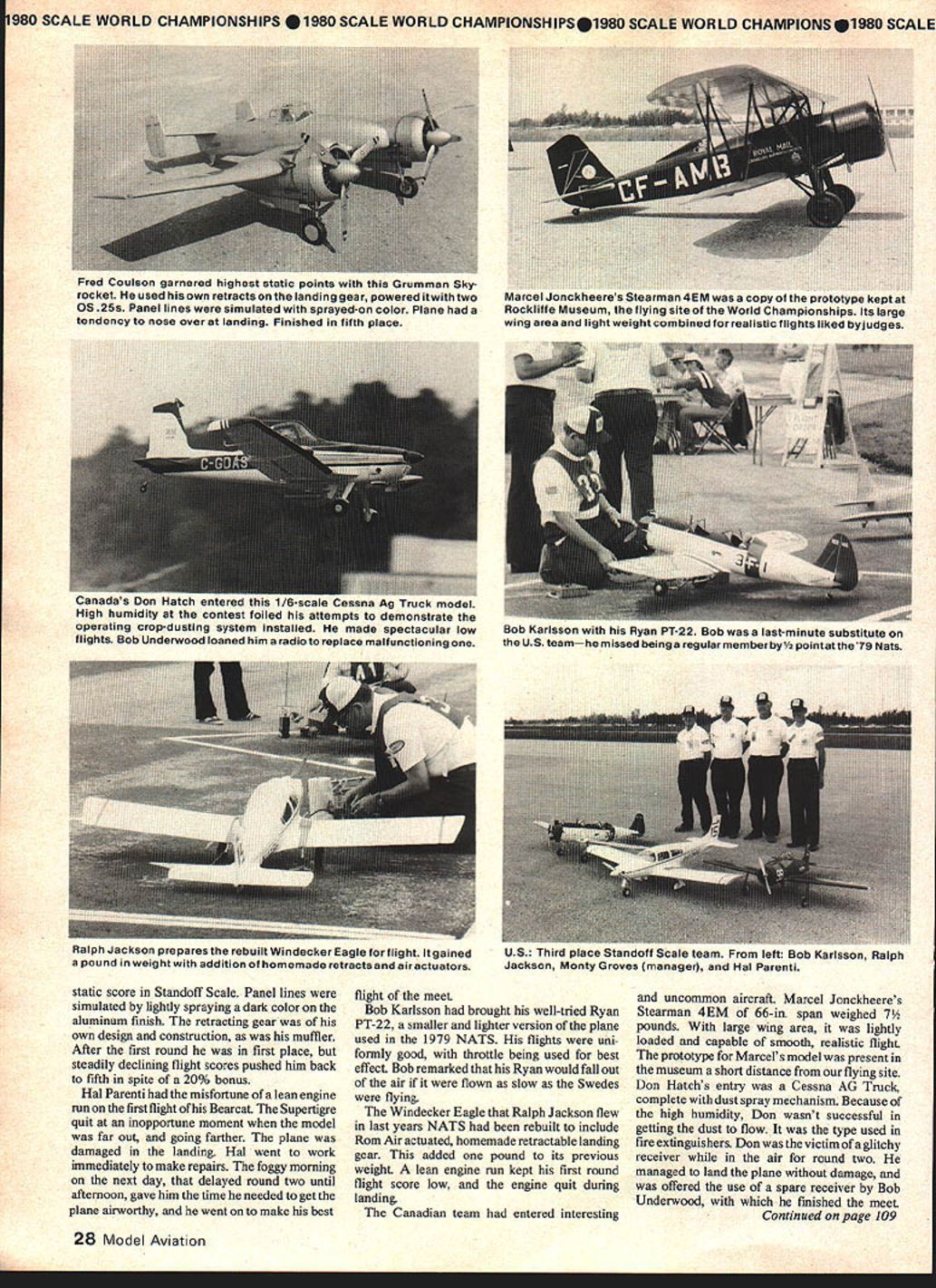
- Fred Coulson used a Grumman Skyrocket to win the British NATS event.
Other Standoff details
- Teams hid small Gold Cup engines inside some cowls; one entry included retracts and complex cockpit detail.
- Bob Underwood’s Hiperbipe suffered minor landing-gear damage in its second official flight and needed rapid repairs and an engine change; he was prepared and continued flying.
- The Swedish approach — light wing loading, rich engine settings, and precise throttle work — set the standard for realistic slow-speed scale flying.
Judges (Standoff Scale)
- Dick Carson (U.S.)
- Stephan Gray (Canada)
- John Preston (U.S.)
- Peter Merrick (Canada)
No continuing article text appears on the scanned page beyond photographs and captions.
Transcribed from original scans by AI. Minor OCR errors may remain.

