
Scale Documentation: Why, What, When, and How
Ron Sears
PROVE IT! If a model builder is to compete in any of the dozen or so different control line or radio control scale events, he must prove that his scale model is a miniature replica of a full‑size, heavier‑than‑air, man‑carrying airplane. Only prototype aircraft that actually made flights can be selected as subjects for competitive modeling.
The burden of proof lies with the modeler. That's probably one reason more modelers don't enter competition. The unknown, or the fear of the unknown, doubtless holds many fliers back. Of course, the amount of time required to build a flight‑line‑quality scale airplane also may discourage some modelers. But those who are willing to invest that time owe it to themselves to authenticate their efforts with good scale documentation.
Documenting your scale model will seem a lot less intimidating once you understand what is expected and how to accomplish it. There are four basic categories you need to know about:
- 1) Why documentation is needed;
- 2) When to prepare documentation;
- 3) What documentation is required; and
- 4) How to present documentation.
Let's examine each in turn.
Why is documentation needed?
The burden of proof lies with you, the modeler. In competition you must prove to the judges that what they see is a miniature replica, or copy, of the real thing. You need to give them the tools with which to make that determination. These tools are found in your documentation. The better the tools, the easier it is for the judges—and, we hope, the better the static score.
When is documentation prepared?
This is the area in which a lot of novices, and even some experts, create their biggest problem. Would a construction contractor start building without a set of blueprints? He needs to know sizes, shapes, locations, materials, and dimensions—things he can't get started without.
Scale modelers need the same information. Yes, you can obtain a construction drawing by mail order or buy a kit. You can even make your own drawing. But you must go a bit farther: you need to know not only the airplane's exact size and shape, but also the location and shape of all the detail. That's why a good three‑view drawing is necessary. You also must show what color or colors were used and where they go; hence the need for color photos and color chips.
Gather all your documentation before you start building. It's much easier to build a model in accordance with a three‑view and color photos than to build the model and then try to find matching documentation.
Too often a modeler builds an airplane and later decides to enter a contest. He gathers whatever documentation he can, which usually doesn't match his model. Or he throws together reams of information to baffle the judges, which doesn't work. He gets a poor score and, knowing his model is better than that, goes away disappointed and perhaps never competes again.
To be competitive you need an edge: first get your documentation, then build your winner.
What is required in documentation?
This advice addresses only control line (CL) and radio control (RC) events. The CL and RC scale events fall into four basic categories: RC Fun Scale, Sport Scale, Precision Scale, and FAI Scale. Each category requires specific documentation. In any of the categories except RC Fun Scale (see below), documentation is more detailed.
RC FUN SCALE
Fun Scale (not to be confused with Fun Scale® models marketed by Dynaflite) is designed to be easy. The same documentation can be used for either a control line or a radio control model, provided both are copies of the same full‑scale aircraft.
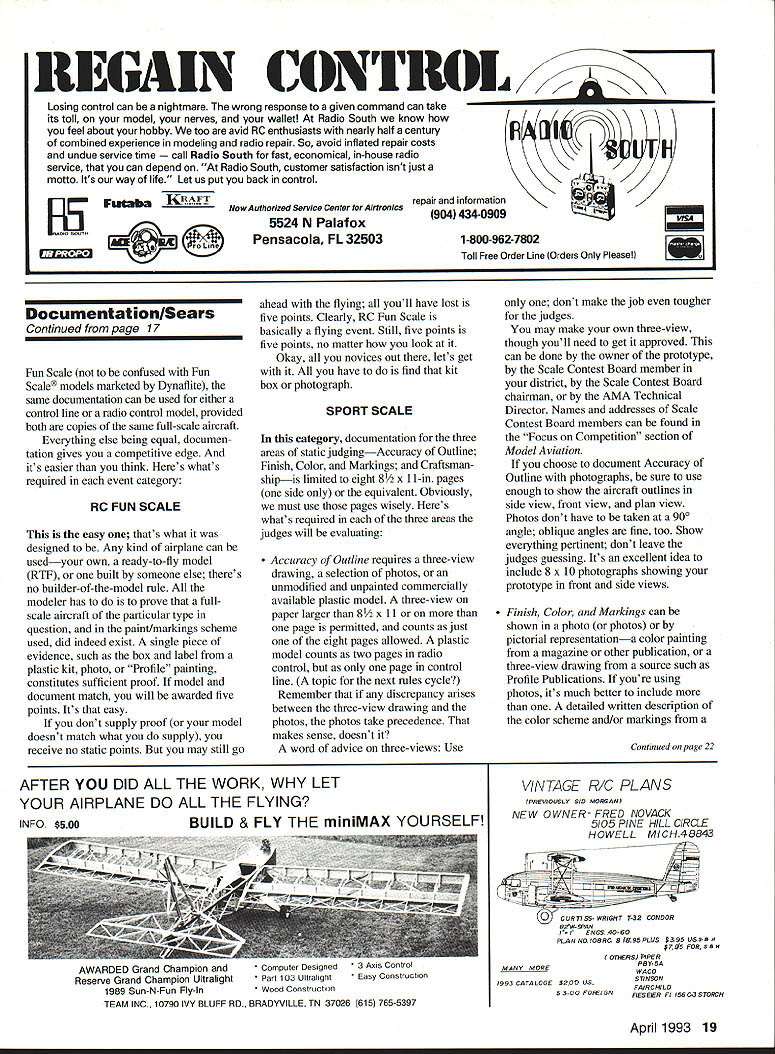
Any kind of airplane can be used—your own, a ready‑to‑fly (RTF) model, or one built by someone else; there is no builder‑of‑the‑model rule. The modeler has to prove that a full‑scale aircraft of the particular type, and in the paint/markings scheme used, did indeed exist. A single piece of evidence—such as the box and label from a plastic kit, a photo, or a "Profile" painting—constitutes sufficient proof. If model and document match, you will be awarded five static points.
If you don't supply proof (or your model doesn't match what you do supply), you receive no static points, but you may still fly; all you'll have lost is five points. RC Fun Scale is basically a flying event—but five points is still five points.
SPORT SCALE
In Sport Scale, documentation for the three areas of static judging—Accuracy of Outline; Finish, Color, and Markings; and Craftsmanship—is limited to eight 8½ x 11 in. pages (one side only) or the equivalent. Use those pages wisely. Here's what's required in each of the three areas judges will evaluate:
- Accuracy of Outline
- Requires a three‑view drawing, a selection of photos, or an unmodified and unpainted commercially available plastic model.
- A three‑view on paper larger than 8½ x 11 or on more than one page is permitted and counts as one of the eight pages allowed.
- A plastic model counts as two pages in radio control, but as only one page in control line.
- If any discrepancy arises between the three‑view and the photos, the photos take precedence.
- Advice: use only one three‑view; don't make the job tougher for the judges.
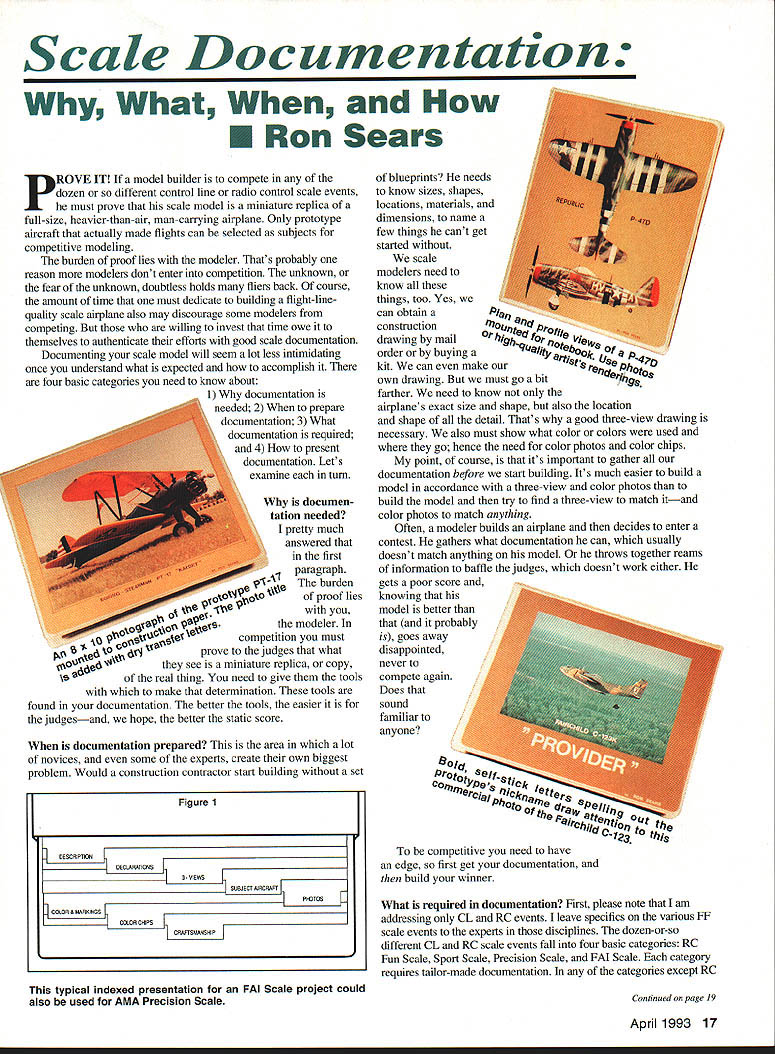
- If documenting with photographs, include enough to show the aircraft outlines in side view, front view, and plan view. Oblique angles are fine. An 8 x 10 photograph in front and side views is an excellent inclusion.
- Finish, Color, and Markings
- Can be shown in photos or by pictorial representation—a color painting, Profile Publications three‑view, or similar.
- Include more than one photo if possible. A detailed written description of the color scheme and/or markings from a reliable source can be used.
- Notes and diagrams of markings on a black‑and‑white three‑view are acceptable if that is all you have.
- Color chips are strong proof of color—preferably authenticated samples such as Federal Standard No. 595a chips or color references from reliable publications. Manufacturer paint chips can be used only if you prove the colors were used on the prototype. You can make your own color chips if they are authenticated by the owner of the prototype or another acceptable authority.
- Craftsmanship
- Judges look for fit, smoothness of surfaces, uniform joints and gaps, uniform paint coverage, sharp and crisp details, thin trailing edges (about 1/4 inch or less where appropriate), straightness (no warps), and overall airplane realism rather than a "toy" appearance.
- Craftsmanship can earn up to 30 points. Good documentation supports a strong score, as long as the model matches the photos.
A Profile Publications color three‑view could serve as a minimum proof for both Accuracy of Outline and Finish, Color, and Markings. If you're out to win, however, supply the judges with the best documentation possible.
PRECISION SCALE
Precision Scale allows up to 25 pages of documentation. Authenticity must be proven in great detail. Judging is done at the model, so detail photos are necessary—the judges may actually touch and closely inspect your aircraft. You can earn a bonus of up to 50 points for a well‑done presentation of your documentation.
Fidelity to scale is judged under eight categories:
- General appearance
- Fuselage
- Wings
- Tail
- Landing gear
- Cockpit or cabin
- Finish, color, and markings
- Engine, cowl, and prop
For each category you'll need a group of photos showing exactly what your prototype looks like. If you're serious about competition, choose a prototype aircraft you can photograph yourself. This helps you in two ways:
- You can measure the prototype to verify your three‑views and to accurately size and place all surface detail, as well as determine wingspan, length, height, etc.
- You fulfill the rule requiring a picture of the prototype.
You can find aircraft to photograph at local airports, aviation events, museums, and air shows. Take plenty of photos; at the very least, bring two rolls of film (24 exposures each). Don't forget several cockpit shots—photographs greatly aid construction where plans are weak or nonexistent.
A photograph of your prototype and model together makes strong documentation and helps prove your color match. Color chips, as described for Sport Scale, are also useful.
FAI SCALE
FAI Scale (classes F4B and F4C) follows Federation Aeronautique Internationale regulations. Static judging differs slightly:
- Scale accuracy and color/markings are judged from a distance of three meters (9.9 feet).
- Surface texture, realism, craftsmanship, and scale detail are judged at one meter (39 inches).
Documentation requirements are similar to AMA Precision Scale but are more intricate. For example, the FAI imposes a minimum size for the three‑view and requires it be submitted in duplicate. Because there are normally five judges, provide multiple copies (three extra copies beyond the duplicates is a good idea so each judge has a set). For early aircraft with no drawings, a selection of photographs may be used.
Profile Publications drawings are acceptable proof of color and markings, as is an authenticated written or printed description. Any drawings must be certified by the National Scale Committee for the appropriate category or by the builder/owner of the original aircraft or similar authority.
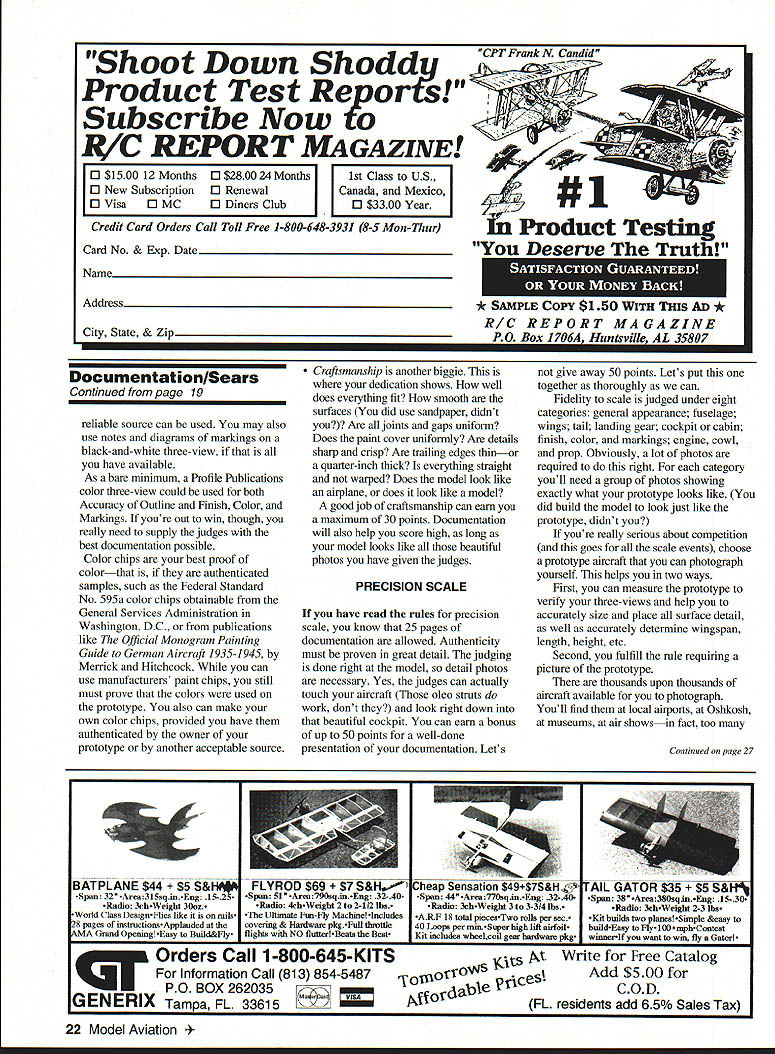
At least three photos of the prototype must be submitted, of which at least one must show the subject aircraft. As with other events, taking your own photos makes presenting pictorial documentation much easier.
How to present documentation
Now that you have gathered your documentation, present it professionally. Don't just throw loose sheets and photos in front of the judges. A tidy, logical, and accessible presentation makes their job easier and reflects well on your craftsmanship.
Recommended presentation components:
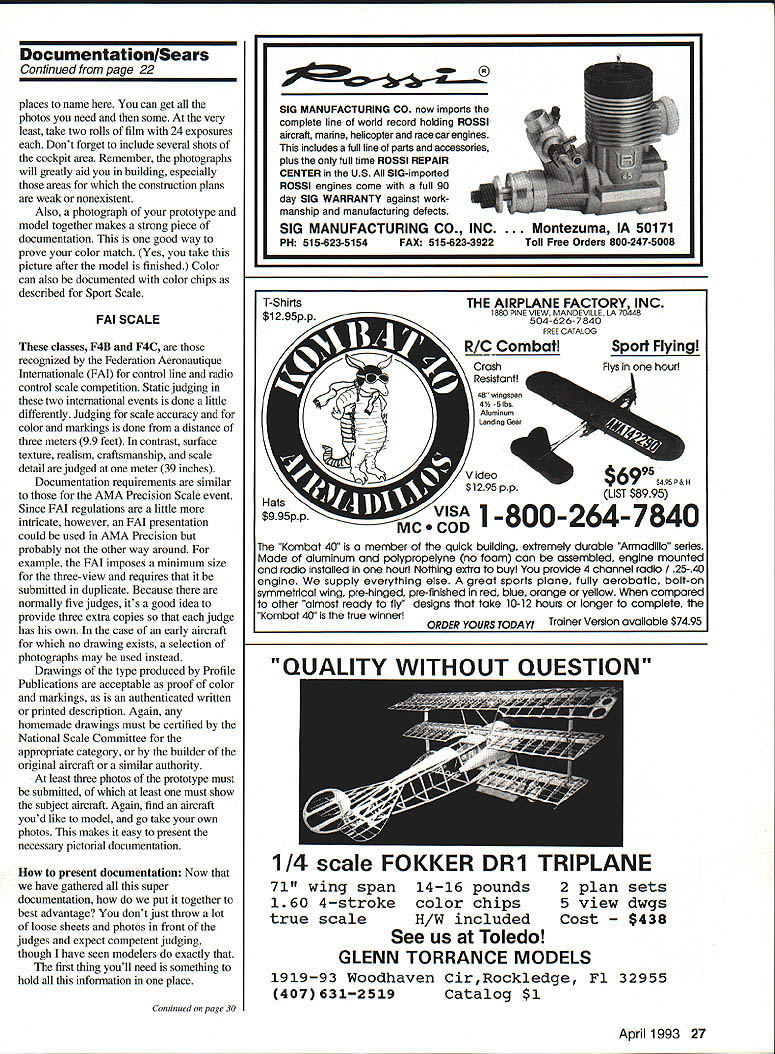
- A three‑ring notebook (loose‑leaf binder) lets judges remove pages for closer inspection without damaging the rest of your documentation.
- Index tabs at the top or side make it easy to find sections. Use clear tabs if possible.
- Clear plastic sleeves for photos so judges can handle pages without getting fingerprints on prints.
- A small labeled envelope attached to the inside cover for color chips.
Include these elements in your binder:
- Title page: your name, address, model name, scale, and name of the prototype.
- A short typed narrative describing any discrepancies between prototype and model.
- Labels for all photos (front, top, left side, right side, cockpit, landing gear, etc.) and numbering that corresponds to entries on the three‑view drawing.
- A references page listing books, articles, or people used as sources.
- Declaration page (for Sport Scale and required events): state parts you did not make and that you are the builder of the model (not required for RC Fun Scale). Sign the sheet.
Suggested order and organization:
- Cover photo (8 x 10) in the front binder pocket (this photo is not usually included in your page count).
- Dividers and index tabs—start with Description (brief prototype description and model statistics: scale, size, engines, etc.). For FAI, include proof of cruising speed if required.
- Declaration tab (separate for Precision Scale or FAI) with the declaration of parts not made and builder statement.
- Three‑view tab—include multiple sets so each judge can have a copy (three sets for AMA Precision; five for FAI).
- Photographs—be selective. In Sport Scale you are limited to about four pages of photos; choose overall views and only essential detail shots. Mount photos inside plastic sleeves and secure them so they don't slip.
- Color tab—include color photos of prototype with model if possible, and color chips. If using a prototype photo for color only, label it "For Color Only."
For Precision Scale and FAI, label tabs and arrange photos in the exact order of the judging categories (refer to the AMA rule book or FAI Sporting Code), and include sufficient photos under each tab for accurate scoring.
Final presentation tips:
- Be neat—presentation is part of craftsmanship. A sloppy display could cost you points.
- Use view binders with clear pockets on front, spine, and back for an attractive, professional look.
- Keep printed material concise—the judges have limited time and prefer brief, typed pages.
You've gathered your documentation and learned the why, what, when, and how. Put together a professional presentation that will impress the judges and make their work easier. In short, you've done everything possible to give yourself the edge in whichever scale event you enter.
Transcribed from original scans by AI. Minor OCR errors may remain.

