
SCALE FLIGHT ROUTINES
For a Winning Combination
Stan Alexander
If you've ever been to a scale meet and watched a champion modeler finesse an aircraft through a flight routine, you quickly realize the pilot knows the aircraft extremely well. There are no unexpected dives, swerves, or groundings toward the crowd; the entire flight is like a movie. The prototype aircraft's flight characteristics and realistic detail — right down to three‑point landings, flaps, and landing lights — attempt to copy the type performance.
The goal in competition is to impress the judges with knowledge of the aircraft and to show the crowd and fellow modelers that you "have the right stuff." Even if you don't fly scale competition, this article will help you fly your scale model more realistically at your local field. If you attend a scale fly‑in you may find competition enjoyable and rewarding.
Competition basics
What comprises a scale flight routine?
A scale flight routine is built from the full‑scale aircraft maneuvers described in the rule book. Combine precision maneuvers, placement (presentation) maneuvers, and realism maneuvers and you have the beginning of a complete routine. A complete routine also includes smooth transitions, realistic engine settings, and authentic takeoff and landing behavior.
Judges and rule books
Flight judges are usually trained for the events they judge, especially at national and international contests such as Top Gun, the AMA Nationals, US Scale Masters Championships, and FAI World Championships. Each competition has its own rule book; many rules are similar, but differences exist and should be known.
At local or regional meets, judges meet before and during contests to review rules and procedures. Any good scale judge studies the rule book beforehand. Competitors should also study the rules and practice the competition flight routine they will use during the season. Having a second routine for a windy day is advisable.
If you're using AMA rules, consult the AMA Competition Regulations (see the Scale General section for definitions, safety regulations, and classes). If in doubt about a rule, contact an AMA District Scale Committee member (names are listed in the Competition section of the magazine).
Flight judging principles
The Radio Control Scale Flight Judging Guide breaks flight judging into three areas: Precision, Presentation, and Realism.
Precision
- Judges form a mental picture of how a maneuver should look in the air; this helps determine scoring.
- Contestants sometimes provide a diagram to clarify unusual maneuvers.
- Different aircraft types approach and perform maneuvers differently (for example, a J‑3 Cub may dive for airspeed before a wingover). Such type‑specific behavior is expected and scored accordingly.
Presentation
- Placement matters. Some maneuvers should be centered directly in front of the judges; others are best flown off to the side. The rule book lists these differences.
- Maneuvers with horizontal symmetry should have their midpoint immediately in front of the judges. Examples:
- Cuban Eight
- Loop
- Roll
- Lazy Eight
- 360° Descending Circle
- Barrel Roll
- Three‑Turn Spin
- Bomb Drop
- Maneuvers best viewed off to one side include Wingover, Stall Turn, and Procedure Turn.
- If the sun is low and in front of the judges, ask to offset maneuvers for safety so judges can see.
- Don’t fly too far out of the judging position to hide errors; points are lost if maneuvers are not centered in the judging area.
- Pay attention to any safety direction from the Chief Judge or Contest Director (e.g., fly over the back edge or centerline of the runway). These are communicated at the pilots' meeting — attend it.
Realism
- Ask: What could the full‑scale aircraft really do? What were its cruise and top speeds? Was it aerobatic?
- Use references (e.g., Jane's Encyclopedia of Aviation) to determine prototype performance and limits.
- Do not perform unprototypical maneuvers. For example, large bombers are not aerobatic and should not be shown inverted.
- Aircraft of the same scale performing the same maneuver can look different; each must be flown in a way that matches the prototype (e.g., a Cub loop may be smaller and more egg shaped than a P‑51 loop).
- If you intend to fly maneuvers not listed in the rule book, be prepared to provide written, published documentation proving the prototype performed them (handwritten notes or verbal recollections are not acceptable at higher‑level events).
Preparing the model and routine
- After building and documenting the prototype, conduct thorough test flights to get comfortable.
- Put together a flight routine for the competition season and practice it repeatedly.
- Practice in varying wind conditions and with a buddy plane to check winds aloft and timing.
- Prepare a second routine for windy days and practice it as well.
- Use realistic engine settings, vary airspeeds and configurations, and use flaps if the prototype had them.
- If planning to land, attempt an authentic landing with realistic approach speeds and flap settings.
- Carry photocopies of documentation (period photos, articles, maintenance extracts) in your flight box to help judges quickly if questions arise.
Practical safety and communication
- Obtain clearance for model handlers to cross runways when retrieving or escorting models.
- Request permission for potentially hazardous maneuvers (e.g., touch‑and‑go or overshoot) if other aircraft are on approach.
- Make it easy on judges and yourself by presenting maneuvers so they can be judged quickly and realistically.
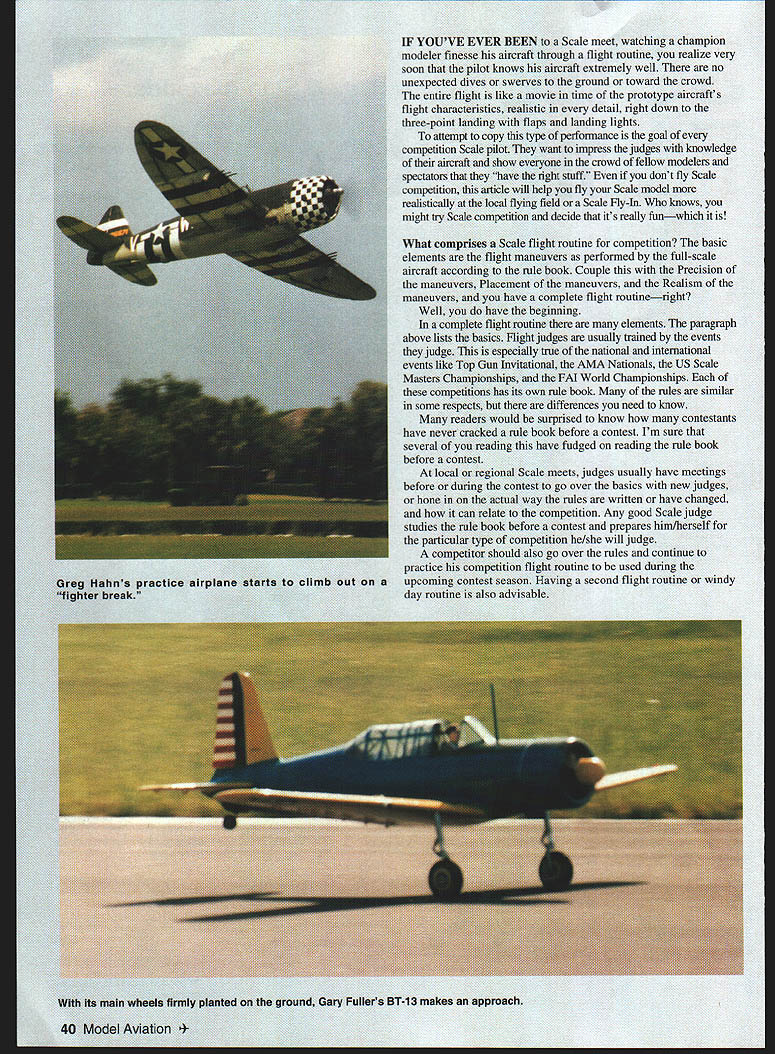
Fly as the pilot of the prototype — Jerry Caudle
Finally, fly your routine as if you were the pilot of the prototype. Relax, breathe, and fly smoothly. Do not rush maneuvers. Set them up and complete them with smooth transitions. Show the judges you know the aircraft and can fly it as intended.
If your aircraft is capable of extra maneuvers, document them in writing and be prepared to present that documentation. One good example is Bob Underwood's IL‑2, which he flew performing a documented "Circle of Death" maneuver based on published historical accounts — documentation was key to acceptance.
Example flight plan (seasoned pilot model)
Before the flight the pilot has researched the aircraft (stall, cruise, top speeds) and practiced the model in varying conditions. He has written a flight plan and practices calling maneuvers as if in front of judges. He practices at different fields to maintain depth perception against varying backgrounds.
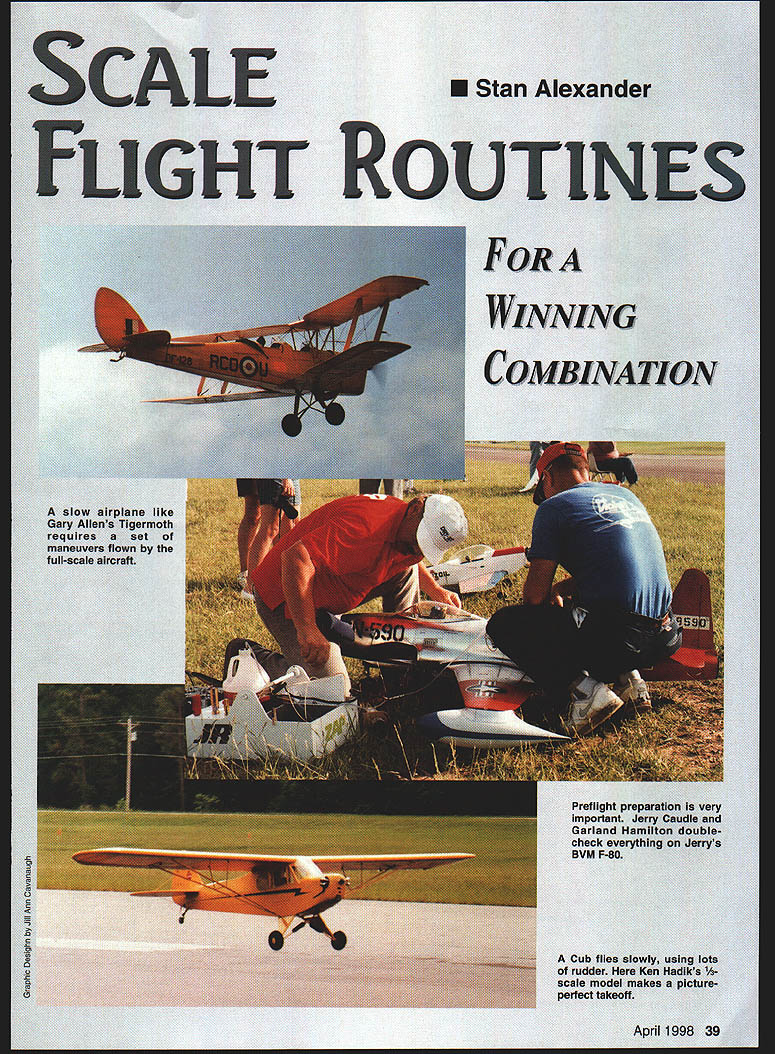
The pilot approaches the judges and announces the aircraft and flight plan. Example opening: "Good morning. Today I will be flying the de Havilland D.H. 82 Tigermoth with a maximum level speed of 109 mph and a cruising speed of 93 mph. I will fly the following maneuvers, in this order."
A sample sequence and pilot calls:
- Takeoff*
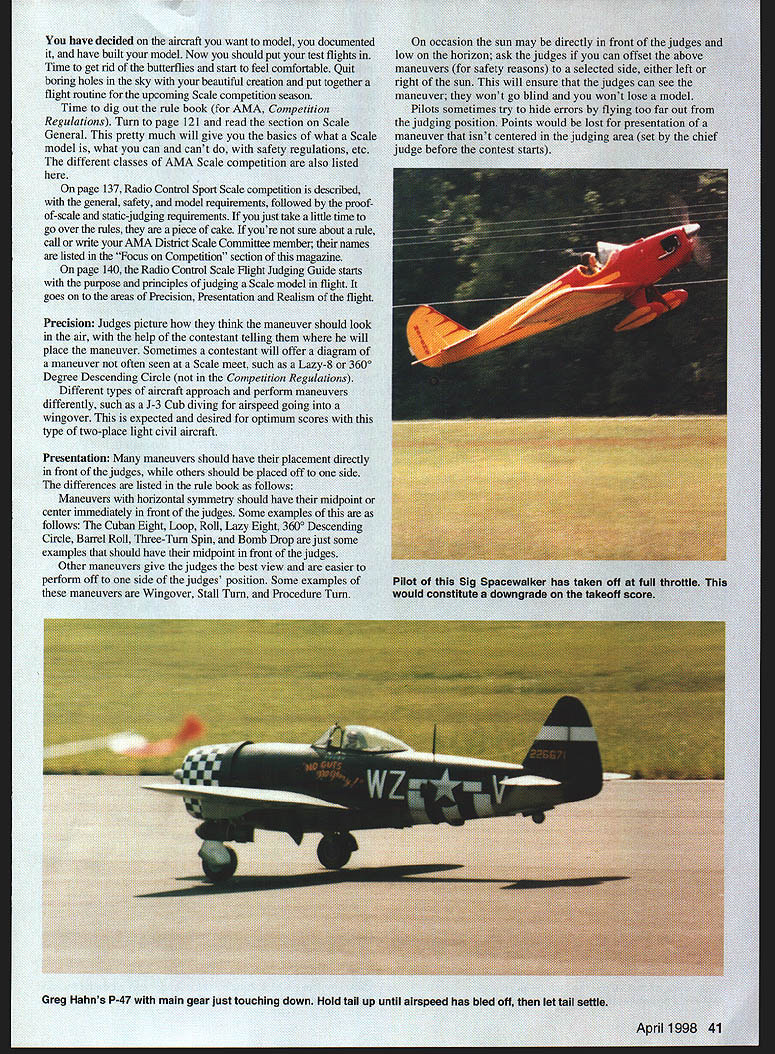
- If the prototype used a tail skid, the handler walks the aircraft to the takeoff point. If the model has tail or nose gear, taxi out, check control surface deflections, then announce takeoff.
- Figure Eight*
- "I will center the crossover point in front of the judges, entering from the left and exiting to the right."
- Fly‑Past*
- "I will pass at 10–20 feet, keeping a consistent heading and altitude."
- Inside Loop
- "I will dive for airspeed; the loop will be slightly egg shaped. I will center the loop in front of the judges. At the top I will cut the throttle and complete the maneuver, resuming level flight at the same altitude."
- Immelmann Turn
- "With a slight dive for airspeed, I will pull up into a half loop and perform a half‑roll to continue opposite on the same heading at a higher altitude."
- Split‑S
- "From level flight I will half‑roll and recover on the same heading at a lower altitude in the opposite direction."
- Straight‑Ahead Stall
- This should be cleared with the Contest Director; present any diagrams to judges beforehand. Plan a 45° climb, throttle to idle to stall, keep wings level, and recover smoothly to previous altitude.
- Barrel Roll
- "I will dive for airspeed, pull the nose up, roll around the barrel and recover upright on the same heading and altitude."
- Landing*
- "I will fly a rectangular pattern, lower flaps as appropriate, and make a full‑scale type landing. I will taxi clear of the runway and call the landing complete."
*Mandatory maneuvers are denoted by an asterisk. Optional maneuvers are limited by the prototype's aerobatic capabilities and the pilot's skill.
Flight realism scoring
Flight Realism is awarded in proportion to how well the model simulates a complete flight: takeoff, taxiing, stability, airspeed, landing characteristics, etc. This score is usually conferred by judges after the flight; each judge should contribute to the discussion. Pilots sometimes narrate elements of the flight during the routine to clarify prototype behavior (for example, announcing when they will cut throttle at the top of a loop).
Final tips
- Know your model intimately and practice until each maneuver is repeatable.
- Practice entries and exits to each maneuver and placement so maneuvers are flown in front of the judges.
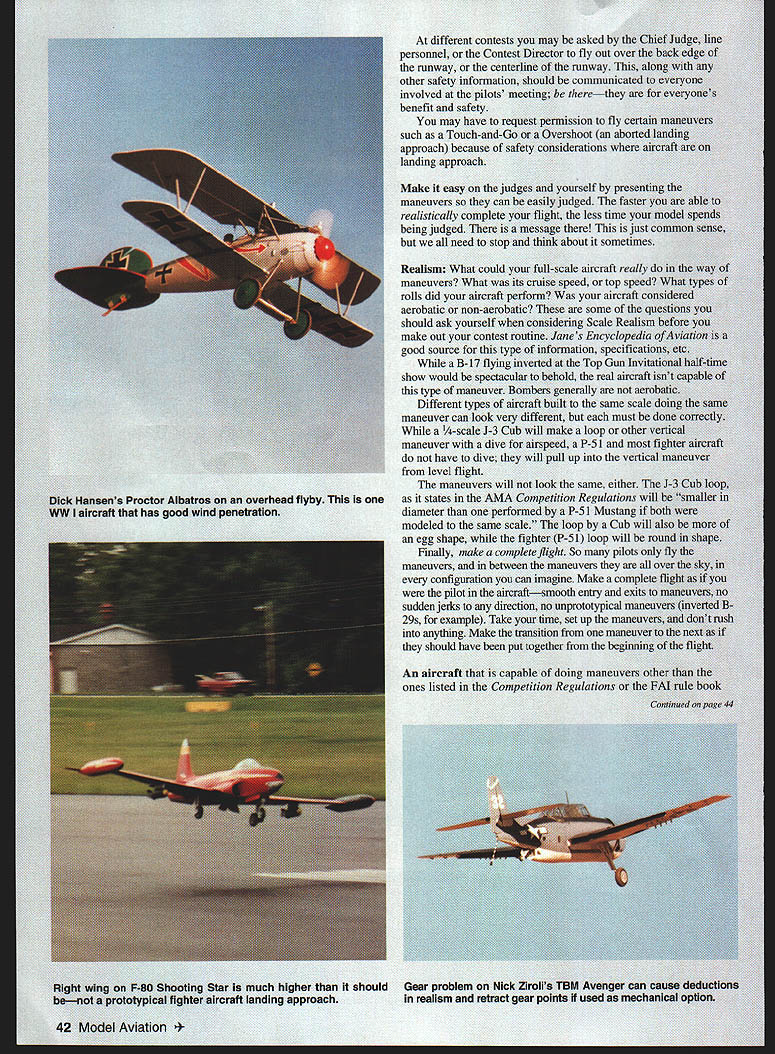
- Practice takeoffs and landings until they appear prototypical and relaxed.
- Relax, follow sportsmanlike conduct, and be ready to help others.
- If unsure about a procedure, ask a flight judge or the Chief Judge — they will help.
Come join us with a winning flight combination.
Stan Alexander 3709 Valley Ridge Dr. Nashville, TN 37211
Information sources
- AMA Competition Regulations
- Federation Aeronautique Internationale Sporting Code
- Jane's Encyclopedia of Aviation
- US Scale Masters Judging Guide 1996
Where to obtain rule books
- AMA Competition Regulations: Write to AMA c/o Supply & Service, ask for stock #3145. Price: $2.50 + $2.50 shipping for non‑members; members may request a copy with proof of membership.
- FAI Sporting Code: Stock #3146 from AMA Supply & Service, $5 + $2.50 shipping.
- US Scale Masters Judging Guide: Send $2.50 to National Association of Scale Aeromodellers, c/o Cathy Barnstine, Secretary/Treasurer, 303 Finch St., Sandusky, OH 44870.
Transcribed from original scans by AI. Minor OCR errors may remain.

