
Scale Masters
George Jenkins
"This really feels good," responded Dennis Crooks after winning Scale Masters '93, held October 21–24. The 40-year-old Big Rock, Illinois, native won the event with his twin ducted-fan Learjet 35A, which had a fiberglass fuselage with a full interior, complete lighting system, and brakes.
The facilities at Mile Square Park in Fountain Valley, California, were great; there was a huge runway and a protected pit area designed for model airplane events. The site was prepared by the host club, the Scale Squadron of Southern California, and the Scale Masters Championship Board. The club even planted trees along the boundary line to dampen the noise.
Attendance was down this year—attributed to the distance and the bad economy. According to Scale Masters founder Harris Lee, the 1994 contest location had not yet been determined at press time.
This year's contestants may want to follow Nick Tusa's example: he shipped his 1/3-scale Fokker D.VII as excess baggage for about $45, and it arrived in its homebuilt crate without a scratch. It's a lot cheaper than airfreight and it doesn't get lost.
The Fliers at Scale Masters
The weather was perfect for the first flight at 9:20 a.m. Light 3–5 mph winds blew down the extra-wide paved runway for newcomer Loren Pearson from Paynesville, Minnesota, who flew a beautiful red, white, and blue Weeks Special. Loren was thrilled to be among so many famous fliers about whom he had read for years. His wife helped ably as pit crew. Loren used a Zenoah G-62 from Indy R/C for a reliable power plant on his big model.
The Santa Ana winds were expected, but they did not arrive until the contest was over on Sunday. Their arrival brought some of the worst fires in Los Angeles history, and everyone was glad to get out ahead of those fires.
The Los Angeles Times and Orange County newspapers carried stories about the Scale Masters. The first day of competition attracted an estimated 6,000 people.
At the Saturday night banquet, Dennis Crooks walked away with most of the honors, including Best Civilian Aircraft for his first-time win as Mr. Scale Master. Dennis flew his much-photographed and published 80-inch Learjet 35A that included a complete interior. The landing lights were bright enough to be seen in the bright sunlight over Mile Square Park.
Dennis' wife Linda smiled as brightly as those landing lights when he invited her to share the pride and spotlight of the win as his most-valued pit crew. Dennis never gave up and even tried to make the last call of the fifth round, although he had to repair a broken onboard glow-plug wire on his left engine.
As Dennis was taxiing for the last flight, however, his engine died; he and Linda took that as an omen not to fly again. Instead of risking that beautiful Learjet, they hoped his earlier flights would be enough for the win.
The two O.S. Max .77s that really screamed for Dennis on his previous flights helped him score 87.00, 97.50, 92.00, and 93.25, and his static score was 96.50 (there was a three-way tie of 96.50 in static). Dennis' total score was 190.75.
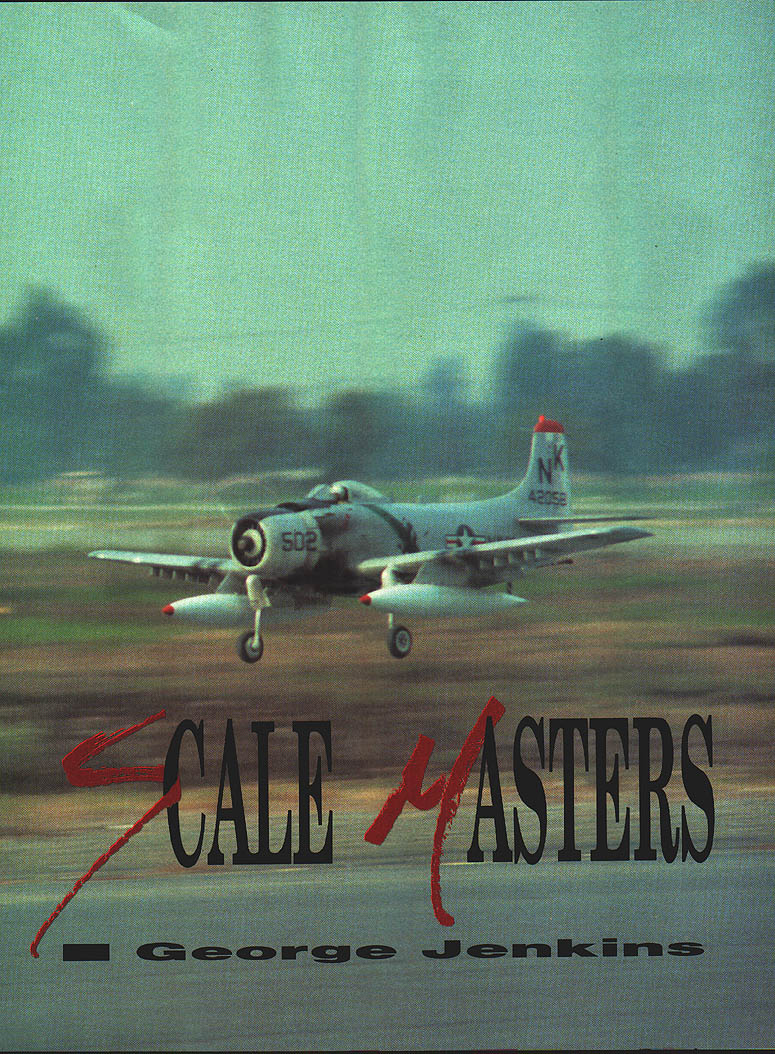
Terry Nitsch was only two points behind at 188.75 with his F-86 built from a Bob Violett kit. Terry also won the Best Graphics award, sponsored by Aero Loft Designs. Terry's F-86 was one of nine jets competing.
Gene Barton's Skyraider—a WWII favorite—placed third with a static score of 95.00 and a close 187.97 total.
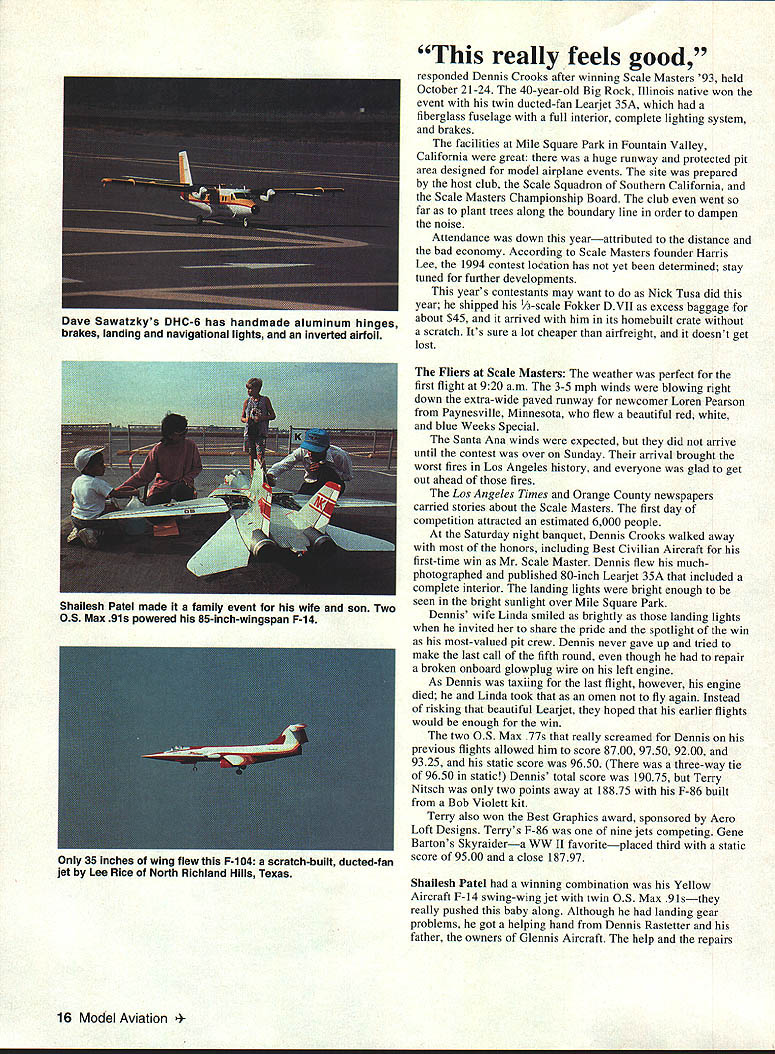
Shailesh Patel had a winning combination with his Yellow Aircraft F-14 swing-wing jet powered by twin O.S. Max .91s. Although he had landing gear problems, he received a helping hand from Dennis Rastetter and his father, the owners of Glennis Aircraft. The help and the repairs were appreciated by Shailesh.
Shailesh also won the award for Best Kit in the Special awards at the Scale Masters banquet. He had qualified with a Corsair for the Regional at this same field in March. Shailesh scored 96.50 in the three-way tie for static points, but he placed fourth with a 187.83 total.
Although Diego Lopez had to be all over the place as contest director, he still managed a fifth-place finish. He was so busy that he forgot to fuel up for his third-round flight and was cut short with a dead-stick landing, scoring only a 53.75. Luckily, competitors were allowed to throw out their worst flight of the five rounds. Diego scored well in all the rest of his flights except for the 87.00 first round.
Don't try this at home unless you have a strong competitive edge when flying under pressure and a reliable model like Diego's Skyraider. Diego asked me to thank his wife Debbie and her assistant, Gail Sharp, for all their hard work prior to the event and for the statistical work they did on the computer during the flights, which ensured that the posted scores stayed up to date.
The scoreboard again featured a photograph of the pilot and his model taken during static judging, so the public could easily associate model and pilot with the scores.
Gordon Truax and Roy Prat also did their fair share of work. John Elliott and Sam Wright handled announcing duties, and Sam's wife operated the video booth, which offered two professionally filmed-and-produced videos of the 1993 Top Gun and the recent Madera races. Eddie Lee helped Harris and the ladies at every turn. Gene Barton both flew and helped Diego while making arrangements for the Scale Masters.
Tom Polapink drew the plans he used to build the WW I Sopwith Snipe that earned him sixth place. His effort also won him the Best Scratch Built Award at the Saturday night banquet. There were only eight scratch-built models.
Tom used Airtronics to guide this 25-pound, 84-inch model. With all the flying wires that had to be attached, it took a good hour to assemble. Tom, go for something easier to put together next year!
Jeff Foley tried for first place again with his Dave Platt A6M3 Model 32 Zero, but he placed seventh after finishing sixth at last year's Scale Masters. This Zero has more than 200 flights and was given the markings and color scheme of an abandoned full-size Zero found in New Guinea in 1942. Jeff scored 94.50—his first two rounds of flight scores in the 70s did not help his chances for higher placement.
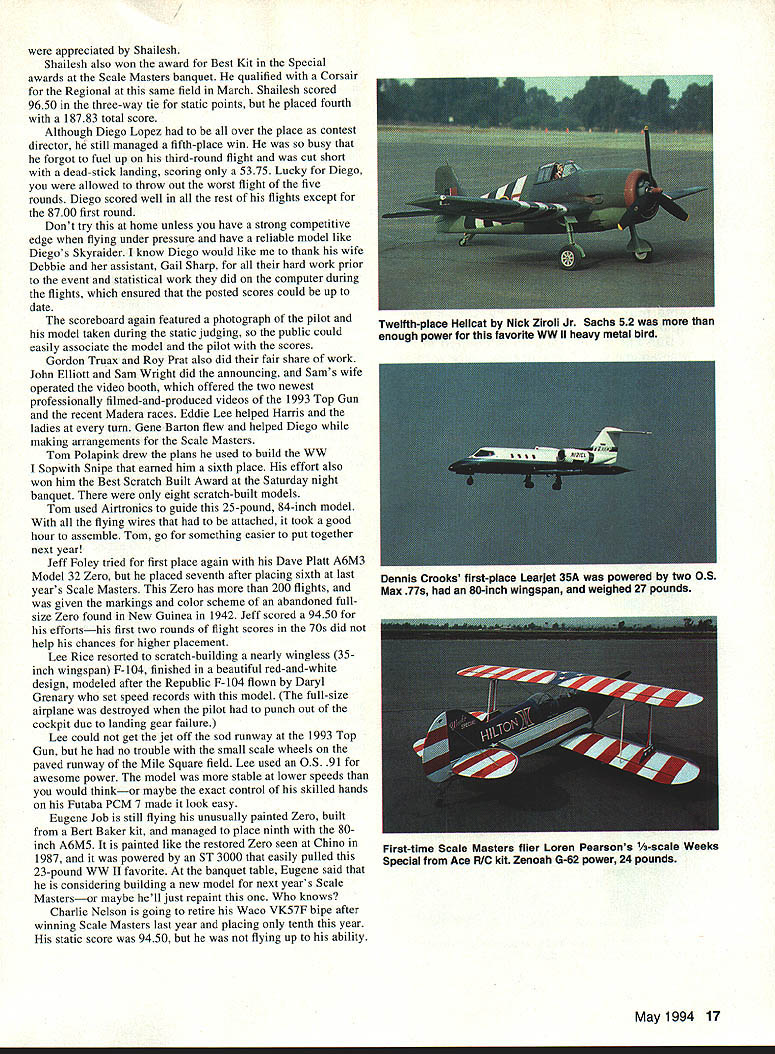
Lee Rice scratch-built a nearly wingless F-104 (35-inch wingspan), finished in a beautiful red-and-white design modeled after the Republic F-104 flown by Daryl Grenary, who set speed records with that model. Lee could not get the jet off the sod runway at the 1993 Top Gun, but he had no trouble with the small-scale wheels on Mile Square's paved runway. Lee used an O.S. .91 for awesome power. The model was more stable at lower speeds than you might think—or perhaps the exact control of his skilled hands on his Futaba PCM 7 made it look easy.
Eugene Job continued flying his unusually painted Zero, built from a Bert Baker kit, and managed to place ninth with the 80-inch A6M5. It is painted like the restored Zero seen at Chino in 1987 and was powered by an ST 3000 that easily pulled this 23-pound WWII favorite. At the banquet, Eugene said he was considering building a new model for next year's Scale Masters—or maybe just repainting this one.
Charlie Nelson will retire his Waco VKS-7F biplane after winning Scale Masters last year and placing only tenth this year. His static score was 94.50, but he felt he was not flying up to his ability. He's not retiring the Waco biplane for good—he's trading it for an even bigger 1/4-scale version of the same model with a new radial engine from Proctor. Charlie had flight shots of the new model, so look for it at Top Gun in 1994.
Other Outstanding Scale Masters
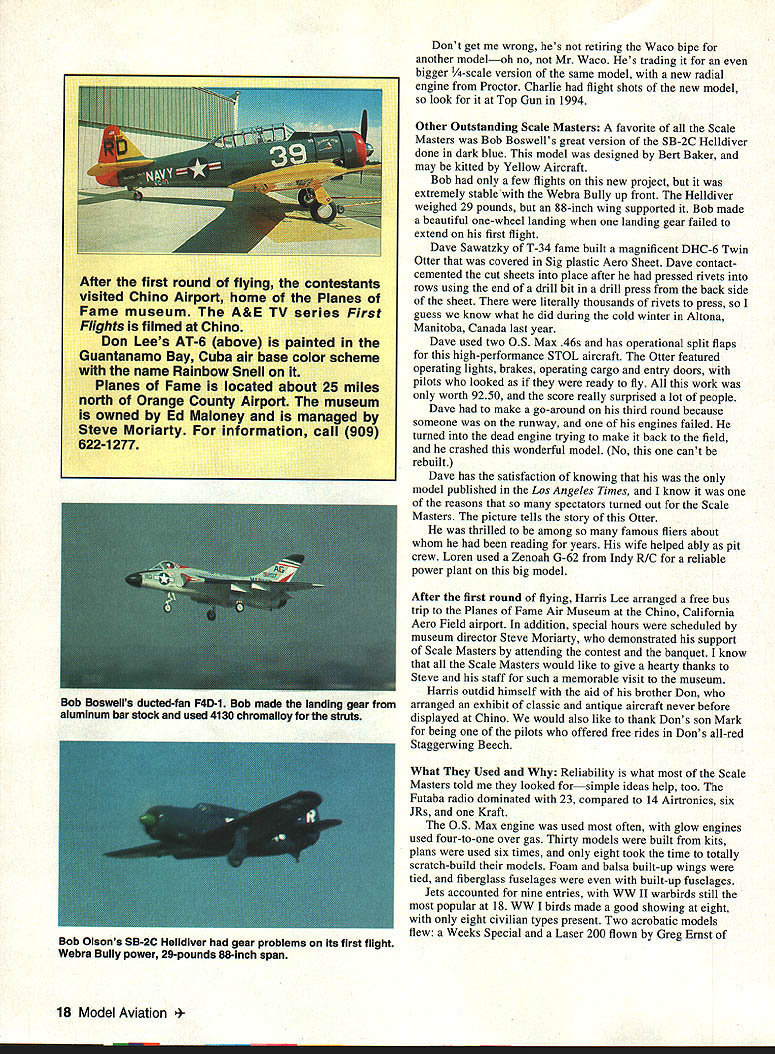
A favorite of all the Scale Masters was Bob Boswell's great version of the SB-2C Helldiver done in dark blue. This model was designed by Bert Baker and may be kitted by Yellow Aircraft. Bob had only a few flights on this new project, but it was extremely stable with the Webra Bully up front. The Helldiver weighed 29 pounds, supported by an 88-inch wing. Bob made a beautiful one-wheel landing when one landing gear failed to extend on his first flight.
Dave Sawatzky of T-34 fame built a magnificent DHC-6 Twin Otter that was covered in Sig plastic Aero-Sheet. Dave contact-cemented the cut sheets into place after he had pressed rivets into rows using the end of a drill bit in a drill press from the back side of the sheet. There were literally thousands of rivets to press—it's what he did during the cold winter in Altona, Manitoba, Canada, last year.
Dave used two O.S. Max .46s and had operational split flaps for this high-performance STOL aircraft. The Otter featured operating lights, brakes, operating cargo and entry doors, and pilots who looked as if they were ready to fly. All this work earned only a 92.50 static score, which surprised a lot of people.
Dave had to make a go-around on his third round because someone was on the runway, and one of his engines failed. He turned into the dead engine trying to make it back to the field and crashed this wonderful model. (No, this one can't be rebuilt.) Dave did have the satisfaction of knowing it was the only model published in the Los Angeles Times, and that the photo helped draw many spectators to the Scale Masters.
After the first round of flying, Harris Lee arranged a free bus trip to the Planes of Fame Air Museum at Chino Airport. Museum director Steve Moriarty demonstrated his support of Scale Masters by attending the contest and the banquet, and special hours were scheduled for the museum visit. All the Scale Masters offered hearty thanks to Steve and his staff for a memorable visit.
Harris outdid himself with the aid of his brother Don, who arranged an exhibit of classic and antique aircraft never before displayed at Chino. Thanks are also due to Don's son Mark, who was one of the pilots who offered free rides in Don's all-red Staggerwing Beech.
What They Used and Why
Reliability was the top priority for most Scale Masters competitors—simple ideas help, too. The Futaba radio dominated with 23 units, compared to 14 Airtronics, six JRs, and one Kraft.
The O.S. Max engine was used most often; glow engines outnumbered gas engines about four-to-one. Thirty models were built from kits, six from plans, and only eight were totally scratch-built. Foam and balsa built-up wings were tried, and fiberglass fuselages were built along with traditional built-up fuselages. Jets accounted for nine entries, with WWII warbirds still the most popular at 18. WWI birds made a good showing at eight, with only eight civilian types present. Two acrobatic models flew: a Weeks Special and a Laser 200 flown by Greg Ernst of Boring, Oregon.
The French propane jet engine (now distributed by Bob Violett Models) impressed the crowds during a demonstration flight at the Scale Masters Noontime Air Show. Kent Nagy flew the jet, but had some trouble landing when a wind gust caused a stall about eight feet off the runway. There was some damage when it hit the ground, but no damage to the jet engine or propane tank, and the model was repairable.
The Future of Scale and Scale Masters
It has taken the dedication of several people who really care about scale aircraft—particularly Harris Lee—to keep the competition going in the United States. It is alarming that only one major manufacturer and one man seem to keep the Scale program alive. There are fewer and fewer scale meets, and the problem may be internal to the hobby.
Most major events are designed for master scale builders rather than average or entry-level builders. It can be intimidating for learners to attend a scale meet and compete against guys who qualify and win the same event year after year.
Harris is attempting to remedy this by allowing those who finished in the top ten at the 1993 Scale Masters to come back next year without having to qualify again. This should make more spots available.
Being in California at the Scale Masters at the wonderful Mile Square field and visiting the Chino Airport was almost too much for the senses. If you couldn't attend, get a video of the event or plan on coming out next year and see it for yourself. There is something for everyone in your family to see and do: the Movieland Wax Museum, the Los Angeles Zoo, Knott's Berry Farm, SeaWorld, and many other attractions in the area should keep everyone entertained while Dad is at the Scale Masters contest.
Manufacturers' Booths at Scale Masters
For the first time, booth space was provided in a long row in front of the flying field. Harris Lee plans to do the same next year, but will also provide a day before Scale Masters starts (possibly during static judging) for manufacturers to demonstrate their wares—what a great idea!
Among Those Who Supported Scale Masters in 1993
- Zap (through the leadership of Hershel Worthy), supporting scale activity in the U.S.
- Futaba Corporation of America (Steve Helms), with Futaba equipment the dominant choice of RC gear at Scale Masters.
- M.A.T. (Model Aviation Technology), introducing the new six-volt gel cell for today's 1/4-scale models.
- Gene Barton, who placed third and had a booth showing his rugged retracts, wheels, and spinners.
- El Pollo Loco, a local sponsor with a food booth and sponsor of official Scale Master shirts given free to pilots and judges.
- Bob Walker of Robart, who supported Scale Masters champion Dennis Crooks.
- JR Radio–Horizon Enterprises, donated a radio for the awards.
- Airtronics, donated a radio and sponsored second-place winner Terry Nitsch and Kent Nagy (who placed eleventh).
- Model Airplane News, a sponsor.
- Bob Holman, showing many scale plans and projects.
- Byron's Originals; Chuck Fuller (the newly ordained Grey Eagle) flew a Byron RV-4 covered in metal.
- JP Products, Scale Instruments, Carl Goldberg Models, Coverite, Fox Manufacturing, Hobbypoxy, and Hobby Shack (which donated many kits, including its new Skyraider as place and drawing prizes).
- Prop Wash Video, which sold VHS tapes of past events and filmed this year's Masters (tapes to be ready to ship by publication).
- Dry-Set, offering durable rub-on dry markings for film-type coverings.
- R/C Report, sponsor.
- Bob Banka, with a booth for Scale Model Research.
- Sig Manufacturing, strong supporter of scale and producer of many reliable scale kits.
- Sullivan Products, showing their new Fuel Fillers.
- Top Gun Aircraft, Tower Hobbies, and Tru-Turn Products, which donated a free book on the "Fighting Lavochkin" 1941–1945 placed in every pilot's registration bag.
- Plane Talk, Scale Specialists, F&M Enterprises, Aero Dynamics, Aviation International, Cermack Electronics, Steve Steel Products, Rogers Custom Products, Don Smith Plans, and Newman Optics.
Many manufacturers contributed additional prizes for the raffle drawing at the end of the meet, helping ensure the Scale Masters would at least break even for Harris Lee and the sponsoring clubs.
I ask that other manufacturers who benefit from the sale of scale products volunteer their support to whatever degree their budgets allow. Sponsor the 1994 Scale Masters by contributing money and product.
Transcribed from original scans by AI. Minor OCR errors may remain.

