
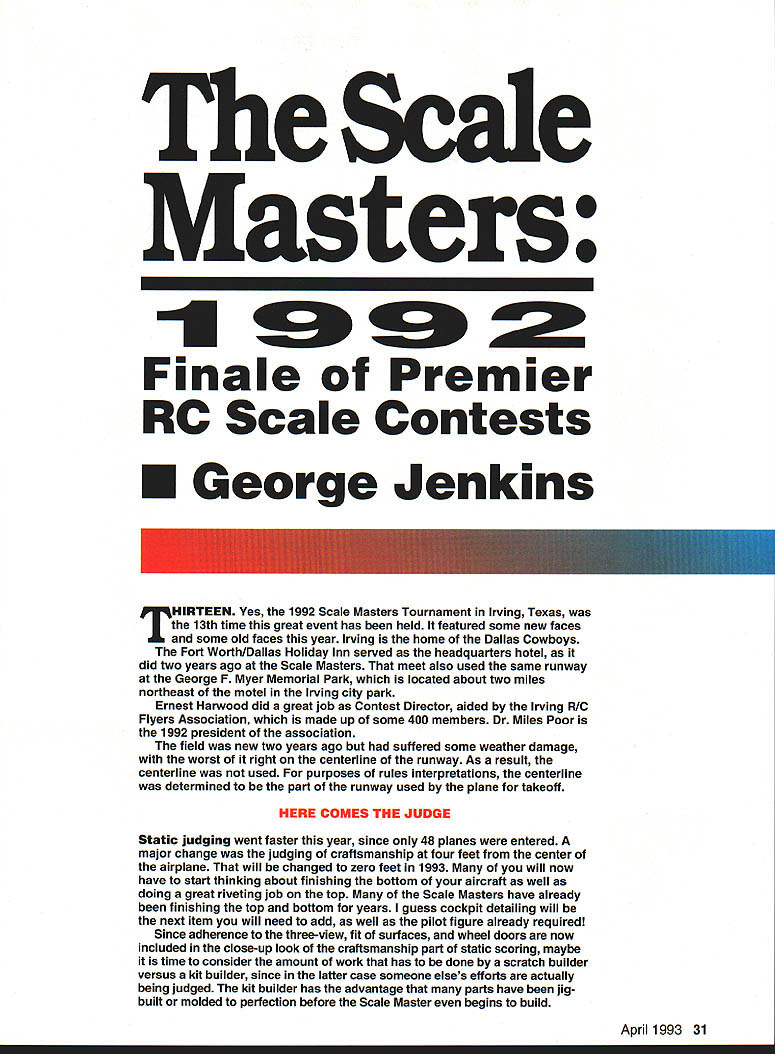
The Scale Masters: 1992 Finale of Premier RC Scale Contests
George Jenkins
THIRTEEN. Yes, the 1992 Scale Masters Tournament in Irving, Texas, was the 13th time this great event has been held. It featured some new faces and some veterans. Irving is the home of the Dallas Cowboys. The Fort Worth/Dallas Holiday Inn served as headquarters, as it did two years ago. The meet used the same runway at the George F. Myer Memorial Park, about two miles northeast of the motel in the Irving city park.
Ernest Harwood did a great job as Contest Director, aided by the Irving R/C Flyers Association, which has about 400 members. Dr. Miles Poor is the 1992 president of the association.
The field had been rebuilt two years ago but suffered some weather damage, with the worst of it right on the centerline of the runway. As a result, the centerline was not used. For rules interpretations, the centerline was determined to be the part of the runway used by the plane for takeoff.
Here Comes the Judge
Static judging and craftsmanship
Static judging moved faster this year; only 48 planes were entered. A major change in craftsmanship judging was the close-up inspection distance: judges evaluated craftsmanship close to the model (the four-foot rule used in 1992 was slated to change to zero feet for 1993). That means modelers will have to finish the bottom of their aircraft as well as the top. Many top Scale Masters already finish both sides, and cockpit detailing (the pilot figure is already required) will likely become more important.
Because three-view adherence, fit of surfaces, and wheel doors are now included in the close-up craftsmanship portion of static scoring, there is renewed discussion about kit builders versus scratch builders. Kit builders benefit from parts that have been jig-built or molded to perfection before assembly; scratch builders start from drawings and build most parts themselves. Some have suggested two categories: a Masters class for models that are largely scratch-built, and a Builder class for kit-based models. This would allow competitors to be judged against others with similar construction requirements and might encourage more scratch-built entries.
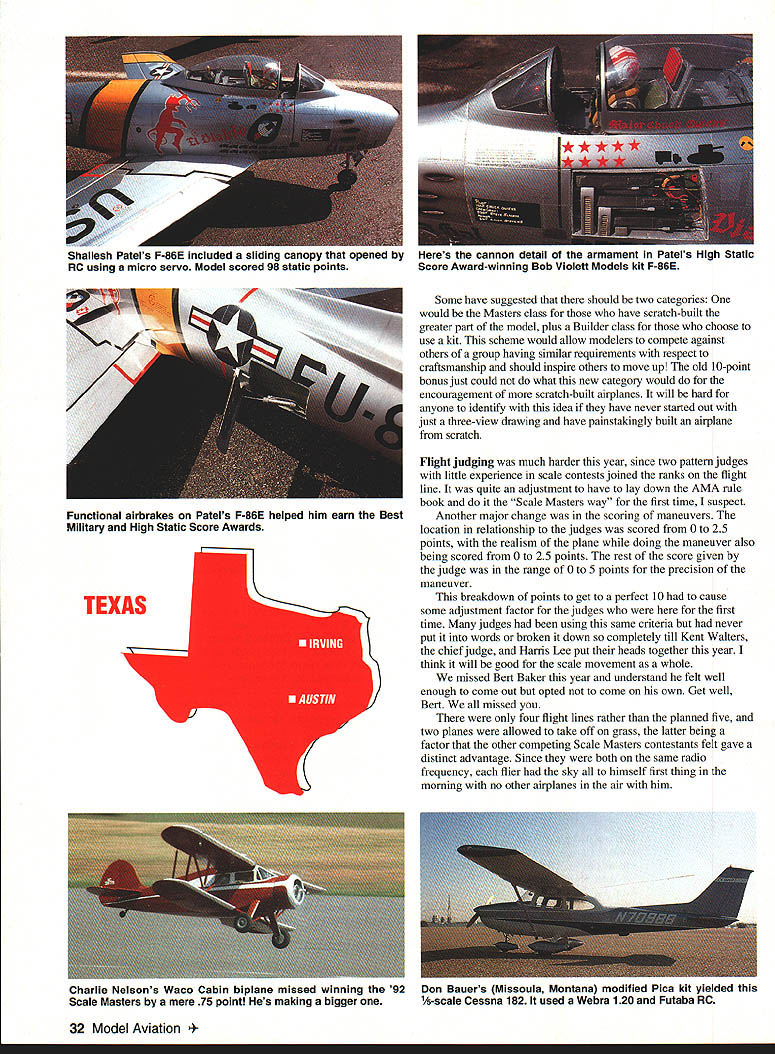
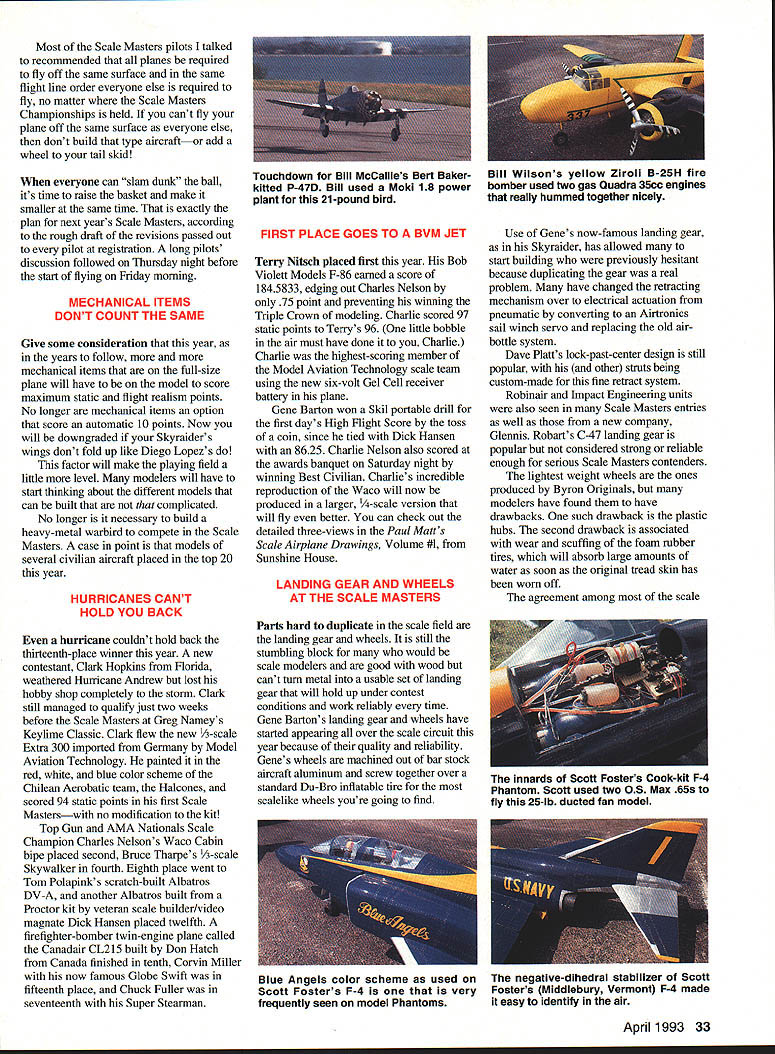
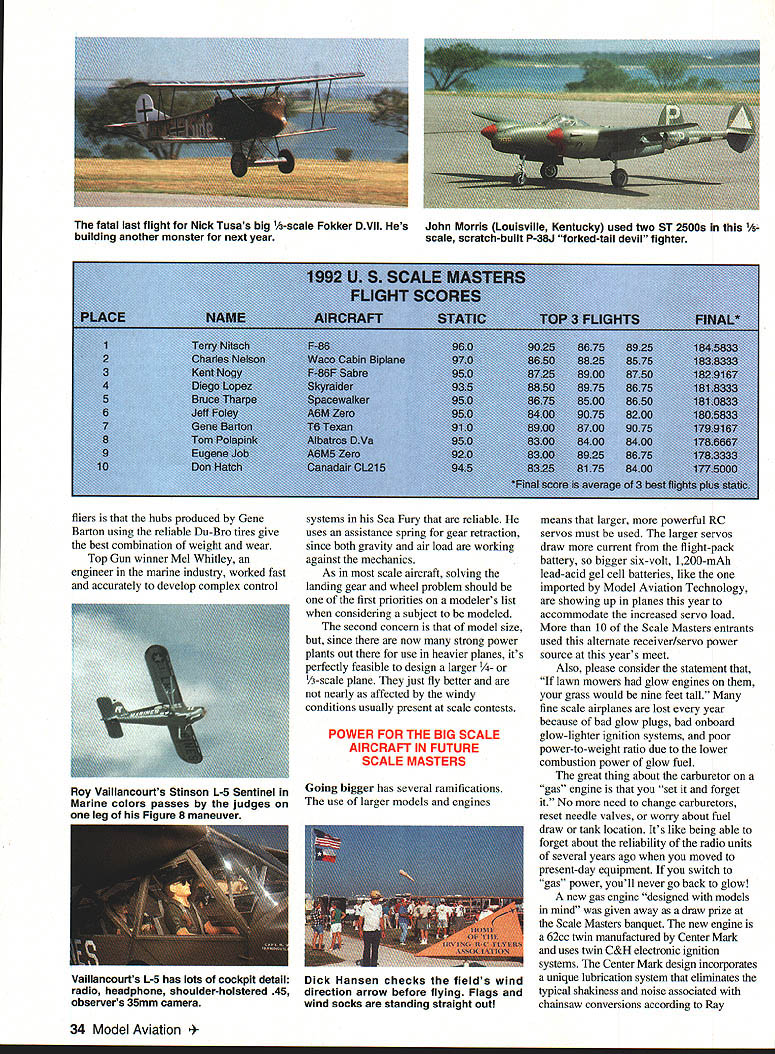
Notable static details: the High Static Award-winning F-86E built by Shallesh Patel (El Diablo) displayed exceptional installation of guns, graphics, panel lines, flush riveting, and operating slats/air brakes. Patel also installed a servo-driven opening canopy and scored 98 static points out of 100.
Flight judging and scoring
Flight judging was more challenging this year because two pattern judges with little scale-contest experience joined the flight line. It took an adjustment to apply the Scale Masters style rather than standard AMA pattern practice.
A major change in maneuver scoring broke a perfect 10 down into three parts:
- Location in relation to the judges: 0 to 2.5 points
- Realism of the plane while doing the maneuver: 0 to 2.5 points
- Precision of the maneuver: 0 to 5 points
Kent Walters (chief judge) and Harris Lee clarified and formalized this breakdown, which should help consistency among judges and benefit the scale movement.
Flight-line issues
There were only four flight lines rather than the planned five. Two planes were allowed to take off from grass, which other competitors felt gave those pilots a distinct advantage: since they were on the same radio frequency, each pilot had the sky to himself early in the morning with no other airplanes aloft. Many contestants recommended that all planes be required to fly off the same surface and in the same flight-line order, wherever the Scale Masters championships are held. If a plane can't use the common surface, pilots were advised to design or adapt their model accordingly.
When everyone can "slam dunk" the ball, it's time to raise the basket and make the target smaller. That was the plan for next year's Scale Masters, according to a rough draft of rule revisions distributed at registration. A long pilots' discussion preceded the flying.
Mechanical items don't count the same
More and more mechanical items that exist on the full-size prototype are expected on models to score maximum static and flight realism points. Mechanical details such as retractable landing gear, flaps, wing slats, and air brakes will no longer be optional items that automatically score top points; they must operate prototypically to earn full credit.
This change levels the playing field. Modelers may choose to build subjects that are less complicated mechanically, and it is no longer necessary to build a heavy-metal warbird to place well—several civilian aircraft placed in the top 20.
Hurricanes can't hold you back
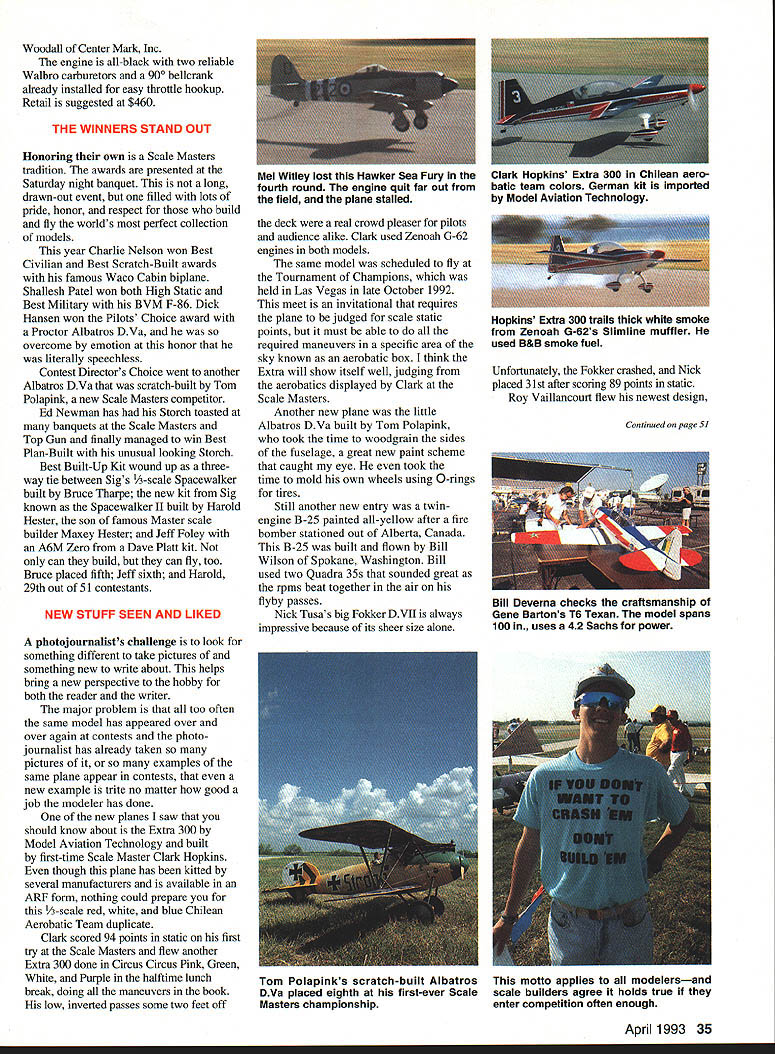
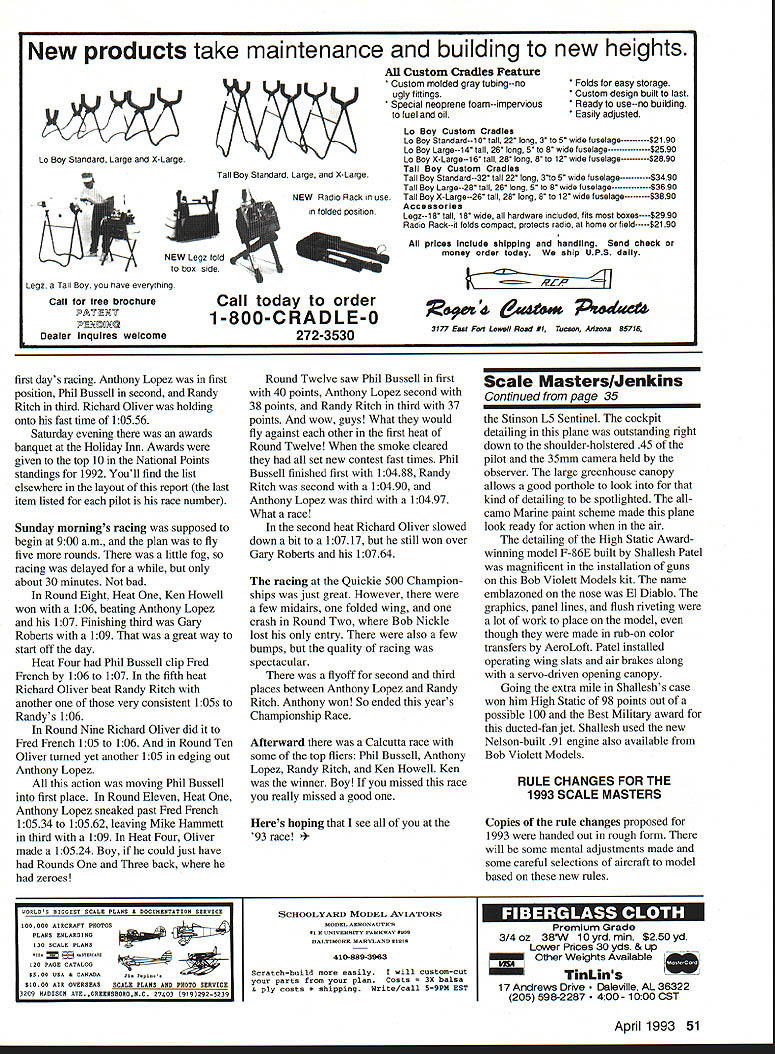
Even a hurricane couldn't hold back the thirteenth-place winner. New contestant Clark Hopkins of Florida weathered Hurricane Andrew but lost his hobby shop in the storm. Clark still qualified two weeks before Scale Masters at Greg Namey's Keylime Classic. He flew a new 1/3-scale Extra 300 imported by Model Aviation Technology, painted in the red, white, and blue scheme of Chile's Halcones aerobatic team, and scored 94 static points in his first Scale Masters—with no kit modification. He used Zenoah G-62 engines and also flew another Extra 300 in a colorful "Circus Circus" scheme during the lunch break, delighting the crowd with low inverted passes.
First place and top finishes
Terry Nitsch placed first. His Bob Violett Models F-86 earned a score of 184.5833, edging out Charlie Nelson by only 0.75 point and preventing Nelson from winning the Triple Crown of modeling. Charlie scored 97 static points to Terry's 96.
Top placings included:
- 1st: Terry Nitsch — BVM F-86 (184.5833)
- 2nd: Charlie Nelson — Waco Cabin biplane (Top Gun and AMA Nationals Scale Champion)
- 4th: Bruce Tharp — 1/3-scale Spacewalker
- 5th: Bruce Tharp — (also listed among Best Built-Up Kit winners)
- 6th: Jeff Foley — A6M Zero (from Dave Piatt kit)
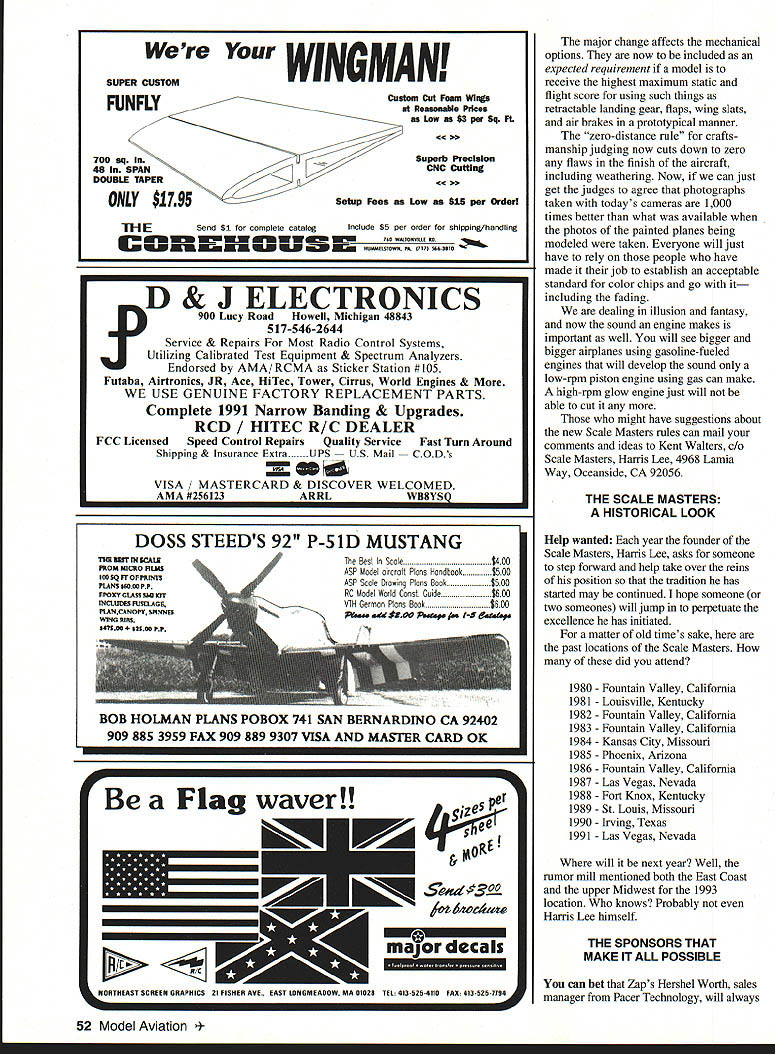
- 8th: Tom Polapink — scratch-built Albatros D.Va
- 10th: Don Hatch (Canada) — Canadair CL-215 firefighting bomber twin
- 12th: Dick Hansen — Proctor kit Albatros D.Va
- 15th: Corwin Miller — Globe Swift
- 17th: Chuck Fuller — Super Stearman
- 29th: Harold Hester — Spacewalker II
- 51 contestants in total
Special mentions:
- Clark Hopkins (new entrant) — 1/3-scale Extra 300, 94 static points
- Gene Barton won a Skil portable drill for first day's High Flight Score by coin toss after tying with Dick Hansen at 86.25
- A Model Aviation Technology team member's receiver power used a six-volt gel-cell battery in some entries
The winners stand out (awards)
Awards were presented at the Saturday night banquet. Highlights:
- Best Civilian and Best Scratch-Built: Charlie (Charles) Nelson — Waco Cabin biplane
- High Static and Best Military: Shallesh Patel — BVM F-86 (High Static 98/100)
- Pilots' Choice: Dick Hansen — Proctor Albatros D.Va
- Contest Director's Choice: Tom Polapink — scratch-built Albatros D.Va
- Best Plan-Built: Ed Newman — unusual Storch
- Best Built-Up Kit (three-way tie):
- Bruce Tharp — Sig 1/3-scale Spacewalker
- Harold Hester — Sig Spacewalker II
- Jeff Foley — A6M Zero (Dave Piatt kit)
Landing gear and wheels at the Scale Masters
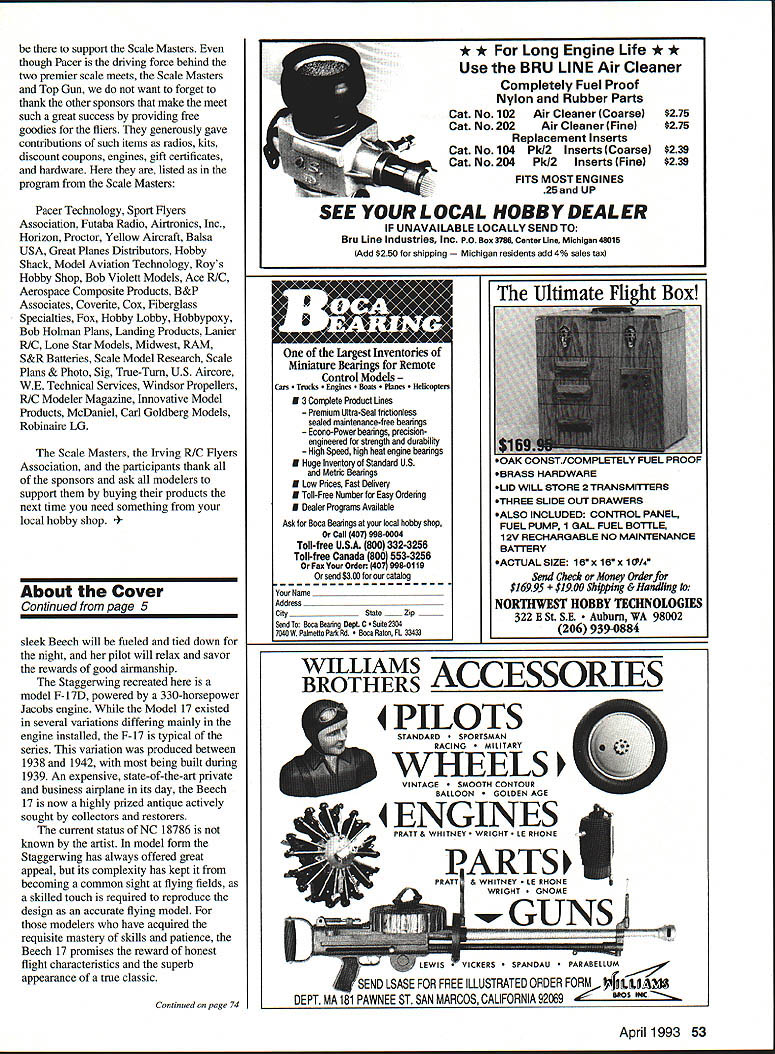
Landing gear and wheels remain one of the most difficult areas for scale modelers, especially those skilled with wood but less so with turned metal. Gene Barton's landing gear and wheels have become popular because they are machined from aircraft aluminum, screw together over standard Du-Bro inflatable tires, and provide a durable, scale-like result. Use of Barton's gear has enabled many builders who previously hesitated to start scale aircraft.
Common trends and hardware seen:
- Conversion from pneumatic to electric retract actuation using an Airtronics sail winch servo and replacing oil-air bottle systems
- Dave Platt's lock-past-center design and custom struts remain popular
- Robinaid and Impact Engineering retract units were seen, as well as units from a newer company, Glennis
- Robart's C-47 gear is popular but not considered robust enough for serious contenders
- Byron Originals makes the lightest wheels but with plastic hubs and foam-rubber tire wear issues
- Many fliers agreed Gene Barton's hubs combined with Du-Bro tires gave the best mix of weight and durability
Top Gun winner Mel Whitley developed complex and reliable control systems for his Sea Fury, using an assistance spring for gear retraction where gravity and air loads work against the mechanism.
Solving landing gear and wheel problems should be a top priority; model size is the second concern. Larger 1/4- and 1/3-scale planes fly better and are less affected by wind, and stronger power plants are now available for heavier models.
Power for the big scale aircraft in future Scale Masters
Going bigger requires larger, more powerful servos and greater receiver power. More entrants used larger six-volt, 1,200-mAh lead-acid gel-cell batteries to handle increased servo load—over 10 entrants used this alternate receiver/servo power source at this meet.
Many big-scale airplanes fail each year because of glow-engine issues (bad glow plugs, poor onboard ignition, or marginal power-to-weight from glow). Gasoline engines offer a "set it and forget it" reliability: consistent carburetion, no frequent needle adjustments, and fewer fuel-draw issues. A new 62cc twin gas engine designed for models (Center Mark) was given away at the banquet; it uses twin C&H electronic ignitions, twin Walbro carburetors, a unique lubrication system, and a 90° bellcrank for throttle hookup. Suggested retail was about $460.
New stuff seen and liked
Photographers and writers look for fresh subjects. Notable new or eye-catching entries this year:
- Clark Hopkins' 1/3-scale Extra 300 (Model Aviation Technology) — Chilean Aerobatic Team scheme, 94 static points, dynamic aerobatics
- Tom Polapink's small Albatros D.Va — careful woodgrain sides and molded wheel wells using O-rings for tires
- Bill Wilson's yellow B-25 fire bomber from Alberta — twin Quadra 35 engines with a pleasing sound on flybys
- Nick Tusa's large Fokker D.VII — impressive due to sheer size
The Extra 300 was also scheduled to fly at the Tournament of Champions in Las Vegas later in the year; its aerobatic capabilities suggested it would perform well in that invitational.
Rule changes for the 1993 Scale Masters
Rough copies of proposed 1993 rule changes were handed out. Major points:
- Mechanical options (retracts, flaps, slats, air brakes) are expected requirements to receive maximum static and flight realism scores—operating prototypically is required.
- The "zero-distance rule" for craftsmanship will reduce tolerance for finish flaws; judges will inspect at zero distance to the extent practical, including weathering effects.
- Greater emphasis on accurate color matching and standards was discussed; modelers and judges will rely on established color-chip standards where available.
- Sound is becoming part of realism: larger gasoline-fueled engines producing low-rpm, full-scale-like sound will be increasingly expected over high-rpm glow engines.
Suggestions and comments on the new rules may be mailed to Kent Walters, c/o Scale Masters, Harris Lee, 4968 Lamia Way, Oceanside, CA 92056.
The Scale Masters: a historical look
Harris Lee, founder of the Scale Masters, annually asks for volunteers to help continue the tradition he started. Past locations of the Scale Masters:
- 1980 - Fountain Valley, California
- 1981 - Louisville, Kentucky
- 1982 - Fountain Valley, California
- 1983 - Fountain Valley, California
- 1984 - Kansas City, Missouri
- 1985 - Phoenix, Arizona
- 1986 - Fountain Valley, California
- 1987 - Las Vegas, Nevada
- 1988 - Fort Knox, Kentucky
- 1989 - St. Louis, Missouri
- 1990 - Irving, Texas
- 1991 - Las Vegas, Nevada
Rumors for the 1993 location mentioned both the East Coast and the upper Midwest.
The sponsors that make it all possible
Pacer Technology (Zap's Hershel Worth) is the driving force behind the Scale Masters and Top Gun, but many other sponsors contributed prizes and support. The Scale Masters, the Irving R/C Flyers Association, and the participants thank them and ask modelers to support these companies:
- Pacer Technology
- Sport Flyers Association
- Futaba Radio
- Airtronics, Inc.
- Horizon
- Proctor
- Yellow Aircraft
- Balsa U.S.A.
- Great Planes Distributors
- Hobby Shack
- Model Aviation Technology
- Roy's Hobby Shop
- Bob Violett Models
- Ace R/C
- Aerospace Composite Products
- B&P Associates
- Covertite
- Cox
- Fiberglass Specialties
- Fox
- Hobby Lobby
- Hobbypro
- Bob Holman Plans
- Landing Products
- Lanier R/C
- Lone Star Models
- Midwest
- RAM
- S&R Batteries
- Scale Model Research
- Scale Plans & Photo
- Sig
- True-Turn
- U.S. Aircore
- W.E. Technical Services
- Windsor Propellers
- R/C Modeler Magazine
- Innovative Model Products
- McDaniel
- Carl Goldberg Models
- Robinair LG
The Scale Masters, the Irving R/C Flyers Association, and the participants thank all sponsors and encourage modelers to support them through purchases at local hobby shops.
Transcribed from original scans by AI. Minor OCR errors may remain.

