
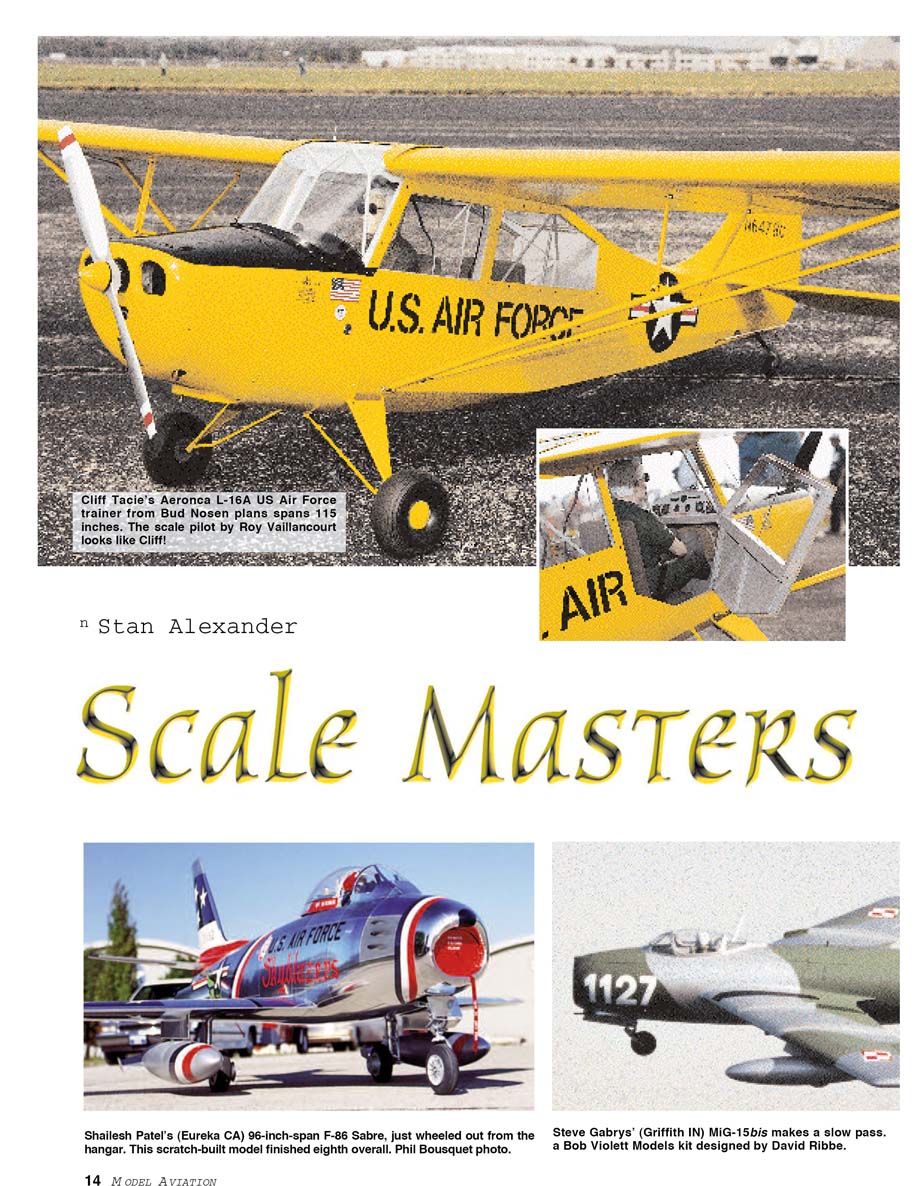
by Stan Alexander
Scale Masters
Dayton, Ohio became the cradle of aviation 97 years ago; it is where the Wright Brothers designed the first powered aircraft that eventually flew at Kitty Hawk, NC. This year, the Scale Masters Association landed at Wright-Patterson Air Force Base on the U.S. Air Force Museum grounds in Dayton, which is the oldest and largest military aviation museum in the world. The museum officially became the U.S. Air Force Museum in 1956, although it was originally located at McCook Field in 1923.
Many aircraft in the museum are presented in dioramas that depict the time and era of the airplane type. The history of aviation is represented from the Wright 1909 Military Flyer to the latest F-117 Stealth Fighters and the YF-22. The aircraft range in size from the B-52 and the B-36 to the J-3 Cub. Besides aircraft, missiles, hardware, uniforms, art prints, engines, models, and a host of other artifacts fill the museum.
The Scale Masters event was held on the museum grounds October 11–15. Contestants and officials felt lucky it wasn’t held a week earlier, when the weather was poor with 30° temperatures and snow flurries. A high-pressure front moved into the area, providing great weather during the five days of activities. Everyone breathed a sigh of relief that Mother Nature cooperated.
Static judging
Most scale competitions begin with static judging, where models are evaluated against the documentation of the full-scale aircraft presented to judges by the contestants. Note that entrants are judged by the documentation: a poor documentation package (photos, color chips, and scale three-view drawings) can ruin a good static score quickly. Everything on the model should match the provided material.
The Masters program is run the same way. It guarantees that all competitors receive static scores before they put in their second flight. However, competitors must have flown at least once to receive a static score.
Static judging was held in front of the museum, in the memorial area. All 76 aircraft were judged Thursday, and the process took roughly nine hours to complete. The field was strong: more than 60 of the 76 aircraft scored 90 points or higher in static judging.
Dinner and museum access
A dinner was held Thursday evening in the Modern Flight Hangar. This was to be open-cockpit night for everyone attending the Masters Championships, but the cockpits were off-limits because of a variety of problems. Talking to a volunteer in the World War II hangar, I learned that a group earlier in the year damaged several aircraft; the cost was too great for the limited museum staff to keep repairing seats and replacing stolen parts.
It's shameful that people can't respect these museum aircraft and revel in the opportunity to sit in some of the most historic aircraft on the planet. During the Scale Masters dinner in 1995, many of us were able to sit in the cockpit of a B-17, a B-24, a B-36, an SR-71, and an F-117.
Mike Barbee held a brief pilots' meeting after the dinner and announced the flight order for the next day. Mike and the Westerville Model Aeronautics Association organized the contest, and they have a commitment with the USAF Museum to hold the event again in 2003—the 100th anniversary of powered flight. Many of us were able to "go behind the ropes" and get close-up shots of cockpits and other interesting displays that fill the museum.
Classes and flight competition
There were two classes contested: Expert and Team Scale. The Expert class had the majority of the modelers, with 66 entries, and the Team event drew 10 entries.
Flight competition began on a crisp Friday the 13th, with little or no wind. The runway is situated so the sun is at your back the entire day; that really helped the judges, who put in long days under mostly sunny skies.
A variety of aircraft types, common to any scale competition, is what many modelers and spectators enjoy. This year was no different; almost every era was represented. The field included:
- 4 jets
- 10 World War I subjects
- 27 World War II models
- 18 civil aircraft models
- 6 multiengine models
- 3 electric-powered subjects
- 7 military models
Several models could have been classified in two or more categories. The rest of the entries were spread throughout decades of aviation history.
Notable models and competitors
Many of the aircraft were impressive—some have been on the contest circuit for several years. Each year, however, new aircraft stand out in one or more ways.
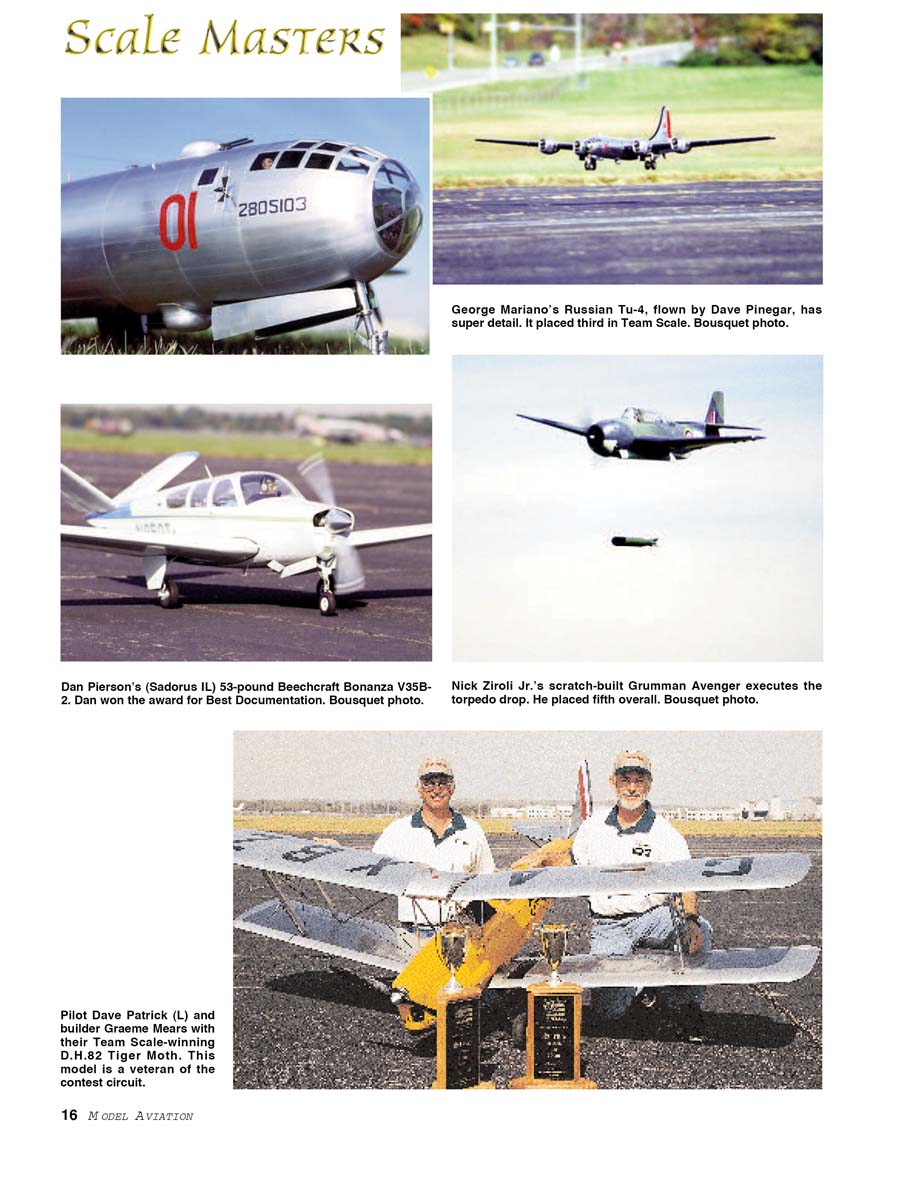
- The most impressive model this year was the Team Scale entry built by George Mariano of Warren, MI: a scale replica of a Tu-4 (a Russian copy of the B-29). George designed this 27¼-pound model around four motors, and the covering was aluminum. This was the most impressive of the four electric-powered entries at the championships.
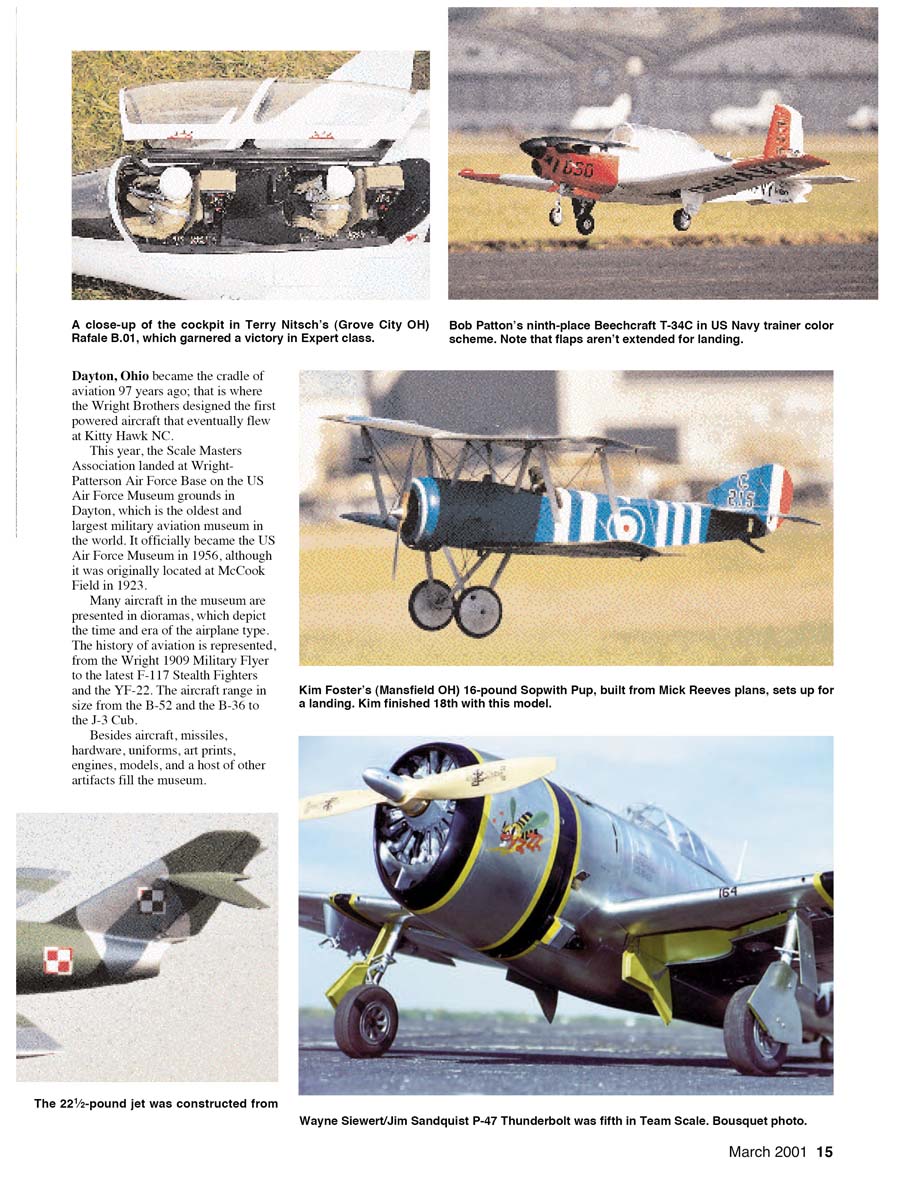
- An impressive jet that wasn't quite ready to fly was Shailesh Patel's North American F-86. Shailesh built the model from factory drawings and measurements he took while at the USAF Museum a few years ago. The F-86's wingspan and length were each 96 inches. Covering was Coverite Presto Metallic Chrome and PPG paint. It was powered by an Olympus turbine with 35 pounds of thrust and controlled with a Futaba ZAP radio. The F-86 had operational lights, a sliding canopy, and retracts. Its construction was a fiberglass fuselage with a foam wing; Shailesh contracted the machinist at Glennis Aircraft to make the landing gear. The big jet weighs 49–51 pounds depending on batteries, and Shailesh has close to $20,000 invested in the model.
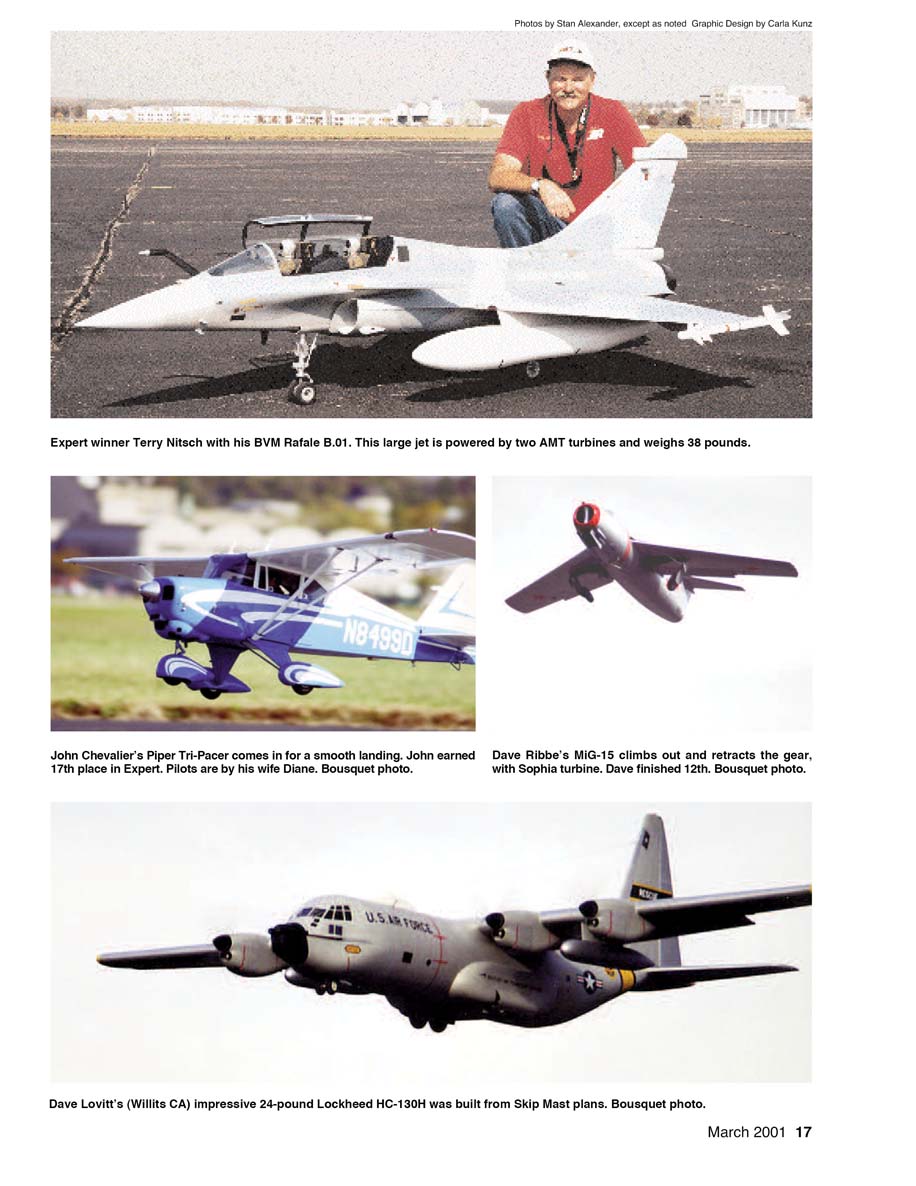
- The winner's circle included familiar names: pilot Dave Patrick and builder Graeme Mears returned with the D.H.82 Tiger Moth—a veteran of the contest circuit. The big biplane spanned 111 inches and was powered by a Moki 3.6 in-line twin two-stroke engine. Built from Frederick Beard plans, the British trainer weighed 35 pounds. Dave and Graeme took first place in a hotly contested class; the top three teams finished less than two points apart.
- Greg Hahn and builder Tim Schurick brought a 96-inch-span OV-10 Bronco to compete in Team Scale. Combining Greg's smooth flying with a static score of 96.00, the team finished second—just ahead of George Mariano and pilot Dave Pinegar's Tu-4, which also received a static score of 96.00. The Tu-4 was quiet, graceful, and strangely realistic in the air; up close you could see the detailed application of individual aluminum panels. George used new MaxClim MAXNEO-13V electric motors in the 115-inch-span model. The batteries consumed the bomb bays, and George utilized them for battery-access panels. Newlywed Dave Pinegar performed piloting duties and skillfully guided the big bomber to a third-place finish.
In Expert class, familiar names and faces were in the top five: Nick Ziroli Jr., Jeff Foley, Greg Hahn, and Mike Barbee. For the first time in memory, Terry Nitsch made a clean sweep of the year's three major scale competitions. Terry won at Top Gun five times with three different aircraft. The year 2000 was his Rafale B.01's first competition; it usually takes a year or two to break in a new model. Terry built his documentation packet, modeled the airframe for which he had the most data, then practiced extensively. "This is the best jet I've flown; it really handles great," he said.
Vanguard leader Mike Barbee did a great deal of the legwork to make sure everything went smoothly and that the Scale Masters was able to land at Dayton this year. Mike is also a competitor; his bright-yellow WACO YMF-5 biplane is a familiar sight at contests and fly-ins. The model had a smoke option in flight—much like the airshow aircraft—and Mike finished a close second to Terry Nitsch with a total score of 192.167.
Greg Hahn rounded out the top three with his SBD Dauntless, a favorite of modelers around the world. Greg won this event in Arizona last year. The big dive-bomber was built from Ziroli plans and weighed 44 pounds. Greg finished the model in the paint scheme of the Atlantic sub-hunters, using a color photo from the era as reference.
Future sites
Next year's site hadn't been chosen yet; it might be Arizona or Oregon. This is the only national scale championship that still travels around the country. Top Gun seems settled at the West Palm Beach Polo Club (FL), and the Scale National Championships is held each year at AMA Headquarters in Muncie, IN. We look forward to hearing where the Scale Masters will land in 2001.
Sponsors
Sponsors play a big part in any scale competition. For the past 21 years, Pacer Technology has been onboard with the U.S. Scale Masters Championships. Director of sales Herschel Worthy represented Pacer at this event. The Zap Tap Room at the local Holiday Inn has become a standard place to let your hair down and cool off after a long day at the field. Bob Walker of sponsoring Robart Manufacturing (landing-gear struts, retract systems) also attended.
The Scale Masters Association thanks the following sponsors, without which the Championships could not have taken place:
- Platinum:
- Airtronics Radio Systems
- Cal Crop USA
- Gold:
- Barbee Concrete & Construction Co.
- ZAP-Pacer Technology
- Silver:
- Bob Smith Industries
- Proctor Enterprises
- Sun Valley Fliers
- Vailly Aviation
- Patron:
- Bob Holman Plans
- Funkshun Graphics
- William Brothers, Inc.
- Associate:
- Gene Barton Landing Gear
- Hansen Scale Aviation Videos
- Scale Model Research
- Scale Specialties
- Friends:
- Lockheed Martin Fairchild Systems
- SKS Video Productions
- USMSA Webmaster Art Newland
Author
Stan Alexander 3709 Valley Ridge Dr. Nashville, TN 37211 onawing@mindspring.com
Transcribed from original scans by AI. Minor OCR errors may remain.

