
SCALE MASTERS
Stan Alexander
Terry Nitsch edges Greg Hahn at Columbus
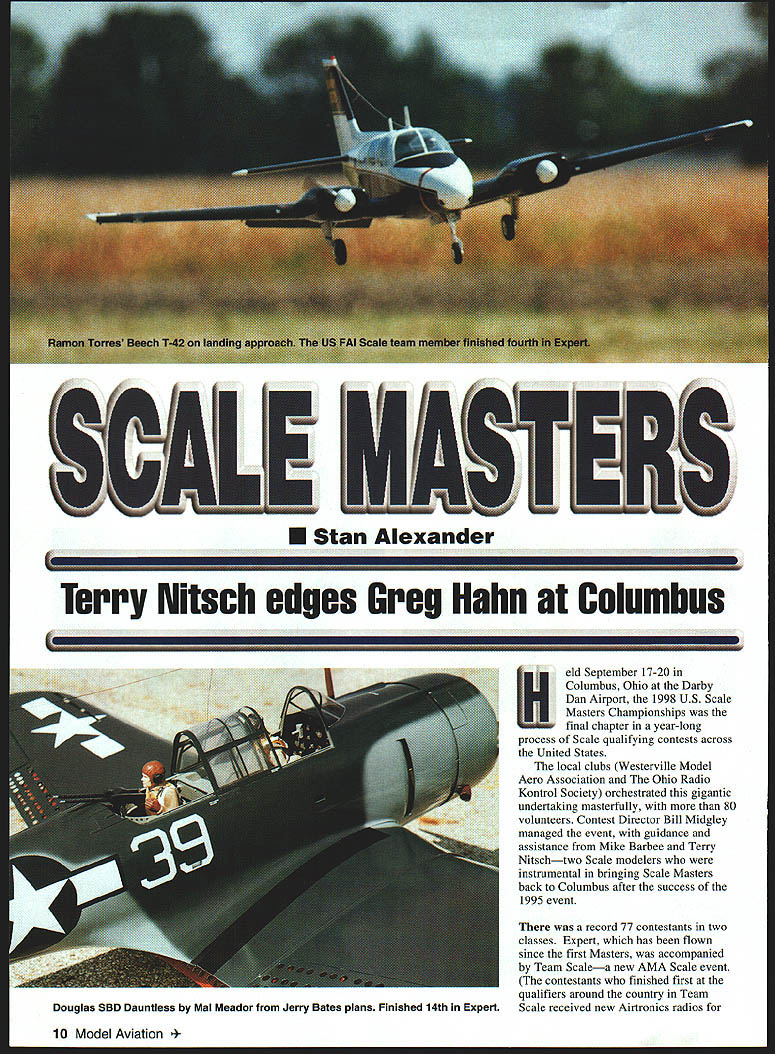
Held September 17–20 in Columbus, Ohio, at the Darby Dan Airport, the 1998 U.S. Scale Masters Championships was the final chapter in a year-long process of Scale qualifying contests across the United States.
The local clubs (Westerville Model Aero Association and The Ohio Radio Kontrol Society) orchestrated this gigantic undertaking masterfully, with more than 80 volunteers. Contest Director Bill Midgley managed the event, with guidance and assistance from Mike Barbee and Terry Nitsch—two Scale modelers who were instrumental in bringing Scale Masters back to Columbus after the success of the 1995 event.
There was a record 77 contestants in two classes. Expert, which has been flown since the first Masters, was accompanied by Team Scale—a new AMA Scale event. The contestants who finished first at the qualifiers around the country in Team Scale received new Airtronics radios for their efforts. Sponsorship and support help to fuel the local and regional levels of competition. "Big" John Elliot Jr. and Airtronics should be commended for their foresight and commitment to the program.
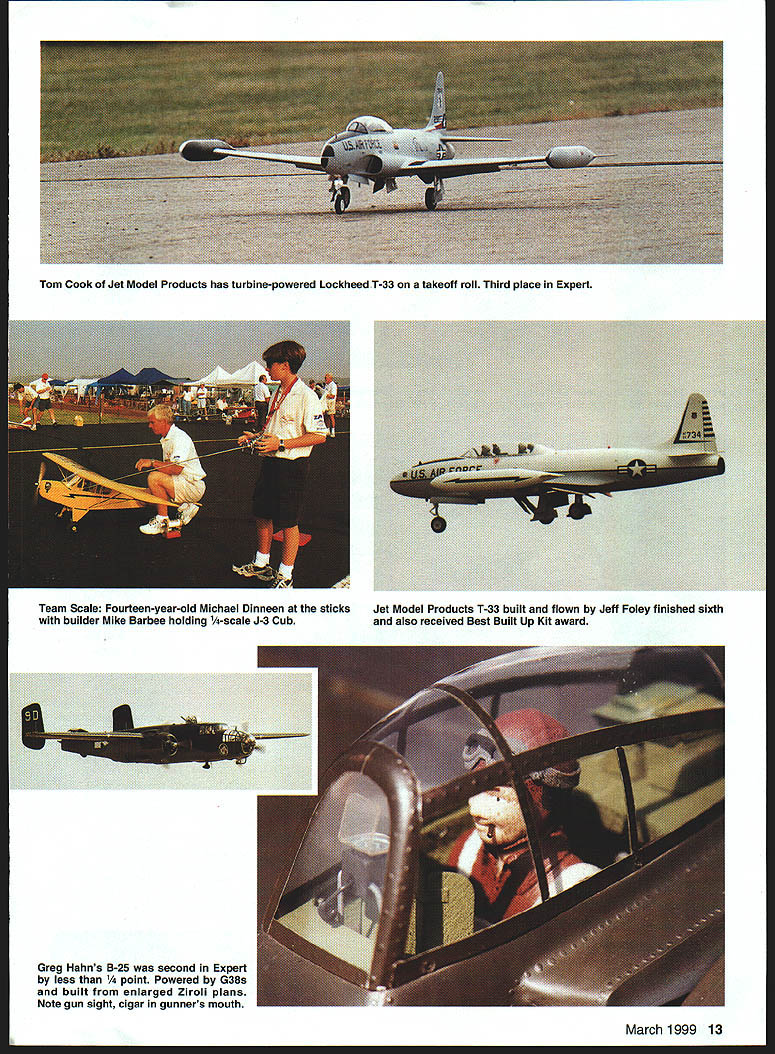
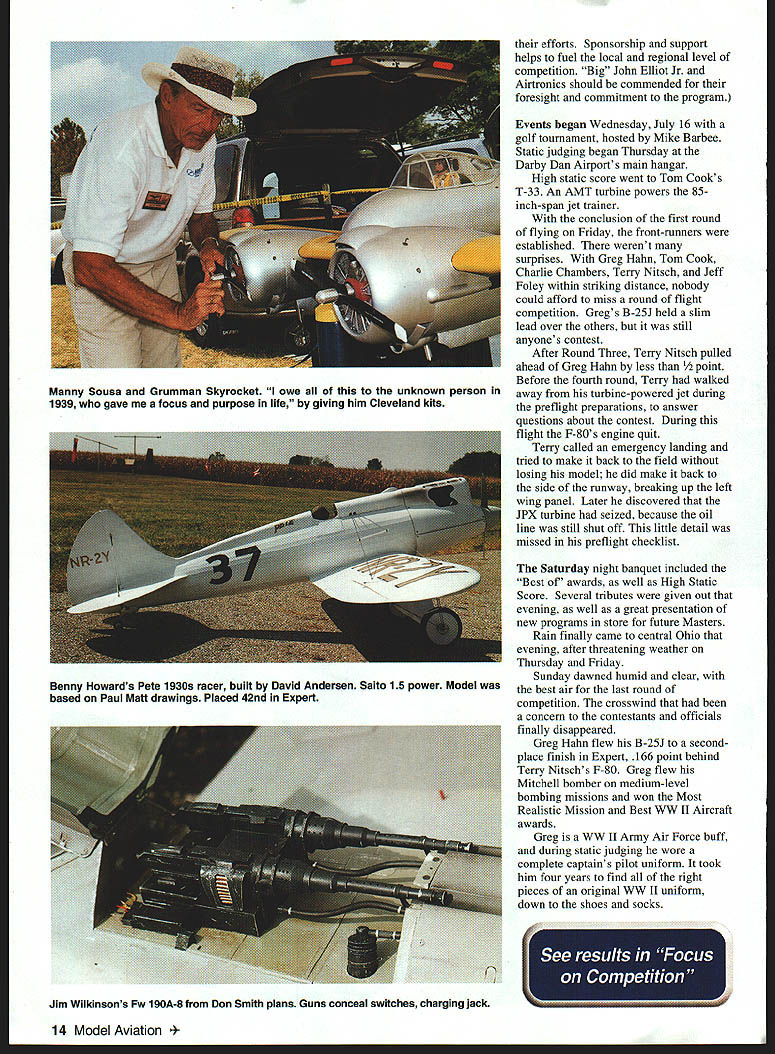
Events began Wednesday, September 16 with a golf tournament hosted by Mike Barbee. Static judging began Thursday at the Darby Dan Airport's main hangar. High static score went to Tom Cook's T-33. An AMT turbine powers the 85-inch-span jet trainer.
With the conclusion of the first round of flying on Friday, the front-runners were established. There weren't many surprises. With Greg Hahn, Tom Cook, Charlie Chambers, Terry Nitsch, and Jeff Foley within striking distance, nobody could afford to miss a round of flight competition. Greg's B-25J held a slim lead over the others, but it was still anyone's contest.
After Round Three, Terry Nitsch pulled ahead of Greg Hahn by less than half a point. Before the fourth round, Terry walked away from his turbine-powered jet during preflight preparations to answer questions about the contest. During that flight the F-80's engine quit. Terry called an emergency landing and tried to make it back to the field without losing his model; he did make it back to the side of the runway, breaking up the left wing panel. Later he discovered that the JPX turbine had seized because the oil line was still shut off. This little detail was missed in his preflight checklist.
The Saturday night banquet included the "Best of" awards as well as High Static Score. Several tributes were given out that evening, along with a presentation of new programs in store for future Masters. Rain finally came to central Ohio that evening, after threatening weather on Thursday and Friday.
Sunday dawned humid and clear, with the best air for the last round of competition. The crosswind that had been a concern to the contestants and officials finally disappeared.
Greg Hahn flew his B-25J to a second-place finish in Expert, 0.166 point behind Terry Nitsch's F-80. Greg flew his Mitchell bomber on medium-level bombing missions and won the Most Realistic Mission and Best WWII Aircraft awards. Greg is a WWII Army Air Force buff; during static judging he wore a complete captain's pilot uniform. It took him four years to find all of the right pieces of an original WWII uniform, down to the shoes and socks.
Kit designer and company owner Tom Cook took third place with his own-design T-33 Trainer. The T-33 kit is available from Tom's company, Jet Model Products.
It's interesting to note the similarities of this year's Top 10 in the Expert class:
- Three were WWII aircraft; only one was a WWI aircraft (Gary Parker's Albatros D.Va).
- Five of the Top 10 were jets; three were turbine-powered.
- Nine of the Top 10 were tricycle-gear aircraft.
- Five were twin-engine aircraft.
- All 10 were military aircraft or had military colors.
Also of note: separate classes for Props and Jets, tried in 1997, were gone in 1998. In addition, the pilot option to delete the takeoff and landing as scored maneuvers was not allowed this year. Few pilots took advantage of this option when it was offered in 1997.
Terry Nitsch has a practice F-80 painted exactly like his competition Minute Men F-80. From this aircraft he used the left wing panel on his competition model. He took the tip tank, flap, the rebuilt landing gear, and other parts from the damaged wing and used these on the new panel. David Ribbe, who was competing in the same class, removed the turbine from his model so Terry could fly in Round Four.
After Terry flew, he said, "I realized some of the contestants were upset that I used this spare panel to complete the fifth round. Because of the objections, I told the officials, before the end of the round, to zero my last flight so there would be no question or hard feelings about the matter.
"I knew I was in contention to win, and after reading the scale portion of the AMA rule book and the Masters Judging Guide, I didn't think there was a problem; otherwise, I wouldn't have flown. The final outcome of the event was not affected either way."
We have all seen friends replace parts using spares, such as wheels, landing gear sets, cowls, and structural repair parts. This is an excellent chance to address rules that need to catch up with modeling technology, however it's interpreted. The U.S. Scale Masters Committee is looking into writing their own complete rule book, and I'm sure this will be a consideration for the future of the Masters program.
Team Scale had nine entries, with a variety of aircraft—everything from biplanes to jets. Results included:
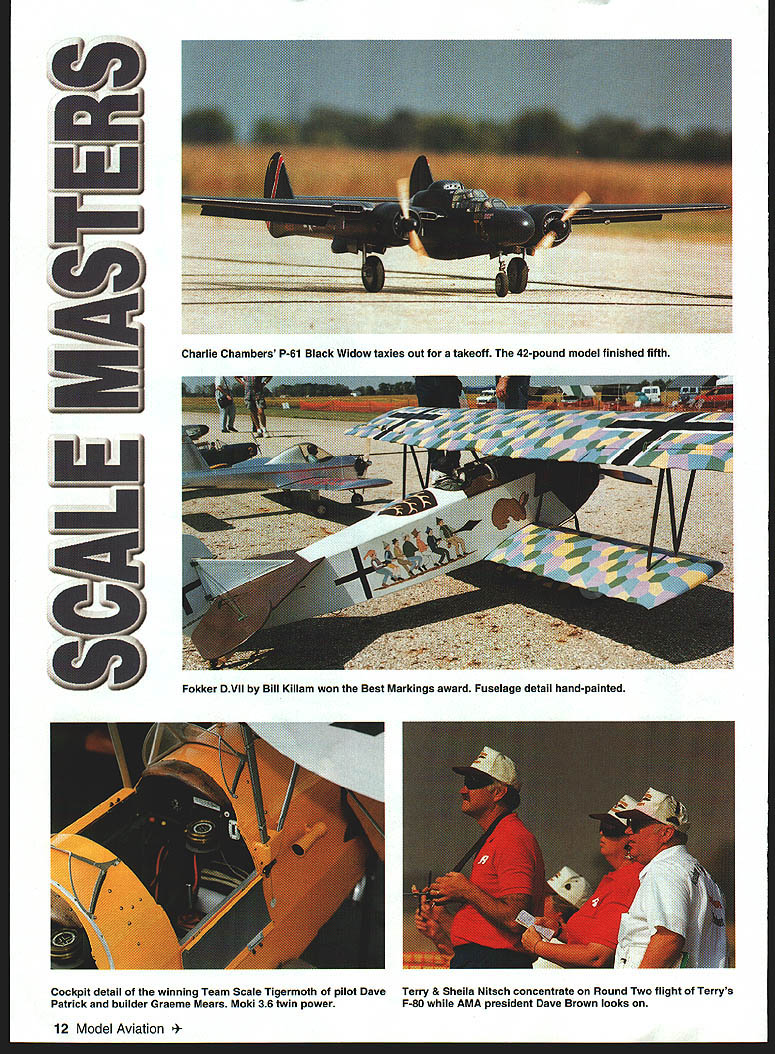
- Dave Patrick (builder) and Graeme Mears (pilot) — Tiger Moth, 31% model powered by a Moki 3.6 inline twin (museum scale).
- Reinol Gonzalez and Albert Araujo — Mirage 2000, kitted by Aviation Designs, powered by a RAM 750 turbine.
- Mariano Alfafara (pilot) and Dave Pinegar (builder) — civil light-aerobatic clipped-wing Cub, built from Mike Gertz plans.
The Youngest Pilot Award winner, 14-year-old Michael Dinneen, teamed with builder Mike Barbee to enter Team Scale this year; they finished seventh. Michael's dad was a major sponsor of the Masters Championships.
After the final round, it's time to reflect, compile scores, hand out awards, and start saying goodbyes to everyone. Speaking of awards: Bob Underwood had lost his Russian IL-2 in a cornfield because of radio interference. It was retrieved intact, slightly worse for landing. He received a special award (a couple of corn stalks) for appeasing the Corn Gods.
For more information on the U.S. Scale Masters Championships, or a qualifier in your area, contact Earl and Josie Aune, 21952 Airport Rd., Aurora, OR 97002, or check out the U.S. Scale Masters website at www.scalemasters.org.
—Stan Alexander 3709 Valley Ridge Dr., Nashville, TN 37211 onawing@mindspring.com
Transcribed from original scans by AI. Minor OCR errors may remain.

