
Scale Soaring Fun Fly
Byron Blakeslee
Event overview
The second annual International Slope Scale Fun Fly, sponsored by the Tri-City Soarers (TRICS), was held just outside Kennewick, WA over Memorial Day weekend. Over 70 pilots brought some 140 scale gliders and power slope ships to this very informal, three-day event. Pilots came from across the northwestern states, California, Arizona, Colorado, Canada, and as far away as West Germany.
Location and host
The Tri-Cities (Kennewick, Richland, Pasco) lie along the Columbia River in southeastern Washington. The semidesert climate provides big hills ideal for slope soaring. The host club was Tri-City Soarers with Wil Byers serving as Event Director. The event is scheduled in late May to take advantage of more reliable wind patterns.
History
The idea for a slope scale event was suggested in 1987 by Bill Liscomb of Carlsbad, CA, who flies quarter-scale ships on Torrey Pines. Wil Byers and clubmates organized the first strictly Slope Scale event in the U.S. in 1988 as a fun fly—"No judging, no documentation, no hassles—just flying, looking, and gabbing." The inaugural event drew 60 pilots with 100 planes; this year saw increased interest.
Aircraft types
About half the entries were models of full-size gliders (primarily quarter-scale), ranging from 1930s vintage types to modern glass ships. The other half were power slope aircraft—model versions of piston- and jet-powered planes. Some power scale ships can reach 60–80 mph while zipping up and down the slope. Small wing areas on many scale ships produce higher wing loading, giving good penetration and fast flying speeds.
Logistics and schedule
- Headquarters: Clover Island Motor Inn (rooms reserved by Wil Byers). Wil and MaryJo used a large hotel room for pilot check-in Thursday afternoon and evening.
- Thursday: Early arrivals tried Eagle Butte and socialized.
- Friday: Wil waited until about 9 a.m. to select the slope based on wind forecast. Eagle Butte was chosen. An answering machine notified pilots: "trail up Eagle Butte."
- Access: The trail to the summit is rough and sandy—more dune-like than road—and must be driven slowly. The summit offers parking, a large pit area, and soft grass behind the slope for landing. The slope face is about 400 ft high, west-facing, steep (~45°), and stony—unsuitable for landing on the face itself; landings are typically made in fields below when necessary.
- Flight operations: Flights typically ran throughout the daylight hours; informal flying often continued as long as light and wind allowed.
Flying rules
The pilots’ meeting outlined strict rules to ensure safety and fairness:
- Event for scale airplanes only. No documentation required, but models should look like real aircraft.
- No alcoholic beverages on the slope.
- Transmitters must have a registration sticker and may not leave impound without a frequency pin.
- Crashes caused by frequency conflict make the guilty party liable for damages.
- Pilots must stand in one of two "boxes" along the slope (about 75 ft apart) to reduce interference and spread out traffic.
- Fly with good manners and proper flight pattern procedures; do not overfly spectators.
- Limit flights to 15 minutes to give everyone equal flying time.
- Maximum of eight models in the air at one time.
- AMA membership required. AMA Safety Code applies. Radios and aircraft must be in safe, airworthy condition. Avoid maneuvers that could cause accidents (e.g., loops toward the hill).
Participants by and large followed these rules; there were no apparent frequency conflicts or midair collisions.
Notable aircraft and builders
- Gary Anderson: Pair of V-5 (five-meter) ASW-20s—top prize winners.
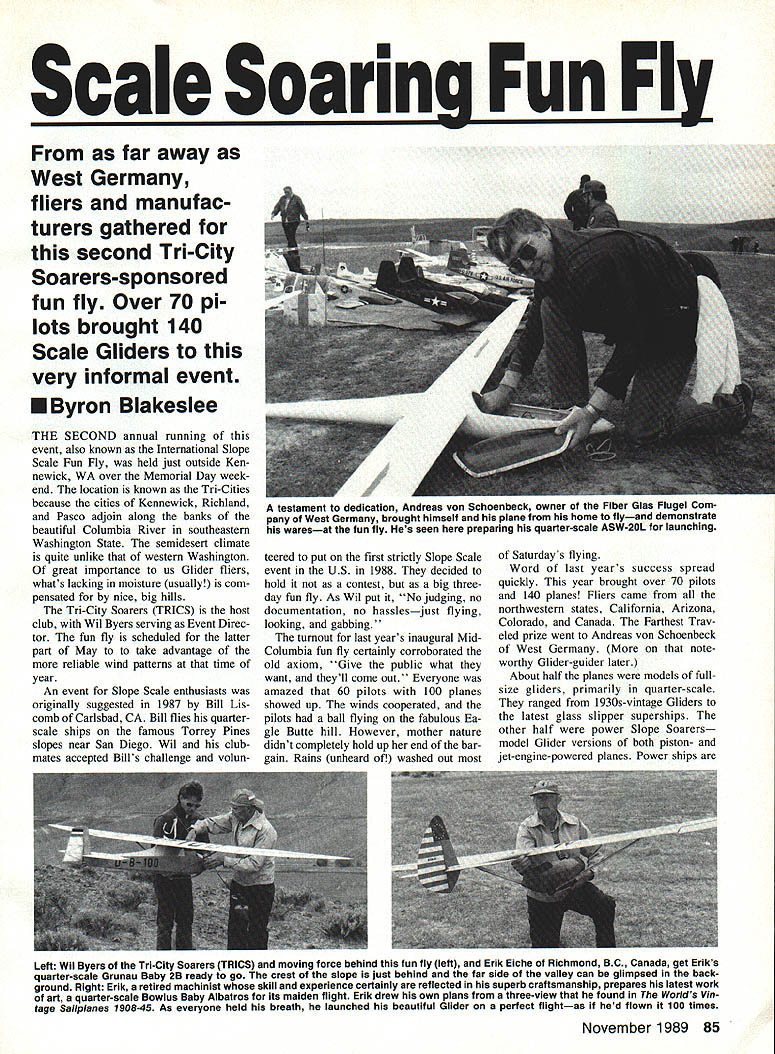
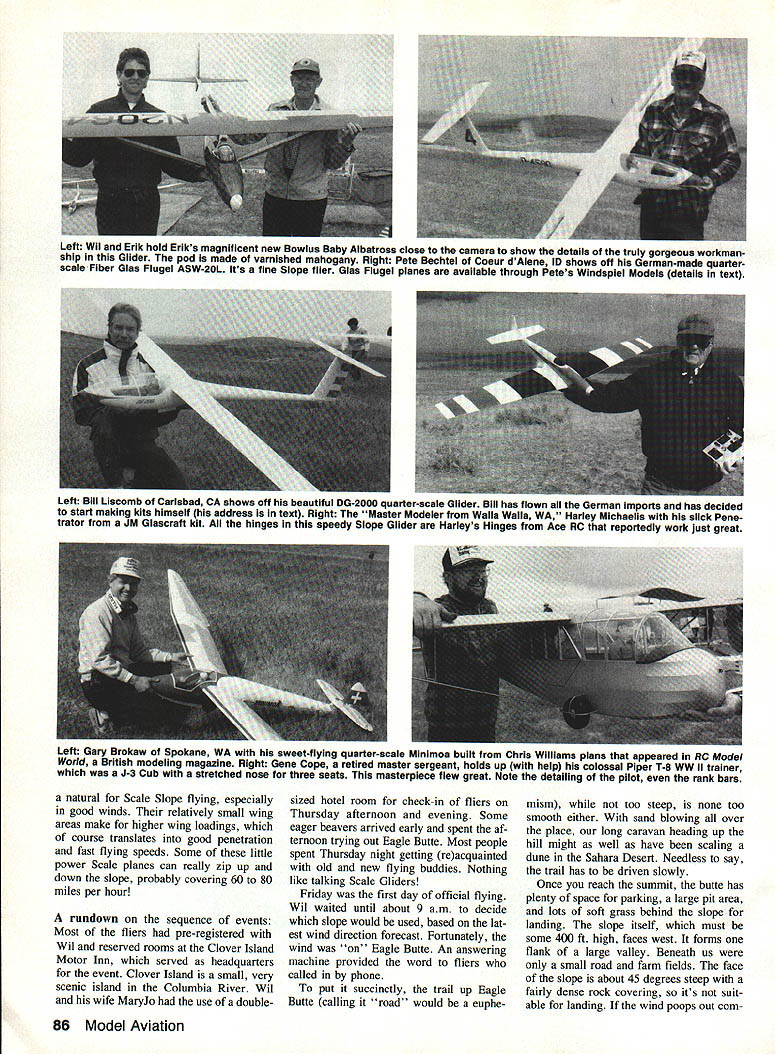
- Erik Eiche (Richmond, B.C., Canada): Quarter-scale Grunau Baby 2B (Cliff Charlesworth plans) and a new quarter-scale Bowlus Baby Albatross (maiden flight at the event). Erik drew plans from the three-view in Martin Simons' The World's Vintage Sailplanes 1908–45. His workmanship (varnished mahogany pod, polished aluminum boom) was exemplary.
- Bill Liscomb: Near-quarter-scale DG-200 with a molded fiberglass fuselage and smooth bagged glass/foam wings. Bill planned to offer kits and makes high-quality scale retract units (quarter and 1/5 scale).
- Andreas von Schoenbeck (West Germany): Owner of Fiber Glas Flugel (Glas Flugel) of Unterwossen near Munich. He brought an ASW-20L quarter-scale plane. Glas Flugel models are highly regarded for quality and performance.
- Pete Bechtel: Host to Andreas and operator of Windspiel Models, importing the Glas Flugel line.
Other notable ships and craftsmanship filled the pits, and enthusiasts came as much to show and admire work as to fly.
Manufacturers, modelers and the press in attendance
- Manufacturers and designers present included:
- American Sailplane Designs (Gary Anderson)
- Precision Foam Cores (Dave Acker)
- Combat Models (Byron Bruce)
- Santa Monica Sailplanes (Vince Parizek)
- Cliff Hanger Models (Marty Silberstein)
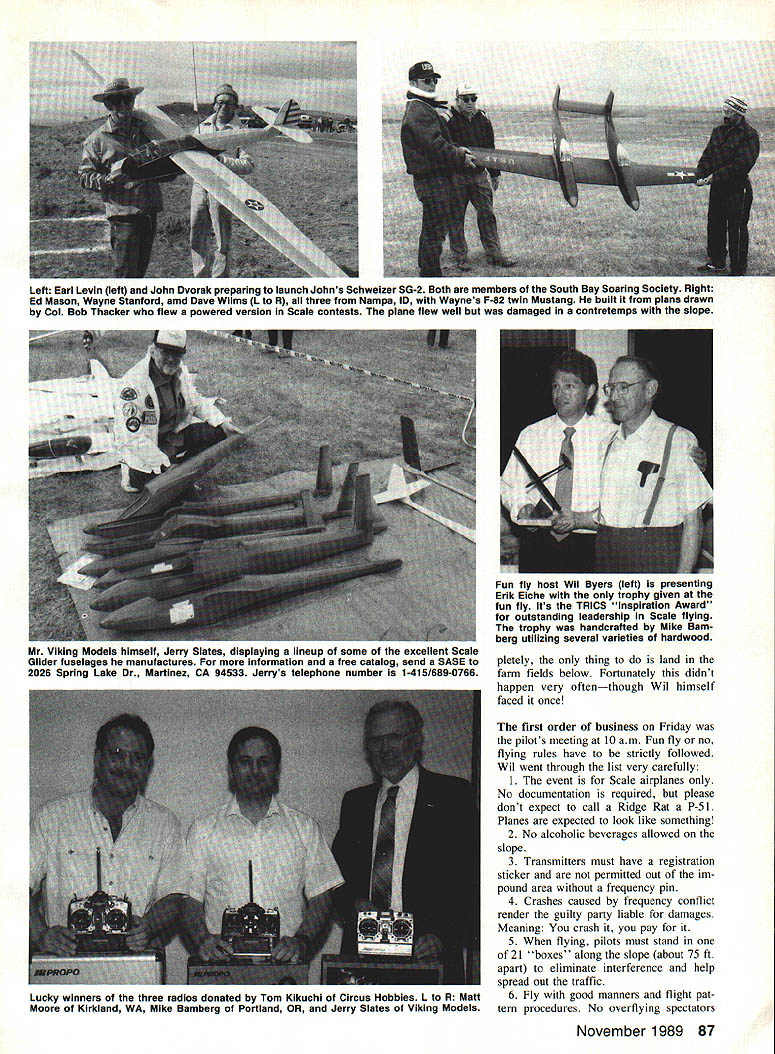
- Viking Models (Jerry Slade)
- VS Sailplanes (Ken Stewart)
- Hi-Performance Sailplanes (Ron and Karen Wagner)
- Windspiel Models (Pete Bechtel)
- Plus others represented among the vendors and attendees
- Press:
- Jim and Peggy Gray — RC Soaring Digest
- Charley Morey — Slope Soaring News
Social events and raffle
- Friday evening: Wine tasting and hors d'oeuvres hosted by Gary Anderson in the hotel room (Gary missed most due to vehicle trouble).
- Saturday: Buffet banquet and large raffle with roughly $5,000 in prizes. Major raffle items included two JR PCM-10 computer radios with aluminum cases (donated by Circus Hobbies and Tom Kikuchi) and a JR Max 7 computer radio from Tom Kikuchi. Many kits, accessories, photos, tools, and gift certificates were also donated by numerous supporters.
- After-dinner speaker: Rudy Almann, who presented slides on the 1976 Smirnoff Derby cross-country sailplane race.
Weather and flying highlights
- Friday: Steady winds (20–30 mph ideal) and chilly mornings. Excellent flying with up to ~80 planes airborne at times.
- Saturday: Light rain in the morning halted some activity; by noon the wind returned and several hours of good flying followed, including thermalling flights (notably Gary Brokaw's quarter-scale Minimoa).
- Sunday: Mixed conditions. Eagle Butte produced about two hours of flying before winds switched; a group at Kiona Butte had smooth flying until a brief hail shower. Since planned communications between slopes failed, crews sometimes didn't know conditions elsewhere.
- Monday (Memorial Day): Many participants extended the trip; Eagle provided another fine day in 20–25 knot winds.
Final thoughts
The event was a relaxed, friendly gathering focused on scale model craftsmanship, camaraderie, and flying. Thanks were extended to Wil and MaryJo Byers and all TRICS members for their work and hospitality. Organizers and participants hope the tradition continues for many years.
Donors / Contributors / Sponsors (selected)
Beemer RC West, Viking Models USA, Santa Monica Sailplanes, Airtronics, Futaba, Scale Model Research, Sig Models, Ace RC, Tower Hobbies, Windspiel Models, Top Flite Models, Combat Models, Hobby Lobby International, Kookaburra Publications, Bob Moore Photographs, Circus Hobbies (Tom Kikuchi), Bremer RC West (Bob Boomer), and numerous individual contributors listed at the event.
Transcribed from original scans by AI. Minor OCR errors may remain.

