
To Borlange, Sweden, on June 18-24 came the world's master scale builders and fliers with the biggest and most varied collection of types yet to be seen in the ultimate competition.
Text and Photos by Bob and Dolly Wischer
World Championships
DALA AIRPORT, near Borlange in central Sweden was the scene of the re-emergence of the British team as the world's greatest RC scale modelers and the continuation of the Soviet modelers as masters in Control-Line Scale. Neither nation had an easy task. The increase in number of nations involved and the marked improvement in airplanes and flying technique kept the outcome of the meet in doubt until near the end. Never before has there been such a collection of excellent scale models, and this was true also in the unofficial Stand-Off and Helicopter events. Several of the Stand-Off models could easily have moved over into full FAI scale. While the Helicopter entries were all kit-built, their finish was outstanding.
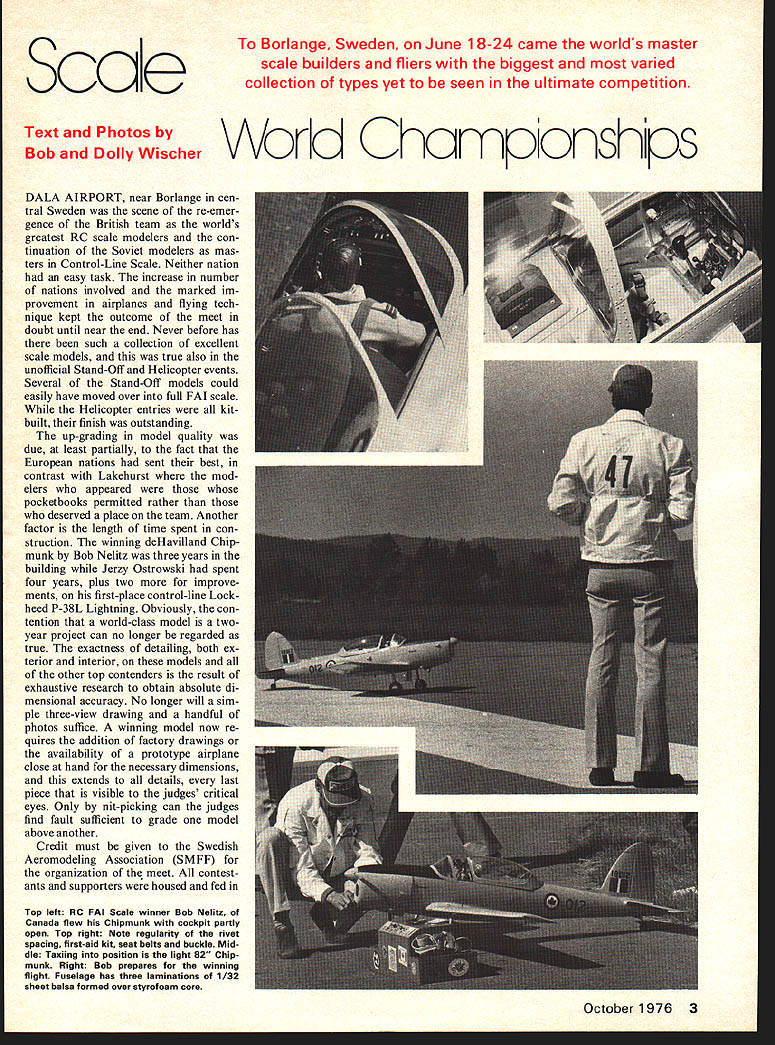
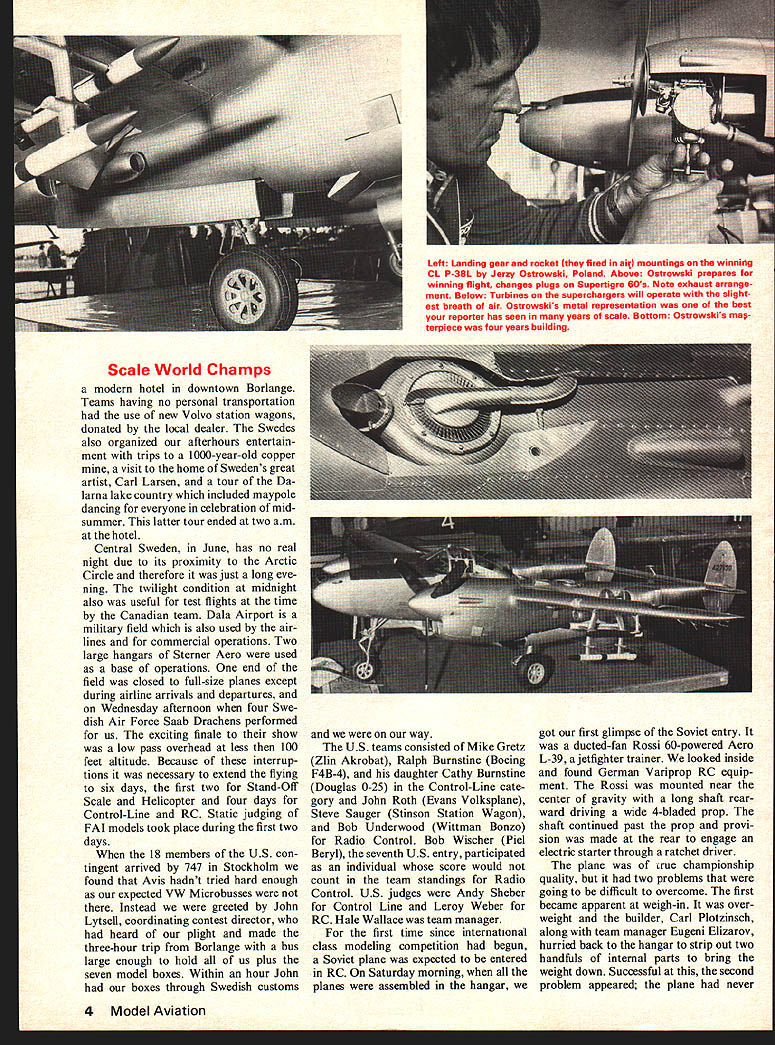
The up-grading in model quality was due, at least partially, to the fact that the European nations had sent their best, in contrast with Lakehurst where the modelers who appeared were those whose pocketbooks permitted rather than those who deserved a place on the team. Another factor is the length of time spent in construction. The winning deHavilland Chipmunk by Bob Nelitz was three years in the building while Jerzy Ostrowski had spent four years, plus two more for improvements, on his first-place control-line Lockheed P-38L Lightning. Obviously, the contention that a world-class model is a two-year project can no longer be regarded as true. The exactness of detailing, both exterior and interior, on these models and all of the other top contenders is the result of exhaustive research to obtain absolute dimensional accuracy. No longer will a simple three-view drawing and a handful of photos suffice. A winning model now requires the addition of factory drawings or the availability of a prototype airplane close at hand for the necessary dimensions, and this extends to all details, every last piece that is visible to the judges' critical eyes. Only by nit-picking can the judges find fault sufficient to grade one model above another.
Credit must be given to the Swedish Aeromodeling Association (SMFF) for the organization of the meet. All contestants and supporters were housed and fed in a modern hotel downtown Borlange. Teams having no personal transportation used new Volvo station wagons donated by a local dealer. Swedes also organized after-hours entertainment trips — 1,000-year-old copper-mine visit, home of Sweden's great artist Carl Larsson, tour of Dalarna lake country which included maypole dancing; everyone celebrated mid-summer. The latter tour ended two a.m. at the hotel. Central Sweden in June has no real night due to its proximity to the Arctic Circle; therefore there is just long evening twilight. The midnight twilight was also a useful test-flight time.
Dala Airport, a military field, was also used; airlines run commercial operations there. Two large hangars of Sterner Aero were used as base operations and the field was closed to full-size planes except during airline arrivals and departures. Wednesday afternoon four Swedish Air Force Saab Drakens performed an exciting finale show with low passes overhead at less than 100 feet altitude.
Because interruptions were necessary, flying was extended to six days — the first two for Stand-Off Scale and Helicopter, four days for Control-Line. RC static judging and FAI models took place during the first two days.
Eighteen members of the U.S. contingent arrived by 747 at Stockholm and found Avis hadn't tried hard enough — we expected VW microbusses. Instead we were greeted by John Lytsell, coordinating contest director, who had heard our plight and made a three-hour trip to Borlange in a bus large enough to hold us plus seven model boxes. Within an hour John had our boxes through Swedish customs and on the way.
U.S. teams consisted of Mike Gretz (Zlin Akrobat), Ralph Burnstine (Boeing F4B-4), daughter Cathy Burnstine (Douglas O-25) in the Control-Line category, John Roth (Evans Volksplane), Steve Sauger (Stinson Station Wagon), Bob Underwood (Wittman Bonzo) in Radio Control, and Bob Wischer (Piel Beryl). The seventh U.S. entry participated as an individual; his score would count in the team standings. Radio Control U.S. judges were Andy Sheber; Control-Line judge Leroy Weber; RC team manager was Hale Wallace.
For the first time since international-class modeling competition began, a Soviet plane expected to enter RC. Saturday morning, when the planes were assembled in the hangar, we got our first gl...
Scale World Championships
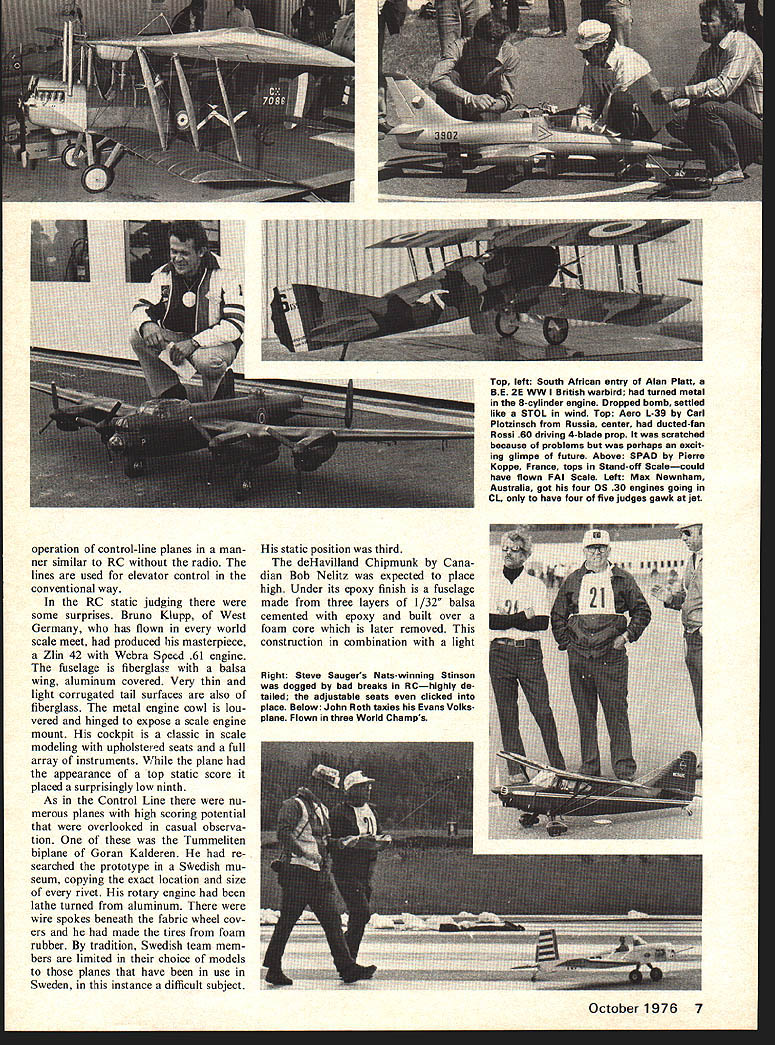
impse of the Soviet entry. It was a ducted-fan Rossi 60-powered Aero L-39, a jet trainer. We looked inside and found German Variprop RC equipment. The Rossi was mounted near the center of gravity with a long shaft rearward driving a wide four-bladed prop. The shaft continued past the prop and provision was made at the rear to engage an electric starter through a ratchet drive. The plane was not up to true championship quality, but it had two problems that were going to be difficult to overcome. The first became apparent at weigh-in. It was overweight and the builder, Carl Plotzinski, along with team manager Eugen Elizarov, hurried back to the hangar to strip out two handfuls of internal parts to try to lighten weight. Successful at this, the second problem appeared; the plane had never been flown been flown. At earliest opportunity Sunday morning they were out on the runway along with a swarm of expectant observers. The engine started, the takeoff was begun too close to the runway end. Lifted off too soon, it staggered into the air in a semi-stalled altitude, climbed about 25 feet and snap-rolled back to earth. The parts were gathered and hastily carried off to the Russian bus. Carl began a marathon effort to return the plane to flying condition and was actually successful. On the final day of flying it made one short hop of a few hundred feet after many attempts. Most efforts were aborted due to engine failures, over-heating and several retract gear collapses.
Meanwhile, a peculiar situation arose in the Soviet control-line team where we saw three airplanes, one of which was a twin-engined jet fighter, also powered by ducted fans. Before we could gather data on the plane it was quickly assembled and carried off to the paved area in front of the airport control tower. This time the military police made certain that all observers were excluded. The rumors spread that the plane had never been flown. We watched from a distance after trying unsuccessfully to break through the guard lines as the Soviet team made numerous efforts to get both engines running. With engines screaming it would hardly taxi, possibly due to wheel problems. It finally staggered into the air, made several laps bordering on stall. It collided heavily with the pavement sending large parts scattering. Thus ends the story of two really exciting entries with ducted-fan power. Later we discovered that the Soviet control-line team was actually four fliers, and the crashed plane was replaced by another.
While we waited impatiently for our static scores, the two unofficial events were flown; Helicopter first, followed by Stand-Off Scale. Helicopter, with only five entries, might have been a disappointment except for the exciting flying of Michael Heid of West Germany. All of the flights in these two events were made under adverse weather conditions of cold gusty wind and frequent showers. In spite of the wind Heid managed to pick up a weight with a sling beneath his helicopter and then proceed to fly through a slalom course of poles. Only one flight, by Ulf Johansson of Sweden, could better the scores of Heid. Ulf flew the Schluter Gazelle. All others flown were Kavan Jet Rangers.
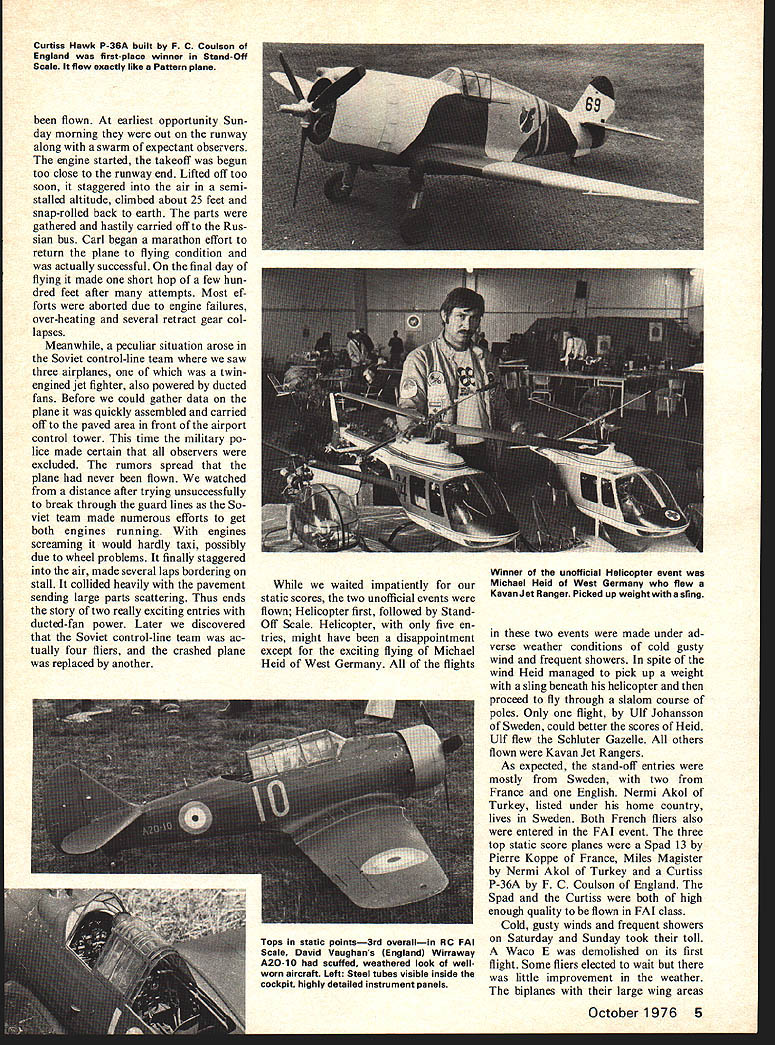
As expected, the stand-off entries were mostly from Sweden, with two from France and one English. Nermi Akol of Turkey, listed under his home country, lives in Sweden. Both French fliers also were entered in the FAI event. The three top static score planes were a Spad 13 by Pierre Koppe of France, Miles Magister by Nermi Akol of Turkey and a Curtiss P-36A by F. C. Coulson of England. The Spad and the Curtiss were both of high enough quality to be flown in FAI class.
Cold, gusty winds and frequent showers on Saturday and Sunday took their toll. A Waco E was demolished on its first flight. Some fliers elected to wait but there was little improvement in the weather. The biplanes with their large wing areas suffered most. Jean Rousseau's Potez 60 had three consistently excellent flights but, unfortunately, also had the lowest static score. The Curtiss flew like a pattern plane, little affected by the wind and went on to win the event.
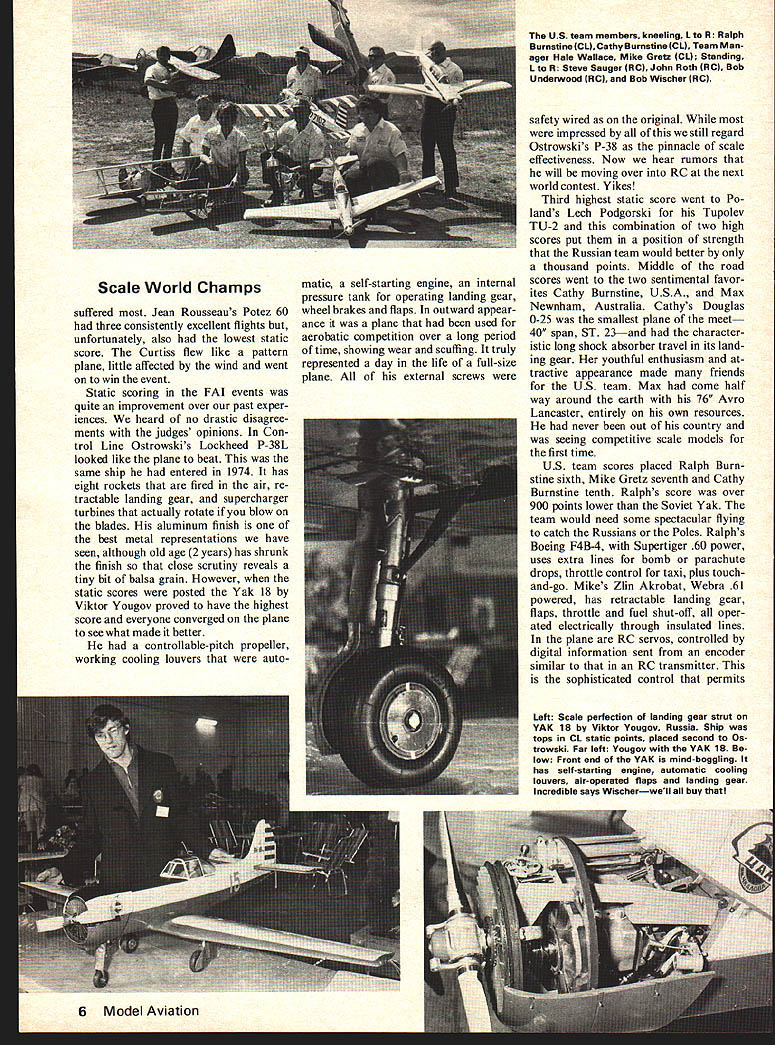
Static scoring in the FAI events was quite an improvement over our past experiences. We heard of no drastic disagreements with the judges' opinions. In Control Line Ostrowski's Lockheed P-38L looked like the plane to beat. This was the same ship he had entered in 1974. It has eight rockets that are fired in the air, retractable landing gear, and supercharger turbines that actually rotate if you blow on the blades. His aluminum finish is one of the best metal representations we have seen, although old age (2 years) has shrunk the finish so that close scrutiny reveals a tiny bit of balsa grain. However, when the static scores were posted the Yak 18 by Viktor Yougov proved to have the highest score and everyone converged on the plane to see what made it better.
He had a controllable-pitch propeller, working cooling louvers that were automatic, a self-starting engine, an internal pressure tank for operating landing gear, wheel brakes and flaps. In outward appearance it was a plane that had been used for aerobatic competition over a long period of time, showing wear and scuffing. It truly represented a day in the life of a full-size plane. All of his external screws were safety wired as on the original. While most were impressed by all of this we still regard Ostrowski's P-38 as the pinnacle of scale effectiveness. Now we hear rumors that he will be moving over into RC at the next world contest. Yikes!
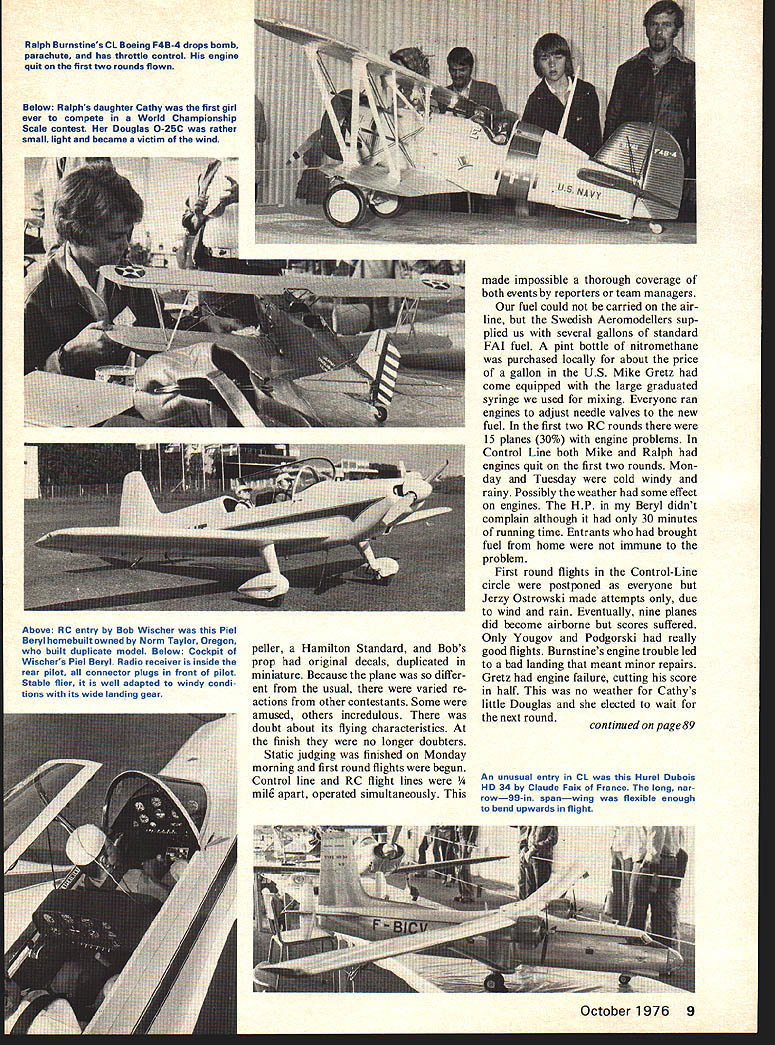
Third highest static score went to Poland's Lech Podgorski for his Tupolev TU-2 and this combination of two high scores put them in a position of strength that the Russian team would better by only a thousand points. Middle of the road scores went to the two sentimental favorites Cathy Burnstine, U.S.A., and Max Newnham, Australia. Cathy's Douglas 0-25 was the smallest plane of the meet — 40" span, ST. 23 — and had the characteristic long shock absorber travel in its landing gear. Her youthful enthusiasm and attractive appearance made many friends for the U.S. team. Max had come half way around the earth with his 76" Avro Lancaster, entirely on his own resources. He had never been out of his country and was seeing competitive scale models for the first time.
U.S. team scores placed Ralph Burnstine sixth, Mike Gretz seventh and Cathy Burnstine tenth. Ralph's score was over 900 points lower than the Soviet Yak. The team would need some spectacular flying to catch the Russians or the Poles. Ralph's Boeing F4B-4, with SuperTiger .60 power, uses extra lines for bomb or parachute drops, throttle control for taxi, plus touch-and-go. Mike's Zlin Akrobat, Webra .61 powered, has retractable landing gear, flaps, throttle and fuel shut-off, all operated electrically through insulated lines. In the plane are RC servos, controlled by digital information sent from an encoder similar to that in an RC transmitter. This is the sophisticated control that permits operation of control-line planes in a manner similar to RC without the radio. The lines are used for elevator control in the conventional way.
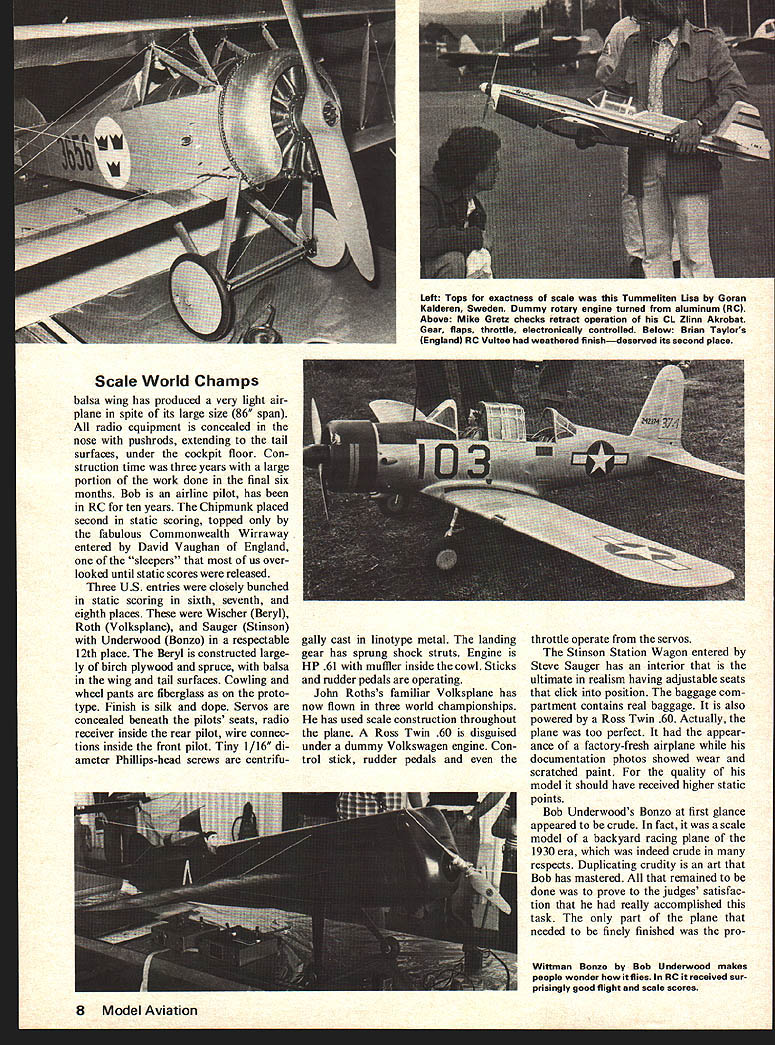
In the RC static judging there were some surprises. Bruno Klupp, of West Germany, who has flown in every world scale meet, had produced his masterpiece, a Zlin 42 with Webra Speed .61 engine. The fuselage is fiberglass with a balsa wing, aluminum covered. Very thin and light corrugated tail surfaces are also of fiberglass. The metal engine cowl is louvered and hinged to expose a scale engine mount. His cockpit is a classic in scale modeling with upholstered seats and a full array of instruments. While the plane had the appearance of a top static score it placed a surprisingly low ninth.
As in the Control Line there were numerous planes with high scoring potential that were overlooked in casual observation. One of these was the Tummeliten biplane of Goran Kalderon. He had researched the prototype in a Swedish museum, copying the exact location and size of every rivet. His rotary engine had been lathe turned from aluminum. There were wire spokes beneath the fabric wheel covers and he had made the tires from foam rubber. By tradition, Swedish team members are limited in their choice of models to those planes that have been in use in Sweden, in this instance a difficult subject.
His static position was third.
The de Havilland Chipmunk by Canadian Bob Nelitz was expected to place high. Under its epoxy finish is a fuselage made from three layers of 1/32" balsa cemented with epoxy and built over a foam core which is later removed. This construction in combination with a light
Scale World Champs
balsa wing has produced a very light airplane in spite of its large size (86" span). All radio equipment is concealed in the nose with pushrods, extending to the tail surfaces, under the cockpit floor. Construction time was three years with a large portion of the work done in the final six months. Bob is an airline pilot, has been in RC for ten years. The Chipmunk placed second in static scoring, topped only by the fabulous Commonwealth Wirraway, entered by David Vaughan of England, one of the "sleepers" that most of us overlooked until static scores were released.
Three U.S. entries were closely bunched in static scoring in sixth, seventh, and eighth places. These were Wischer (Beryl), Roth (Volksplane), and Sauger (Stinson) with Underwood (Bonzo) in a respectable 12th place. The Beryl is constructed largely of birch plywood and spruce, with balsa in the wing and tail surfaces. Cowling and wheel pants are fiberglass as on the prototype. Finish is silk and dope. Servos are concealed beneath the pilots' seats, radio receiver inside the rear pilot, wire connections inside the front pilot. Tiny 1/16" diameter Phillips-head screws are centrifugally cast in linotype metal. The landing gear has sprung shock struts. Engine is .61 with muffler inside the cowl. Sticks and rudder pedals are operating.
John Roth's familiar Volksplane has now flown in three world championships. He has used scale construction throughout the plane. A Ross Twin .60 is disguised under a dummy Volkswagen engine. Control stick, rudder pedals and even the throttle operate from the servos.
The Stinson Station Wagon entered by Steve Sauger has an interior that is the ultimate in realism having adjustable seats that click into position. The baggage compartment contains real baggage. It is also powered by a Ross Twin .60. Actually, the plane was too perfect. It had the appearance of a factory-fresh airplane while his documentation photos showed wear and scratched paint. For the quality of his model it should have received higher static points.
Bob Underwood's Bonzo at first glance appeared to be crude. In fact, it was a scale model of a backyard racing plane of the 1930 era, which was indeed crude in many respects. Duplicating crudity is an art that Bob has mastered. All that remained to be done was to prove to the judges' satisfaction that he had really accomplished this task. The only part of the plane that needed to be finely finished was the pro- peller, a Hamilton Standard, and Bob's prop had original decals, duplicated in miniature. Because the plane was so different from the usual, there were varied reactions from other contestants. Some were amused, others incredulous. There was doubt about its flying characteristics. At the finish they were no longer doubters.
Static judging was finished on Monday morning and first round flights were begun. Control line and RC flight lines were 1/4 mile apart, operated simultaneously. This made impossible a thorough coverage of both events by reporters or team managers. Our fuel could not be carried on the airline, but the Swedish Aeromodellers supplied us with several gallons of standard FAI fuel. A pint bottle of nitromethane was purchased locally for about the price of a gallon in the U.S. Mike Gretz had come equipped with the large graduated syringe we used for mixing. Everyone ran engines to adjust needle valves to the new fuel. In the first two RC rounds there were 15 planes (30%) with engine problems. In Control Line both Mike and Ralph had engines quit on the first two rounds. Monday and Tuesday were cold, windy and rainy. Possibly the weather had some effect on engines. The H.P. in my Beryl didn't complain although it had only 30 minutes of running time. Entrants who had brought fuel from home were not immune to the problem.
First round flights in the Control-Line circle were postponed as everyone but Jerzy Ostrowski made attempts only, due to wind and rain. Eventually, nine planes did become airborne but scores suffered. One Young and Pogorski had really good flights. Burnstine's engine trouble led to a bad landing that meant minor repairs. Gretz had engine failure, cutting his score in half. This was no weather for Cathy's little Douglas and she elected to wait for the next round. In round two Ostrowski's P-38, first to fly, fired its rockets at the right time and managed to shoot down judge Eric Coates. Podgorski's Tupolev made the highest scoring flight of the round to keep him in first place. Borzov succeeded in flying his best round in spite of the continuing bad weather. Max Newnham got three of four engines going for the first time on his Avro Lancaster and completed a flight for the third highest score of the round. Jacques Matter was pull testing the lines on his Caudron racer when one line broke. The demonstrative Frenchman then proceeded to kick a hole in his wing in protest.
The time schedule included a sightseeing trip to Falun for Tuesday afternoon, postponing half of round two flights until Wednesday. The good weather had finally arrived and now for the first time our team shirts, donated by Sig. Smed, could be seen. Although the temperature was higher, there were occasional gusts greater than the predicted four knots. One of the gusts came along as Cathy made her first flight. The lines slackened and she was forced to run to keep control. This led to pitch problems resulting in climbing and diving which became worse with each lap. The lightly built Douglas eventually pranged on the pavement, damaged beyond repair. Cathy's disappointment was shared by everyone. Even the Borlänge newspaper carried the story in their headlines.
Round three was completed on Thursday, the final day of competition and, while rain threatened early, most of the day was excellent. Temperatures were near 80°F and wind was almost non-existent. Ostrowski made the highest scoring flight of the meet while Yougov could not equal his own first round score. When added to static points this put Ostrowski into first place with Yougov second. Mike Gretz flew his first complete flight with no engine problems but the 1000-point difference in static score held him to fifth place. Max Newnham was able to get all four engines running for his highest score. Imagine his disgust when he discovered that four of the judges (the U.S. judge was the exception) had been watching and photographing a passing Swedish military jet during his taxi demonstration. Ralph Burnstine made his best flight in the final round, his first without engine troubles.
Judges are expected to confer during static scoring and this limits the point difference between high and low scores. In the case of Newnham's Lancaster this was a 3-1/2 point spread. If flight scores are made during a flight this point spread would naturally be greater. However, the Control-Line judges were scoring after conferring at the end of flights which meant that the point of spread between the high and low judge was as little as five points. This leaves some doubt about the validity of the method; in a world championship it should be more clearly defined. The spread was five points on the flight of the Lancaster. Gaudynski of Poland had a spread of 39 points, the maximum given for his Dovizine flight for scores of 1500 to 3000 points is this too small a percentage.
Jack Swift of Canada, flying a Fokker D-7 was first off at the RC site. The weather began immediately taking its toll. After a fair takeoff he lost his engine during the procedure turn and flipped on landing. Jean Rousseau's C.A.P. 20 proved to be a fine stable flier under adverse conditions; he made the important good landing in the inner circle. The Stampe biplane by Hasefi Guatoschi was next to brave the wind and was battered about mercilessly. The flight came to an early end when his engine quit during his loop. Next up was an even slower biplane, the B.E.2E, of South Africa's Alan Platt. After a takeoff that could best be described as hasty he too was buffeted by the wind, dropped a bomb, and settled into the landing circle like a sloth. Jack Stromqvist's BHT Beauty, which we had seen at Lakehurst two years ago, put in a good flight for the large crowd present but landed far short of the circle.
First American to fly was Bob Wischer with his Piel Beryl. The plane is a fine stable flier, well adapted to windy conditions with its wide gear. He flew all of his maneuvers too close to the judges, landed in the circle but nosed over. His low score reflected the mistakes made. Esbjorn Stromqvist of Sweden flew the same SAAB Safir we had seen at Lakehurst, this time in a rain shower. The prototype of Esbjorn's model landed at Dala Airport on Thursday, making possible an on-the-spot comparison. Of all Swedish planes this is very likely the one best suited to scale modeling with its long moments and retract gear. Almost unnoticed by the weather, the Safir provided an excellent flight to the delight of the Swedish audience. Immediately following the show Bruno Klupp of West Germany made his takeoff with the Zlin 42 and very quickly returned because of engine failure. John Roth's first flight of his Evans Voltplane was very smooth, marred only by a bouncy landing. Earl Brydges nosed over his Pitts S-1S on takeoff. This brought up one of the British entries with the highest static points, the Commonwealth Wirraway of David Vaughan. We were not to be disappointed. It flew like a pattern plane, a stable fine flier, obviously being flown by a capable pilot. This flight, in combination with its high static score, was to put him in third place overall.
Two C.A.P. 20 planes appeared at Borlänge, alike except for color since they were both models of the same plane before and after the prototype was repainted. The second was next to fly, the entry of Rene Rousselot. After an excellent takeoff he followed with a rather poor figure-eight, but his stall turn and loop were deserving of highest scores. The landing in the center of the circle added the finishing touch that assured him of fifth place in the final standings.
Now everyone's eyes were on Bob Underwood and his Wittman Bonzo. This was the plane that some doubted would fly while others were curious as to how it would perform. Although Bob suffered from world championship jitters the flight came off rather well. He landed in the circle, a wheel came off, and the plane nosed up.
Scale (continued)
The plane with second highest static score, the de Havilland Chipmunk of Bob Nelitz, was also the center of attention. For its wing area it is a very light airplane and would need a better day for optimum performance. However, Bob did very well throughout the flight, including a spin at fairly low altitude. The landing bounced about. He regained control to smooth the second touch-down. This was followed by an even more spectacular performance. Brian Taylor and his Vultee BT-13A, fourth in static scoring, were next to fly. This was a true professional in action. He worked without a caller, doing all maneuvers with precision in spite of the wind and his flight was to place him first in the standings until late in the contest. Up to this point all of those with high static scores were establishing themselves with good flights as the top competitors.
Goran Kalderen's Tummeliten biplane was the next victim of the weather. After an unsteady takeoff with an engine out of adjustment, swinging a very large propeller, the plane appeared to crash-land. The biplane partly dug into the turf but the damage was minor. Steve Sauger was the last U.S. entrant in the first round. The wind had diminished and was no longer a serious factor. His Stinson Station Wagon lost its takeoff points due to ground loops. It lifted off, flew straight out for 500 feet then abruptly nosed down and crashed. No cause could be found. Toni Beichold of West Germany, flying a Brügger MB-2 Colibri, used inverted flight as part of his routine, quite unusual for a scale model. Czechoslovakia's lone representative to the world championship was Rudolf Lechmann who flew a T-tail Verner Broucek. Radio interference problems prompted him to change crystals. We had heard rumors that this could occur but his was the only example of actual interference. After the change his flight was uneventful, a good stable plane.
Walter Reger of West Germany, in his second world meet, flew his Fairchild PT-19 at the end of round one. Earlier engine trouble might have caused him to take an attempt. Now, with less wind, he could possibly improve the score. Rounding out our round one were the two young Swiss fliers Hansrudi Zeller and Peter Gafner, SE-5A and North American T-28B. Steve Sauger would not be called upon to fly until Wednesday. This gave him two days in which to repair his Stinson. One of the Borlänge modelers offered his workshop, a short distance from our hotel, and Steve went to work building a new right wing. When it was his turn to fly in round two the plane was ready. The new wing was not beautiful, but it was finished and painted. A quick test flight showed that everything was in working order. When it came time to fly the ground-loop tendencies reappeared and an attempt was called to save the flight. On his official flight there were engine troubles, his two-cylinder Ross running on one cylinder. With this problem solved he took off and was flying the figure-eight when the engine stopped.
With an improvement in the weather almost everyone had higher scores in round two. Bob Nelitz was a notable example. His Chipmunk performed flawlessly, giving him the highest score of the meet and first place. Brian Taylor's round two and three scores were lower than in the first round. David Vaughan did not fly in round two and his score in round three was even lower. These were two of the English entries that were capable of catching Nelitz. There were no other contenders with a chance to catch him. Wischer's third round score was good, but it would have needed to be a perfect flight to move him from fourth to third place. In the team standings England, with three strong entries, took back the Eddie Keil Memorial trophy that had been in the U.S. for four years.
In the middle of the third round the judges decided that the wind was now across the runway and that landings would have to be in that direction. This meant that a plane could land in the circle and yet have no place to go but off the runway into a rough area. World championship planes deserve better treatment. An airplane needs a run-out space after touching down. When the damage caused by this decision was pointed out to the judges by Hale Wallace, he received a flippant answer.
There were some interesting sidelights to the meet. There were gifts to each of us from Sig., and for which we were grateful; they were in demand at the close of the contest. We could have sold all of them, but none of us would part with his shirts. Could Sig. be convinced to add these to his catalog?
Another humorous incident occurred when the French team made the discovery that they had come to Sweden without fuel and had to drive to Stockholm, 2 1/2 hours distant, to obtain some. The 30 cans that appeared to contain gallons (5 liters) of fuel actually were wine, calculated to last a week.
On the airport was a small restaurant. The large number of unexpected customers overwhelmed the capacity of the single official who was preparing the meals. Members of the teams had to do the plating and the serving. There were not many restaurants in Borlänge. The only restaurant was in the hotel. Most of us bought 220-volt—110-volt transformers to charge batteries in Sweden. The prize list included a certificate to the effect that the winner would receive a $20,000. He must really be switching to RC.
Transcribed from original scans by AI. Minor OCR errors may remain.

