
Scale World Championships
To Woodvale, near Liverpool, England, came the finest craftsmen and fliers of many nations. It was the second-best showing ever for an American RC team, but unfortunately global conditions led to the cancellation of the control-line events—since the requirement that five teams must compete could not be met. ■ Bob Wischer
Team
The United States team consisted of:
- Team Manager: George Buso
- Radio Control: Bob Underwood, Bob Wischer, Steve Sauger
- Control Line: Roland Baltes, Ray Smith, Dan Osdoba
The team was accompanied by 20 supporters. It was recognized before departing from home that the Control Line Scale event would likely not be conducted because of political problems, but tickets had been purchased and plans made by the team, and they made the trip with their models in hope that some nations would do the same. All three RC team members had been on previous teams.
Accommodations and Organisation
The living quarters at Liverpool University, where everyone stayed and had meals in the large dining room, encouraged friendly communication between teams, with no evidence of the political nonsense. Regular meetings for our team members, conducted by George Buso, kept us well informed of our duties and the schedule of events. There were also discussions on our presentations and the all-important meeting with judges prior to static judging.
Woodvale Royal Air Force Base, near Liverpool and a few miles inland from Britain's west coast, was the scene of the RC Scale World Championships, August 4–10. Eight nations competed in the event. A ninth, U.S.S.R., did not arrive as a political protest against the entry of South Africa into the Control Line Speed event.
In an effort by the British organizers to make the championship self-supporting by admission charges from the public, a program of demonstrations was added to attract crowds. In spite of rain, wind and very cool temperatures this proved successful as the Saturday and Sunday attendance was truly enormous. Additional activities that made up the Woodvale Rally included a carnival, antique and classic cars, steam engines, games, a retail hobby display that rivaled Toledo, full-size airplanes, and a circus atmosphere.
The team's living accommodations were in Liverpool University dormitories about 20 miles south of Woodvale; the daily trip provided an educational experience in driving on the left side of the road. The models were displayed in a large hangar, along with approximately 50 show planes that were used in exhibition flying. Most Sport Scale planes could not be accommodated.
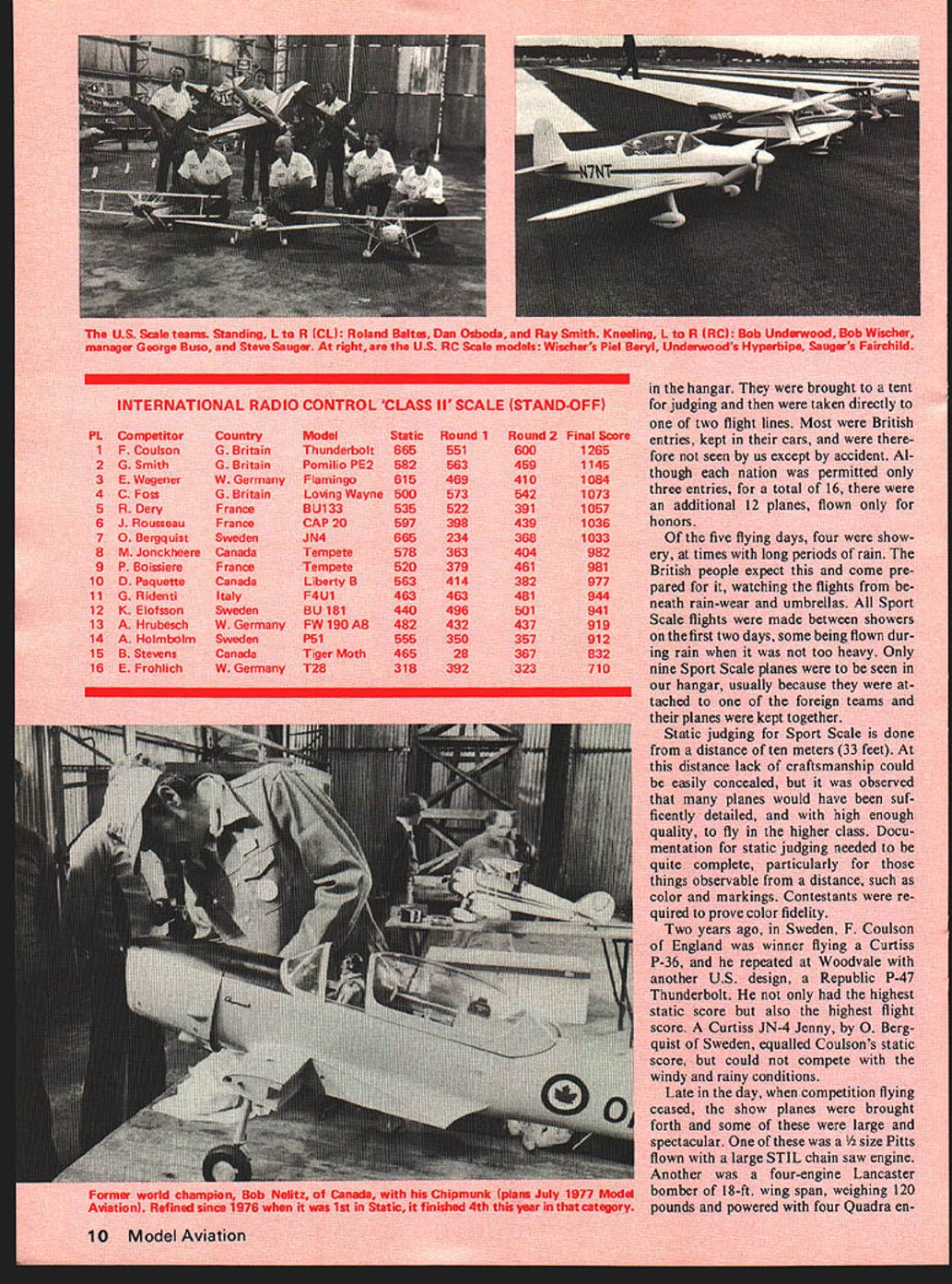
INTERNATIONAL RADIO CONTROL 'CLASS II' SCALE (STAND-OFF)
- F. Coulson — Great Britain — Thunderbolt — Static: 665, Round 1: 551, Round 2: 600 — Final: 1265
- G. Smith — Great Britain — Pomilio PE2 — Static: 582, Round 1: 563, Round 2: 459 — Final: 1145
- E. Wagener — West Germany — Flamingo — Static: 615, Round 1: 469, Round 2: 410 — Final: 1084
- C. Foss — Great Britain — Loving Wayne — Static: 500, Round 1: 573, Round 2: 542 — Final: 1073
- R. Dery — France — BU133 — Static: 535, Round 1: 522, Round 2: 391 — Final: 1057
- J. Rousseau — France — CAP 20 — Static: 597, Round 1: 398, Round 2: 439 — Final: 1036
- O. Bergquist — Sweden — JN4 — Static: 665, Round 1: 234, Round 2: 368 — Final: 1033
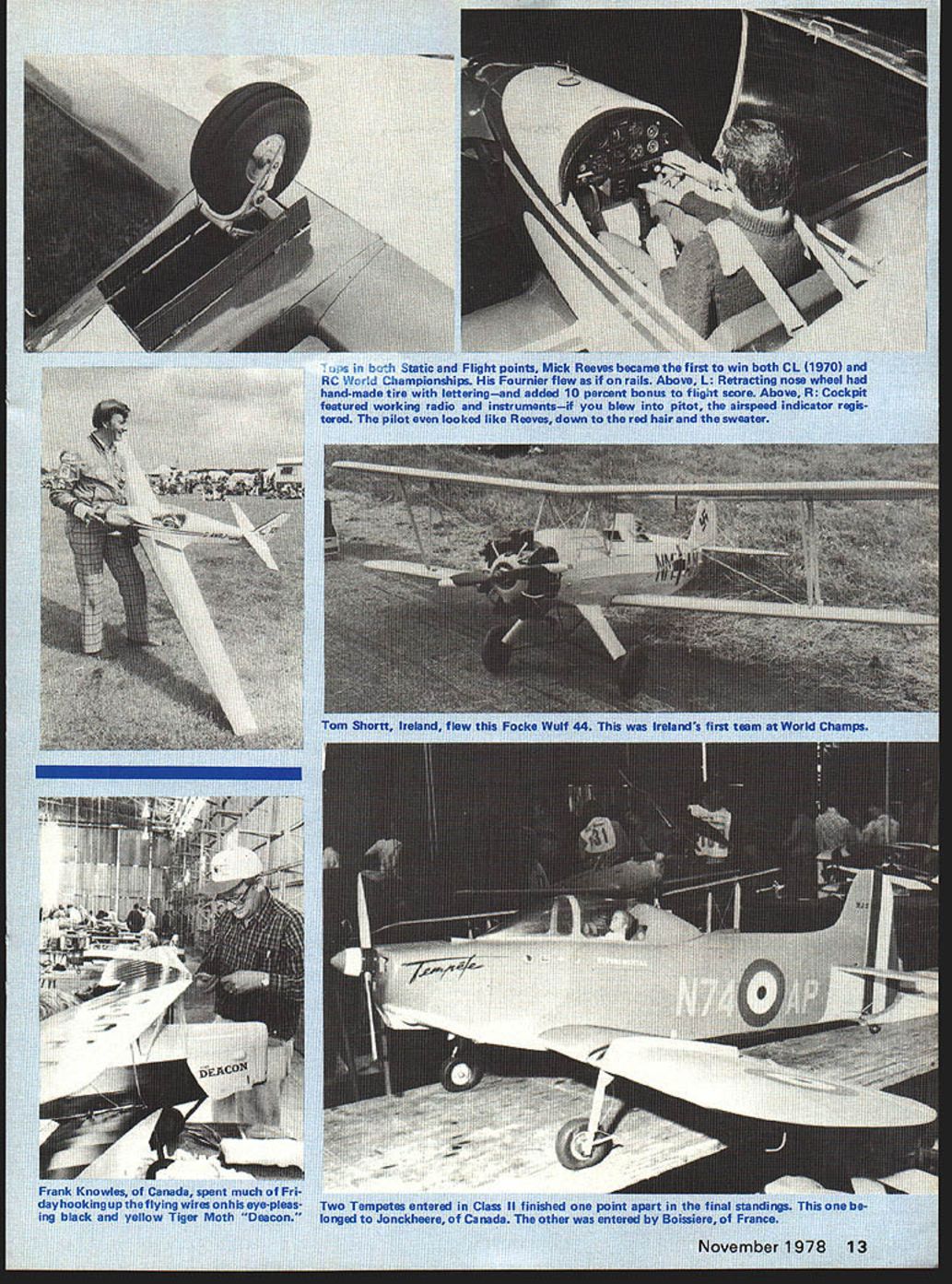
- M. Jonckheere — Canada — Tempete — Static: 578, Round 1: 363, Round 2: 404 — Final: 982
- P. Boissiere — France — Tempete — Static: 520, Round 1: 379, Round 2: 461 — Final: 981
- D. Paquette — Canada — Liberty B — Static: 563, Round 1: 414, Round 2: 382 — Final: 977
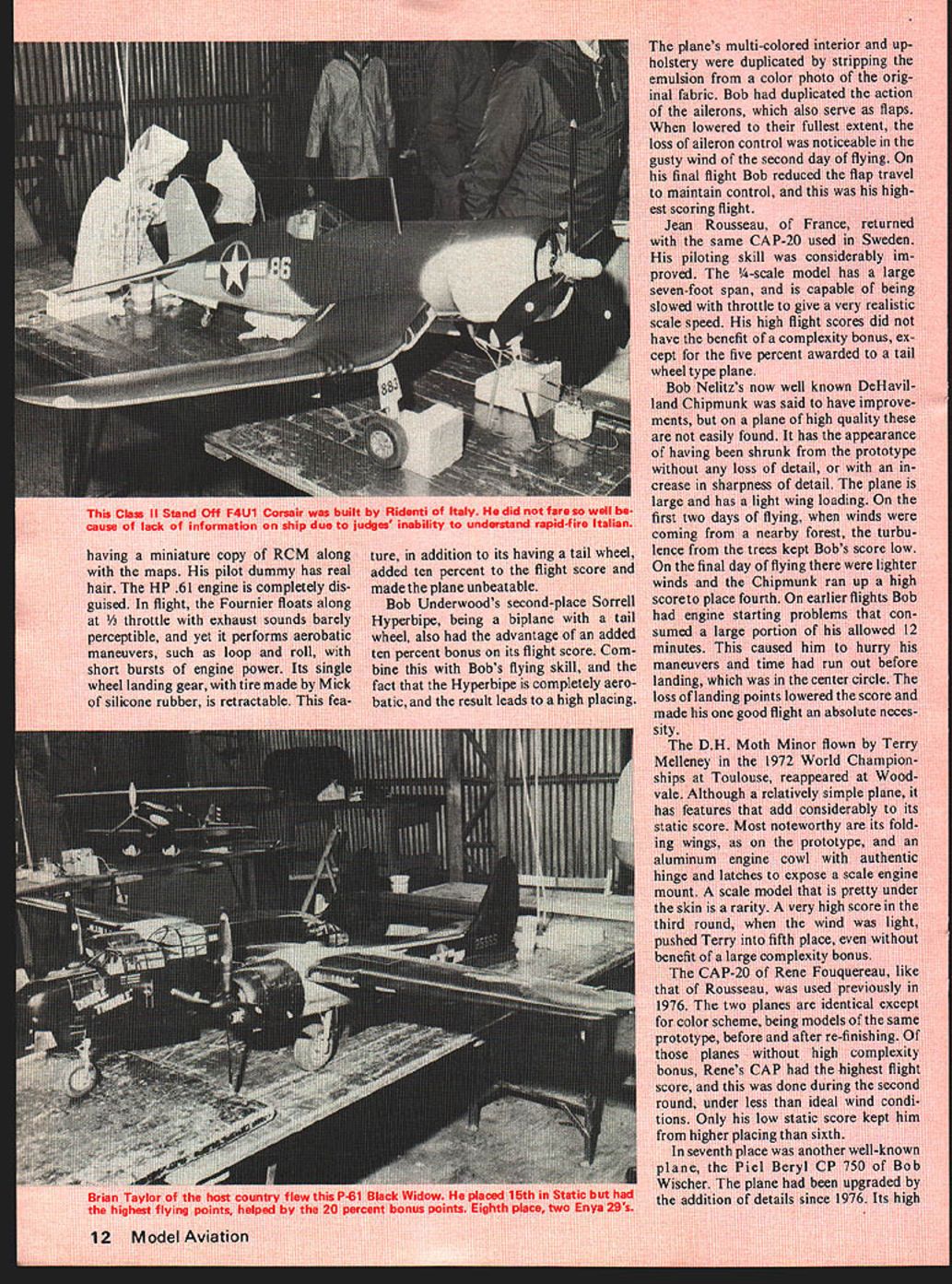
- G. Ridenti — Italy — F4U1 — Static: 463, Round 1: 463, Round 2: 481 — Final: 944
- K. Elofsson — Sweden — BU 181 — Static: 440, Round 1: 496, Round 2: 501 — Final: 941
- A. Hrubesch — West Germany — FW 190 A8 — Static: 482, Round 1: 432, Round 2: 437 — Final: 919
- A. Holmblom — Sweden — P51 — Static: 565, Round 1: 350, Round 2: 357 — Final: 912
- B. Stevens — Canada — Tiger Moth — Static: 465, Round 1: 28, Round 2: 367 — Final: 832
- E. Frohlich — West Germany — T28 — Static: 318, Round 1: 392, Round 2: 323 — Final: 710
Hangar and Flying Conditions
Models were brought to a tent for judging and then taken directly to one of two flight lines. Although each nation was permitted only three entries (for a total of 16), there were an additional 12 planes flown only for honors. Of the five flying days, four were showery, with long periods of rain at times. The British come prepared for this, watching flights from beneath rainwear and umbrellas. Sport Scale flights were made between showers on the first two days, and some were flown during light rain. Only nine Sport Scale planes were seen in our hangar, usually because many were kept with their respective foreign teams and not shown to others.
Static Judging
Static judging for Sport Scale is done from a distance of ten meters (33 feet). At this distance lack of craftsmanship can be concealed, but many planes were sufficiently detailed and of high enough quality to fly in the higher class. Documentation for static judging needed to be quite complete, particularly for items observable from a distance such as color and markings. Contestants were required to prove color fidelity.
Under the new flight scoring system a bonus is applied to flight scores for planes that are complex subjects, so a high static score did not guarantee a high final placing.
Notable Results and Models
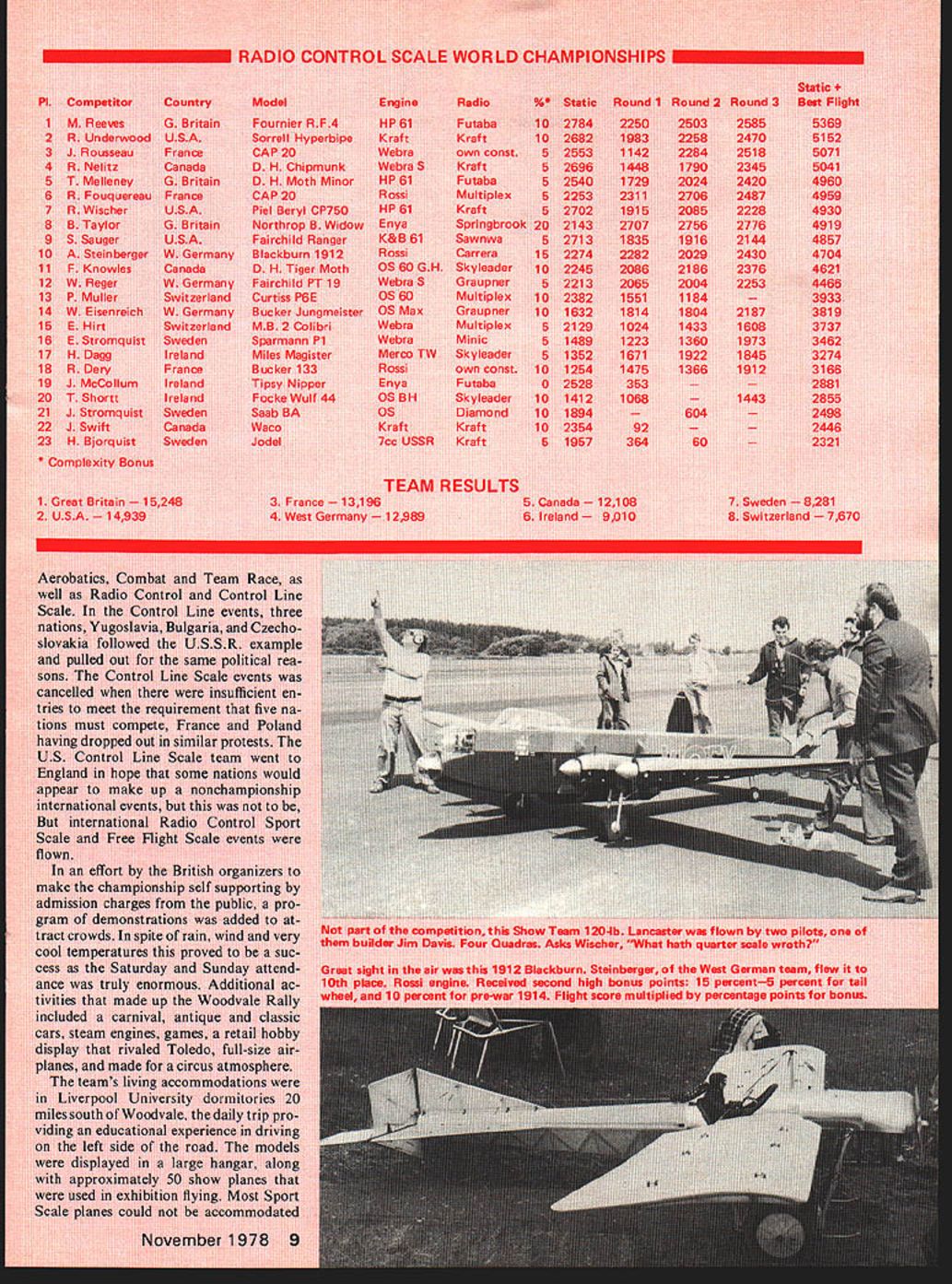
- Mick Reeves (England) won, flying a Fournier RF4. Reeves had the highest static score and the highest flight score. His model displayed superb craftsmanship: instruments worked (the airspeed indicator operated by pressure differences, the throttle linked to a tachometer), a working radio headset could be plugged into the panel, and a detailed cockpit interior aided model setup. The plane's multi-colored interior and upholstery were duplicated by stripping the emulsion from a color photo of the original fabric. Reeves also adjusted his aileron/flap travel on the final flight to maintain control in gusty winds, producing his highest-scoring flight.
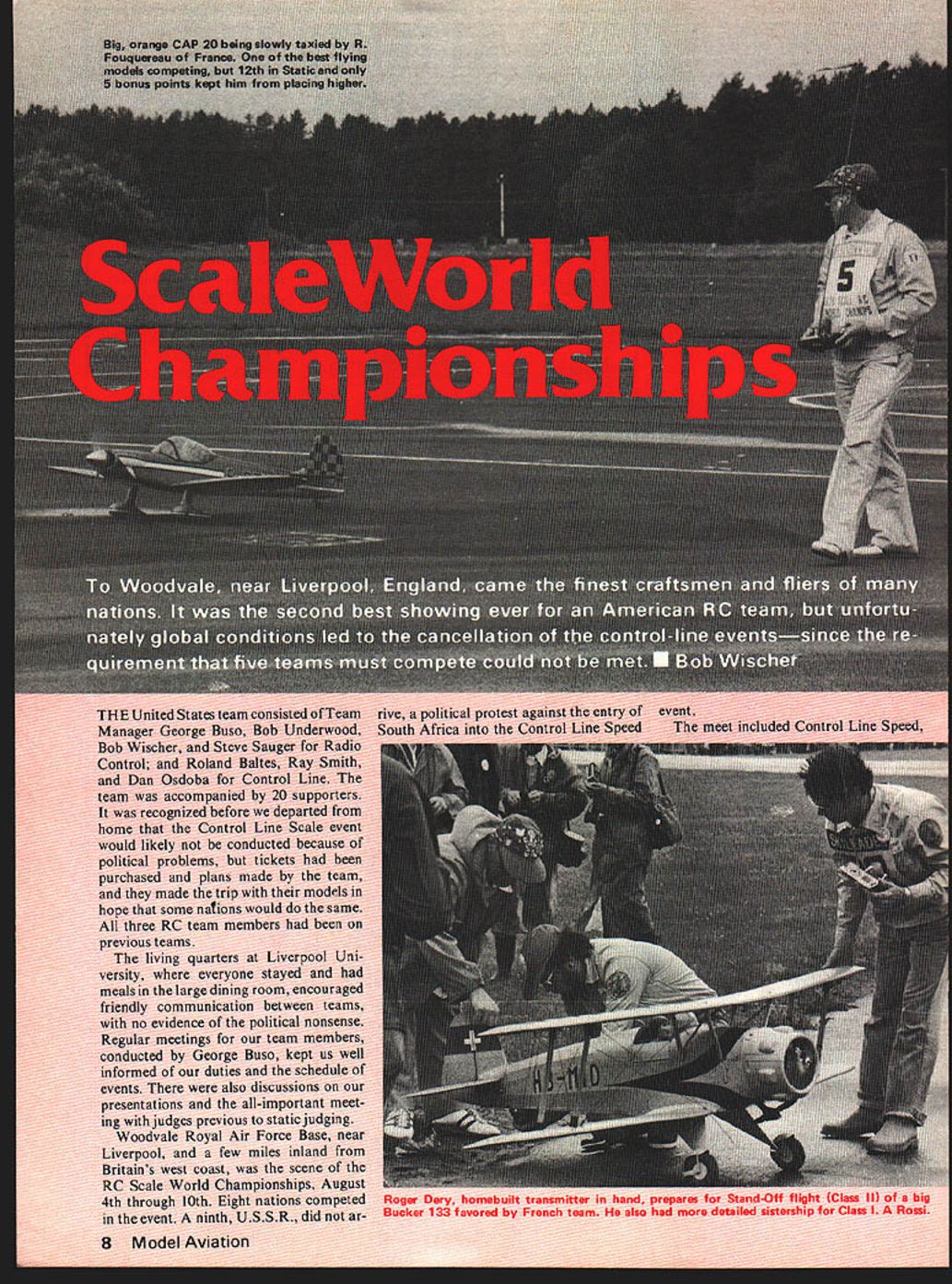
- Jean Rousseau (France) returned with the same CAP-20 used in Sweden. His piloting skill had improved considerably. The 1/4-scale model has a large seven-foot span and can be slowed with the throttle to give a realistic scale speed. Rousseau's high flight scores received only a small complexity bonus (five percent for tail-wheel types).
- Bob Nelitz's well-known De Havilland Chipmunk displayed exceptional fidelity to the prototype. Early winds and turbulence kept his score low on the first two days, but lighter winds on the final day produced a high score and a fourth-place finish. Engine-starting problems earlier had consumed much of his 12-minute flight allowance, resulting in hurried maneuvers and a loss of landing points.
- Terry Melleney's D.H. Moth Minor, first seen in the 1972 World Championships at Toulouse, reappeared. Although a relatively simple plane, folding wings and an authentic aluminum engine cowl with hinges and latches added to its static score. A very high third-round score in light wind pushed Terry into fifth place despite limited complexity bonus.
- Rene Fouquerau's CAP-20 (identical to Rousseau's except for color scheme) earned the highest flight score among planes without a large complexity bonus; however, a low static score kept him in sixth.
- Bob Wischer placed seventh with his upgraded Piel Beryl CP 750 (CP 750). Added detailing since 1976 improved his static score and kept him in contention.
- Brian Taylor's Northrop Black Widow, with two engines and retractable landing gear (adding a 20% flight bonus), looked like a possible winner based on flight scores, but a very low static score placed it eighth.
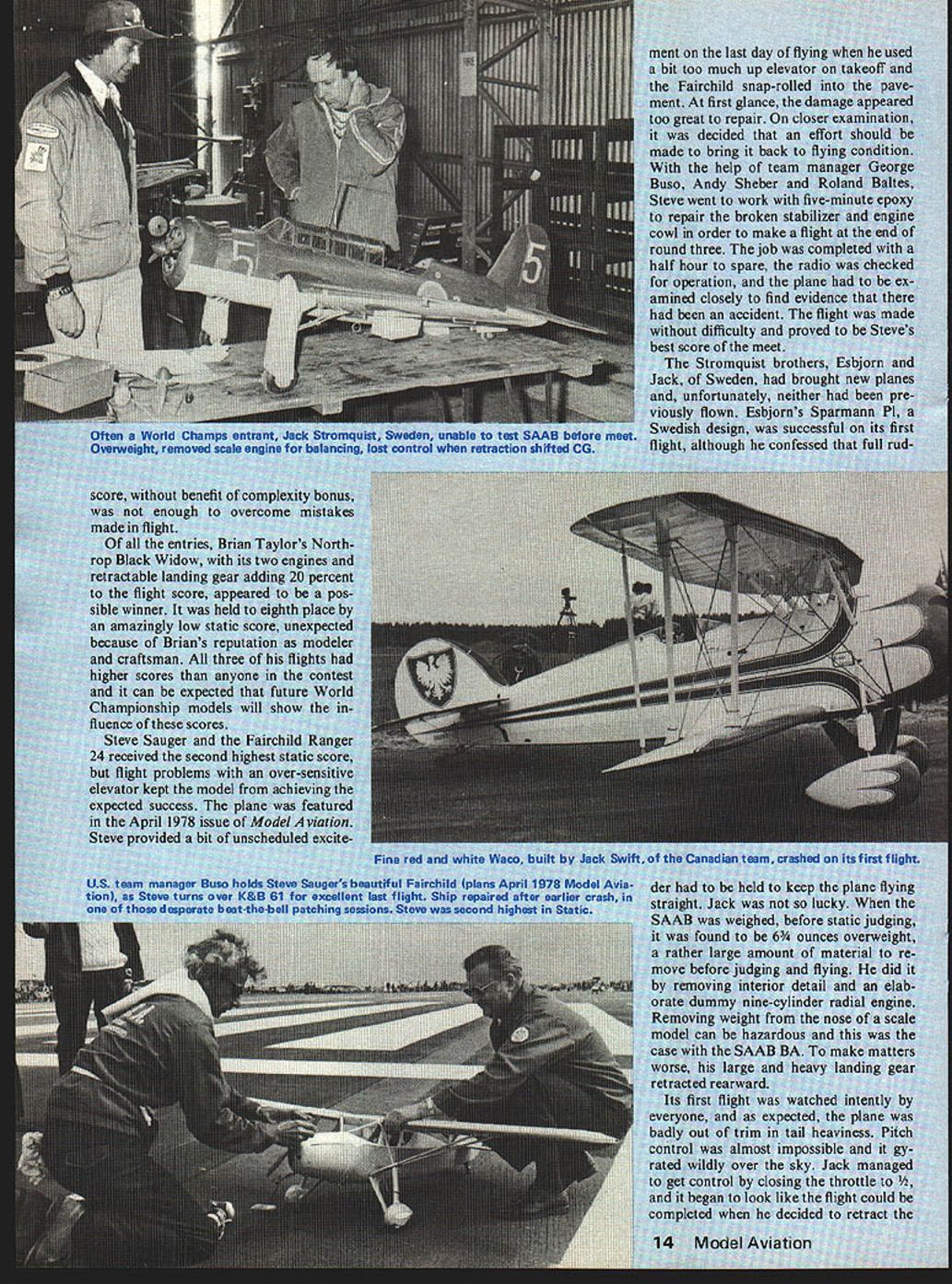
- Steve Sauger's Fairchild Ranger 24 had the second-highest static score, but an over-sensitive elevator caused flight problems. On the last day Sauger overused up elevator on takeoff and the Fairchild snap-rolled into the pavement. Initial damage appeared severe, but with help from George Buso, Andy Sheber, and Roland Baltes, a rapid repair with five-minute epoxy allowed a final-round flight that became Sauger's best score of the meet.
- Two Tempests in Class II (Jonckheere of Canada and Boissiere of France) finished one point apart. Boissiere's score, without the benefit of a complexity bonus, was not enough to overcome mistakes made in flight.
Exhibition and Show Planes
Late in the day, show planes were brought out; some were large and spectacular. Examples included:
- A 1/2-size Pitts flown with a large STIL chainsaw engine.
- A four-engine Lancaster bomber with an 18-ft wingspan, weighing 120 lb and powered by four Quadra engines; each engine had an onboard starter. Early attempts failed because of engine and control problems; a marginal flight was seen on the fifth day.
- Me-109, Boeing 747 (11-foot span, 57 lb, four .60 FS engines; used two transmitters and had a lighting system), additional 1/2-size Pitts, a twin-engined Lancaster, and a Pilatus Porter.
Incidents and Crashes
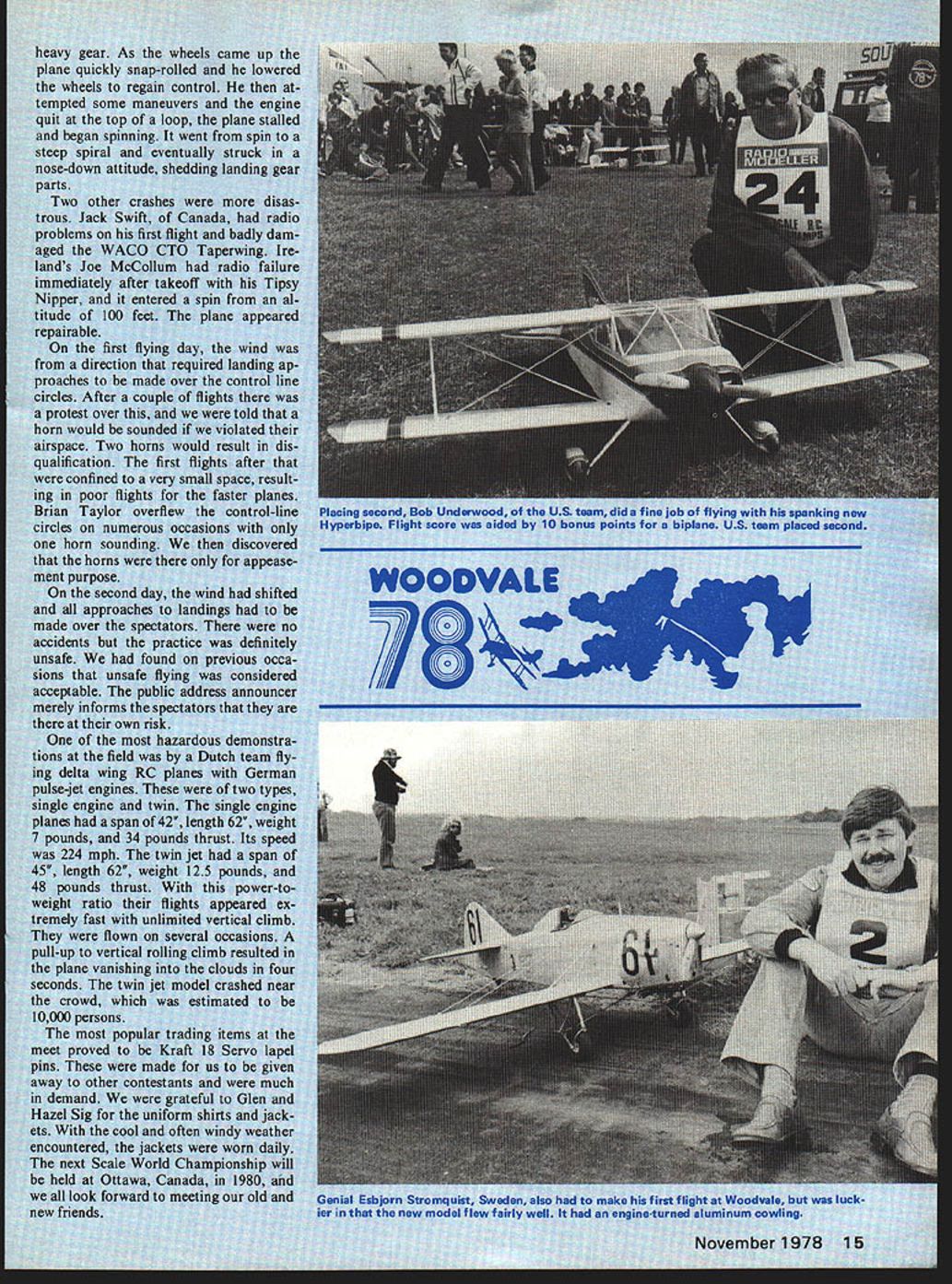
- The Stromquist brothers (Esbjorn and Jack) from Sweden brought new, unflown models. Esbjorn's Sparmann PI managed a successful first flight but required full rudder to keep straight. Jack's SAAB was overweight before static judging; removed interior detail and a dummy engine to reduce weight, which made the model tail-heavy. Its first flight was badly out of trim; attempts to retract heavy gear led to a snap-roll. An engine quit at the top of a loop, and the plane stalled, spun, and struck the ground in a nose-down attitude, shedding landing gear parts.
- Jack Swift (Canada) had radio problems on his first flight and badly damaged a WACO C10 Taperwing.
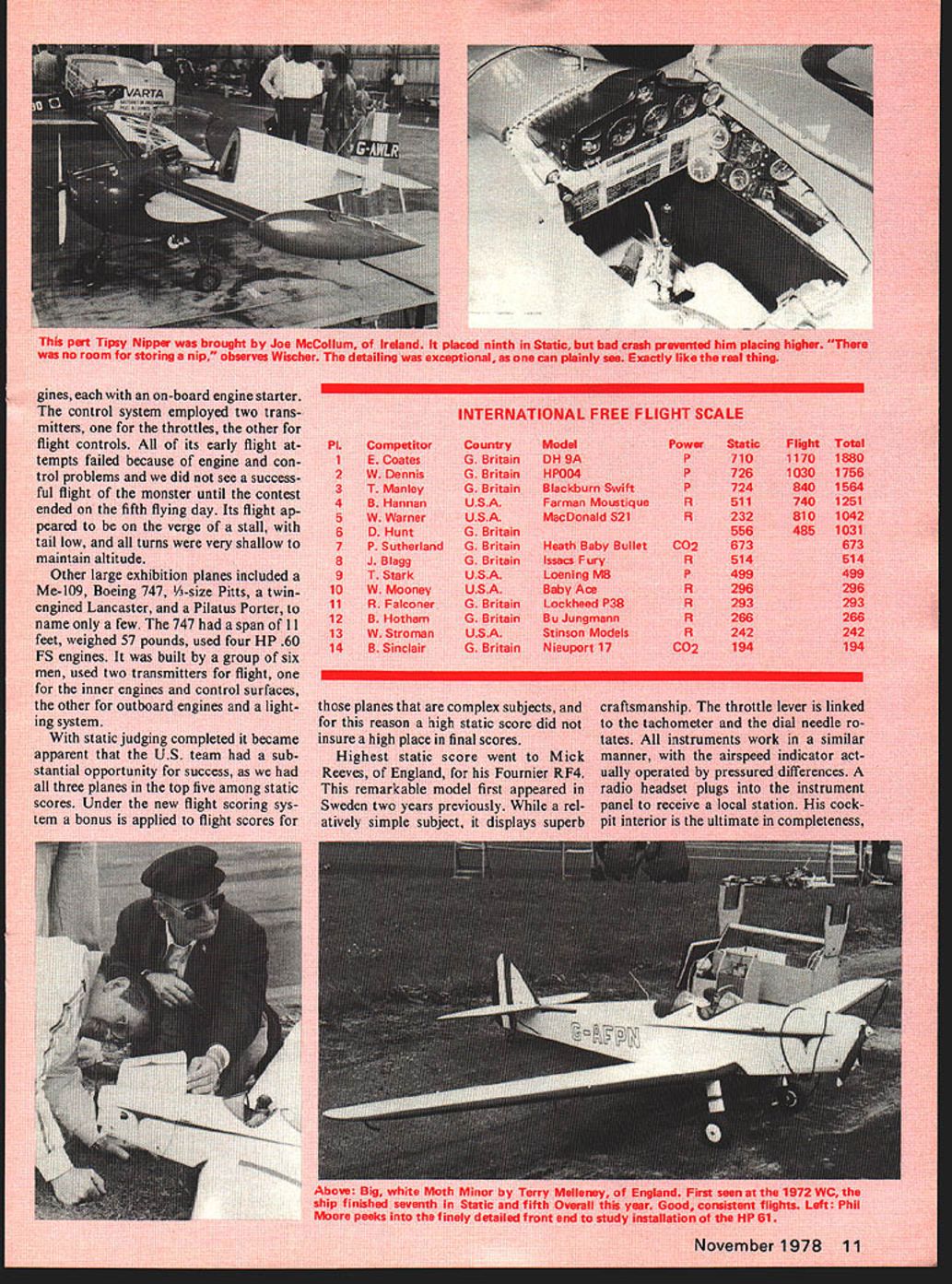
- Joe McCollum (Ireland) suffered radio failure immediately after takeoff with his Tipsy Nipper; it entered a spin from about 100 feet. The plane appeared repairable.
Safety, Airspace and Demonstrations
On the first flying day the wind direction required landing approaches over the control-line circles. A protest followed, and we were told a horn would be sounded if airspace violations occurred; two horns would lead to disqualification. Subsequent flights were confined to a very small space, producing poor flights for faster planes. Despite repeated overflies by Brian Taylor, only one horn sounded; the horns proved largely for appeasement.
On the second day the wind shifted and approaches had to be made over the spectators. Although there were no accidents, the practice was unsafe. The public-address announcer informed spectators that they were present at their own risk.
One hazardous demonstration featured a Dutch team flying delta-wing RC planes powered by German pulse-jet engines. The single-engine type: span 42", length 62", weight 7 lb, thrust 34 lb, speed ~224 mph. The twin-jet: span 45", length 62", weight 12.5 lb, thrust 48 lb. With such power-to-weight ratios their flights appeared extremely fast with unlimited vertical climb; a pull-up to a vertical rolling climb could take the plane into clouds within seconds. The twin-jet model crashed near the crowd, which was estimated at 10,000 persons.
Miscellaneous
- The most popular trading items at the meet were Kraft '78 servo lapel pins, made to give away to other contestants. They were in much demand.
- The team was grateful to Glen and Hazel Sig for uniform shirts and jackets; given the cool and windy weather, the jackets were worn daily.
- The next Scale World Championship was announced for Ottawa, Canada, in 1980, and teams looked forward to meeting old and new friends.
Transcribed from original scans by AI. Minor OCR errors may remain.

