
SCALE WORLD CHAMPIONSHIPS
Bob and Dolly Wischer
This year's contest at Paris, July 2–8, enjoyed excellent weather that allowed lightly loaded planes to compete effectively with heavier models. Australians took the top two places in the Radio Control event, and the U.S.S.R. team again dominated Control Line.
Location and facilities
Historic Le Bourget Airport and the Paris Musée de l'Air hosted the Eighth Scale World Championships for Radio Control (RC) and Control Line (CL) airplanes. Models were displayed inside the old terminal building (late 1930s era), which has seen no airline activity since traffic was diverted to Charles de Gaulle and Orly. The building is being renovated to receive aircraft from Chalais-Meudon. During the week, concrete dust from thousands of visitors constantly coated the models.
Le Bourget remains in use for freight operations. Flight activity for the contest took place along one edge of the field adjacent to the museum, separated from full-scale operations by a half mile or more. The Control Line circle, its concrete joints polished smooth, was only a few feet from the terminal's main entrance. Radio Control flights were made from an immense, formerly passenger-loading, paved area about 800 feet from the terminal. The distance between the two areas made it difficult to properly report on both events.
A row of extremely tall light poles ran along the spectator side; some pilots found them intimidating. In practice, flying near those poles would have resulted in maneuver disqualification, as flying above spectators or behind the deadline was forbidden.
Organization and accommodations
Organization of the meet was adequate. Contestants were accommodated in a single modern hotel about 1–1½ miles from the airport. Breakfasts and dinners were served at the hotel and lunches in the terminal dining room. The shared meals encouraged mixing of nationalities. Except for typically light French breakfasts, many felt they were being too well fed — plenty of water was available (and a reminder: don't drink wine with a meal).
Seventeen nations competed. Forty airplanes entered the RC competition and 18 entered the CL competition. The large number of RC entries (40 flown over three days) required strict discipline on the flight line because separate judging panels handled static and flight scoring. Control Line operations were conducted at a more leisurely pace.
Weather and competitive effect
Fortunately, the weather for the three competition days was ideal: warm temperatures and an almost complete absence of wind during the day. The lack of wind had a considerable effect on final results, giving aircraft an equal chance regardless of wing loading.
As expected, RC models that benefited from higher flight-score bonuses placed high in the standings. Of the dozen entries carrying only a 5% bonus, the highest placement among them was 17th. Two 30% bonus multiengine entries with low static scores were effectively dropped from contention because the bonus could not overcome their static marks.
Teams and officials
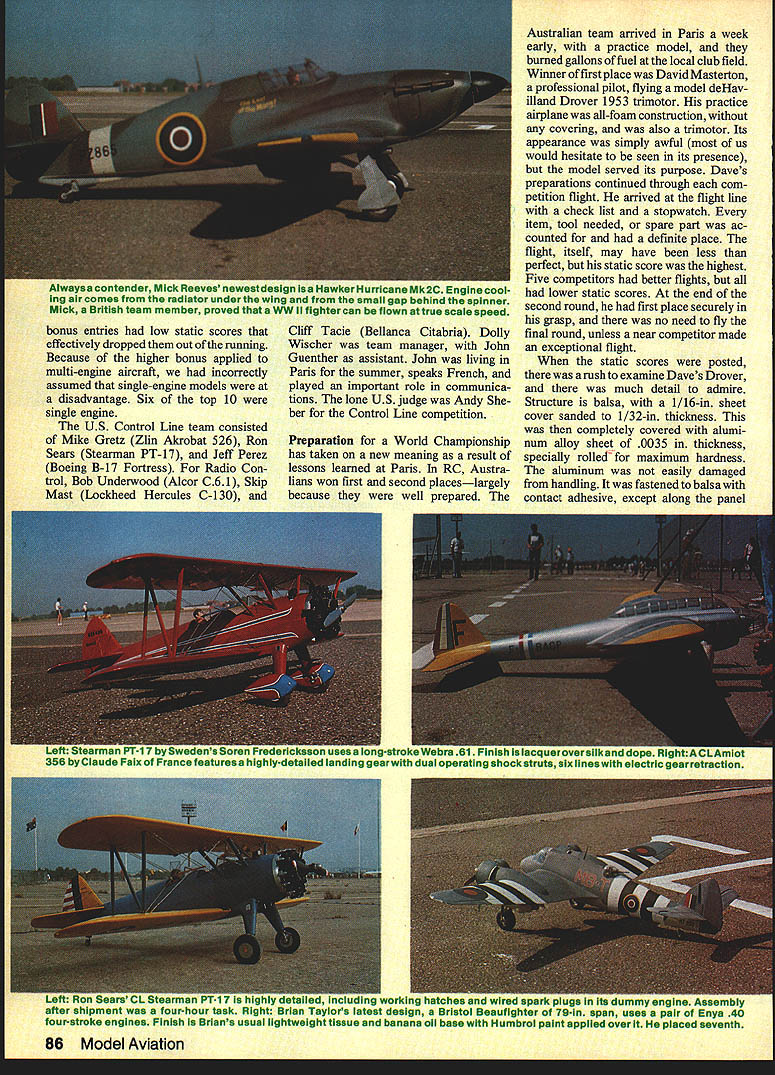
- U.S. Control Line team: Mike Gretz (Zlin Akrobat 526), Ron Sears (Stearman PT-17), Jeff Perez (Boeing B-17 Fortress).
- U.S. Radio Control team: Bob Underwood (Alcor C.6.1), Skip Mast (Lockheed Hercules C-130), Cliff Tacie (Bellanca Citabria).
- U.S. team management: Dolly Wischer (team manager), John Guenther (assistant; lived in Paris and handled communications).
- U.S. Control Line judge: Andy Sheber.
Radio Control competition — preparation and training
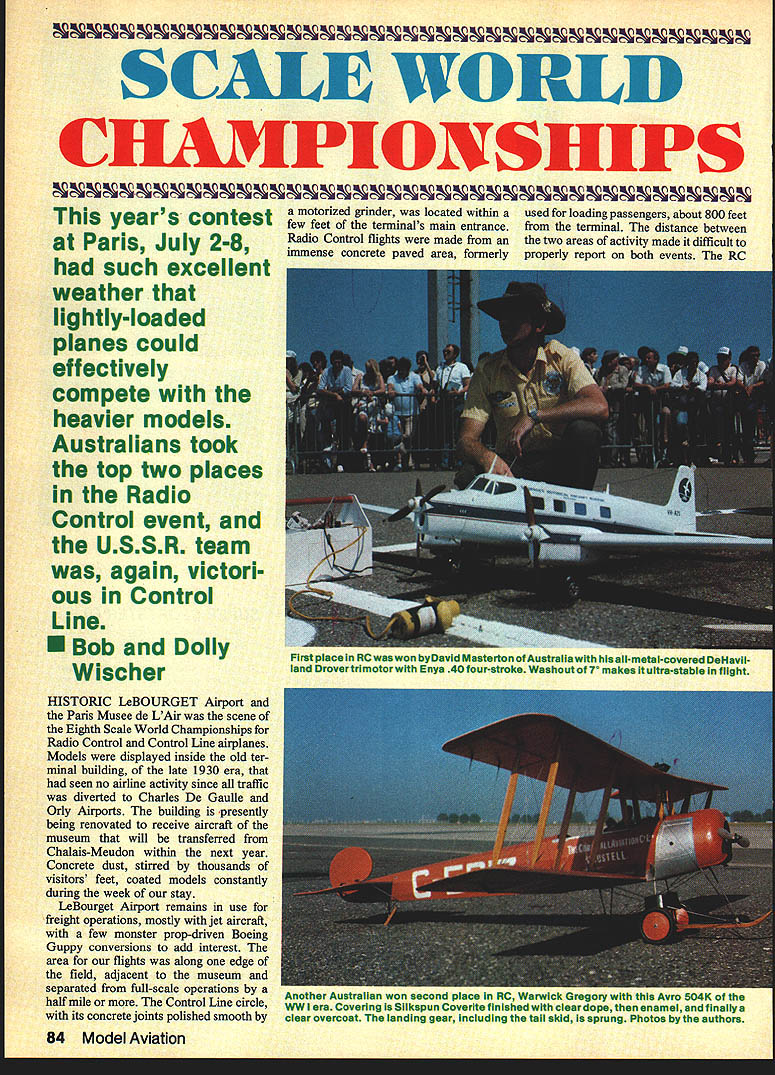
Preparation for a World Championship showed its importance in Paris. The Australian team arrived a week early with a practice model and practiced extensively at a local club field. David Masterton (Australia), a professional pilot, won first place flying a model de Havilland Drover 1953 trimotor. His practice airplane was an all-foam, uncovered trimotor that looked rough but served its purpose.
Masterton's detailed preparation at the flight line was notable: he used a checklist and stopwatch; every item, tool, and spare part had a designated place. His static score was the highest even though five competitors had better flight performances; his high static advantage ensured his lead after the second round and made a third-round flight unnecessary unless a rival produced an exceptional performance.
Notable Radio Control models and entries
- David Masterton (Australia) — de Havilland Drover trimotor
- Structure: balsa with 1/16-in. sheet sanded to 1/32-in., covered with 0.0035-in. aluminum alloy sheet bonded with contact adhesive and cement at panel edges.
- Rivet detail embossed per panel; three Enya .40 four-stroke engines; 7 ft wingspan; 10.6 lb weight.
- Stability aided by 7° washout in the sharply tapered wing.
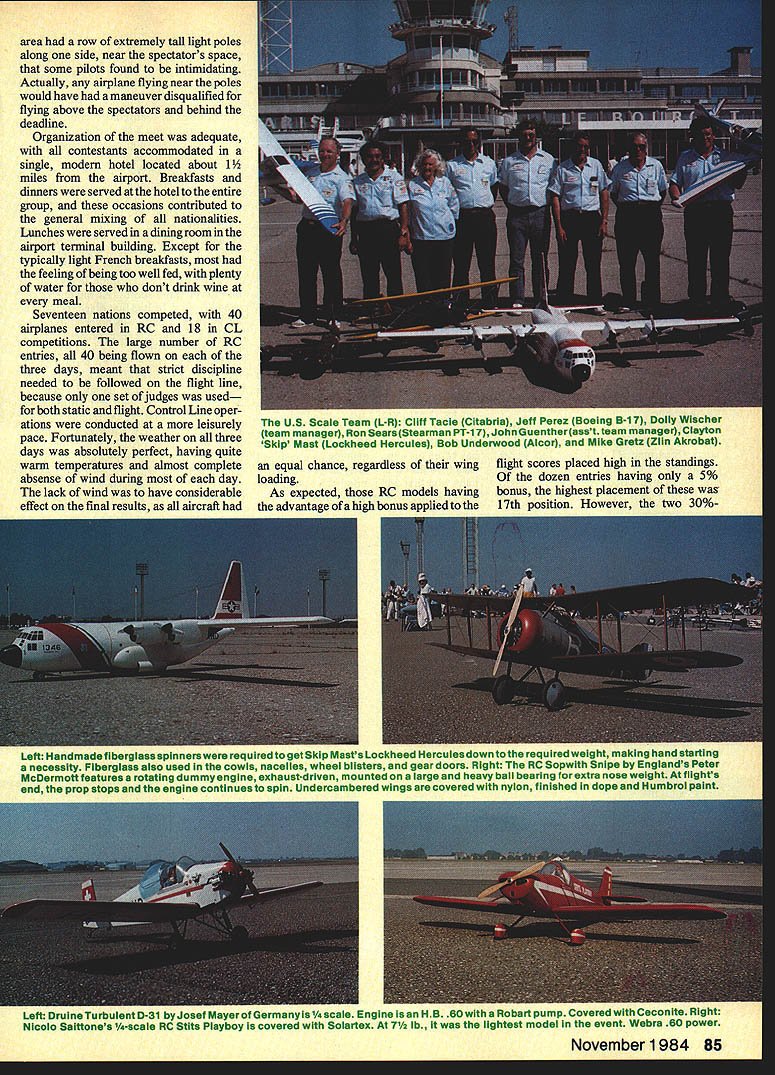
- Warwick Gregory (Australia) — Avro 504K (WWI-era)
- 72 in. span; 10.25 lb. Light wing loading helped in the calm conditions.
- Qualified for a 25% flight bonus (10% claimed as pre-1914 design; jury later interpreted bonus rule to mean "designed before 1914" after protests).
- Built from David Boddington's drawings with modifications including an undercambered scale airfoil for an extra 5% bonus.
- Covering: silkspan and Coverite, clear dope and enamel with final clear overcoat; sprung landing gear and tail skid.
- Bob Underwood (USA) — Alcor C.6.1
- Two Saito .45 engines; notable for very smooth, precise flying and quiet engines.
- Single-engine flight option used; configuration and built-in out-thrust allowed single-engine operation with minimal control compensation.
- Better landings might have bridged narrow point differences with Masterton.
- Skip Mast (USA) — Lockheed C-130 Hercules
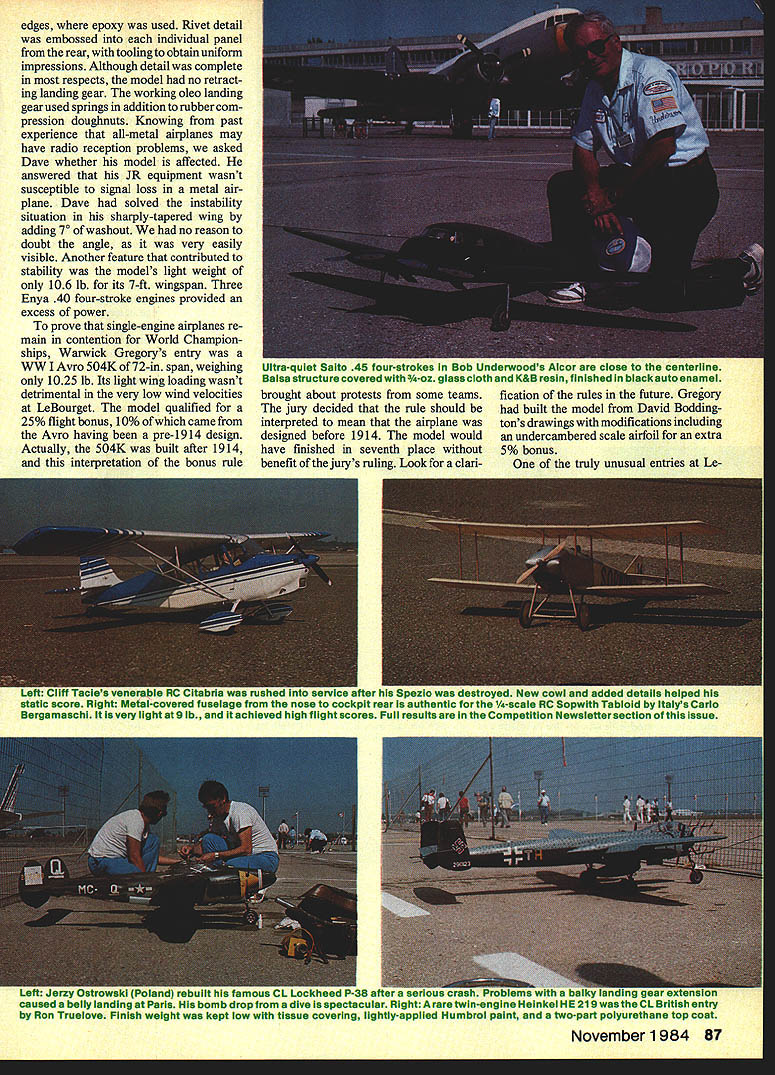
- Foam construction, four engines; weight kept under the 6 kg FAI limit using handmade fiberglass spinners and other fiberglass components (cowlings, nacelles, wheel blisters, gear doors).
- Required re-weighing before and after flights to ensure compliance; lost bonus points when an engine quit in the second flight and initially lost gear retraction bonus (later returned after appeal).
- Re-weighing and bonus loss rulings indicated need for rule clarifications about engine-run duration for bonus retention.
- Other notable RC entries:
- Konrad Oetiker (Switzerland) — Bücker Jungmeister 1/4-scale, 12.6 lb, Saito 20cc four-stroke (4th place).
- Hansruedi Zeller (Switzerland) — de Havilland 88 Comet racer, twin O.S. .40 four-strokes (5th place).
- Steve Gray (Canada) — de Havilland DH86B Rapide Express, O.S. .20 engines, 8 ft span; high flight performance but low static score due to incomplete documentation.
- Graham Ireland (Canada) — Fokker F VIIa trimotor; initially overweight, substituted balsa wheels; had a takeoff nose-over and tank leak; static score suffered from incomplete documentation.
- Jean Rousselot (France) — Moynet 360 Jupiter push-pull twin; balsa with thin aluminum skin and compound-curve sections glassed; used 11 servos; destroyed in a high-altitude dive (possible radio or structural failure).
- Charles Levy (France) — Colomban Cri-Cri (half-size), all-metal twin using two OPS .40 engines; weighed 5.99 kg with 78 in span, built to FAI limits.
- Brian Keating (England) — large model (79 in span) weighed down to 12 lb via special covering and dummy engines inside cowlings.
Observations:
- The success formula for FAI RC Scale contests appears to be: build large, multi-engine, four-stroke-powered models and approach the maximum allowed weight (near 6 kg). Twenty of the 40 RC entries weighed near 6 kg; three models exceeded the limit.
- Four-stroke engines provided advantages, allowing large-diameter, efficient propellers and smoother engine behavior, which likely influenced judges.
Control Line competition — highlights
The Control Line contest was dominated by the Soviet team, but competition among the rest was spirited.
- U.S.S.R. winners:
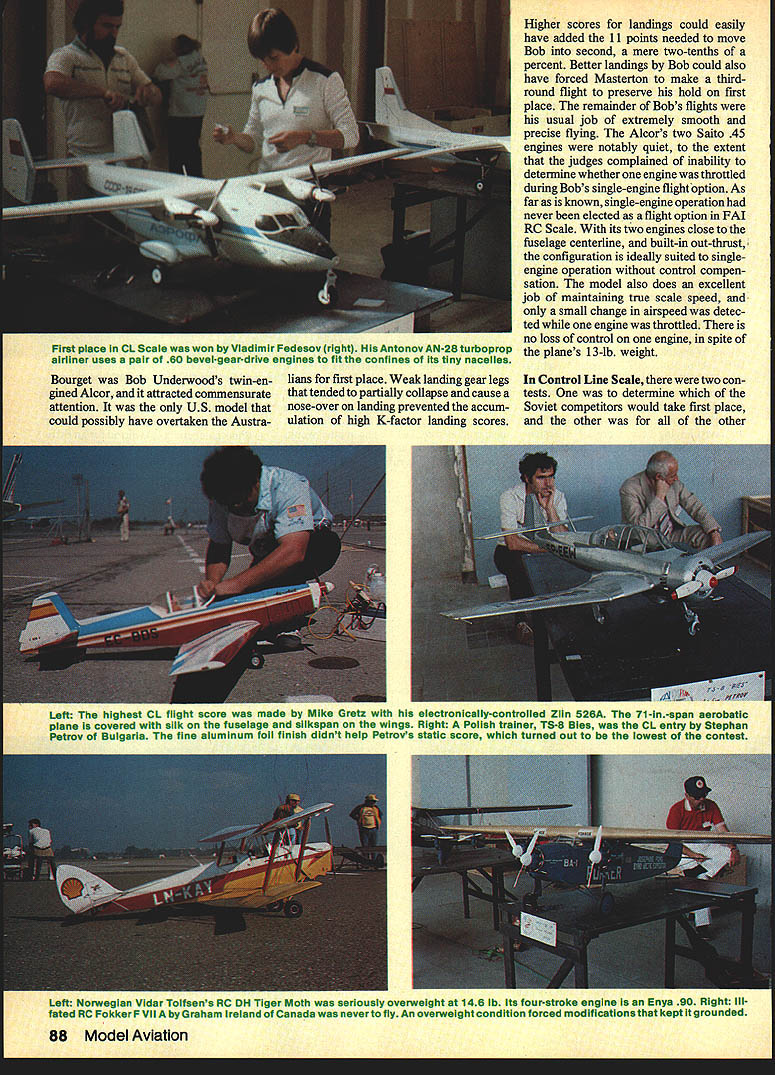
- Vladimir Fedosov — Antonov AN-28 (twin); used bevel-gear-drive .60 engines in turboprop nacelles; first place.
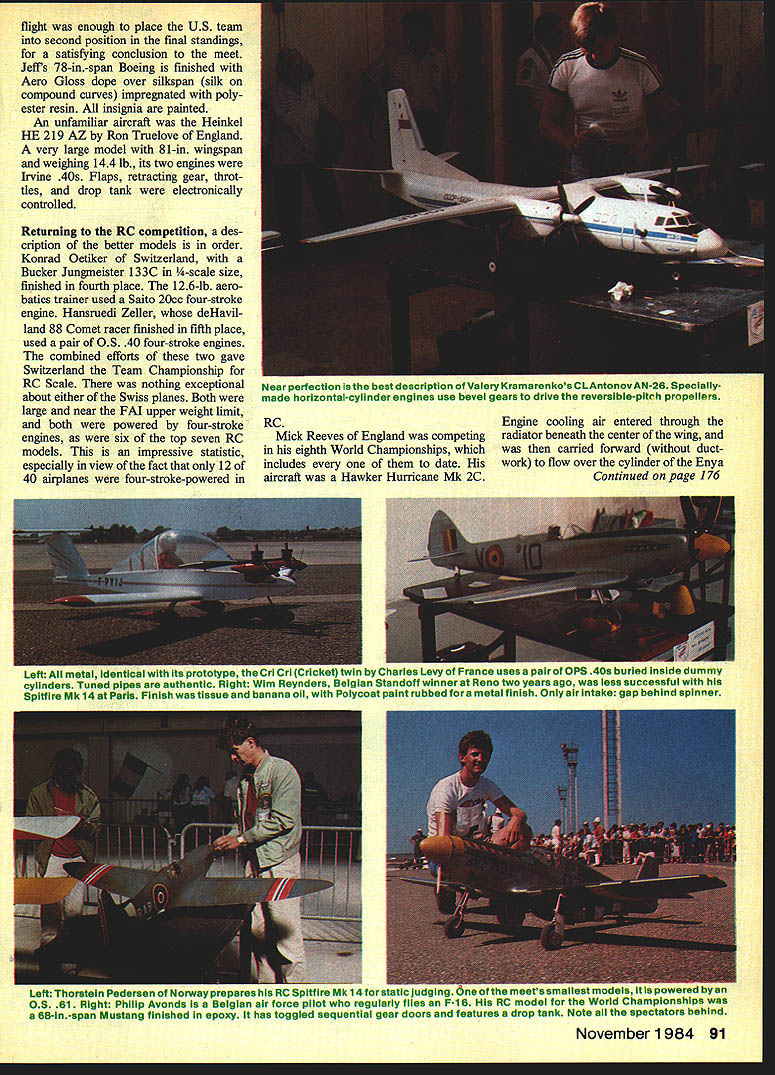
- Valery Kramarenko — Antonov AN-26 (twin); second place. Models used line control for flaps, retracts, throttle, and prop pitch reversal; Kramarenko had three landing lights actuated by lowering wheels.
- Vladimir Boulatnikov (U.S.S.R.) — Air I biplane (late 1920s)
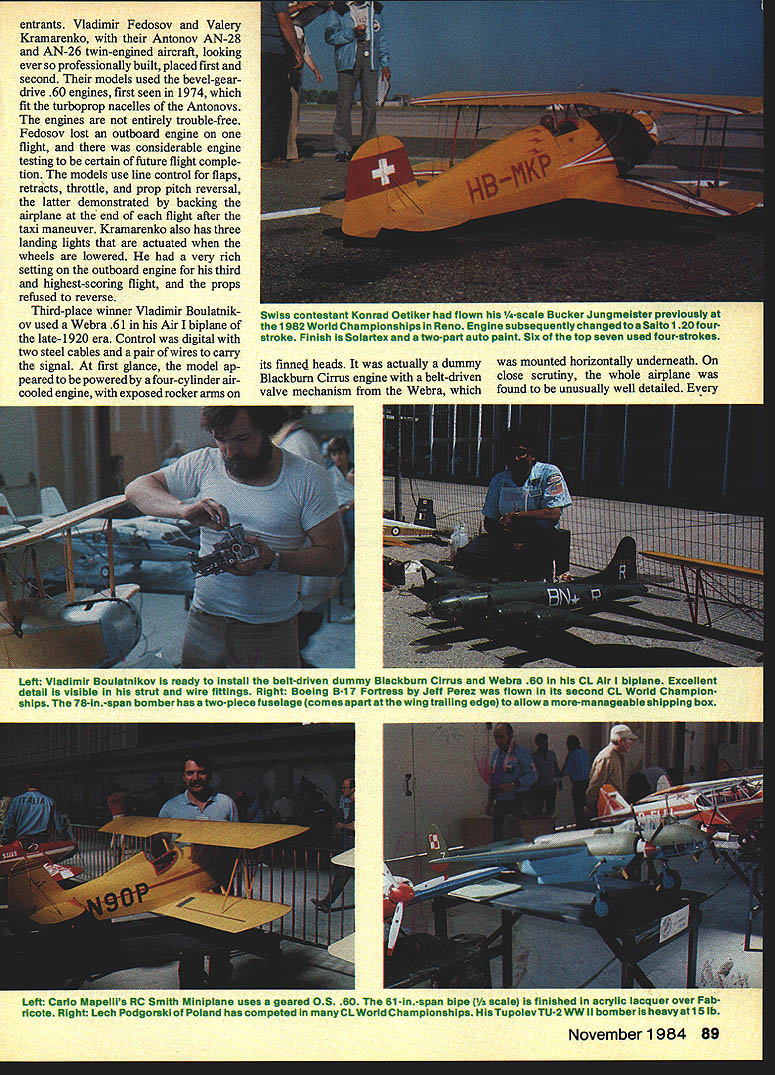
- Third place. Powered by a Webra .61; detailed construction with precise fittings and rigging; control was digital with two steel cables and signal wires.
- The model featured a dummy Blackburn Cirrus engine and a belt-driven valve mechanism from the Webra. Animated pilot turned his head and saluted when stopped before the judges.
- Jerzy Ostrowski (Poland) — Lockheed P-38 Lightning
- Returned with a rebuilt masterpiece after a previous crash. Engine trouble due to lean runs caused failure on the second flight; the model could not sustain altitude on one engine. A landing gear extension failure led to a belly landing, with the belly tank absorbing impact. The P-38 performs a hazardous steep dive that barely allows recovery time.
- Mike Gretz (USA)
- Highest placing U.S. entrant in CL; his Zlin Akrobat 526 overcame a low static score by making the highest scoring CL flight, finishing fifth. Smooth control with digital equipment; control box mounted on belt (left hand for controls, right hand for elevator).
- Chris Bradford (England)
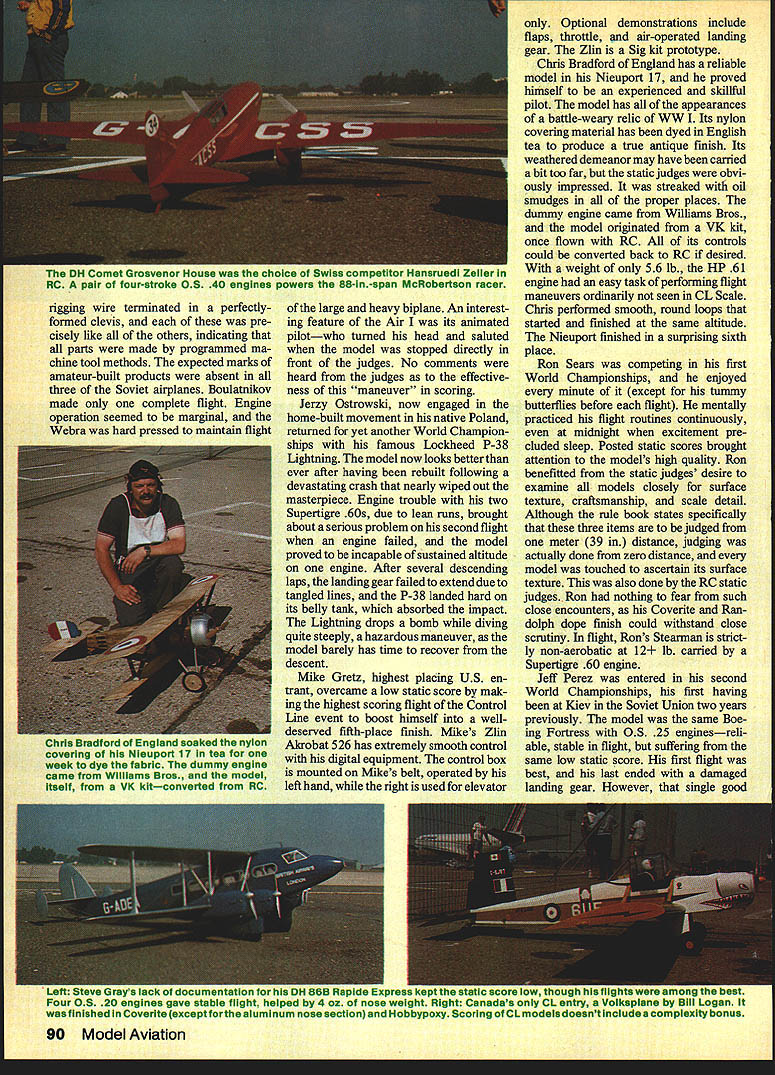
- Nieuport 17, weighing 5.6 lb with HP .61 engine, finished sixth. Model had an authentic "battle-worn" finish dyed with tea and oil streaking; performed smooth, round loops and impressed static judges.
- Ron Sears (USA)
- First World Championships; Stearman PT-17 (12+ lb) with Coverite and Randolph dope finish; non-aerobatic in flight but showed high-quality static finish.
- Jeff Perez (USA)
- Boeing B-17 Fortress, O.S. .25 engines; reliable and stable with a good first flight and damaged landing gear on the last. His single strong flight helped the U.S. CL team finish second overall. The 78-in. span B-17 was finished with Aero Gloss dope over silkspan impregnated with polyester resin; all insignia painted.
- Ron Truelove (England)
- Heinkel He 219 AZ, 81 in span, 14.4 lb, Irvine .40 engines with electronically controlled flaps, retracts, throttles, and drop tank.
Judging, documentation, and procedural issues
- Static and flight judging:
- Judges used separate panels for static and flight scoring. Static judges often examined models extremely closely; in Paris the stated rule of judging from one meter (39 in) was ignored and judges frequently touched models and examined them at zero distance.
- When models were touched, judges held color cards directly against surfaces and inspected wheel wells and interiors. This close contact raised concerns and may prompt a rule change specifying minimum judge distance.
- Documentation:
- Many contestants suffered from insufficient documentation, particularly first-time attendees or those who had only flown in stand-off events. Printed materials are rarely read by judges; multiple three-view drawings and clearly presented, easily circulated documentation are preferred.
- When documentation was bound in books, judges found it harder to circulate; disassembled presentation or loose sheets allowed easier review.
- Score sheets and communication:
- Contestants were not given copies of their score sheets; only team managers could examine them. This differed from other World Championships where contestants received duplicates. Team managers often made handwritten copies to keep pilots informed.
- On the positive side, score totals and standings (with and without bonuses, and static scores) were announced at dinnertime each evening.
- Timing of static judging:
- Early in the static judging process judges took over half an hour per plane; near the end per-plane time dropped to about 20 minutes. Being judged later could be advantageous as judges tended to view top, sides, front, and bottom more briefly.
Equipment, weights, and FAI limits
- Weighing procedure:
- Models were weighed before static judging and, for some critical entries, re-weighed after flights to ensure compliance with the 6 kg FAI limit. This caused irritation among some competitors, as repeated weighings implied suspicion. In many cases models weighed slightly less after flights.
- Engine types and trends:
- Six of the top seven RC models used four-stroke engines, though only 12 of the 40 RC entries were four-stroke-powered. The advantage of smoothness and the ability to swing large efficient props makes four-strokes desirable.
- Many teams built to the FAI upper weight limit, and three models were actually over the 6 kg limit.
Recommendations and likely future changes
- Clarify bonus and engine-run rules:
- Clarify rules regarding the interpretation of "designed before 1914" for pre-1914 bonuses.
- Clarify required duration of engine operation to retain multiengine or retraction bonuses.
- Judging distance and handling:
- Consider specifying that judges may not approach within one meter of models to prevent touching and potential damage.
- Documentation format:
- Require several loose three-view drawings and easily circulated documentation rather than bound books or long printed text.
- Judge staffing and entry limits:
- Forty entries seems to be the practical limit for a single crew of five judges. Expect the need for additional judges (and higher entry fees) as entries grow.
Closing observations
Paris provided near-perfect weather and a high level of craftsmanship. The meet highlighted the benefits of meticulous preparation (as demonstrated by the Australian team), the increasing role of four-stroke engines and careful weight management, and the continuing dominance of the Soviet team in Control Line. Several procedural ambiguities surfaced that should be clarified in future rulebooks. Overall, the Eighth Scale World Championships offered outstanding competition and many models worthy of close study.
Transcribed from original scans by AI. Minor OCR errors may remain.

