


Scale World Championships
By Bob and Dolly Wischer
Overview
Norway hosted the Ninth Scale World Championships at Kjeller Airport, a military field about 20 miles northeast of Oslo. Seventeen nations competed: 47 airplanes in Radio Control (RC) and 13 in Control Line (CL). The large RC entry placed a heavy burden on contest management; organizers considered limiting flights to two rounds but ultimately allowed three flights per competitor. The contest concluded within the allotted time only because the weather cooperated—an additional rain shower would have required an extra day.
Organization and judging
- The Norwegian Aero Club made several early decisions that helped compress all activity into five days:
- RC flight judges were used for CL static scoring, and CL judges handled RC static scoring. This allowed RC flights to begin before all static judging was complete.
- Static judging began with a lineup of entries and was conducted outdoors.
- Weather (showers) interrupted static judging and some early flights.
- Flight-line operation was accelerated later in the week by moving the No. 1 ready box to the runway behind the flight judges.
- Flight-line bosses such as Dave Brown and Ron Hesselbrock would have helped speed early flying; their services were missed at the start.
- For future events, with 60–70 entries expected, two complete sets of judges will be required. A three-flight schedule can create unequal exposure and may hurt some flight scores.
- The number of available aero club volunteers was small, but overall the meet was well-run.
Accommodations, social life, and local highlights
- Two hotels within walking distance (about one mile) of the airport served as headquarters.
- The setting was attractive: forested hills with many homes, and the hotel sat on a slight knoll with scenic views.
- Meals were taken together in a large dining room; smaller side rooms hosted evening social gatherings.
- The Norwegian Aircraft Museum was specially opened one evening for competitors.
- With about 21 hours of daylight in July at Oslo's latitude, evening activity extended late—one banquet continued until 4 a.m.
Participation notes
- Several nations made their first appearances at Scale Worlds.
- The Japanese team attended to learn and enjoy the event rather than to "sweep" the top places; they showed above-average models and flying skills and were a welcome presence. First-flight jitters were common; once settled, some Japanese entries showed championship potential. Okamoto's Nieuport 11 had an exciting first takeoff that nearly caused a scramble among the judges, but the model was repaired and flew well in later rounds.
- The Soviet RC team's dropouts were a major disappointment; their expected strong showing did not materialize. In CL, however, the Soviet team was dominant.
Control Line (CL) Scale
Results and highlights
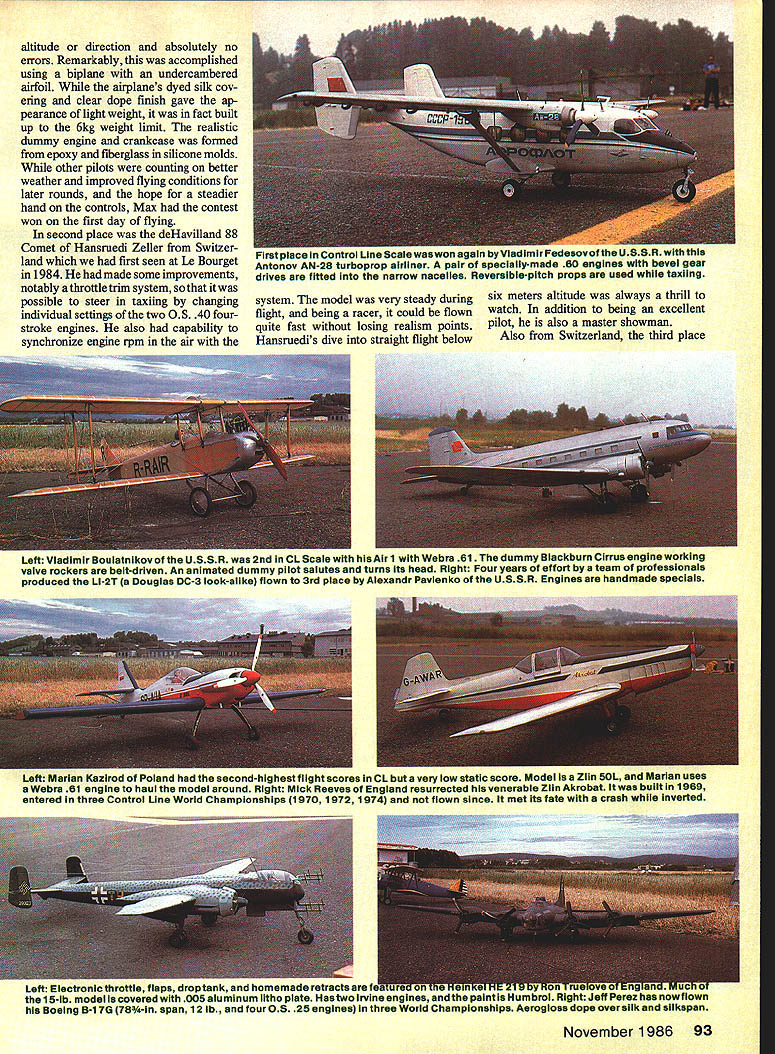
- The Soviet team in CL was dominant, even without Valery Kramarenko’s Antonov (lost in a crash). Alex Pavlenko flew an IL-2T (listed as a copy of the Douglas DC-3) and finished third.
- First place went to Vladimir Fedosov with an Antonov AN-28 turboprop airliner; his high static score gave a slight edge over Bulatnikov’s biplane Air-1.
- Soviet entries showed the highest craftsmanship and a professional finish.
- For many years, CL had effectively become two contests: one among the top Russian pilots for the podium positions and another among the remaining contestants for other placings.
U.S. entries
- Jeri Perez (Boeing B-17G) overcame a low static score with excellent flying to become the U.S. leader.
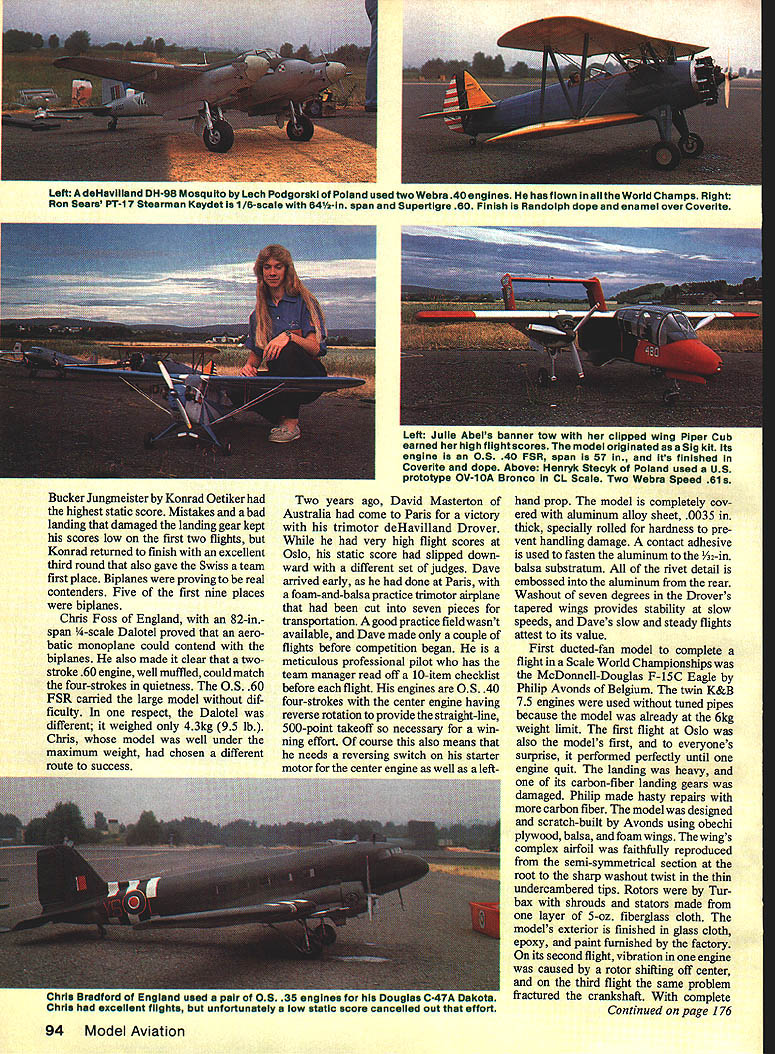
- Ron Sears (Stearman PT-17) had a relatively high static score but managed only one reasonably good flight with the heavy model.
- Julie Abel’s clipped-wing Cub needed high flight scores to compensate for a low static score; a few lost maneuvers prevented a higher placing. Julie was also the only female contestant and became a popular figure, appearing in a front-page newspaper photo.
- Both Ron and Julie were penalized with zeros in maneuvers when the model lines did not reach the required 45° for prescribed laps—highlighting an oddity in CL scoring and the need for clear measurement procedures.
Other CL notes
- Mick Reeves of England, who has flown in every Scale Worlds, returned to CL with his Zlin 526 Akrobat after being unable to make the RC team. Stored since 1974, the model was returned to service 12 years later but suffered damage when an internal fuel pickup tube had disintegrated and the model was later badly damaged.
- Only four nations initially had CL contestants; Norway became the fifth by entering a semi-scale Mustang by Petter Harsem. Without such entries, CL risks being reduced from a World Championship to a mere international contest.
Radio Control (RC) Scale
Overall U.S. team performance
- The U.S. RC team suffered from low static scores and finished in 10th, 14th, and 22nd places overall.
- Static ranks: Steve Sauger’s Stinson Trimotor (6th), Skip Mast’s C-130 Hercules (23rd), and Cliff Tacie’s Savoia-Marchetti Trimotor (34th).
- Large static-score deficits required strong flight scores (with 20–30% bonuses for certain types) to make up ground. Small errors in flight are highly punitive because of the scoring multipliers and difficulty K-factors.
Scoring example and advice
- Takeoff is scored 1–10 by each of five scale judges. A perfect takeoff (five 10s) with a K-factor of 10 yields 500 points; with a 25% bonus that becomes 625.
- A swerve reducing a takeoff score to 5 would reduce that maneuver’s value by roughly 312 points after weighting—illustrating how crucial perfect takeoff and landing are in FAI Scale contests.
Individual U.S. entries
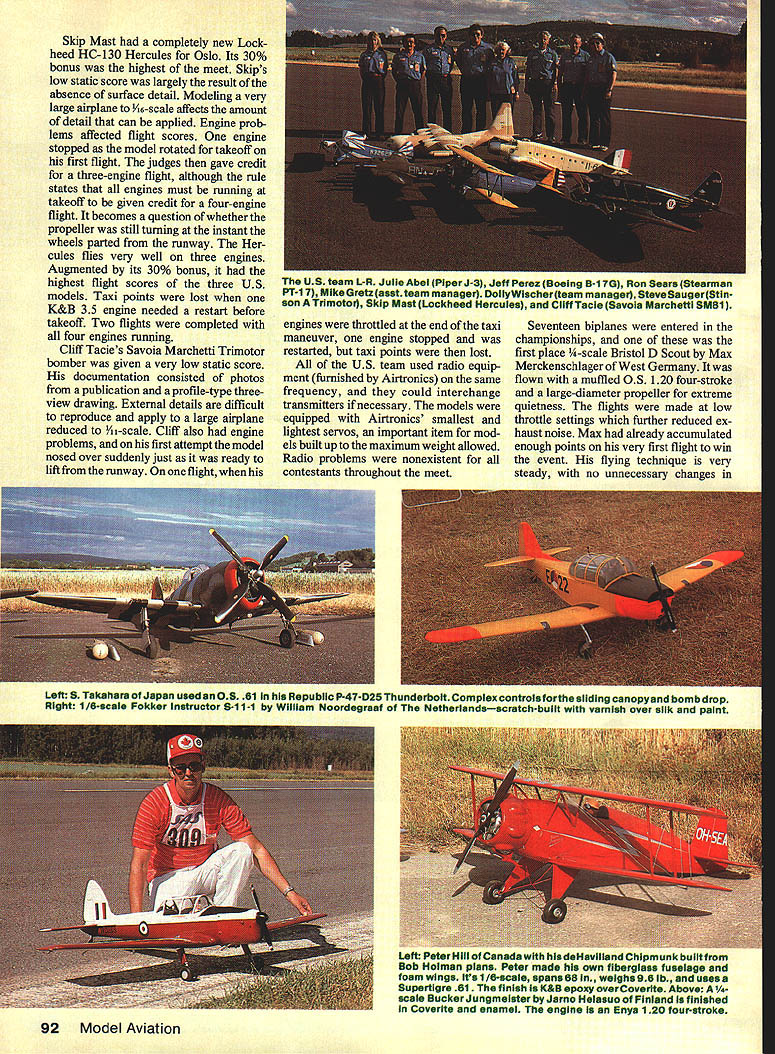
- Steve Sauger — Stinson Trimotor
- Considered one of the glamour machines of the contest.
- Was the only U.S. entry found overweight on the digital scale; Steve substituted a lighter 450 mAh battery pack to make weight.
- Static scoring suggested the Stinson deserved a better placing; however, documentation could have been stronger. Incremental flight errors and the limits of the 25% bonus prevented a top finish.
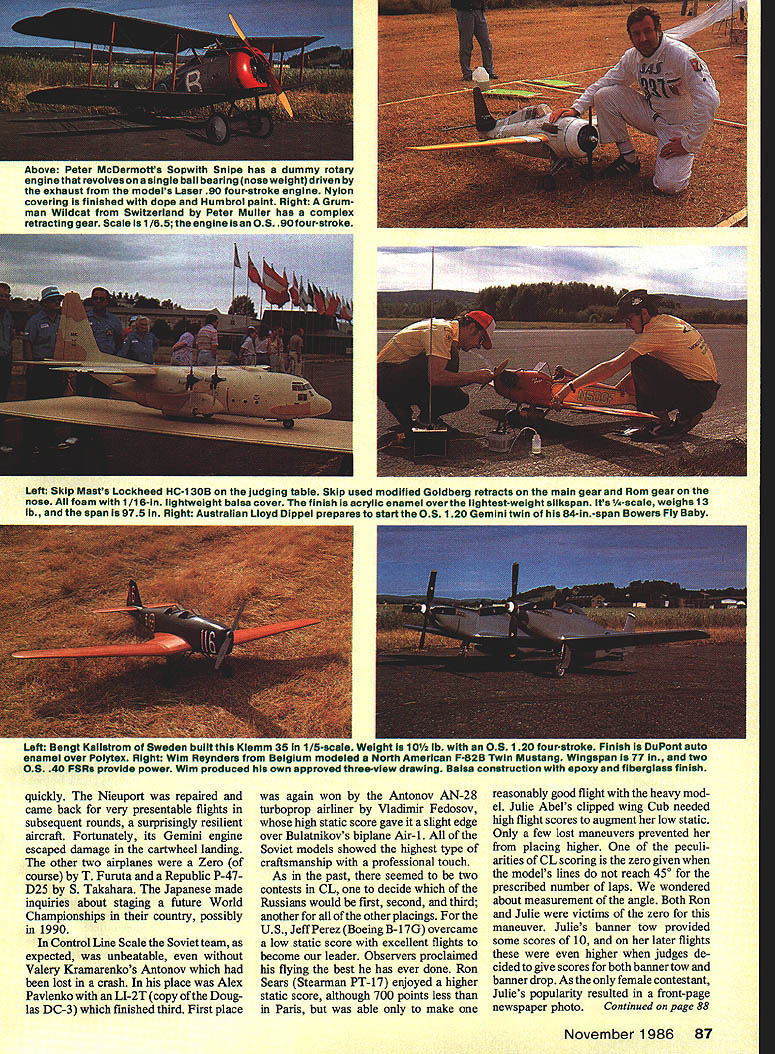
- Skip Mast — Lockheed HC-130 Hercules
- New 1/6-scale Hercules carried the meet’s highest bonus at 30% for a four-engine transport.
- Low static score largely due to a lack of surface detail typical with very large models scaled to 1/6.
- Engine problems affected flight scores: one engine stopped as the model rotated for takeoff on the first flight. Judges gave credit for a three-engine flight despite rules that state all engines must be running at takeoff to count as a four-engine flight—an issue of whether a prop was still turning at the moment wheels left the runway.
- The Hercules flew well on three engines and achieved the highest flight scores among the U.S. models when augmented by the 30% bonus.
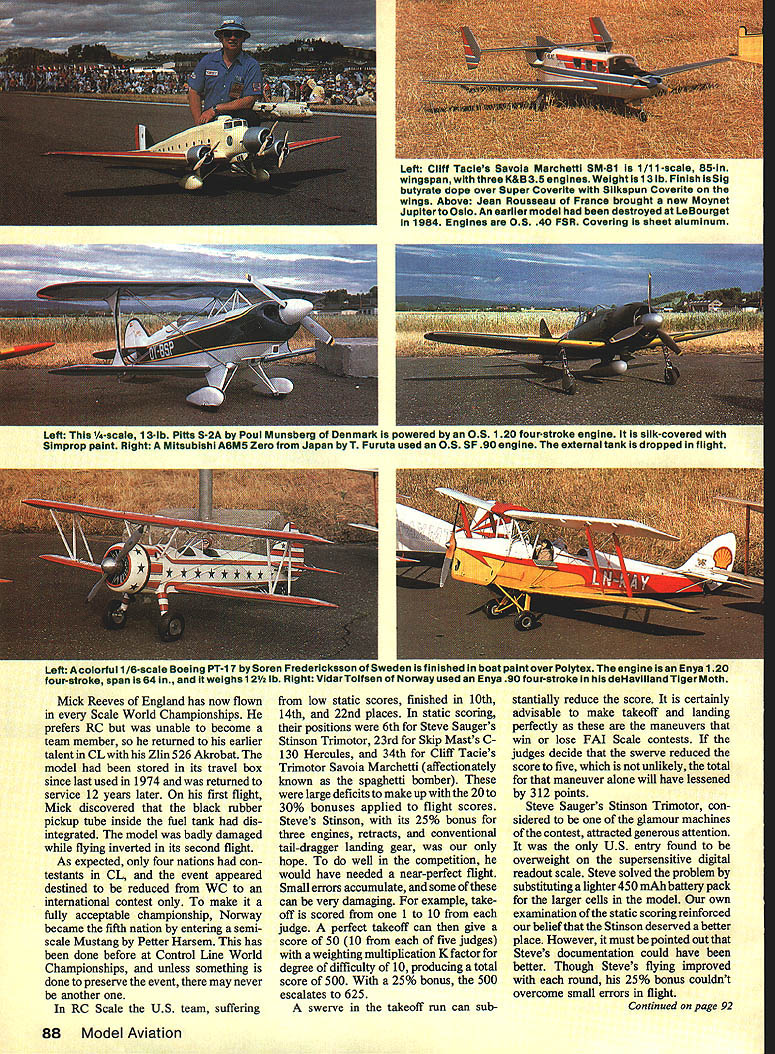
- Cliff Tacie — Savoia-Marchetti Trimotor
- Received a very low static score; documentation was limited to publication photos and a profile three-view.
- External details are hard to reproduce at 1/6 scale; engine problems also hurt performance. On one flight the model nosed over in rotation; on another a throttle issue caused an engine to stop and restart, costing taxi points.
Radio equipment and reliability
- The U.S. team used radio gear furnished by Airtronics; all team radios were on the same frequency and transmitters were interchangeable.
- Models used Airtronics’ smallest, lightest servos to stay within weight limits.
- Radio reliability was excellent—no reported radio problems for contestants.
Notable RC entries and winners
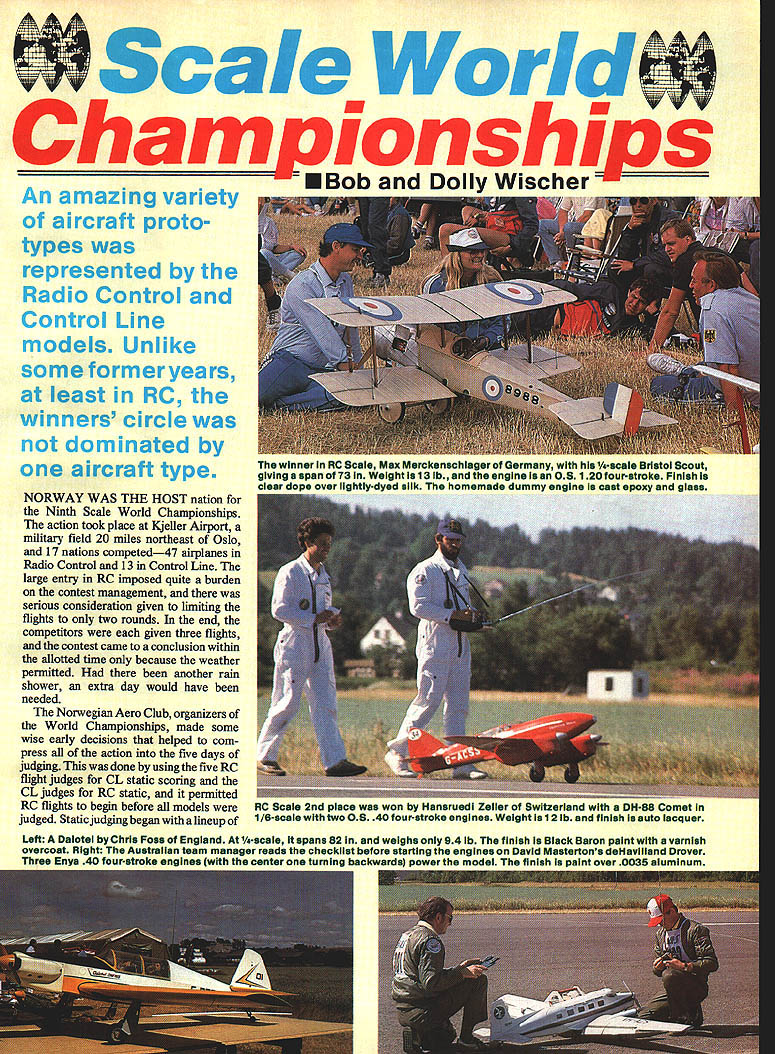
- First place (1/4-scale Bristol D Scout) — Max Merckenschlager, West Germany
- Flown with a muffled O.S. 1.20 four-stroke and large prop for quiet operation at low throttle settings.
- Achieved enough points on his very first flight to secure the event; flying technique was steady with no unnecessary power changes.
- Second place — Hansruedi Zeller, Switzerland (de Havilland 88 Comet)
- Improvements included a throttle-trim system for steering during taxi and rpm synchronization in flight. The racing model was steady and impressive, often diving into straight flight below six meters altitude to show realism.
- Biplanes and other placings
- Bücker Jungmeister by Konrad Oetiker had the highest static score; poor early flight landings hurt initial rounds, but a strong third-flight performance helped the Swiss team to first place.
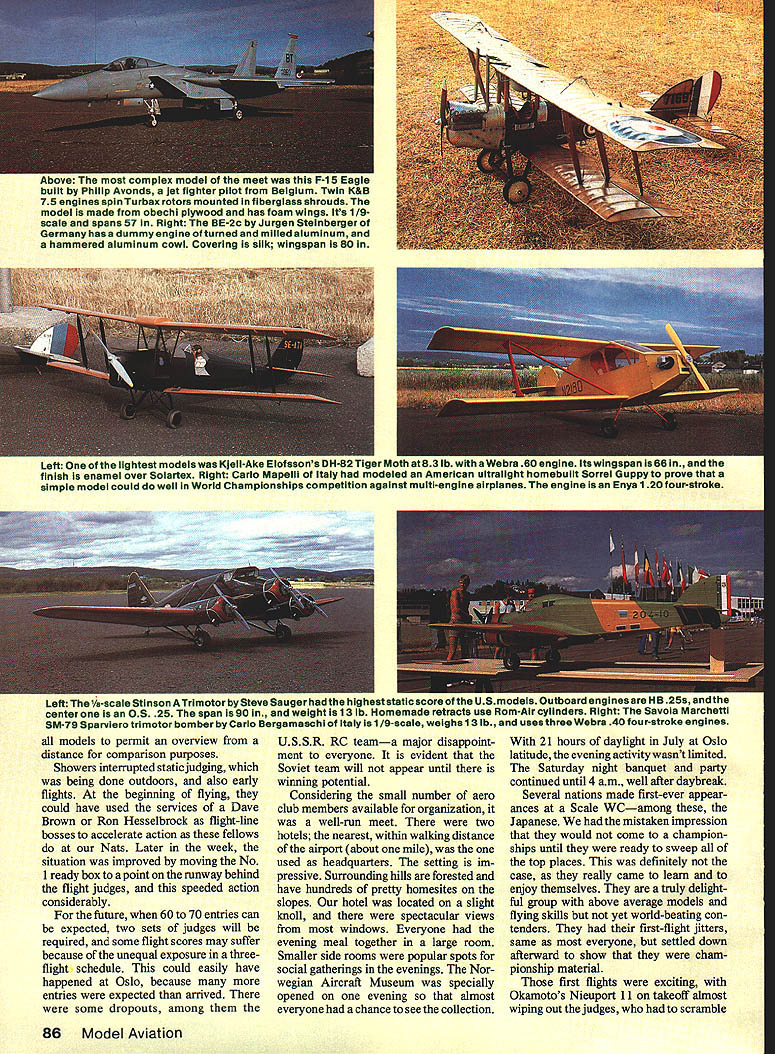
- Five of the first nine places were biplanes; three biplanes finished 7th–9th: Jurgen Steinberger’s BE-2c (W. Germany), Kjell-Åke Elofsson’s DH-82 Tiger Moth (Sweden), and Carlo Mapelli’s Sorrell Guppy (Italy). The Guppy demonstrated that a simple, well-executed model can compete with more complex multi-engined aircraft.
- Chris Foss (England) placed highly with an 82-inch 1/4-scale Dalotel aerobatic monoplane powered by a muffled two-stroke .60 engine; the model weighed only 4.3 kg.
- David Masterton (Australia) flew a trimotor de Havilland Drover with very high flight scores but lower static scoring from a different judging panel. The Drover was notable for aluminum sheet covering and detailed construction techniques.
- Philip Avonds (Belgium) flew the first ducted-fan model to complete a flight in Scale Worlds: a McDonnell-Douglas F-15C Eagle. The model’s twin K&B 7.5 ducted fans were used without tuned pipes to stay within the 6 kg limit. After initial engine and rotor vibration issues—and a fractured crankshaft—the model finished sixth aided by a good static score and a 20% bonus.
Judging procedures and controversies
- Static judging protocol:
- Models were presented by helpers and viewed from all sides, including the bottom, from a distance of three meters for overview comparison.
- Detailed judging of surface texture, craftsmanship, and scale detail was done from one meter. Judges carried 1-meter balsa sticks to enforce distance.
- The only U.S. judge was George Buso, who acted as chief judge for RC static and also judged CL flights. The lack of a U.S. judge on the RC flight line was a concern for U.S. contestants after stiff static and low first-flight scores.
- Some contention arose when judges left the flight line to watch other models while remaining RC judging duties were assigned to fewer judges—potentially giving some pilots unequal exposure in front of the judging panel.
- Reports of nationalism and inconsistent scoring (for example, one judge giving a "4" for a maneuver while three others gave a "9") have led hosts to consider scrutinizing individual flight score sheets. Past incidents of favoritism have resulted in banning individuals from judging.
- Rules and bonuses:
- For the future, a 20% maximum bonus was proposed and would affect contestants’ choice of model type.
- The bonus for biplanes without undercambered airfoils has been eliminated.
- Many multi-engined entrants felt their flight realism scores were already being discounted; few multi-engined flights were error-free, and many suffered from unsteadiness in roll and altitude changes.
Spectators and special attractions
- The RC flight line drew large, appreciative crowds who applauded well-executed maneuvers.
- Spectator control was good, and views were clear.
- Crowd-pleasing moments included:
- Savoia-Marchetti bombers dropping dummy bombs.
- Skip Mast’s Hercules performing a parachuted cargo drop.
Acknowledgments and closing notes
- Thanks to Narve Jensen and the Norwegian Aero Club for organizing a well-run championship.
- Thanks to Hazel Sig-Hester for supplying shirts and jackets.
- Special thanks to the Mid-Hudson RC Society for financial support of the team fund.
- Miscellaneous note: The 50th reenactment of the 1937 Wakefield Cup contest will be held at Old Warden in England; preparations are already underway.
Transcribed from original scans by AI. Minor OCR errors may remain.

