
Scale World Championships
By Bob Underwood
A banked right turn signaled the end of a very pleasant 7½-hour flight from Detroit to The Netherlands. It seemed as if the giant KLM 747 was using its wingtip to point out features of interest in the city that is sometimes referred to as "the Venice of the North." Canals, clock towers, and museums holding the treasures of the many great Dutch artists were visible below.
With our arrival at Schiphol Airport in Amsterdam, the saga of the 1994 Scale World Championships could really begin for us.
The event began August 13 as teams from 21 nations gathered at Arnhem. This city, located in the corner of the Netherlands near the German border, became the site for the movie A Bridge Too Far. Located on the Rhine River, the area is unlike most of Holland. Rolling, wooded hills remind one more of eastern Ohio than the flat, reclaimed land called polder that one associates with The Netherlands.
The 1¼-hour drive from Amsterdam to Arnhem was accomplished over excellent limited-access roads at a 120-kph speed limit. (Actually, several trips between these two cities were accomplished in a much shorter time by various team members, but that's another story!)
The contest site was a large airbase named Deelen. The only hints that it was an airbase were the runway complex and many armed guards—most of whom were accompanied by dogs who didn't appear to answer to the names Spot or Fido, and were not looking to be petted by a stranger. If one looked carefully, buildings could be seen in the clumps of trees scattered around the countryside. Despite the security, the military was most helpful.
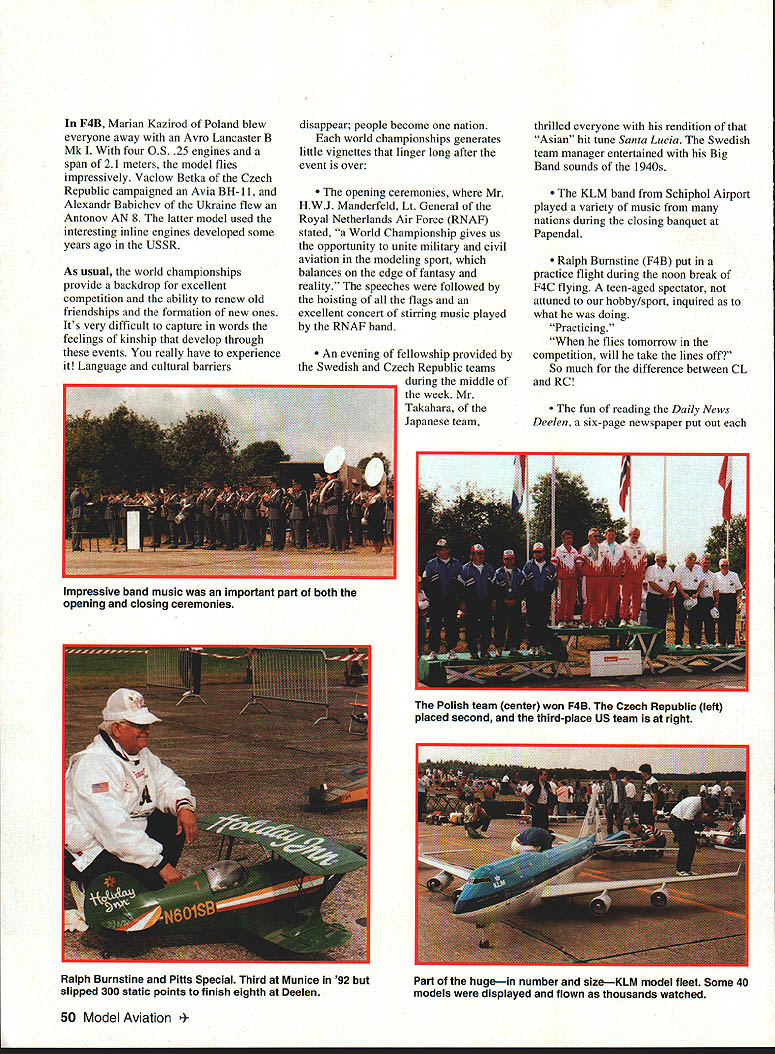
The five United States team members included Ralph Burnstine, Dale Campbell, and Jack Sheeks in F4B (Control Line), with Kim Foster and Earl Thompson representing F4C (Radio Control). I served as team manager.
Mechanics and supporters swelled the United States ranks to 23 persons. Stan Alexander and his wife Esther were also present; Stan served as an F4C flight judge. During our ten-day stay there were many other groups in and out of the complex. Golf, track, and other sports were represented at the site, which is used by the Netherlands to select and train their national sports teams.
Someone asked the front-desk person how to tell the groups apart: "Look for the older men. They're the ones flying the model planes."
The competition venue had some real plus marks and a few concerns. A huge circus tent served as the hangar for the models. There was plenty of room to move around, and the light-colored roof generally allowed photographs without a flash. The spectators loved it!
On the other hand, the tent was about half a mile from the flying site. After a somewhat impassioned request from team managers at the Saturday night meeting, transportation was arranged for the models and pilots. However, everyone else got more than enough exercise. Unfortunately, no direct communication existed between the flying site and the tent. As a result, teams and supporters banded together to assure pilots and teams "made it to the church on time."
The computer-generated scoring was quite efficient and fast. However, the sheets received by the contestant gave no clue as to how each judge scored, or even the spread for each score. There was simply a total for each maneuver, which could then be divided by three to arrive at an average score. Granted, it kept the individual judge's score confidential, but it was difficult to assess the overall judging atmosphere.
Sunday was used for model processing. While the United States had a couple of models that bumped the upper-weight limit, everything came out fine. Assembly, fussing about getting settled in, pictures, and opening ceremonies took up most of the day.
On to Monday, with flying and static judging. F4C flying occurs before the static judging; F4B, with its lower participant numbers, does static judging first.
Now the symphony of attempting to be at the right place at the right time began. The overall communication problem made that difficult at times. It was almost impossible for a single team manager to represent two teams in the manner generally accepted by the FAI scale community.
Trying to get to the flying site, the static judging area (at the hangar tent), and the tabulation left our team manager somewhat tuckered out at each day's end. For those not accustomed to FAI competition, it should be understood that all communication with judges, jury, and contest management occurs through the team manager. And this year, there was a meeting almost every evening.
Site layout made it possible to shift flight line direction 90°. For a couple of the flying days, the shifting process became a sort of gamesmanship that tended to slow down F4C.
The original Control Line circle was not used. The organizers were plagued by problems with rain when trying to resurface the planned area. We ended up using an end of the runway fairly near the RC site, which actually worked out quite well for spectators and contestants.
As is typical at so many contests, weather became a factor. Placement in the flying order (especially in F4C, where a round lasts almost two full days) became an interesting study. As it turned out, virtually everyone had an opportunity to fly during one of those calmer periods. The FAI uses the best two of three flights to calculate scores, and only a few contestants managed to get two really good calm periods.
The static quality of the models was high. Flying evidenced a much greater spread in scoring. The static scores of the United States models were above the norm; the same was generally true for the flying.
The US F4C team had no chance to place in the top three, because we only had two members. At our 1993 team selection event, only a very few tried for the team, and none of the alternates was able to fill in the third position when the third team qualifier was unable to go.
In F4B, the flight grouping of the United States static and flight scores brought the team third place. We were behind Poland and the Czech Republic, who always score well.
Interesting details about the models
There were three de Havilland D.H. 88s present—all representatives of the bright red Grosvenor House racer. Two were in F4C; the third was the beautiful F4B version presented by Dale Campbell of the United States. Unfortunately, Dale had to fight through some engine problems and was able to get only one official flight. It was, however, a beautiful presentation of the racer.
It was interesting to view the three models. Though they were never in the same place at the same time, it was not difficult to note differences in the models—especially in color. We were not privy to all the model presentations, but it is interesting to see how one aircraft can create different impressions.
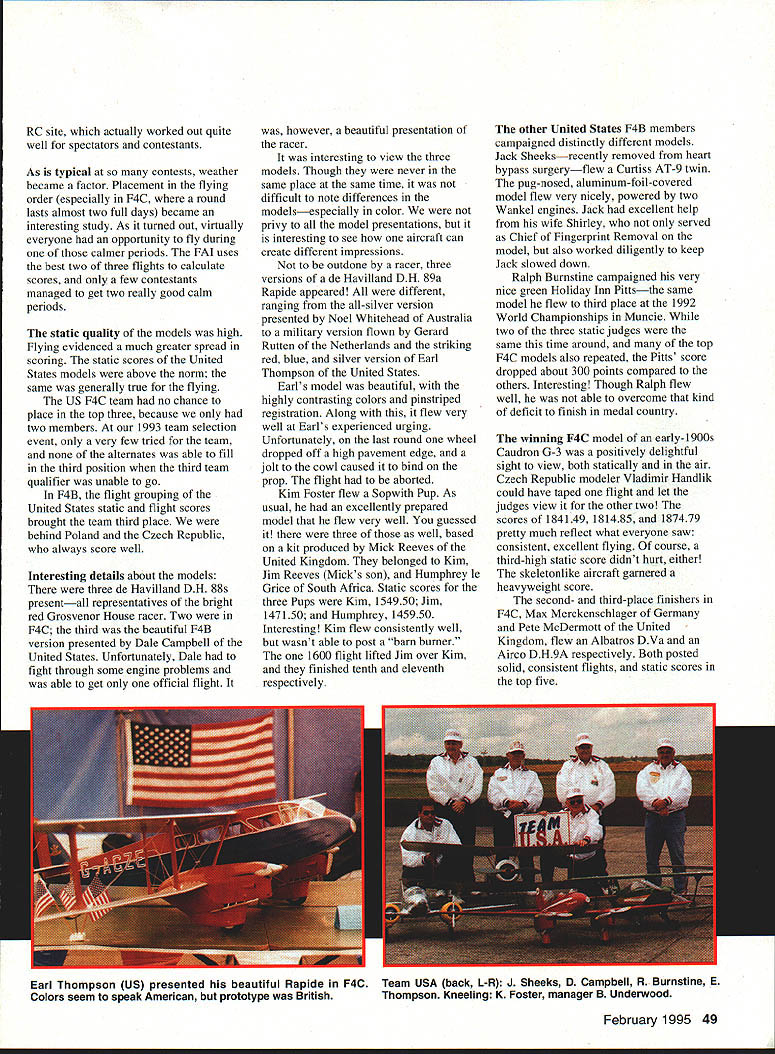
Not to be outdone by a racer, three versions of the de Havilland D.H. 89a Rapide appeared! All were different, ranging from the all-silver version presented by Noel Whitehead of Australia to a military version flown by Gerard Rutten of the Netherlands and the striking red, blue, and silver version of Earl Thompson of the United States.
Earl's model was beautiful, with the highly contrasting colors and pinstriped registration. Along with this, it flew very well at Earl's experienced urging. Unfortunately, on the last round one wheel dropped off a high pavement edge, and a jolt to the cowl caused it to bind on the prop. The flight had to be aborted.
Kim Foster flew a Sopwith Pup. As usual, he had an excellently prepared model that he flew very well. You guessed it—there were three of those as well, based on a kit produced by Mick Reeves of the United Kingdom. They belonged to Kim, Jim Reeves (Mick's son), and Humphrey Grice of South Africa. Static scores for the three Pups were Kim 1549.50; Jim 1471.50; and Humphrey 1459.50. Interesting! Kim flew consistently well, but wasn't able to post a "barn burner." The one 1600 flight lifted Jim over Kim, and they finished tenth and eleventh, respectively.
The other United States F4B members campaigned distinctly different models. Jack Sheeks—recently removed from heart bypass surgery—flew a Curtiss AT-9 twin. The pug-nosed, aluminum-foil-covered model flew very nicely, powered by two Wankel engines. Jack had excellent help from his wife Shirley, who not only served as Chief of Fingerprint Removal on the model, but also worked diligently to keep Jack slowed down.
Ralph Burnstine campaigned his very nice green Holiday Inn Pitts—the same model he flew to third place at the 1992 World Championships in Muncie. While two of the three static judges were the same this time around, and many of the top F4C models also repeated, the Pitts' score dropped about 300 points compared to the others. Interesting! Though Ralph flew well, he was not able to overcome that kind of deficit to finish in medal country.
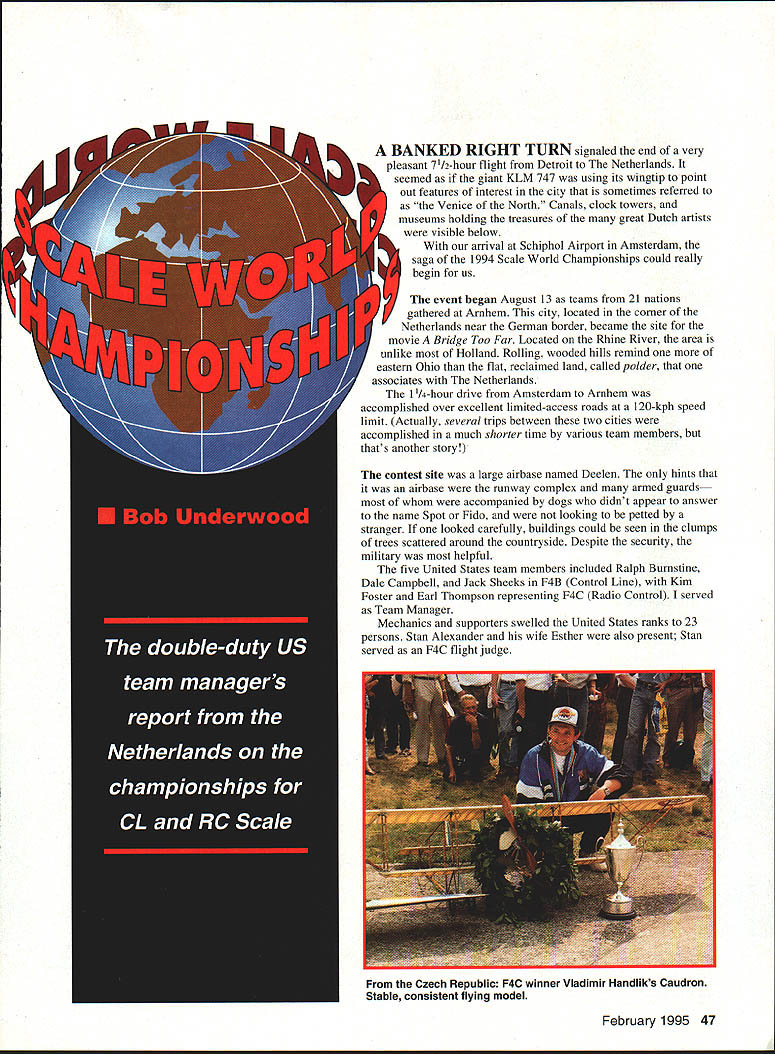
The winning F4C model of an early-1900s Caudron G-3 was a positively delightful sight to view, both statically and in the air. Czech Republic modeler Vladimir Handlik could have taped one flight and let the judges view it for the other two! The scores of 1841.49, 1814.85, and 1874.79 pretty much reflect what everyone saw: consistent, excellent flying. Of course, a third-high static score didn't hurt, either. The skeletonlike aircraft garnered a heavyweight score.
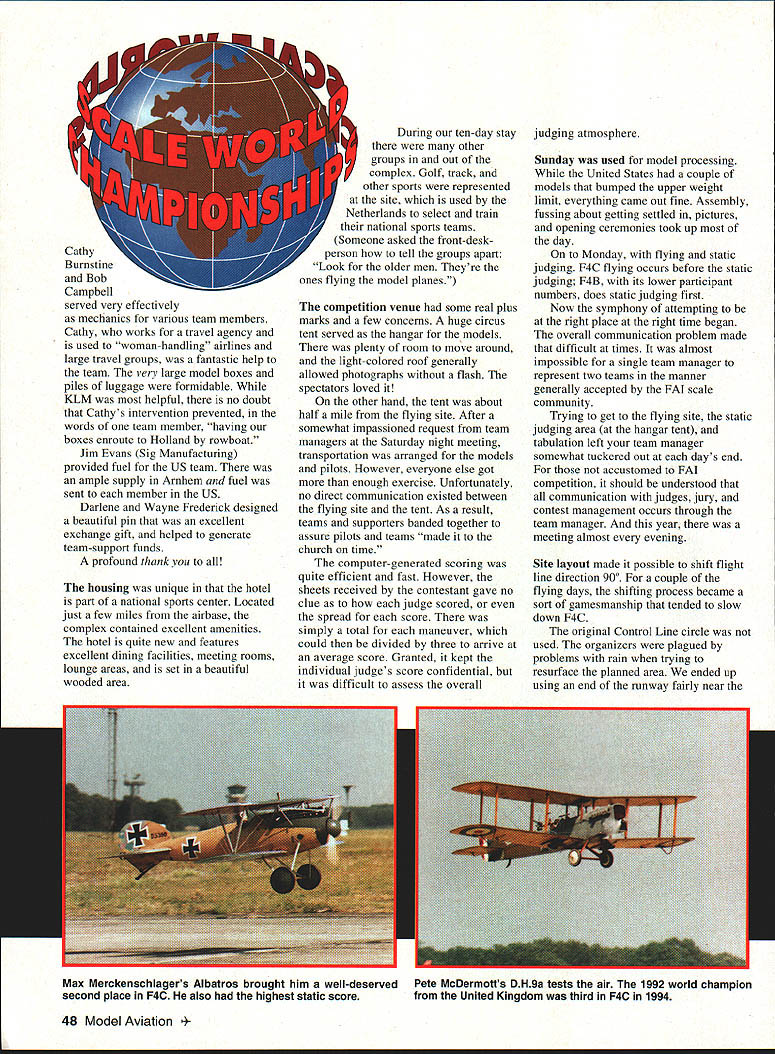
The second- and third-place finishers in F4C, Max Merkenschnagger of Germany and Pete McDermott of the United Kingdom, flew an Albatros D.Va and an Airco D.H.9A respectively. Both posted solid, consistent flights, and static scores in the top five.
In F4B, Marian Kazirod of Poland blew everyone away with an Avro Lancaster B Mk I. With four O.S. .25 engines and a span of 2.1 meters, the model flies impressively. Vaclav Betka of the Czech Republic campaigned an Avia BH-11, and Alexandr Babichev of the Ukraine flew an Antonov AN-8. The latter model used the interesting inline engines developed some years ago in the USSR.
Vignettes and highlights
As usual, the world championships provide a backdrop for excellent competition and the ability to renew old friendships and form new ones. It's very difficult to capture in words the feelings of kinship that develop through these events. You really have to experience it! Language and cultural barriers disappear: people become one nation.
The event generated little vignettes that linger long after the contest:
- The opening ceremonies, where Mr. H.W.J. Manderfeld, Lt. General of the Royal Netherlands Air Force (RNAF), stated, "A World Championship gives us the opportunity to unite military and civil aviation in the modeling sport, which balances on the edge of fantasy and reality." The speeches were followed by the hoisting of all the flags and an excellent concert of stirring music played by the RNAF band.
- An evening of fellowship provided by the Swedish and Czech Republic teams during the middle of the week. Mr. Takahara of the Japanese team thrilled everyone with his rendition of that "Asian" hit tune Santa Lucia. The Swedish team manager entertained with his Big Band sounds of the 1940s.
- The KLM band from Schiphol Airport played a variety of music from many nations during the closing banquet at Papendal.
- Ralph Burnstine (F4B) put in a practice flight during the noon break of F4C flying. A teen-aged spectator, not attuned to our hobby/sport, inquired as to what he was doing. "Practicing." "When he flies tomorrow in the competition, will he take the lines off?" So much for the difference between CL and RC!
- The fun of reading the Daily News Deelen, a six-page newspaper put out each day during the championships by the organizer. It included many informative articles about the contestants and the KLM display planes, funny happenings, and biographies of many workers who were so busy and helpful.
- An individual box lunch each day that contained two pieces of meat, cheese, four hamburger-type rolls, a raisin roll, milk, and yogurt. Somebody must have really been able to get a good deal on rolls!
- A beautiful setting for the opening ceremony and the awards, with a semicircle of national flags, a band, and many honored guests and spectators.
- The participants were treated to a ride in the Dutch Dakota Association DC-3. The aircraft celebrated its fiftieth anniversary in 1993. It participated in the D-Day operation as part of the 9th Air Force and was used in A Bridge Too Far. The organizers are to be commended for a fantastic and memorable opportunity!
- The Dakota flight was promoted as a chance to "See" Holland by air. With good humor the organizers stated, "We made a terrible mistake by changing 'see' into 'sea' in the invitation for the contestants to sea...eh...see Holland by air."
- A display of 40 models that represented all of the aircraft flown by KLM during its 75 years in commercial aviation.
- Some 30–40,000 spectators lining the runway to watch the Fokker-KLM model fleet flown on the closing Sunday. Shoulder-to-shoulder, ten to twelve deep, they stretched out forever! Thousands more milled about and listened to the KLM concert band.
- The impressive final Sunday program. As the crowd assembled to view the flying of the many KLM models, the awards ceremony took place at the circle of flags. The many honored guests enjoyed excellent band music and the presentation of team members, model displays, and awards.
The medals and trophies were presented by the president of KLM, Mr. Hartog. Following the presentation, the KLM and military guests mingled and chatted with the team members and supporters.
Other memories include the comment born of the many biplanes entered (due to the present—but passing—system of bonus points): "I wonder what's flying now?" "Oh, it's another biplane."
And the image of a caravan of four vehicles—a car, two "people" vans, and a cargo van—hurtling across the Dutch countryside during the morning rush hour to get to the airport on time for departure.
We will always remember the excellent hospitality provided by the modelers of the Netherlands. Everyone worked very hard to make a large and difficult event happen. They did their job well. From the pipe-smoking contest director on his bike to the wooden-shoed driver of the van and trailer that served as model transportation, we received friendly help.
It's on to France in 1996! Why don't you think about trying to be a part of that experience and try for a place on the team in 1995? Try it—you'll like it!
Transcribed from original scans by AI. Minor OCR errors may remain.

