

Scale World Championships
Stan Alexander
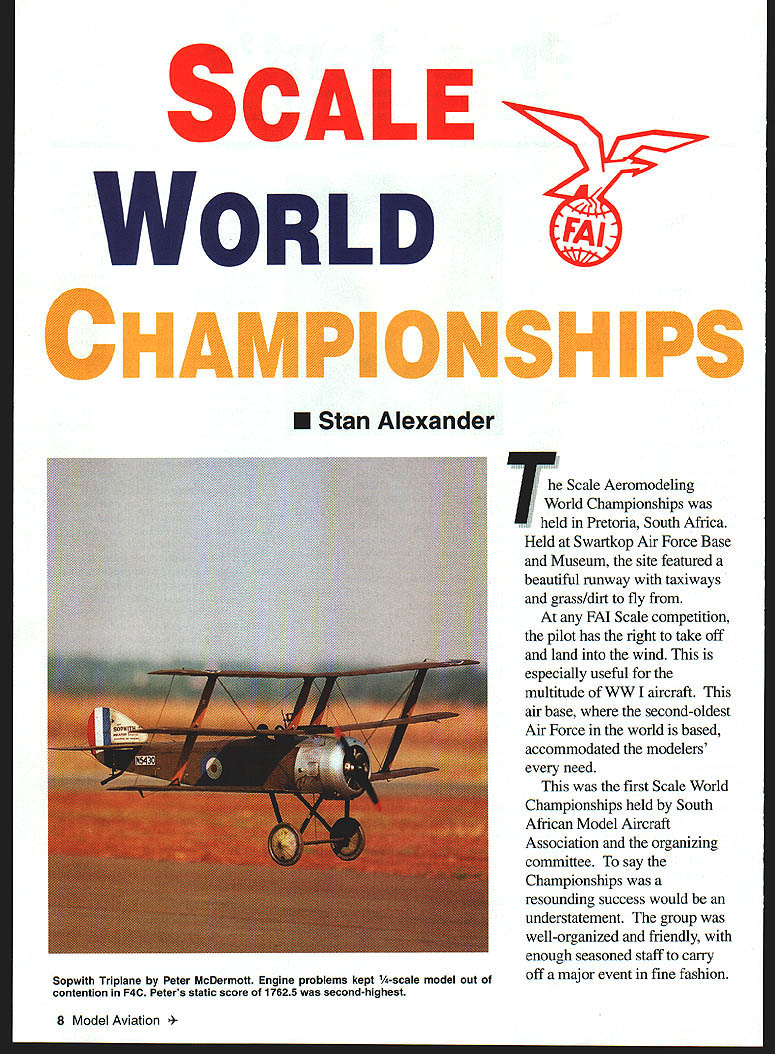
The Scale Aeromodeling World Championships were held at Swartkop Air Force Base and Museum in Pretoria, South Africa. The site featured a beautiful runway with taxiways and grass/dirt flying areas and accommodated the modelers' every need. At any FAI Scale competition, pilots have the right to take off and land into the wind, a rule especially useful for the many World War I aircraft entered.
This was the first Scale World Championships organized by the South African Model Aircraft Association and its committee. The event was exceptionally well organized and friendly, with enough seasoned staff to carry off a major international contest in fine fashion.
Competition Format and Selection
- The Championships are held every two years and include Control Line (F4B) and Radio Control (F4C) categories.
- Past and future sites: 1996 — Périgueux, France; 2000 — Interlaken, Switzerland.
- Modelers must qualify at regional and national levels to represent their countries. In the U.S., national finals decide the team: three modelers comprise each F4B and F4C team.
- There are team and individual competitions.
FAI Scale runs at a slower pace than AMA Scale from the contestant’s standpoint because only one aircraft at a time is flown in RC or CL. This reduces distractions, eliminates the chance of midair collisions, and allows other teams to observe flights and scoring.
Scale Modeling and Craftsmanship
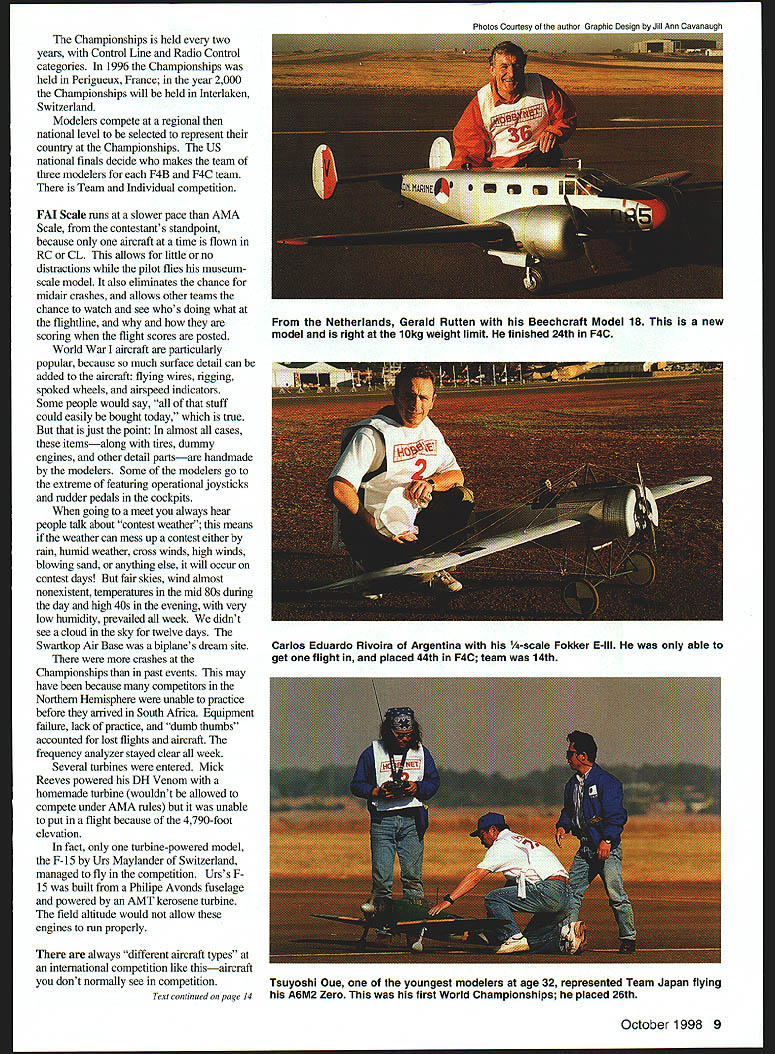
World War I aircraft are particularly popular because of the extensive surface detail modelers can add: flying wires, rigging, spoked wheels, airspeed indicators, and more. While many detail items can be purchased today, most competitors still scratch-build tires, dummy engines, and other parts. Some modelers go to extremes, fitting operational joysticks and rudder pedals in scale cockpits.
Weather and Site Conditions
Contest weather is always discussed because it can ruin an event—rain, humidity, crosswinds, blowing sand, etc. Fortunately, Swartkop enjoyed nearly perfect conditions for the Championships: fair skies, almost no wind, daytime temperatures in the mid 80s, cool evenings in the high 40s, and very low humidity. There was not a cloud in the sky for twelve days. Swartkop Air Base was a biplane’s dream site.
Turbines and High-Altitude Effects
There were more crashes at the Championships than in some past events, possibly because many Northern Hemisphere competitors were unable to practice before arriving. Equipment failure, lack of practice, and pilot error accounted for lost flights and aircraft. The frequency analyzer stayed clear all week.
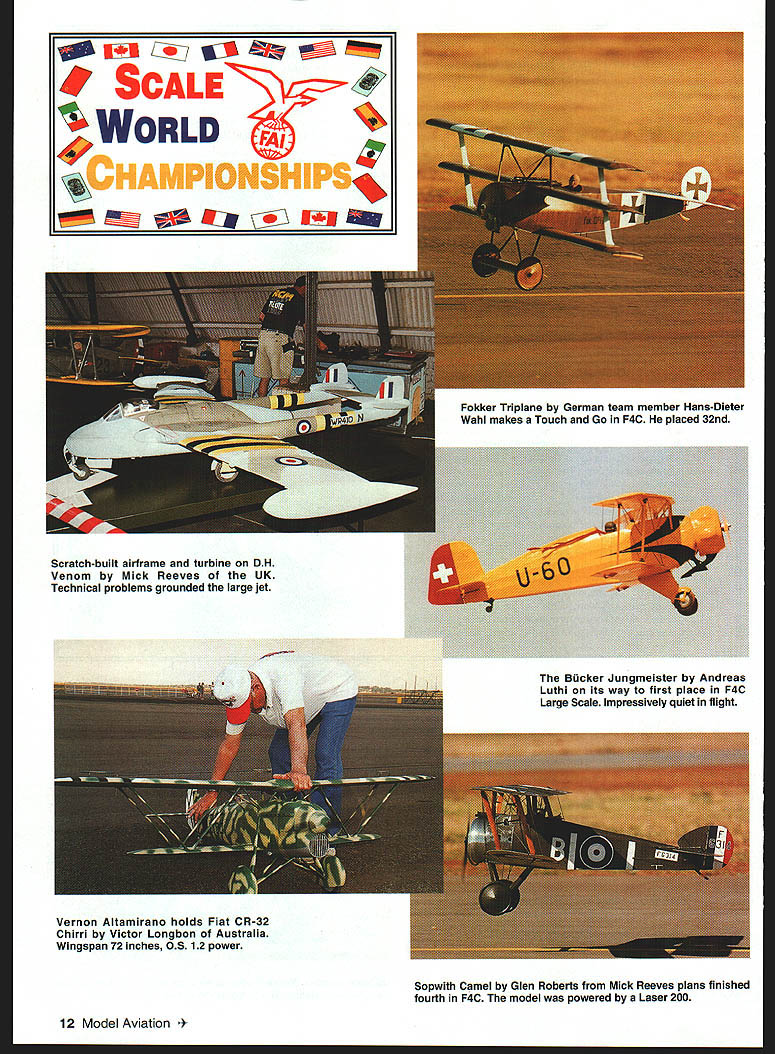
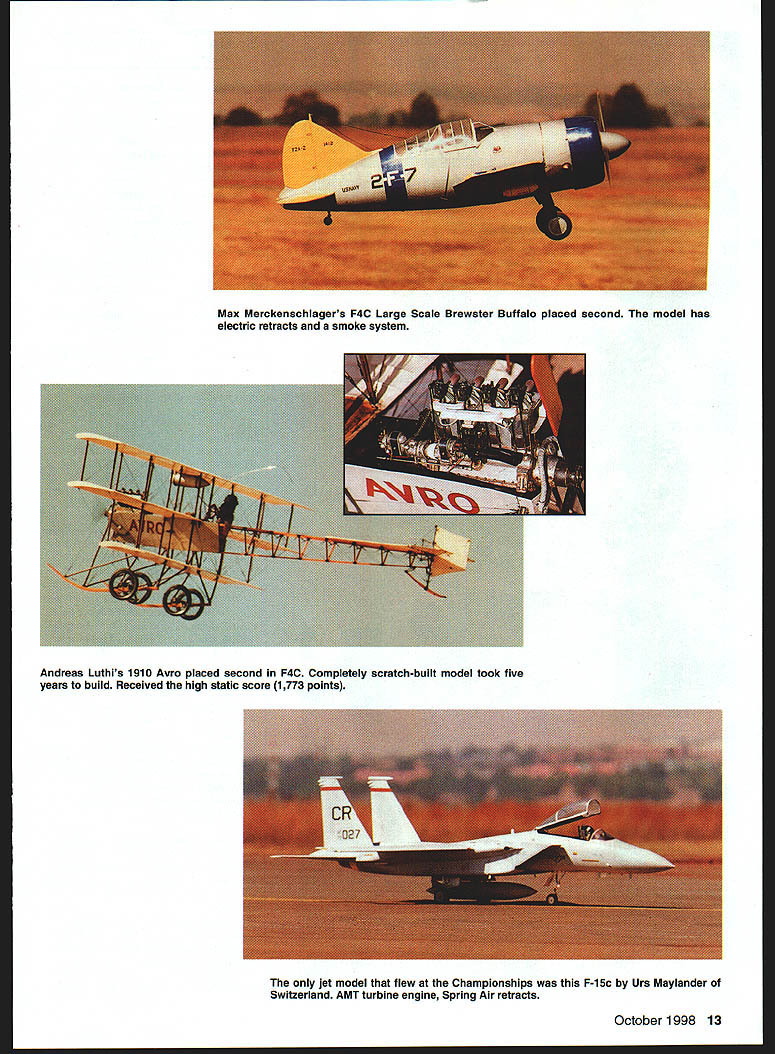
Several turbine-powered models were entered. Mick Reeves attempted to power his DH Venom with a homemade turbine (which would not be allowed under AMA rules), but it failed to fly because the 4,790-foot field elevation degraded turbine performance. In fact, only one turbine-powered model managed competition flights: Urs Maylander of Switzerland flew an F-15 built from a Philippe Avonds fuselage and powered by an AMT kerosene turbine. Field altitude limited turbine operation for most entrants.
Notable Aircraft and Competitors
- Germany’s Max Merkenschlager (F4C Champion in 1996) competed in F4C Large Scale with an unusual original Brewster Buffalo. The model featured electric retracts, was powered by a King 140 RV engine turning a 28 x 12 prop, had a 104¼-inch wingspan, and weighed just over 41 pounds. Max finished second in the large-scale equivalent of the old Giant Scale class.
- Victor Longbon from Australia entered a Fiat CR-32 built from museum drawings in Turin. The model sported a splinter camouflage scheme used in North Africa, had a six-foot wingspan and a 65-inch fuselage, and was powered by an O.S. .12 four-stroke with CH spark ignition.
- Many competitors used O.S. or British Laser four-stroke engines because of their size and reputation for reliable performance.
F4B (Control Line Scale)
- Field was limited to 12 models; several regular European competitors did not attend.
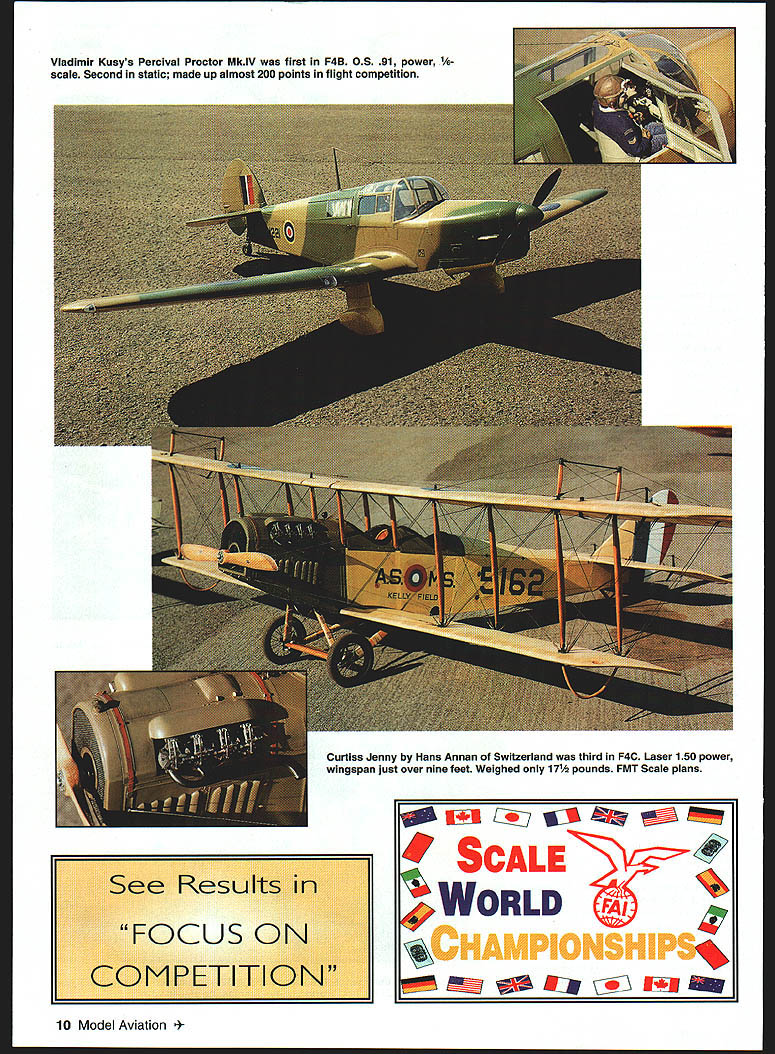
- The winner was Vladimir Kusys of the Czech Republic with a scratch-built Percival Proctor Mk. IV in British colors (1/6 scale, 76-inch wingspan), powered by an O.S. 91 FS. He won by 9.25 points over the 1996 winner.
- Second place: Marian Kaziorod (Poland) — Avro Lancaster.
- Third place: Boguslaw Malota (Poland) — Yak-6.
- The Polish F4B team won the team competition.
U.S. F4B team:
- Team Manager: Darlene Frederick
- Competitors: Jack Sheeks (Hellcat F6F-5) — 8th place; Ralph Burnstine (Chipmunk) — 11th place; Steve Ashby (Do-17z) — 6th place.
- The U.S. team finished second.
F4C (Radio Control Scale)
- F4C had a very large field dominated by biplanes—nine of the top ten aircraft were World War I types.
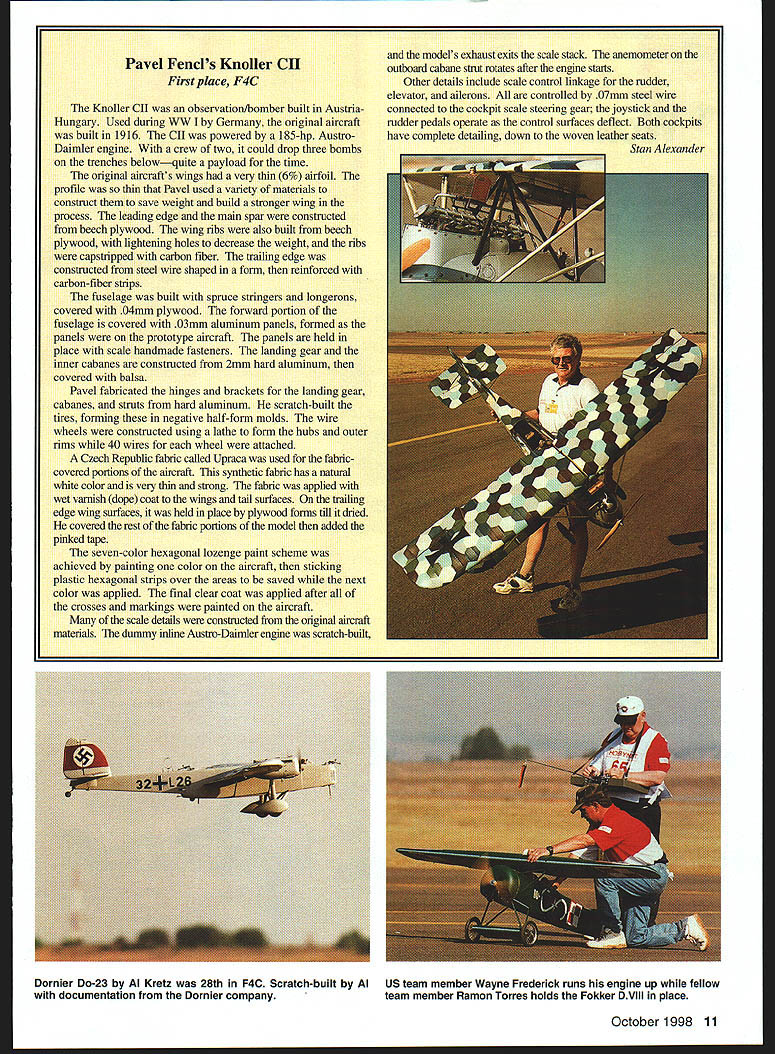
- First place: Pavel Fencl (Czech Republic) — Knoller CII, 3,304 points (won by 41.50 points).
- Second place: Andreas Luthi (Switzerland) — 1910 Avro (featured in the film Those Magnificent Men & Their Flying Machines). He spent five years and more than 4,000 hours building it and had just flown it for its sixth flight.
- Third place: Hans Ammann (Switzerland) — Curtiss Jenny in Love Field colors, built from FMT Scale drawings by Ralph Beck.
- Fourth place: Glen Roberts (South Africa) — Sopwith F1 Camel (Laser-powered).
- Fifth place: Ramon Torres (U.S.) — Beechcraft T-42 (military Baron).
- Other U.S. F4C team members: Wayne Frederick (Fokker D.VIII) and Al Kretz (Dornier DO-23). Al Kretz was competing in his first Championships and finished 28th.
F4C Large Scale
- Entries were down, likely due to travel distance and the size/weight of the models.
- Andreas Luthi entered both F4C and F4C Large Scale: he finished second in F4C with the Avro and first in F4C Large Scale flying a Bücker Jungmeister in 1/3 scale.
- Second place: Max Merkenschlager.
- Third place: Kils Pretorius (South Africa) — Harvard Mk. II.
- Max’s large-scale entry finished a close second.
Pavel Fencl's Knoller CII
First place, F4C
- The Knoller CII was an observation/bomber built in Austria-Hungary and used by Germany during World War I; the original was built in 1916 and was powered by a 185-hp Austro-Daimler engine. It carried a crew of two and could drop three bombs.
- Pavel Fencl’s model required careful weight-saving and strengthening because the original wing airfoil was very thin (6%). Construction highlights:
- Leading edge and main spar: beech plywood.
- Wing ribs: beech plywood with lightening holes, strapped with carbon fiber.
- Trailing edge: steel wire formed and reinforced with carbon-fiber strips.
- Fuselage: spruce stringers and longerons covered with 0.04 mm plywood; forward fuselage covered with 0.03 mm aluminum panels formed to prototype shape and held with scale handmade fasteners.
- Landing gear and inner cabanes: 2 mm hard aluminum covered with balsa; hinges and brackets fabricated from hard aluminum.
- Wheels: lathe-formed hubs and rims with 40 wire spokes per wheel; tires scratch-built in negative half molds.
- Fabric covering: a Czech synthetic fabric called Upcrac (natural white, thin and strong) applied with wet varnish (dope) coats; pinked tape used on edges.
- Paint scheme: seven-color hexagonal lozenge achieved by painting one color, masking with plastic hexagonal strips, and painting the next color; crosses and markings applied last followed by clear coat.
- Many scale details were scratch-built from materials similar to the original: the dummy inline Austro-Daimler engine, exhaust exiting a scale stack, and a rotating anemometer on the outboard cabane strut.
- Scale control linkages for rudder, elevator, and ailerons use 0.07 mm steel wire connected to cockpit steering gear; joysticks and rudder pedals operate the control surfaces. Both cockpits are fully detailed, including woven leather seats.
Banquet and Acknowledgments
A formal banquet was held at the Holiday Inn Crowne Plaza in downtown Pretoria. Several modelers received awards, and the Dennis Thumpton Memorial Trophy was presented by Dennis’s widow, Irene. (Dennis Thumpton was the FAI Scale Subcommittee Chairman until 1995.)
Thanks to South African Airways, the South African Air Force, the Air Force Museum, Lt. Col. Dave Knoesen, and Maj. Neil Thomas for their work and accommodation of everyone involved in the Championships.
If you would like to compete in the next World Championships and represent the U.S., contact the AMA Competitions Department for details about the next qualifier.
Stan Alexander 3709 Valley Ridge Dr. Nashville, TN 37211
Transcribed from original scans by AI. Minor OCR errors may remain.

