



Scale World Championships
By Bob Underwood & Steve Ashby
World's best scale modelers compete in scenic Interlaken
Interlaken is a storybook Swiss town. Nestled in a deep valley, it seems captured by crystal-clear lakes edged by a tapestry of tree-covered mountains. This beautiful area was the scene of the nine-day 2000 Scale World Championships, held August 18–26. As the Swiss Alps came into view, the 2½-hour bus ride from Zurich International Airport became more like an amusement ride; the vehicle climbed the twisting, narrow road, barely missing oncoming cars and buses. As your eyes traced the source of a rushing mountain river, three snow-capped peaks dominated the view. At 13,000+ feet, the Jungfrau is the master of this trio. Through breaks in the tall pine trees, occasional glimpses down into the valley afforded panoramic views of Interlaken and the two gorgeous blue-green lakes—Thun and Brienz—on either side.
The U.S. Scale team rolled past quaint Swiss chalets adorned with multicolored geraniums and stopped in front of the team's home for the Championships—Hotel Artos. It is barely 10 minutes from the Interlaken air base—the site of the contest.
The tradition in Fédération Aéronautique Internationale (FAI) Radio Control (RC) Scale has been to fly the models from one site and a single flightline. This would have created a significant logistics problem in RC, so a total of three sites—two RC—were used to accommodate each of the three model types: F4B (Control Line), F4C (Radio Control), and Large Scale. The military airfield used was large enough to keep the models from impacting other sites. The great distances from the hangars—where the models were stored—to the sites required that the airplanes be moved by trailers and crews. The hangars were earthen-covered concrete bunkers. It's strange to see sheep grazing on the hangar roof at a Championships!
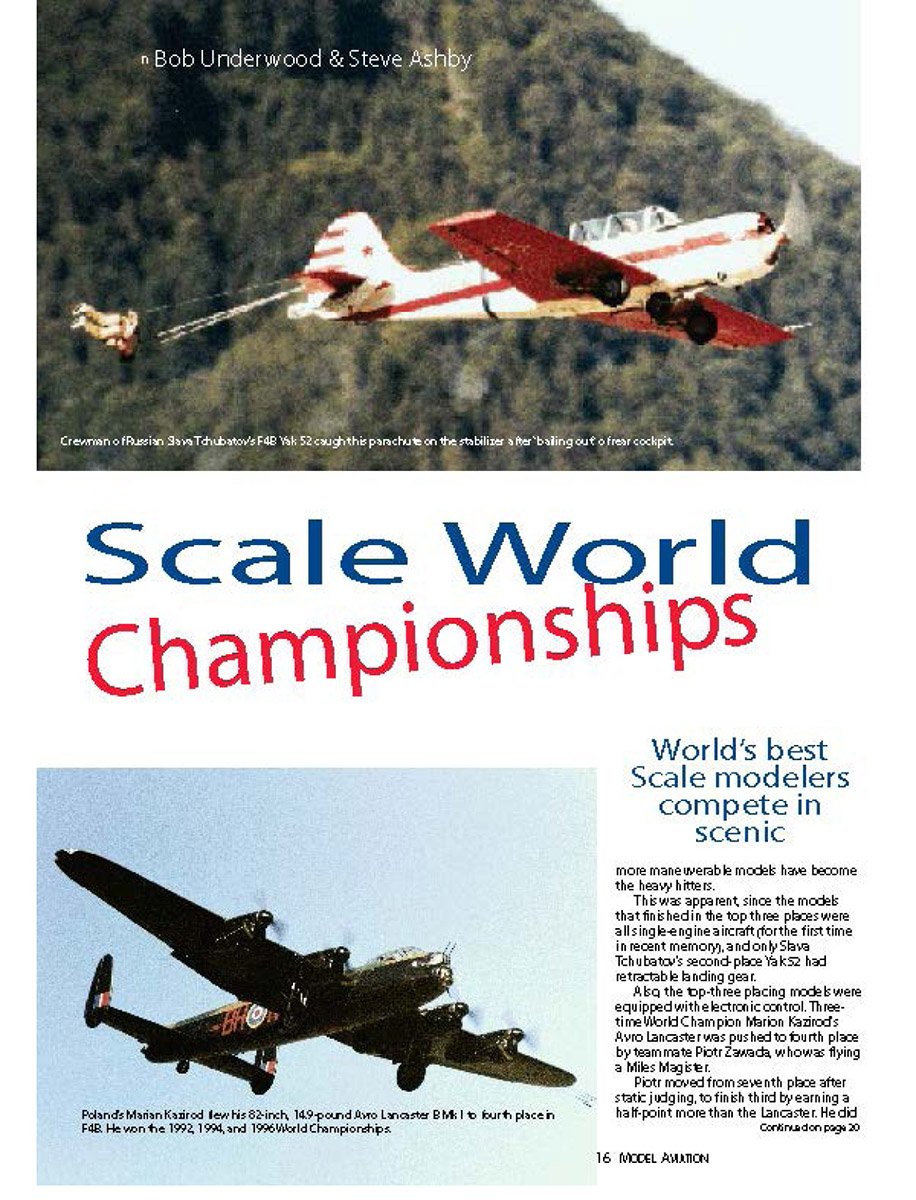
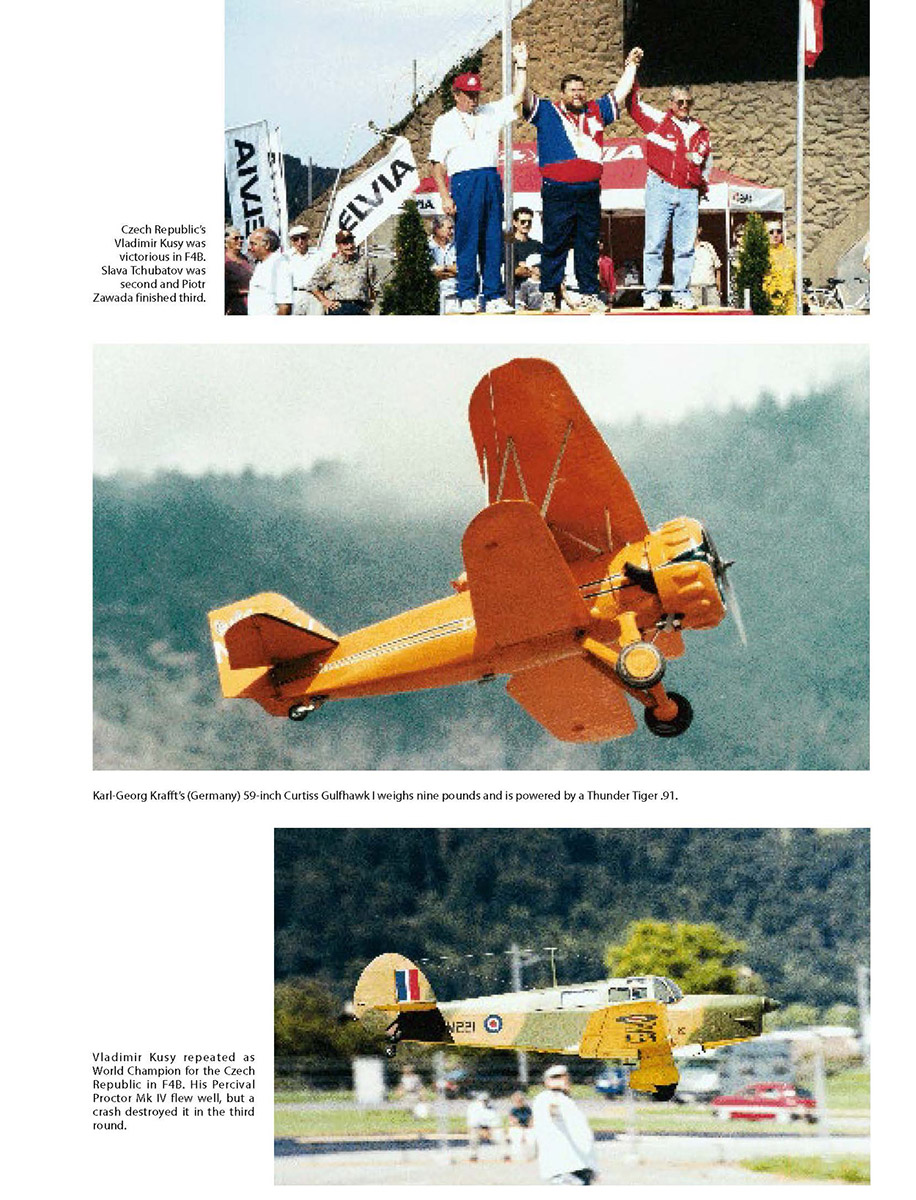
More maneuverable models have become the heavy hitters. This was apparent: the models that finished in the top three places were all single-engine aircraft (for the first time in recent memory), and only Slava Tchubatov's second-place Yak 52 had retractable landing gear. Also, the top-three placing models were equipped with electronic control. Three-time World Champion Marian Kazirod's Avro Lancaster was pushed to fourth place by teammate Piotr Zawada, who was flying a Miles Magister. Piotr moved from seventh place after static judging to finish third. He did it by posting the highest flight score of the competition.
Unfortunately, the F4B models were hangared in a separate area, quite some distance away; this almost created a "second event" for Control Line (CL). There was just not enough space for all three events' competitors to be housed in one location because of the number of F4C and Large Scale entrants.
Most of the teams were settled in prior to the opening ceremonies at the main hangar on Saturday, August 19. In addition to welcoming words and a flag ceremony, the Swiss military provided a wonderful air show featuring nine Pilatus PC-7s flown in various formations and maneuvers, and a large military Super Puma helicopter demonstrated very nimble moves. At times, the aircraft would blend into the greenery of the mountains surrounding the valley and become totally lost from view.
F4C
This year's event was the largest Scale gathering since the formation of the category as a world-championship class more than 30 years ago. The official Radio Control classification (F4C) fielded 22 teams and 59 competitors.
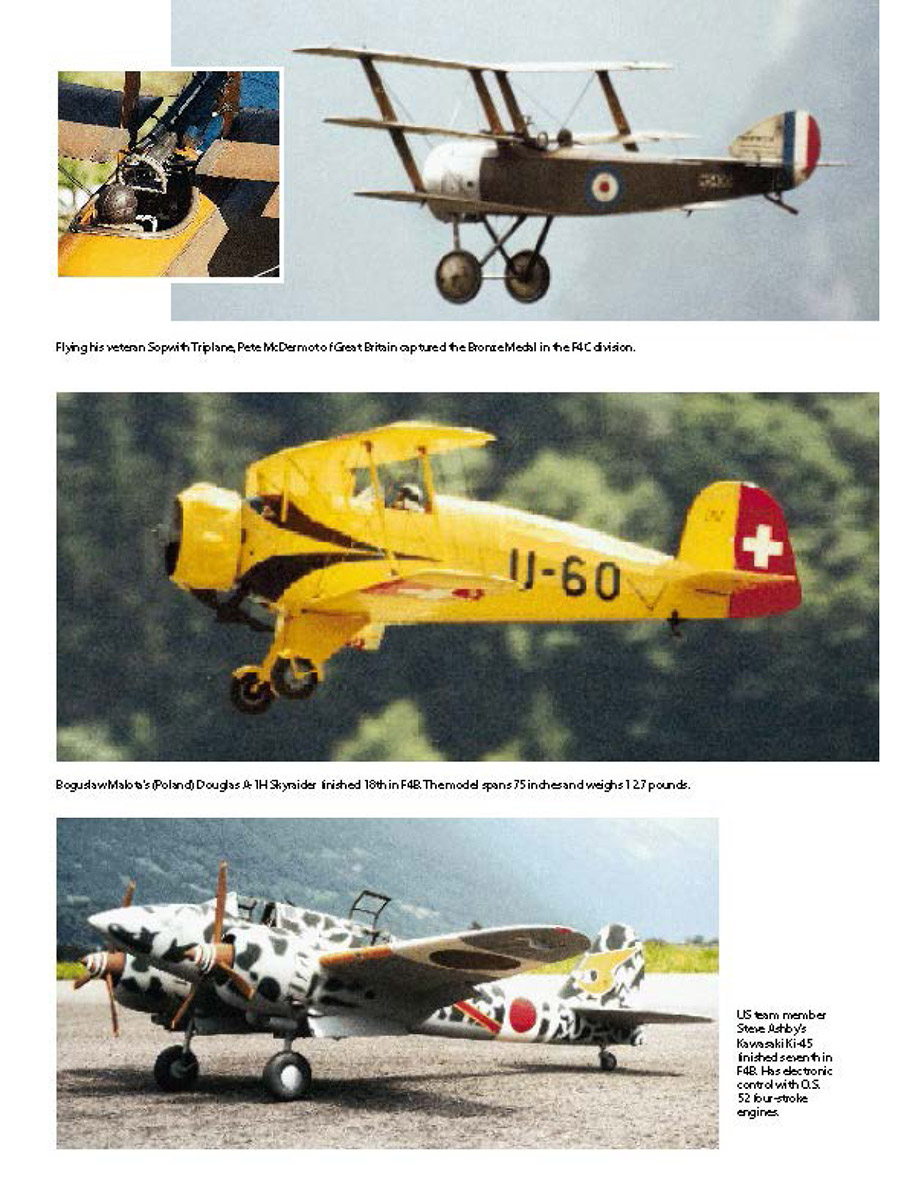
The competition featured the usual blend of older tried-and-true models and newer ones. The top three models had a total of eight wings! Switzerland's Andreas Luthi competed with an Avro Triplane. The fragile-looking model garnered the second-highest static score of 1,732.50 points, and had two consistent and high flight scores, which averaged 1,754.75. Andreas's teammate Hans Ammann flew a Curtiss JN4-D2 "Jenny" to second place, 153 points behind Andreas. Third place went to Pete McDermot of Great Britain, flying his well-known Sopwith Triplane. Pete's model pulled the highest static score of 1,750.50 points. He earned a total of 3,331.50 points to Ammann's 3,334.25. Germany's Max Merckenschlager, flying a Grumman F7F-3, was only 4.26 points behind McDermot.
Except for Monday, beautiful weather provided gentle breezes and excellent flying conditions—especially for the more lightly loaded models. One disconcerting condition for competitors and judges was the background of the tree-covered mountains—particularly for the camouflaged aircraft. Monday offered special challenges when violent thunderstorms gathered on the other side of the mountains and pounded like panthers, whistling down the valley on fierce winds. Lightning striking high on the mountainside, followed by claps of thunder that reverberated through the valley, completed the scene.
Unlike most past championships, there were several crashes. The Canadians lost two F4C models—a Focke-Wulf and a Beechcraft Bonanza. A Belgian contestant's Hawker Typhoon crashed during the competition. The United States' Hal Parenti lost his beautiful Ryan Fireball shortly before landing in the second round—and it had not been static judged yet. Early in the 1990s, a controversial rule designed to take care of the disparity between the time required to static-judge a model and flight time was added. The intent was to be able to start both judging chores at the same time. The rule states that the static judges will ignore damage sustained during a crash.
Hal flew twice. The crash, cause unknown, resulted in the model going nose-first into a rushing mountain river. The Interlaken police returned what was left of the model after it traveled 1½ miles in the churning waters. In an effort to gain points toward a possible team placing, the Fireball was static judged. This created a difficult situation, since the rule allowing it was not designed to accommodate major missing areas of the model. Although many of the judging categories could be completed, the major portion of the scoring—the outline—could not be assessed accurately. The resulting score ended any chances of the U.S. team placing.
The results of long deliberations concerning this problem should result in the demise of the rule. Several plans have been put forward to allow models to be static-judged prior to their being flown.
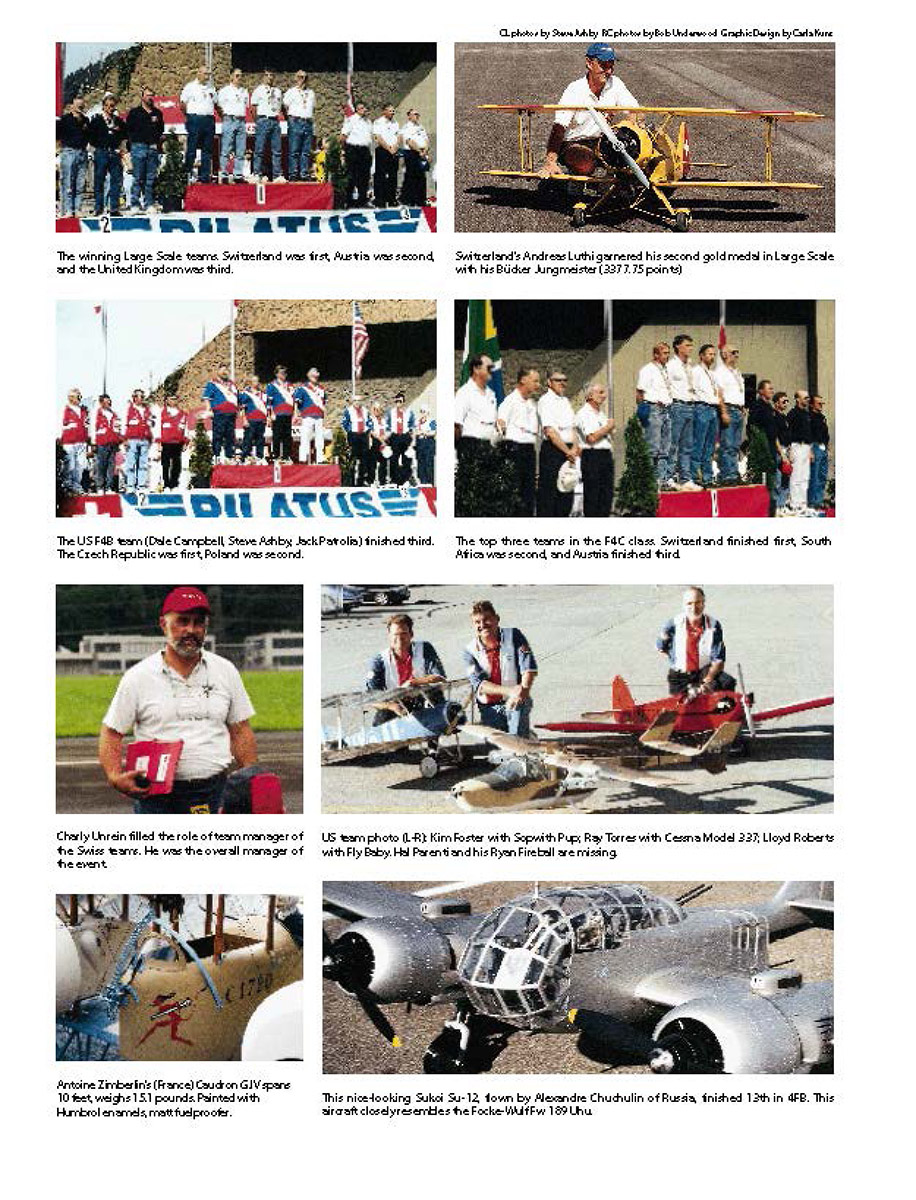
The other U.S. F4C participants were Ramon Torres, flying a twin-engine Cessna in military format, and Kim Foster, flying a Sopwith Pup. Ramon used an interesting flying option on two rounds: he shut down the Cessna's front engine, flew a circuit, and restarted the engine in the air while he flew past the judges. The option was impressive and well executed. Kim's Sopwith was campaigned in an earlier event but was refinished in a different color scheme for the World Championships.
Large Scale
Large Scale (unofficial) accumulated 20 competitors from nine countries. Lloyd Roberts was the only U.S. participant in this class; other team members had misfortunes that made their participation impossible. This was an unofficial event, so outside funding was minimal.
Lloyd bought a Fly Baby model. He designed and built the full-scale aircraft several years ago. Although the model's general appearance is similar to that of the full-scale Fly Baby, there were major differences. Lloyd piloted the model in a consistent, realistic fashion.
F4B
F4B: A spacious concrete bunker was "home base" for 19 competitors from 10 countries—the highest number of entries ever represented at a CL Scale World Championships. The bunker's dirt-and-grass covering provided a cool retreat from the warm sun, which brought temperatures in the mid to upper 80s.
Standing in the flying circle provided an awe-inspiring view; it was totally surrounded by mountains. It was as if nature had provided its own "bowl" for this "Olympics" of scale aeromodelling.
Monday began with shuttling competitors and models on a flatbed trailer to an adjacent hangar where static judging took place. The models were officially weighed before the competitors presented them for scoring.
A "new" procedure was implemented. Each competitor was required to present a list of their flight maneuvers to the flight judges for approval. The rule has been in place for some time, but this was the first time in recent memory it was actually practiced. This change eliminated confusion and time-consuming discussions between judges and competitors at the flight circle. The flier was no longer required to fill out five score sheets for each of the three rounds. The flight judges printed the score sheets prior to flying; when the competitor presented himself at the flying circle for each round, the score sheet was already in the judges' hands.
When the competitors entered the flying circle, they had the opportunity to change flight options to any of those on the previously submitted list. All 19 models were static-judged Sunday. With only 30–35 minutes for each model, the judges still had a rather long day.
Polish team member Marian Kazirod's Avro Lancaster had the top static score of 1,878.00. Russian Slava Tchubatov's Yak 52 was not far behind with 1,845.50, and the third-place static score of 1,810.50 went to the Czech Republic's Vladimir Kusy and his Percival Proctor.
Monday was the first day of flying; it started well, with very little wind. The wind picked up as the morning progressed, and by noon it was obvious that a storm was approaching. Lunch was extended for two hours, in hopes that the storm would pass and the winds would subside. The winds did calm slightly and several scary flights were made, but the break didn't last long. With the wind exceeding the nine-meter-per-second limit and lightning in the area creating static discharge, Contest Director Peter Germann halted all flights immediately. The ominous sky let loose, and strong winds and rain developed into a serious storm.
The storm had passed by evening, and Peter Germann discussed the situation with the judges and competitors. It was decided that the entire first round would be canceled, and the contest would start over the next day. That proved to be an excellent decision; the weather was beautiful for the duration of the competition.
Rounds One and Two proceeded with only a few models suffering minor scrapes or slight damage. Round Three began with another new procedure for this World Championships: the flight order for the third round is the inverse order of the standings at the end of Round Two. Vladimir Kusy of the Czech Republic was in first place at the end of Round Two, so he flew last in Round Three. He went on to finish in first place with outstanding flights and repeat as World Champion with his Percival Proctor—but not without a price. When Vladimir was executing his last option on his last flight of the competition, the "up"-line connector failed and the model crashed—literally at the flight judges' feet. It was extremely distressing to witness the destruction of this beautiful model.
Under the capable leadership of Scale team manager George Buso and Control Line team manager Darlene Frederick, the U.S. team had performed well in the first two rounds. At the beginning of the third round, Steve Ashby was in fifth place with a new Kawasaki Ki-45; Dale Campbell was in eighth place with his Ryan STA; and in his first World Championships, Jack Patrolia was in 17th with his Pitts S-2A Special. Steve improved his third-round flight score but fell two positions to finish seventh. Dale slipped slightly to finish ninth, and Jack improved his flight score to finish 16th. The U.S. team finished third, behind the Czech Republic and Poland.
There were several firsts at this World Championships. A new F4B judges' guide was implemented, placing more emphasis on precise flying and flight presentation. It also included the previously mentioned procedural changes. The new flight-maneuver descriptions, which include diagrams, are more precise; therefore, the judging of these maneuvers is more critical. Since flight maneuvers have become more crucial, lighter and more maneuverable models are now at an advantage. This year's finish illustrates that a complex, multiengine model is no longer necessary to be competitive at this level.
Overall, the flying was of high quality. The excellent weather and site conditions helped. However, Scale has moved to new levels—especially in the flying portion. For those accustomed to the action of four flightlines at one site, as with events such as Top Gun and Scale Masters, the one-at-a-time pace is very different. With 60 models using this format, a single round requires about 15 hours to complete!
The FAI Sporting Code that becomes effective January 1, 2001 allows models as large as 12 kilos. That results in an increase of roughly four pounds from the present 10 kilos, to a maximum of 26.4 pounds. Although this is still well below the weight limit of 55 pounds in the United States, it does open up the competition to larger models. Hopefully this will result in greater interest in the U.S.
An incredible amount of effort and planning is involved in transporting a Scale team to a World Championships in Europe. A tremendous thanks to AMA, the National Association of Scale Aeromodellers (NASA), and all the sponsors, including those who supported the team through pin sales and donations to the Scale Team Fund. Continental Airlines provided vital sponsorship and accommodations with the transportation of model boxes, which saved the Scale team thousands of dollars. Other sponsors included:
- Byron Fuels
- Slimline Products
- Frank Tiano Enterprises
- Horizon Hobby
- Zurich Sunglasses
Sunday's closing ceremonies brought an end to the 2000 Scale World Championships, but not to the memories and friendships. These will remain for a lifetime, and new ones will begin at the next Scale World Championships, scheduled to be held in Canada in 2002.
Bob Underwood Box 40 St. Peters, MO 63376
Stephen M. Ashby 4771 Cinnamon Pl. Indianapolis, IN 46237
Transcribed from original scans by AI. Minor OCR errors may remain.

