
Scalemasters
George Jenkins
Overview
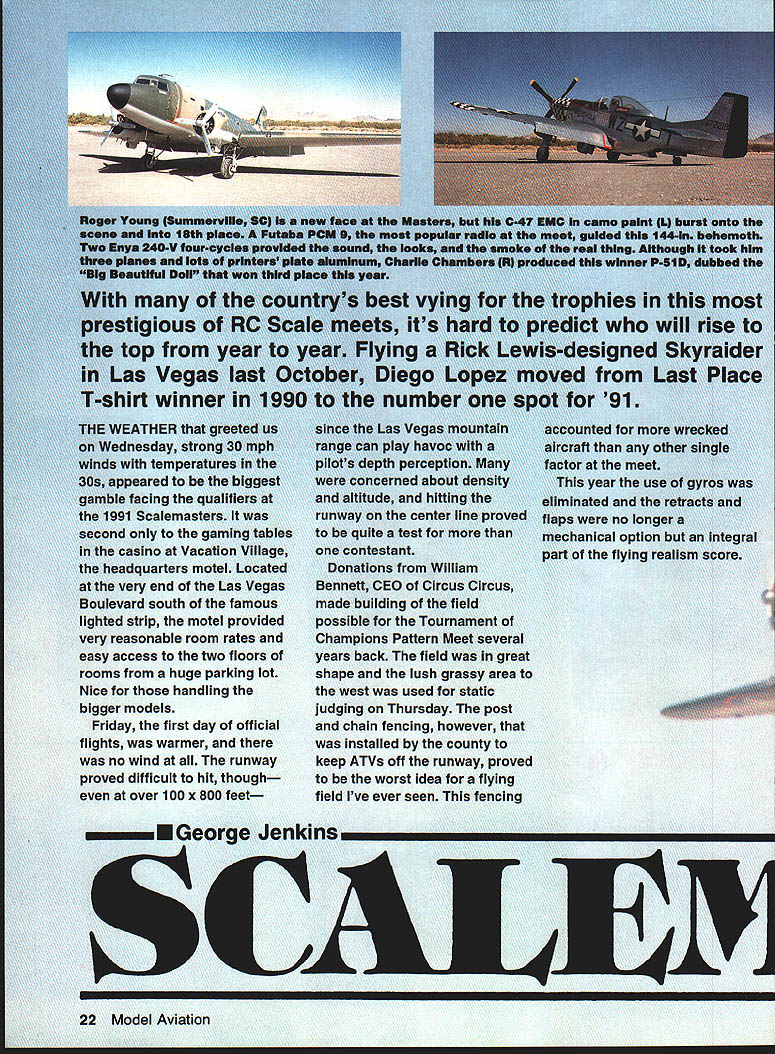
With many of the country's best vying for trophies at this most prestigious RC scale meet, it's hard to predict who will rise to the top from year to year. Flying a Rick Lewis–designed Skyraider in Las Vegas last October, Diego Lopez moved from perpetual Last Place T‑shirt winner in 1990 to the number one spot for 1991.
Weather and the Field
The weather that greeted competitors on Wednesday was a significant challenge: strong 30 mph winds and temperatures in the 30s. The Vacation Village headquarters motel, located at the very end of Las Vegas Boulevard south of the lighted strip, provided reasonable room rates and easy access to the field from a huge parking lot — convenient for those handling larger models.
Friday, the first day of official flights, was warmer and wind-free. Even so, the runway — over 100 by 800 feet — proved difficult to hit because the nearby Las Vegas mountain range plays havoc with depth perception. Density altitude was a concern, and hitting the center line tested many pilots.
Donations from William G. Bennett (CEO of Circus Circus) had made the building of the field possible for an earlier Tournament of Champions pattern meet. The field was in good condition, and the grassy area to the west was used for static judging. Unfortunately, a post-and-chain fence installed by the county to keep ATVs off the runway proved disastrous; that fencing caused more wrecks than any other single factor at the meet.
Rule Changes
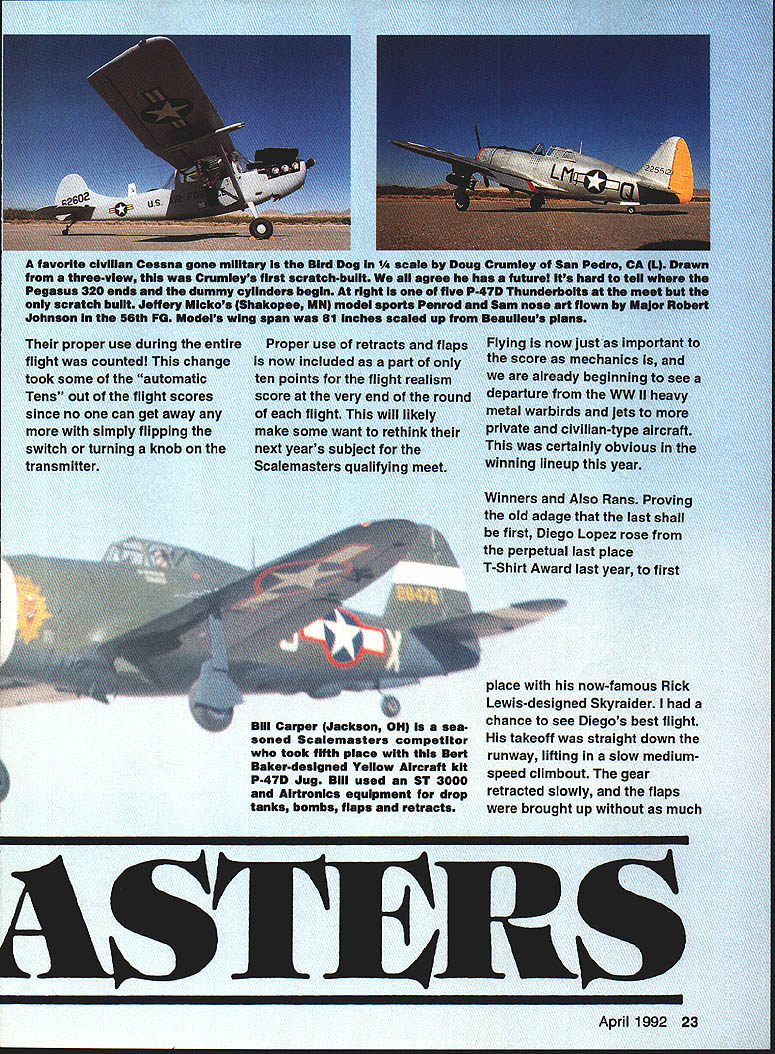
This year the use of gyros was eliminated. Retracts and flaps are no longer merely mechanical options but are integral to the flying realism score — their proper use throughout the entire flight is required. Retracts and flaps now count as part of a 10‑point flight‑realism subscore evaluated at the end of each flight. That change removes some of the "automatic tens" from flight scores and may lead entrants to rethink subjects for next year's Scalemasters. Flying skill is now as important to the overall score as mechanical realism, and the contest is seeing more private and civilian-type aircraft in the winner lineup.
Top Winners (1991)
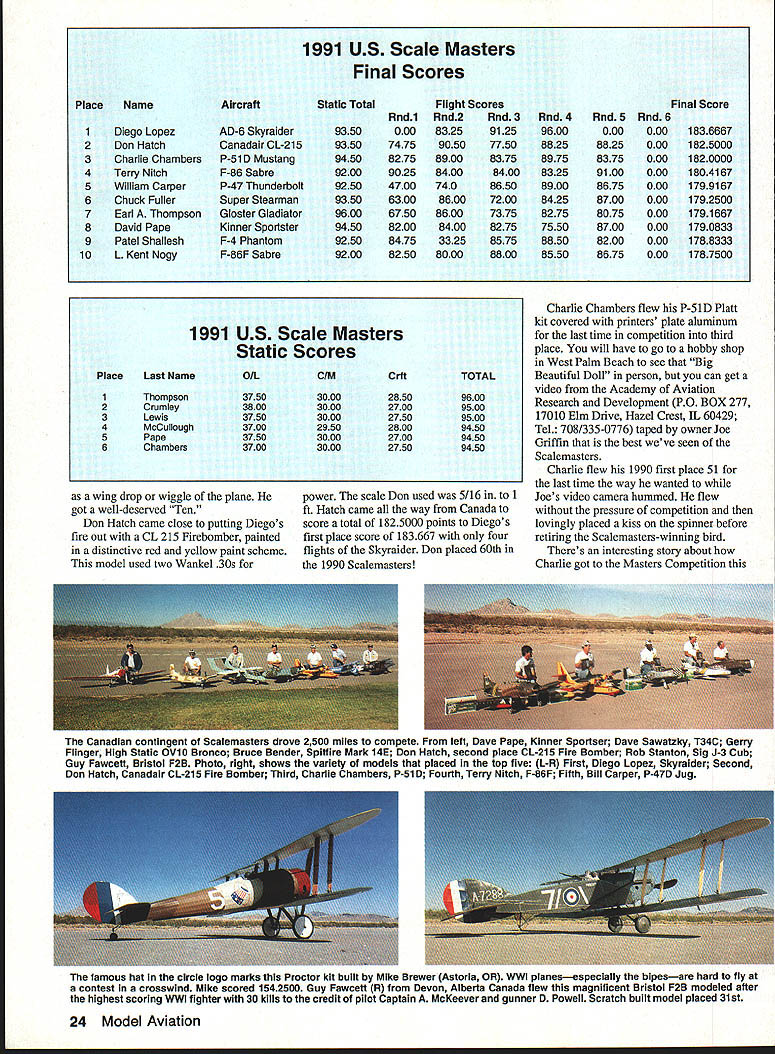
- Diego Lopez — AD‑6 Skyraider — 183.6670
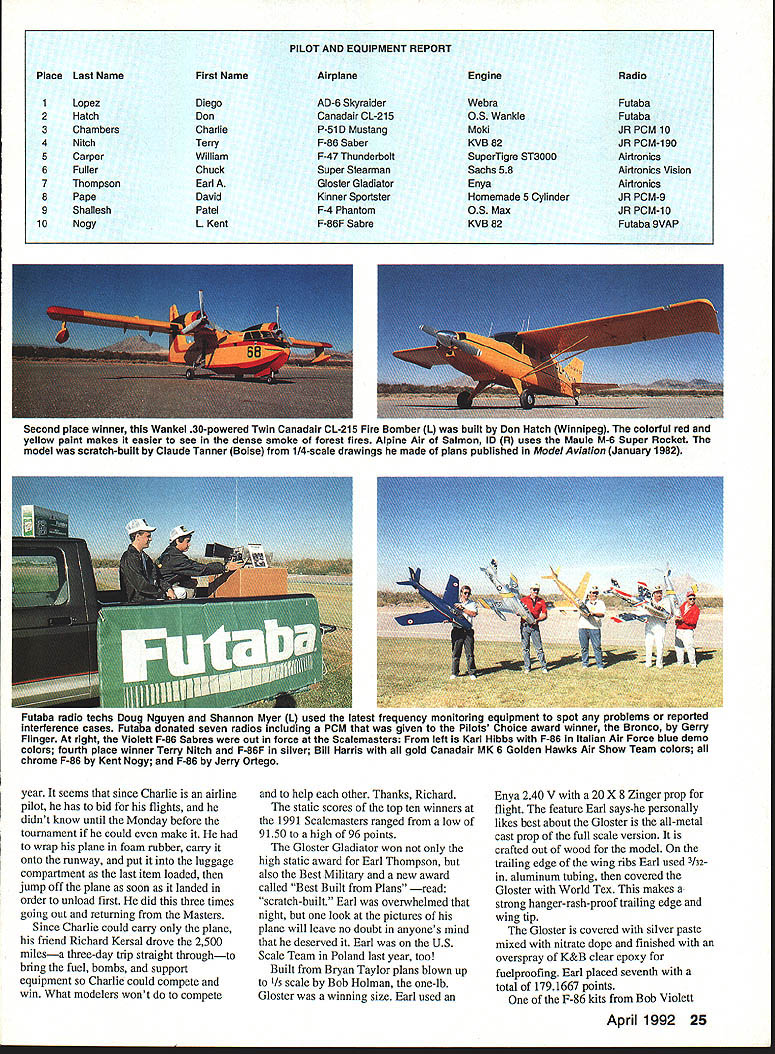
- Don Hatch — Canadair CL‑215 Firebomber — 182.5000
- Charlie Chambers — P‑51D Mustang
- Terry Nitch — F‑86 Sabre — 180.4167
- William (Bill) Carper — P‑47 Thunderbolt — 179.9167
- Chuck Fuller — Super Stearman
- Earl Thompson — Gloster Gladiator — 179.1667
- Dave Pape — Kinner Sportster
- Shallesh Patel — F‑4 Phantom — 178.8333
- Kent Nogy — F‑86F Sabre — 178.7500
The static scores of the top ten winners ranged from a low of 51.0 to a high of 96 points.
Winning Flights and Notable Performances
- Diego Lopez rose from a perennial last‑place T‑shirt recipient to champion with a Rick Lewis Skyraider. His best flight featured a straight takeoff, a slow medium‑speed climbout, slow gear retraction, and flaps brought up cleanly — earning him a well‑deserved "ten" for realism.
- Don Hatch nearly beat Diego with a distinctive red‑and‑yellow CL‑215 firebomber powered by two Wankel .30s; Hatch used 5/16‑in. scale and scored 182.5000.
- Charlie Chambers flew a P‑51D covered with printer's plate aluminum into third place. His "Big Beautiful Doll" was videotaped by the Academy of Aviation Research and Development (P.O. Box 277, 17010 Elm Drive, Hazel Crest, IL 60429; Tel.: 708/335‑0776).
- Terry Nitch placed fourth (180.4167) and Bill Carper took fifth flying the Bert Baker P‑47D design.
Static Awards and Scratch‑Built Highlights
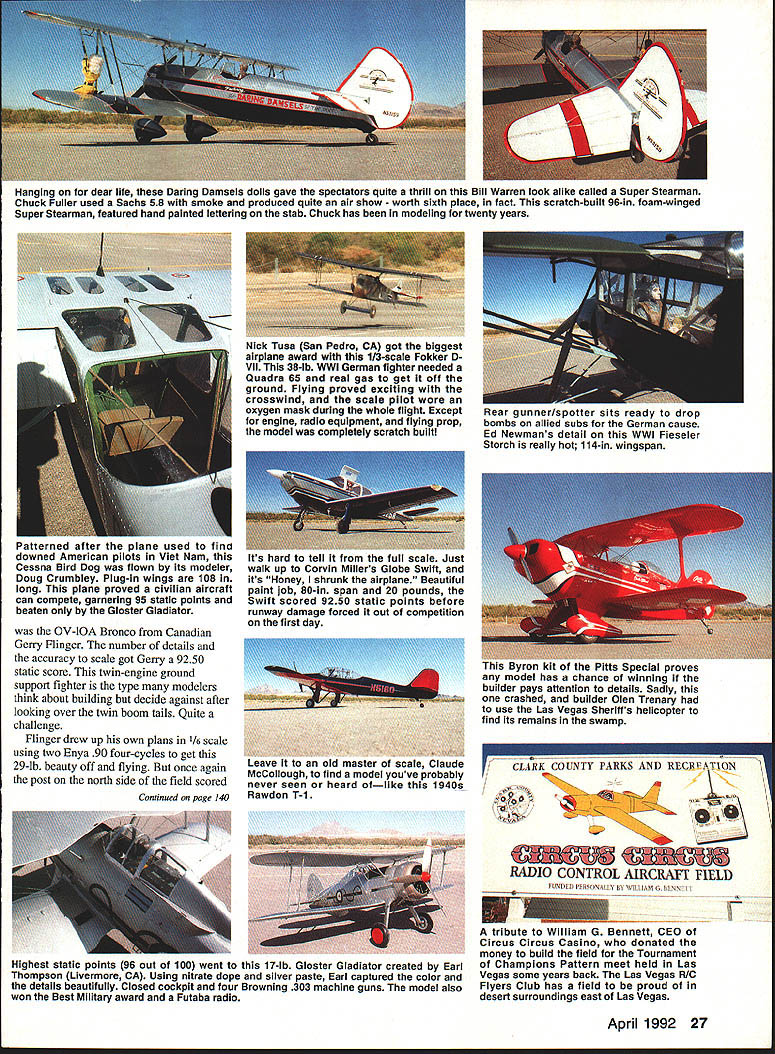
- Earl Thompson's Gloster Gladiator won high static, Best Military, and a new "Best Built from Plans" (scratch‑built) award. Earl's Gloster was built from Bryan Taylor plans scaled up to 1/5 by Bob Holman; the model weighed about one pound and flew on an Enya 2.40 V with a 20 x 8 Zinger prop. Earl used 3/32‑in. aluminum tubing on the wing trailing edges and World Tex covering, finished with silver paint, nitrate dope, and a K&B clear epoxy overspray for fuelproofing.
- Dave Pape's all‑scratch 1933 Kinner Sportster (a five‑cylinder engine layout) again proved that a well‑built civilian homebuilt can compete with warbirds at the Masters.
Incidents and Recoveries
- Shallesh Patel's F‑4 Phantom suffered engine problems (wouldn't idle, long runout) and ultimately crashed when it could not be brought under control; he finished ninth but would have placed higher with reliable power.
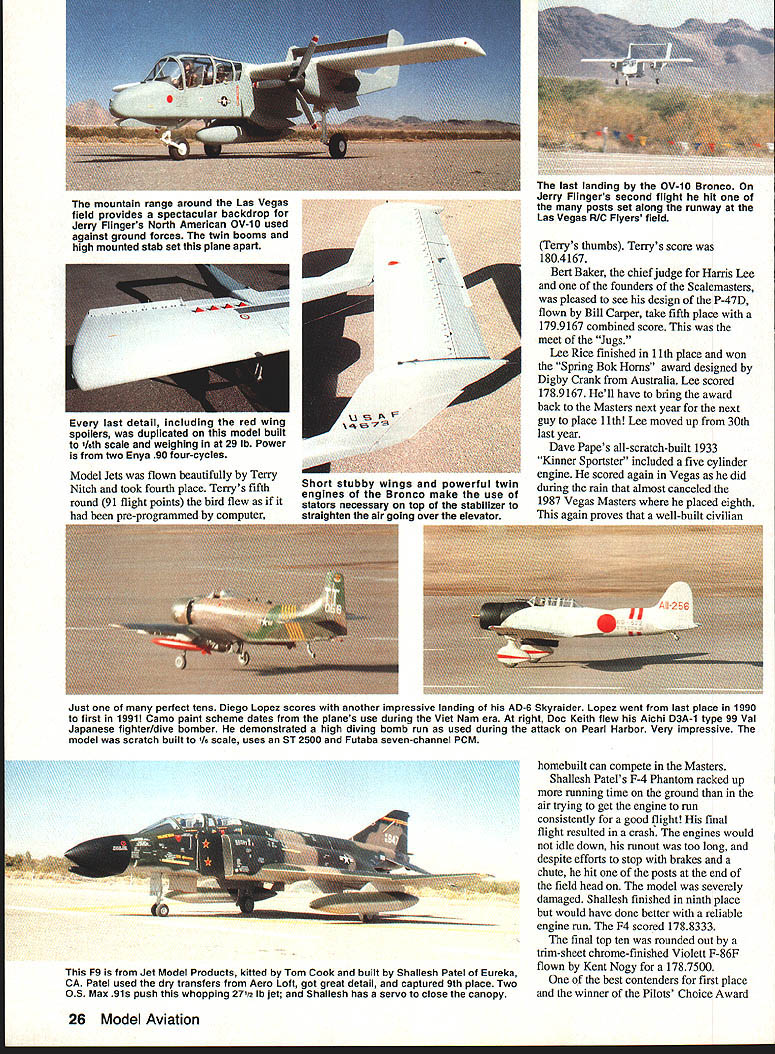
- Gerry Flinger suffered a direct hit that broke an OV‑10 Bronco and its wing center section; the model appeared repairable.
- Corvin Miller's Swift performed a reverse Cuban Eight slightly low — he had the elevator low‑rate switch engaged by mistake, did a belly flop, damaged the prop, lost a cylinder on one engine, and ended in a tree in swampy ground.
- The "swamp" north of the field is thick backfill with undergrowth and quicksand‑like conditions; recoveries are difficult. Rick Lewis's Skyraider dived into the swamp when its battery went low; volunteers found and recovered it after the event, saving the cost of a helicopter. Olen Trenary used a helicopter the prior day to recover his Byron Pitts Special; the sheriff's department assisted.
Crowd Pleasers
- Chuck Fuller's scratch‑built Super Stearman (with wing‑walking girls) provided an airshow feel. He flew it with smoke and a Sachs 5.8 engine. Bill Warren had flown the type on the airshow circuit for years.
Canadian Contingent
A sizable Canadian group attended, including:
- Dave Pape — Kinner Sportster
- Dave Sawatzky — T‑34C
- Gerry Flinger — OV‑10 Bronco (static)
- Bruce Bender — Spitfire Mk XIV
- Don Hatch — CL‑215
Sponsors and Support
Sponsors made the event possible and provided many prizes:
- Futaba PCM was the R/C equipment of choice; field reps Doug Nguyen and Shannon Myer provided frequency control and supplies. Futaba donated seven radios as prizes. Contact Futaba (attn: Steve Helm) for hats, jackets, and patches.
- Pacer Industries provided major financial support and each contestant received a Scalemasters shirt, hat, pin, patch, and plaque. Hershel Worthy and Zap's support were singled out for appreciation.
- Other sponsors and donors included: Proctor & Company, Balsa USA, Sig, Ace R/C, Pica, Cox Hobbies, Robart, JR Radio, APC Props, Master Airscrew, and Carl Goldberg Models.
Sponsors donated kits, props, landing gear, radios, and other prizes. Balsa USA and Sig donated kits; Pica gave away a 1/5‑scale P‑51; Robart offered 1/4‑scale landing gear; APC and Master Airscrew supplied propellers; Carl Goldberg Models was also represented.
Organization and Thanks
The Las Vegas R/C Flyers Club and field sponsors can be proud of a fine event. CD Shawn Stroe (called in at the last minute) and assistant CD Mike Calmy ran an organized, smooth contest. Dave Pinjuv and club members provided manpower and concession proceeds were donated to the Kiwanis Club D.A.R.E. drug program. A drawing for a Byron Christen Eagle (with Quadra 35 and Futaba radio) helped offset club expenses.
Harris Lee announced that the 1992 Scalemasters will be held in Dallas–Fort Worth (the same site used in 1990). Harris welcomes help organizing the event and invites interested parties to send a resume and ideas.
Final Notes
Plan to attend the Scalemasters as a contestant or observer. Stay at the headquarters motel, meet the "Masters," and learn from them — they are usually happy to answer questions and help solve design or mechanical problems. Build the plane you love for your first club project; the labor of love will see you through. Hope to see you at the Scalemasters in 1992.
Transcribed from original scans by AI. Minor OCR errors may remain.

