
Scepter
Allen Brickhaus
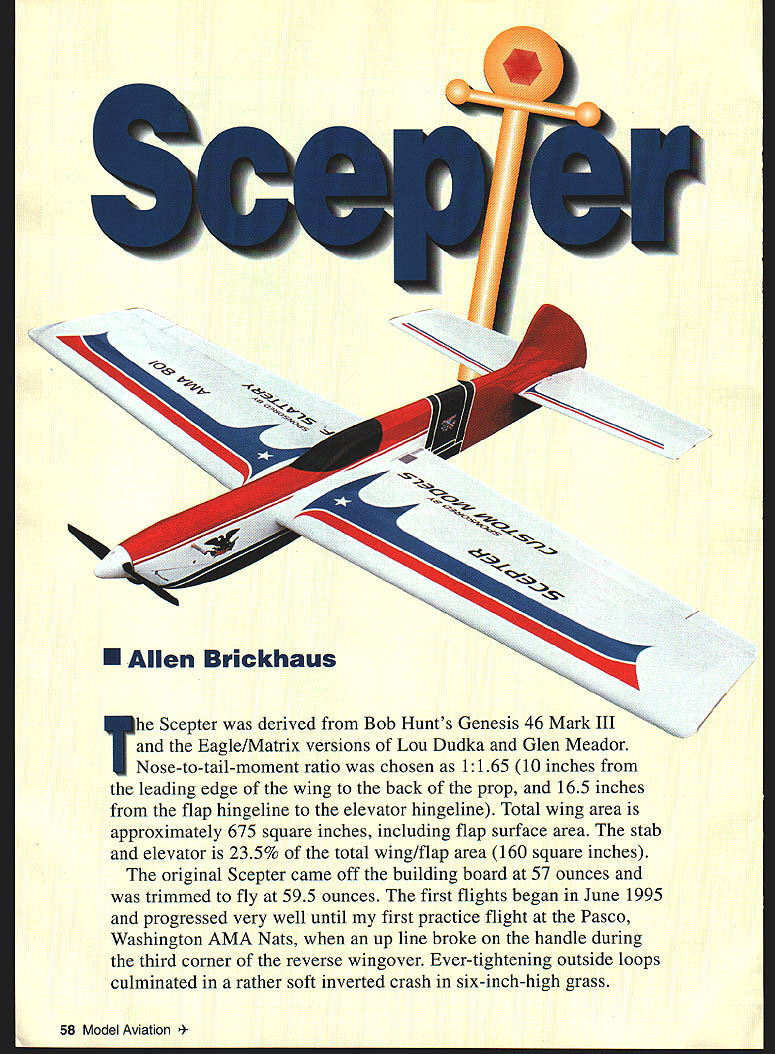
The Scepter was derived from Bob Hunt's Genesis 46 Mark III and the Eagle/Matrix versions of Lou Dudka and Glen Meador. Nose-to-tail moment ratio was chosen as 1:1.65 (10 inches from the leading edge of the wing to the back of the prop, and 16.5 inches from the flap hingeline to the elevator hingeline). Total wing area is approximately 675 square inches, including flap surface area. The stab and elevator is 23.5% of the total wing/flap area (160 square inches).
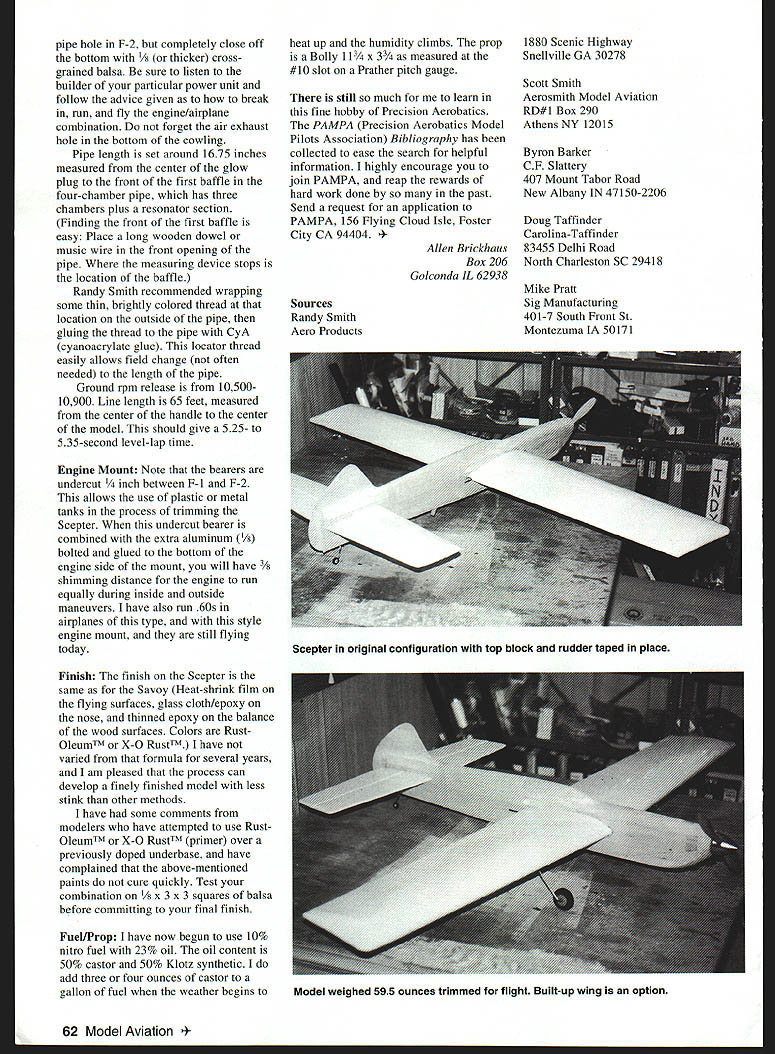
The original Scepter came off the building board at 57 ounces and was trimmed to fly at 59.5 ounces. The first flights began in June 1995 and progressed very well until my first practice flight at the Pasco, Washington AMA Nats, when an up line broke on the handle during the third corner of the reverse wingover. Ever-tightening outside loops culminated in a rather soft inverted crash in six-inch-high grass.
The crash seemed relatively minor until I watched the stab flex. I picked the model up and spent a day-and-a-half attempting a fix. Cooler voices—experienced ones—told me to lay the model aside and concentrate on the backup version. The long ride home after the Nats kept my mind busy thinking about whether I would repair the Scepter and bring it back to life. Could I fix the stab? A quick-but-efficient repair would get the model back in the air.
On August 2, 1995, nineteen flights later, the outer wing popped off during a practice flight. A stress crack that occurred during the Pasco crash had gone unnoticed during the subsequent repair process. I finished the season with my backup airplane and vowed to get the Scepter repaired correctly the second time. It took some time to put heart and soul back into the Scepter and to look at it again in an objective manner. The slow process of rebuilding the airplane took place during the winter of 1995–96. Rebuilding probably took much longer than original construction, but I felt it was worth it.
Serious flying resumed in June 1996 and led to several wins on the Midwest Stunt circuit, placing 17th at the 1996 AMA Nationals.
CONSTRUCTION
Basic construction is very similar to the Savoy. The December 1996 Model Aviation Savoy article outlines the vast majority of building techniques that parallel this model. If you prefer a built-up wing, a foam-core example can simply be used; develop aluminum and plywood templates and use the ribbed version. The forward foam spar shown on the plans should be located with wooden spars for a built-up wing. Refer back to MA plan #193, Stiletto by Les McDonald, for a very simple way to construct a built-up wing.
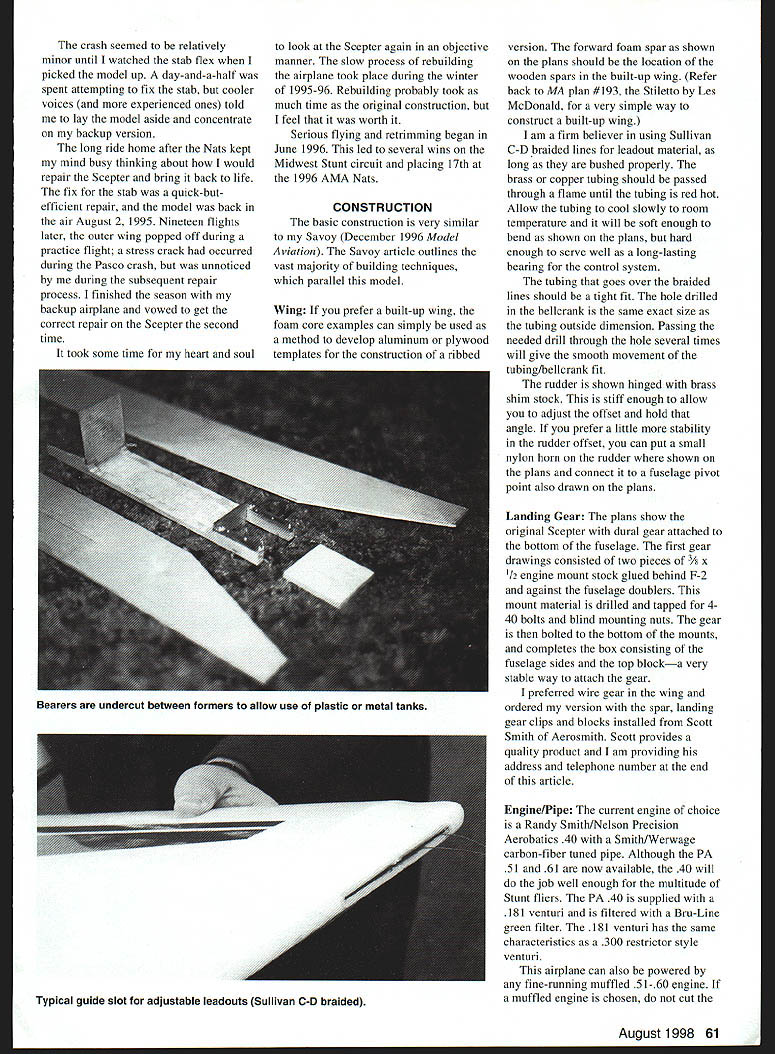
I am a firm believer in using Sullivan C-D braided lines for leadout material. Long leadouts should be bushed properly; brass or copper tubing should be passed through a flame until the tubing is red hot. Allow the tubing to cool slowly to room temperature; it will be soft enough to bend as shown on the plans, yet hard enough to serve well as a long-lasting bearing. The control-system tubing that goes over the braided lines should be a tight fit. The hole drilled in the bellcrank should be the exact outside dimension of the tubing. Passing the tubing back through the hole several times will give a smooth movement and a good tubing/bellcrank fit.
The rudder shown is hinged with brass shim stock, which is stiff enough to allow for an adjustable offset and to hold the angle. If you prefer a little more stability, rudder offset can be used; a small nylon horn shown on the plans connects the fuselage pivot point as drawn.
Landing-gear plans show the original Scepter dural gear attached to the bottom of the fuselage. The first gear drawings consisted of two pieces of 3/16 x 1/2 engine-mount stock glued behind F-2 against the fuselage doublers. The mount material is drilled and tapped for 4-40 bolts with blind mounting nuts; the gear is bolted to the bottom mounts. This completes the box consisting of fuselage sides and top blocks — a very stable way to attach the gear. I preferred a wire gear on later versions. Spar landing-gear clips and blocks were installed by Scott Smith at Aerosmith; Scott provides a quality product.
Engine/Pipe
My current engine choice is the Randy Smith / Nelson Precision Aerobatics .40 — the Smith/Werwage carbon-fiber tuned pipe. Although PA .51 and .61 units are now available, the .40 will do the job well enough. A multitude of stunt fliers use the PA .40. The PA .40 is supplied with a .181 venturi and a Bru-Line green filter. The .181 venturi has the same characteristics as the 300-restrictor-style venturi.
The airplane can also be powered by any fine-running muffled .51–.60 engine. If a muffled engine is chosen, do not cut the pipe hole in F-2, but completely close off the bottom with 1/8 (or thicker) cross-grained balsa. Be sure to listen to the builder of your particular power unit and follow the advice given as to how to break in, run, and fly the engine/airplane combination. Do not forget the air exhaust hole in the bottom of the cowling.
Pipe length is set at around 16.75 inches measured from the center of the glow plug to the front of the first baffle in the four-chamber pipe, which has three chambers per major reactor section. (Finding the front of the first baffle is easy: place a long wooden dowel or music wire in the front opening of the pipe. Where the measuring device stops is the location of the baffle.)
Randy Smith recommended wrapping some thin, brightly colored thread at that location on the outside of the pipe, then gluing the thread to the pipe with CyA (cyanoacrylate glue). This locator thread easily allows field change (not often needed) to the length of the pipe.
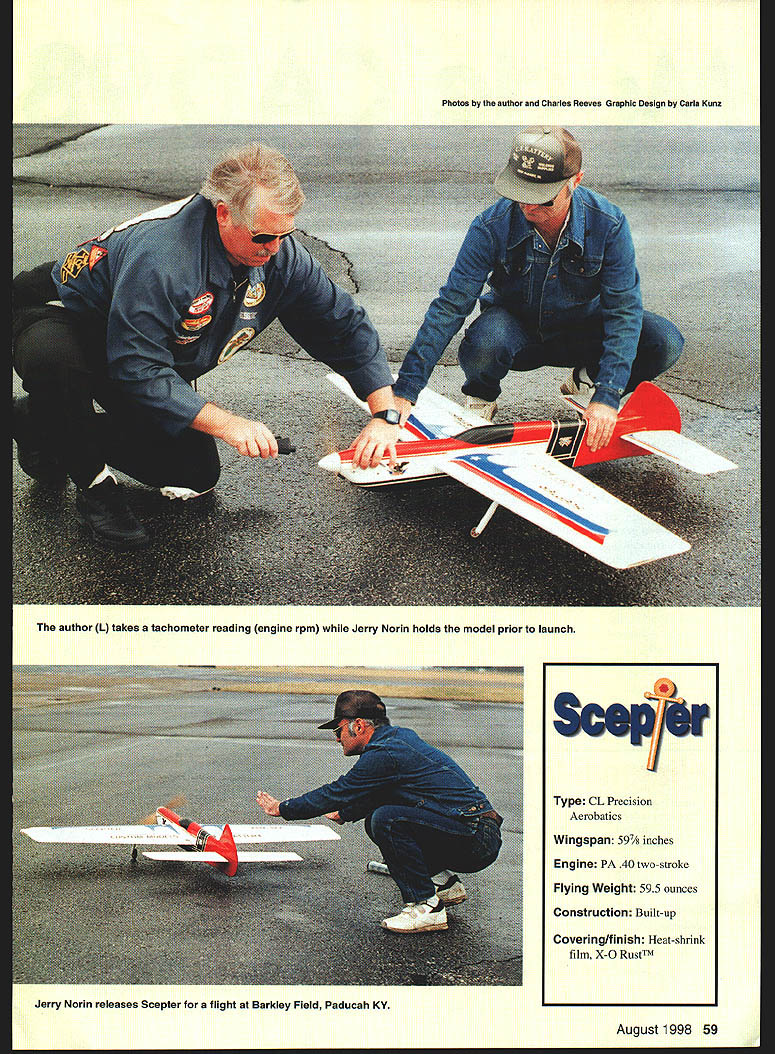
Ground rpm release is from 10,500–10,900. Line length is 65 feet, measured from the center of the handle to the center of the model. This should give a 5.25- to 5.35-second level-lap time.
Engine Mount
Note that the bearers are undercut 1/4 inch between F-1 and F-2. This allows the use of plastic or metal tanks in the process of trimming the Scepter. When this undercut bearer is combined with the extra aluminum (1/8) bolted and glued to the bottom of the engine side of the mount, you will have 3/8 inch shimming distance for the engine to run equally during inside and outside maneuvers. I have also run .060 engines in airplanes of this type, and with this style engine mount, and they are still flying today.
Finish
The finish on the Scepter is the same as for the Savoy: heat-shrink film on the flying surfaces, glass cloth/epoxy on the nose, and thinned epoxy on the balance of the wood surfaces. Colors are Rust-Oleum or X-O Rust. I have not varied from that formula for several years, and I am pleased that the process can develop a finely finished model with less stink than other methods.
I have had some comments from modelers who have attempted to use Rust-Oleum or X-O Rust (primer) over a previously doped underbase, and have complained that the above-mentioned paints do not cure quickly. Test your combination on 1/8 x 3 x 3 squares of balsa before committing to your final finish.
Fuel/Prop
I have now begun to use 10% nitro fuel with 23% oil. The oil content is 50% castor and 50% Klotz synthetic. I do add three or four ounces of castor to a gallon of fuel when the weather begins to heat up and the humidity climbs. The prop is a Bolly 11 3/4 x 3 3/4 as measured at the #10 slot on a Prather pitch gauge.
There is still so much for me to learn in this fine hobby of Precision Aerobatics. The PAMPA (Precision Aerobatics Model Pilots Association) Bibliography has been collected to ease the search for helpful information. I highly encourage you to join PAMPA, and reap the rewards of hard work done by so many in the past. Send a request for an application to PAMPA, 156 Flying Cloud Isle, Foster City, CA 94404.
Allen Brickhaus Box 206 Golconda, IL 62938
Sources
- Randy Smith
Aero Products 1880 Scenic Highway Snellville, GA 30278
- Scott Smith
Aerosmith Model Aviation RD#1 Box 290 Athens, NY 12015
- Byron Barker
- C.F. Slattery
407 Mount Tabor Road New Albany, IN 47150-2206
- Doug Taffinder
Carolina-Taffinder 83455 Delhi Road North Charleston, SC 29418
- Mike Pratt
Sig Manufacturing 401-7 South Front St. Montezuma, IA 50171
Transcribed from original scans by AI. Minor OCR errors may remain.

