
Schneider Trophy Races
The Schneider Trophy was originally offered to the winner of an international speed competition for seaplanes. Before the long series had ended, it had created an entirely new class of aircraft and had stimulated the development of airframes and engines to a greater extent than any other competition in aviation history. Strangely, it never led to any important advances in operational seaplanes.
The first race, in 1913, was won at the staggering speed of 43 mph. The final race, in 1931, was won at 340 mph—more than seven times as fast. The U.S., Britain and Italy poured enormous amounts of money into the creation of some of the most glamorous aircraft ever seen. Even though almost all the true racing seaplanes built for the Schneider carried huge drag-producing pontoons hanging below their trim fuselages, they held the absolute world speed record for more than 11 years.
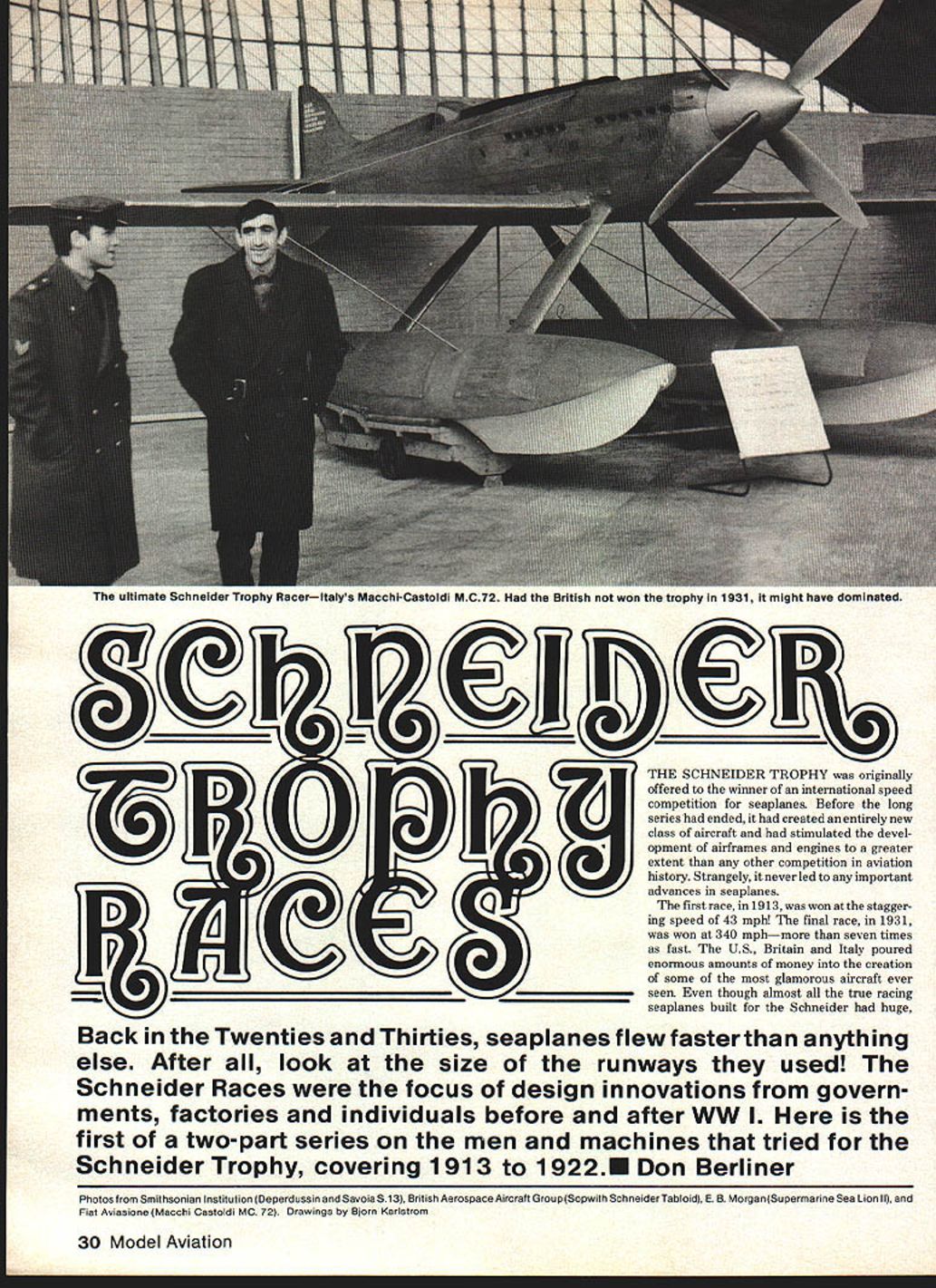
Back in the 1920s and 1930s, seaplanes flew faster than anything else. After all, look at the size of the runways they used! The Schneider Races were the focus of design innovations from governments, factories and individuals before and after World War I. The 50th anniversary of the final Schneider Trophy Race was celebrated on September 13, 1981, with the focus on the Science Museum in South Kensington, London, where the 1931 winning Supermarine S.6B and the Schneider Trophy are on display.
Origins and rules
It all began on December 5, 1912, when M. Jacques Schneider offered a large bronze trophy and a small purse to the winner of an annual race for water-borne flying machines at a meeting of the Aero Club of France. It had been less than three years since the first plane had flown off the water, and already the potential of "runway-less" aircraft was becoming apparent.
To make sure every aircraft in the competition was a true seaplane, a series of seaworthiness tests had to be passed. Each entry had to:
- fly one lap of a short course during which the pilot had to land twice and taxi half a mile at a speed of at least 12 knots;
- then moor the racer to a buoy for six hours to show it was still seaworthy.
In the first race, more than half the entries failed at least one of these tests and were not allowed to race.
1913 — Monaco (first race)
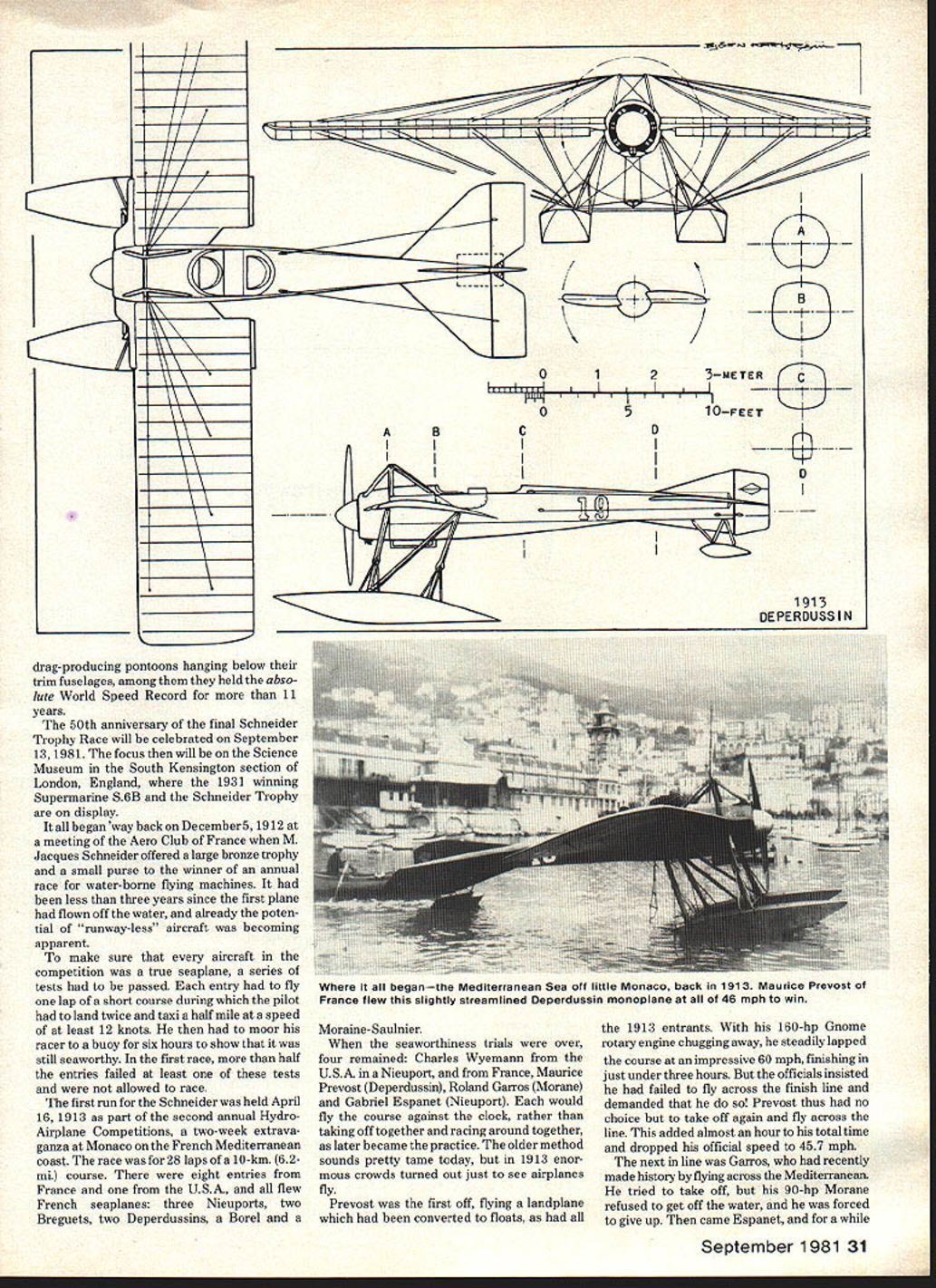
The first run for the Schneider was held April 16, 1913, as part of the second annual Hydro-Airplane Competitions, a two-week extravaganza at Monaco on the French Mediterranean coast. The race was 28 laps of a 10-km (6.2-mi) course. There were eight entries from France and one from the USA; all flew French seaplanes: three Nieuports, two Breguets, two Deperdussins, a Borel and a Morane-Saulnier.
When the seaworthiness trials were over, four remained: Charles Weymann (USA) in a Nieuport, and from France Maurice Prévost (Deperdussin), Roland Garros (Morane) and Gabriel Espanet (Nieuport). Each flew the course against the clock rather than starting en masse.
Prévost was the first off, flying a landplane converted to floats with a 160-hp Gnome rotary engine. He steadily lapped the course at an impressive 60 mph, finishing in just under three hours. Officials, however, insisted he had failed to fly across the finish line and demanded he do so; he therefore had to take off again and fly across the line. This added almost an hour to his total time and dropped his official speed to 45.7 mph.
Garros attempted to take off next, but his 90-hp Morane refused to get off the water and he was forced to retire. Espanet looked certain of first place after 20 laps at just over 60 mph, but an oil line broke on lap 26 and he had to retire, handing the race to Prévost.
1914 — Monaco (second race)
The scene for the second Schneider, April 20, 1914, was Monaco again. The Aero Club of France laid out a 10-km course that would have caused apoplexy in any modern race pilot: a rectangle with one side just 800 feet long and a hairpin turn of 165°. Not only would this chop speeds, it would add the then-unknown danger of high-speed stalls. Amazingly, there were no accidents or injuries in this race, nor in any Schneider Race.
Entries included:
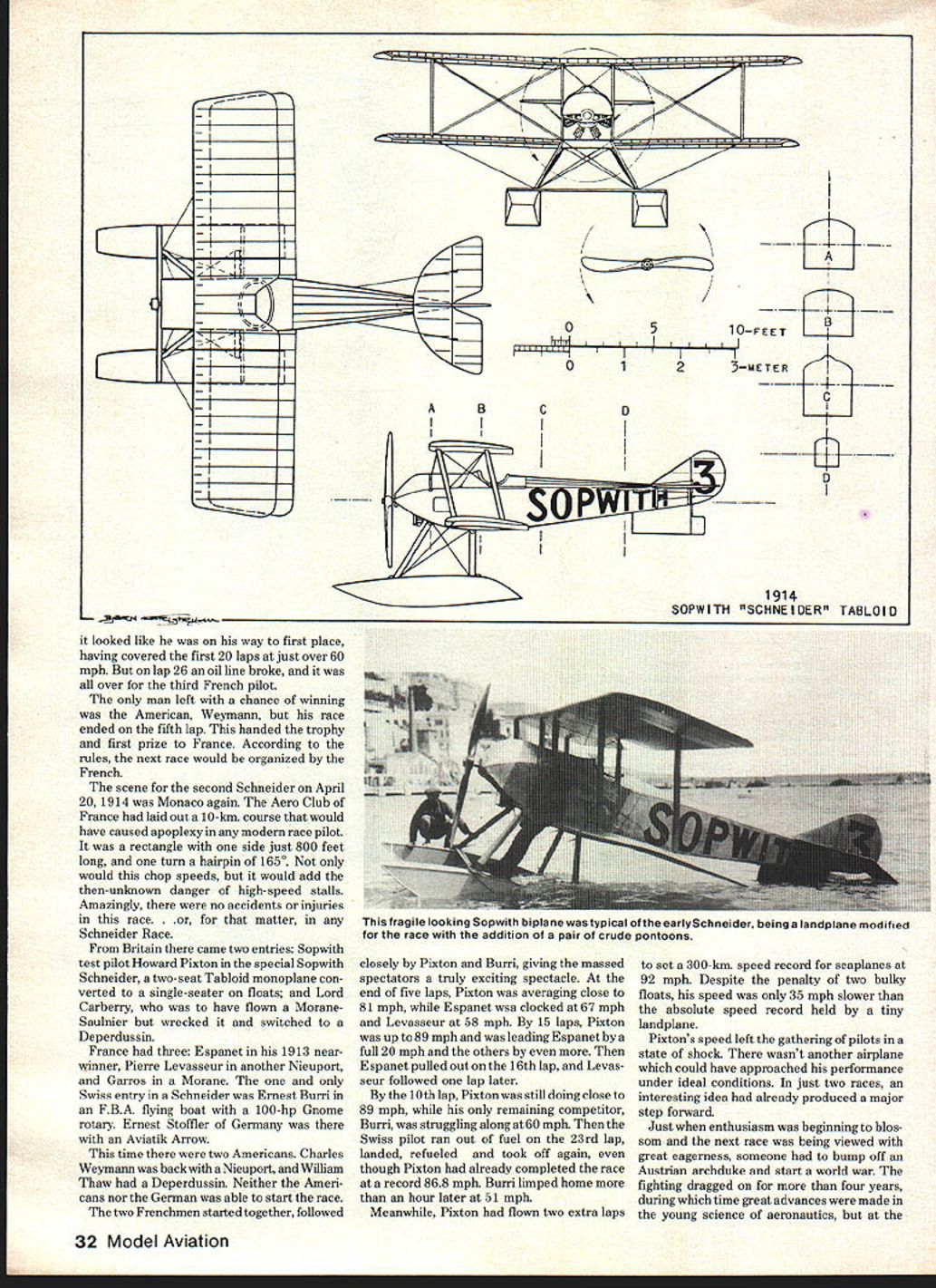
- Britain: Howard Pixton in the special Sopwith Schneider (a Tabloid monoplane on floats) and Lord Carberry (who switched to a Deperdussin after wrecking a Morane-Saulnier).
- France: Gabriel Espanet (returning), Pierre Levasseur (Nieuport) and Roland Garros (Morane).
- Switzerland: Ernest Burri in an F.B.A. flying boat with a 100-hp Gnome rotary.
- Germany: Ernest Stoffler in an Aviatik Arrow.
- USA: Charles Weymann (Nieuport) and William Thaw (Deperdussin), though the Americans and the German failed to start.
Pixton and Burri provided an exciting duel. After five laps Pixton averaged close to 81 mph; by 15 laps he was up to 89 mph and well ahead. Espanet and Levasseur retired on laps 16 and 17 respectively. Burri ran out of fuel on lap 23, landed, refueled and took off again, but Pixton had already completed the race at a record 86.8 mph. Burri limped home more than an hour later at 51 mph.
Pixton then flew two extra laps to set a 300-km seaplane speed record at 92 mph. Despite the drag penalty of two bulky floats, his speed was only about 35 mph slower than the absolute landplane record. Pixton's performance shocked the gathering of pilots—only two races in, and seaplane speeds had leapt forward.
World War I interruption
Just when enthusiasm was blossoming and the next race was eagerly anticipated, the assassination of an Austrian archduke triggered World War I. The fighting dragged on more than four years, during which great advances were made in aeronautics at a terrible human cost.
When the war ended it was the turn of Great Britain to stage the next Schneider Trophy Race.
1919 — Bournemouth (third race)
The third Schneider Trophy Race was held September 10, 1919, off Bournemouth on the south coast of England: 10 laps of a 23-mi triangle. Entries included:
- Britain: Vincent Nicholl (Fairey IIIA, 450-hp Napier Lion), Harry Hawker (Sopwith Tabloid, 450-hp Cosmos Jupiter), Basil Hobbs (Supermarine Sea Lion I, Napier Lion).
- France: Jean Casale and Henri Malard (Nieuports, 360-hp Hispano-Suiza V-8s) and Sadi Lecointe (SPAD-Herbemont S.20).
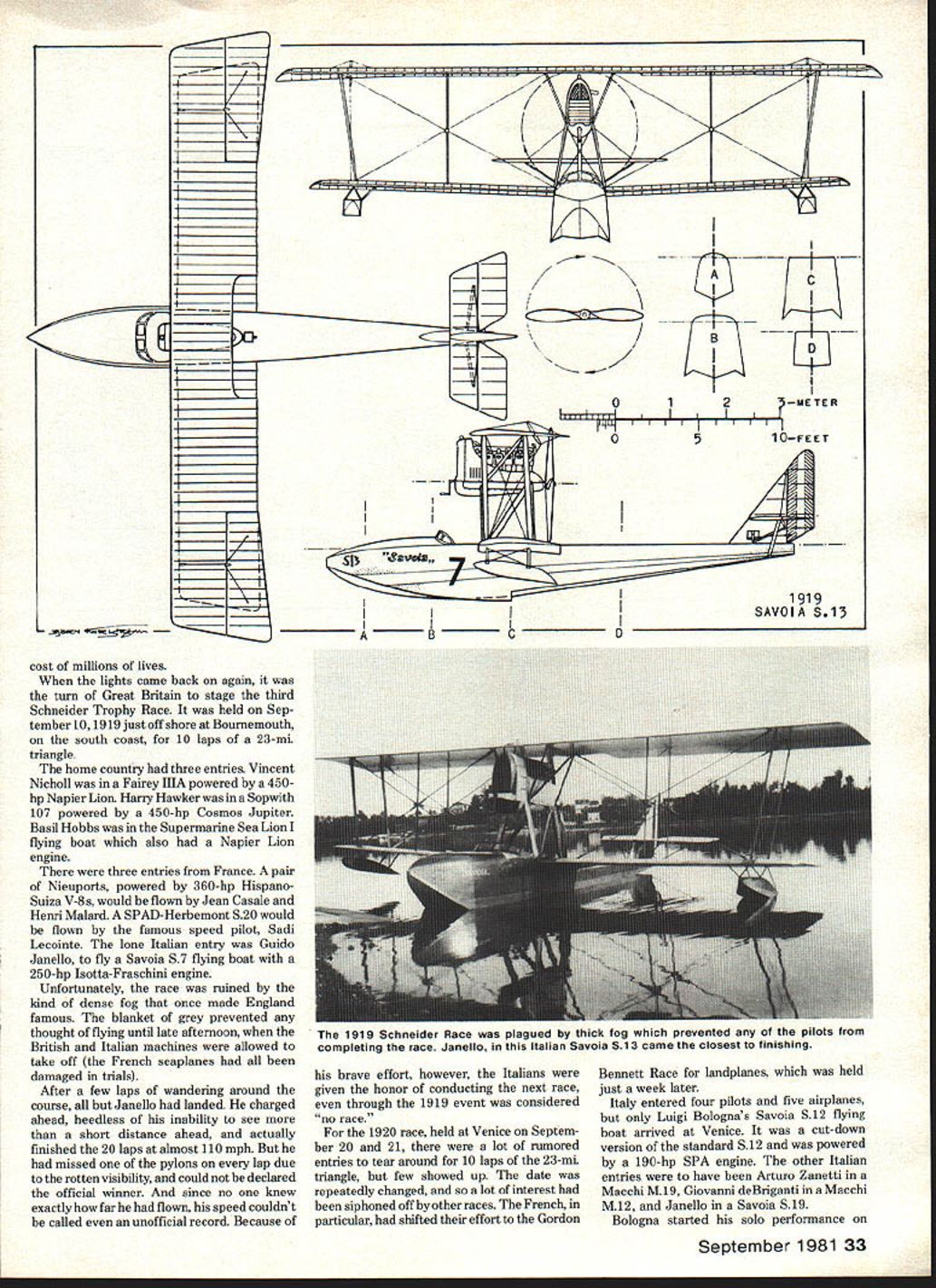
- Italy: Guido Janello (Savoia S.7 flying boat, 250-hp Isotta-Fraschini).
Dense fog ruined the event. Flying was delayed until late afternoon; only the British and Italian machines were able to take off (the French seaplanes had been damaged in trials). Janello charged on despite poor visibility and completed 20 laps at almost 110 mph, but he missed one pylon on every lap and thus could not be declared the official winner. Because of his effort, however, Italy was awarded the honor of conducting the next race, even though the 1919 event is considered "no race."
1920 — Venice (fourth race)
The 1920 race was held at Venice on September 20–21 for 10 laps of the 23-mi triangle. Although many entries had been rumored, few showed up; the date had been changed repeatedly and interest had been siphoned off by other events, notably the Gordon Bennett Race for landplanes the following week.
Italy entered four pilots with five airplanes, but only Luigi Bologna's Savoia S.12 arrived. It was a cut-down version of the standard S.12 powered by a 190-hp SPA engine. Bologna started on September 20 but was forced to land after five laps because of heavy rain. He flew the full distance the next day, averaging an official record of 105.97 mph and preserving Italy's hold on the trophy.
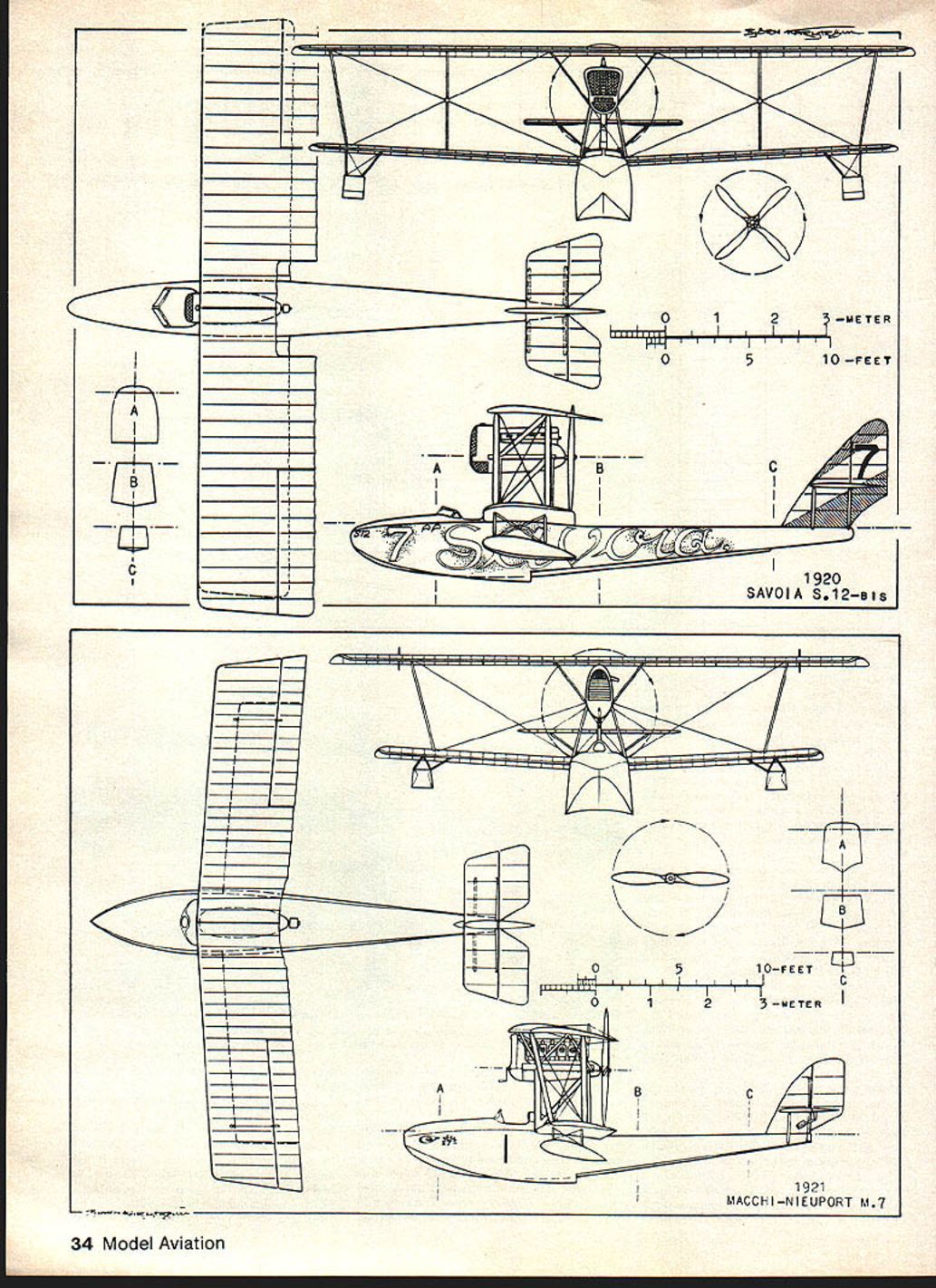
1920 — Savoia S.12-bis
(1920 Savoia S.12-bis)
1921 — Venice (fifth race)
The 1921 event was again at Venice, on August 6–7, this time for 16 laps around a 15.3-mi triangle. There were four actual entries (not counting six others that were in Italian eliminations):
- Italy: Arturo Zanetti (Macchi M.19, 600-hp Fiat A.14), Piero Corngolino (Macchi M.7, 240-hp Isotta-Fraschini V-6) and Giovanni de Briganti (Macchi M.7bis).
- France: Sadi Lecointe (Nieuport-Delage 29, 300-hp Hispano-Suiza V-8).
Lecointe failed the seaworthiness trials when one of his floats was damaged and began to take on water, leaving an all-Italian contest. Zanetti dominated early, flying close to 130 mph lap after lap, but on the 11th lap his crankshaft broke and he was forced to land. That left Corngolino and de Briganti battling for the win. On the 15th lap Corngolino's engine sputtered and stopped with only about 40 seconds of fuel remaining; he landed and de Briganti cruised on to victory at 117.9 mph.
1921 — Macchi-Nieuport M.7
(1921 Macchi-Nieuport M.7)
1922 — Naples (sixth race)
The sixth Schneider Trophy Race was held August 10–12, 1922, at Naples, Italy. The course was a 17.7-mi triangle to be flown for 13 laps (230 mi). After two disappointing postwar races, a third poor event could have jeopardized the series.
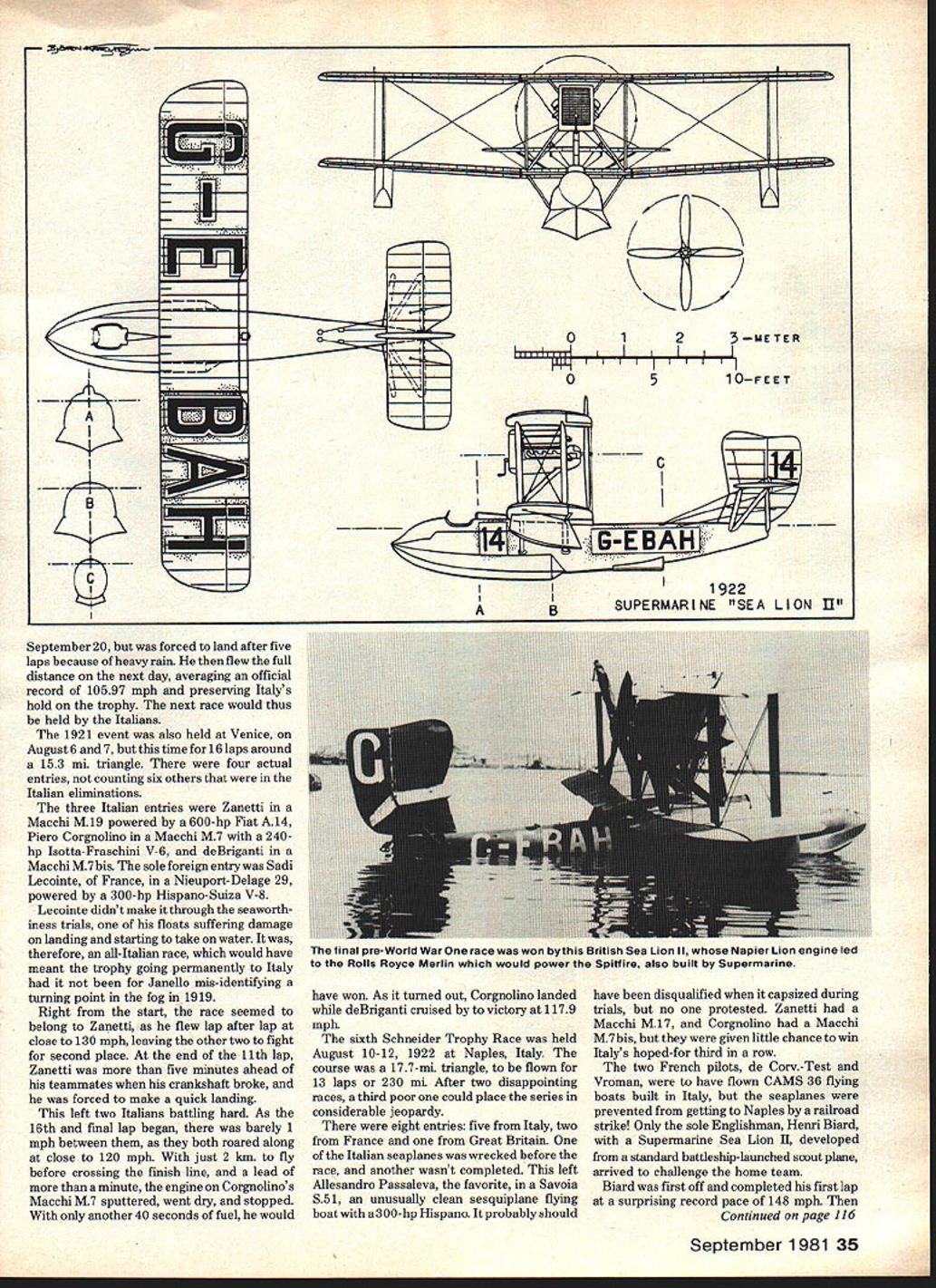
There were eight entries: five from Italy, two from France and one from Great Britain. One Italian seaplane was wrecked before the race and another wasn't completed, leaving Alessandro Passalacqua in a Savoia S.51 (an unusually clean sesquiplane flying boat with a 300-hp Hispano) as the favorite. The two French pilots, de Corv-Test and Vroman, were to fly CAMS 36 flying boats built in Italy, but the seaplanes were prevented from reaching Naples by a railroad strike. The sole English entrant was Henri Biard in a Supermarine Sea Lion II (derived from a standard battleship-launched scout plane).
Biard was first off and completed his first lap at a surprising record pace of 148 mph. When Passalacqua took off, his S.51 had capsized earlier in trials and the soaking had affected the glue in its wooden propeller; the laminations began to separate and he was forced to throttle back to control vibration. The propeller held together long enough for him to finish, but he placed almost two minutes behind Biard. Final averages were: Biard 145.7 mph (record), Passalacqua 142.6 mph, Zanetti 133 mph and Corngolino 124 mph. The increasingly competitive Schneider Trophy had pushed all four finishers above the previous speed record.
After 1922 — the race evolves
The next race — the seventh in the series — was scheduled for Cowes, England, in the autumn of 1923. It would see the first serious entry from the United States and mark the end of the era when standard or modified production seaplanes dominated. From then on, the Schneider would become a race for purpose-built racing aircraft. Those later races would bring into the spotlight some of the most exciting pure-speed aircraft ever seen and form the second half of the Schneider Trophy story remembered by aviation enthusiasts worldwide.
Transcribed from original scans by AI. Minor OCR errors may remain.

