
Schneider Trophy Races
Don Berliner
AMERICA ENTERED the Schneider Trophy Race for real in 1923 and completely transformed the well-established series of international seaplane speed competitions. Modified factory-built aircraft went out, and true racers came in. Private enterprise went out, and full government sponsorship came in. Improving old designs became passé, and the emphasis was on testing very advanced ideas in aerodynamics and engines.
The site of the seventh Schneider Race was Cowes, England, on September 27–28, 1923. The 42.8‑mi. triangular course between the Isle of Wight and the coast near Portsmouth had to be flown five times for a total of 214 mi. In this second and final entry in our series on the great Schneider seaplane races, we see the Americans coming in and getting out, the Italians hanging on gamely, and the British finally sewing up the trophy. We also see the first big day for a fellow named Doolittle, who would go on to even bigger things. These men made history and boosted the evolution of aviation in the process.
1923 — Cowes, England
The British brought a cleaned-up seaplane called the Supermarine Sea Lion III (last year's Sea Lion II with smaller wings and a more powerful Napier Lion engine), to be flown by 1922 winner Henri Biard. The only other British entry was the Blackburn Pellet, also a biplane flying boat with a pusher engine; it sank during trials so Reginald Kenworthy could not race it.
The French had finally received their Italian-built CAMS flying boats and entered two, to be flown by Maurice Hurel and Georges d'Oisy. A Blanchard-Blériot boat was damaged in testing, and a Latham L.1 boat was damaged after landing in England.
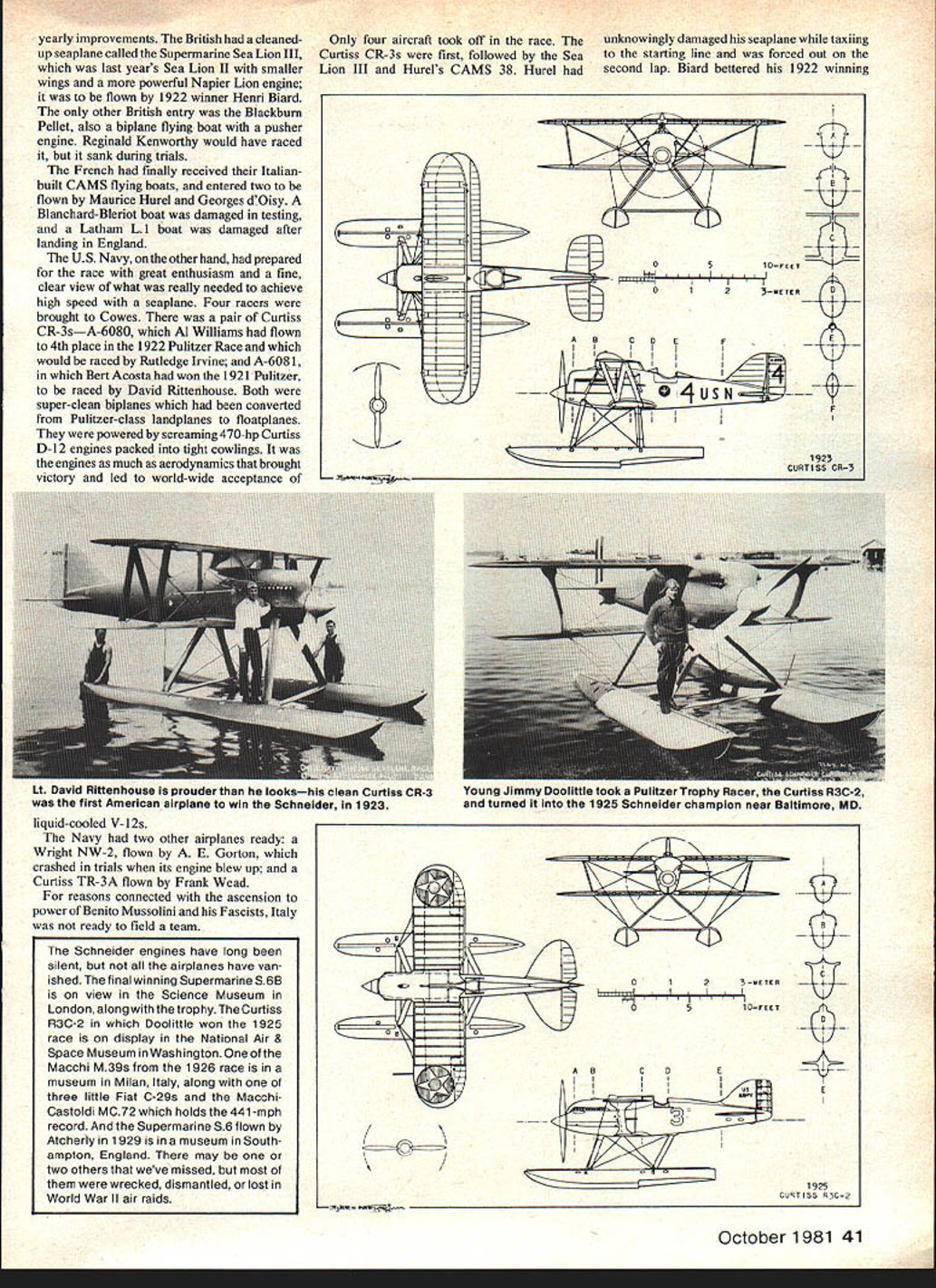
The U.S. Navy, on the other hand, prepared with great enthusiasm and a clear view of what was needed to achieve high speed with a seaplane. Four racers were brought to Cowes:
- Curtiss CR-3 A-6080 (converted from a Pulitzer-class landplane), to be raced by Rutledge Irvine. This airplane had been flown to 4th place in the 1922 Pulitzer Race.
- Curtiss CR-3 A-6081 (another converted racer), to be raced by David Rittenhouse. Bert Acosta had once won a Pulitzer in this machine.
- Wright NW-2, to be flown by A. E. Gorton (this crashed in trials when its engine blew up).
- Curtiss TR-3A, to be flown by Frank Wead.
Both CR-3s were super-clean biplanes powered by screaming 470‑hp Curtiss D‑12 engines packed into tight cowlings — it was engines as much as aerodynamics that were bringing victory and leading to worldwide acceptance of liquid-cooled V‑12s. Italy, for reasons connected with the ascension of Benito Mussolini and his Fascists, was not ready to field a team.
Only four aircraft took off in the race: the two Curtiss CR-3s were first, followed by the Sea Lion III and Hurel's CAMS 38. Hurel had unknowingly damaged his seaplane while taxiing to the starting line and was forced out on the second lap. Biard bettered his 1922 winning time.
Survivors and museums
Though the Schneider engines have long been silent, several of the racers survive in museums:
- The final winning Supermarine S.6B is on view in the Science Museum in London, along with the trophy.
- The Curtiss R3C-2 in which Jimmy Doolittle won the 1925 race is on display in the National Air & Space Museum in Washington.
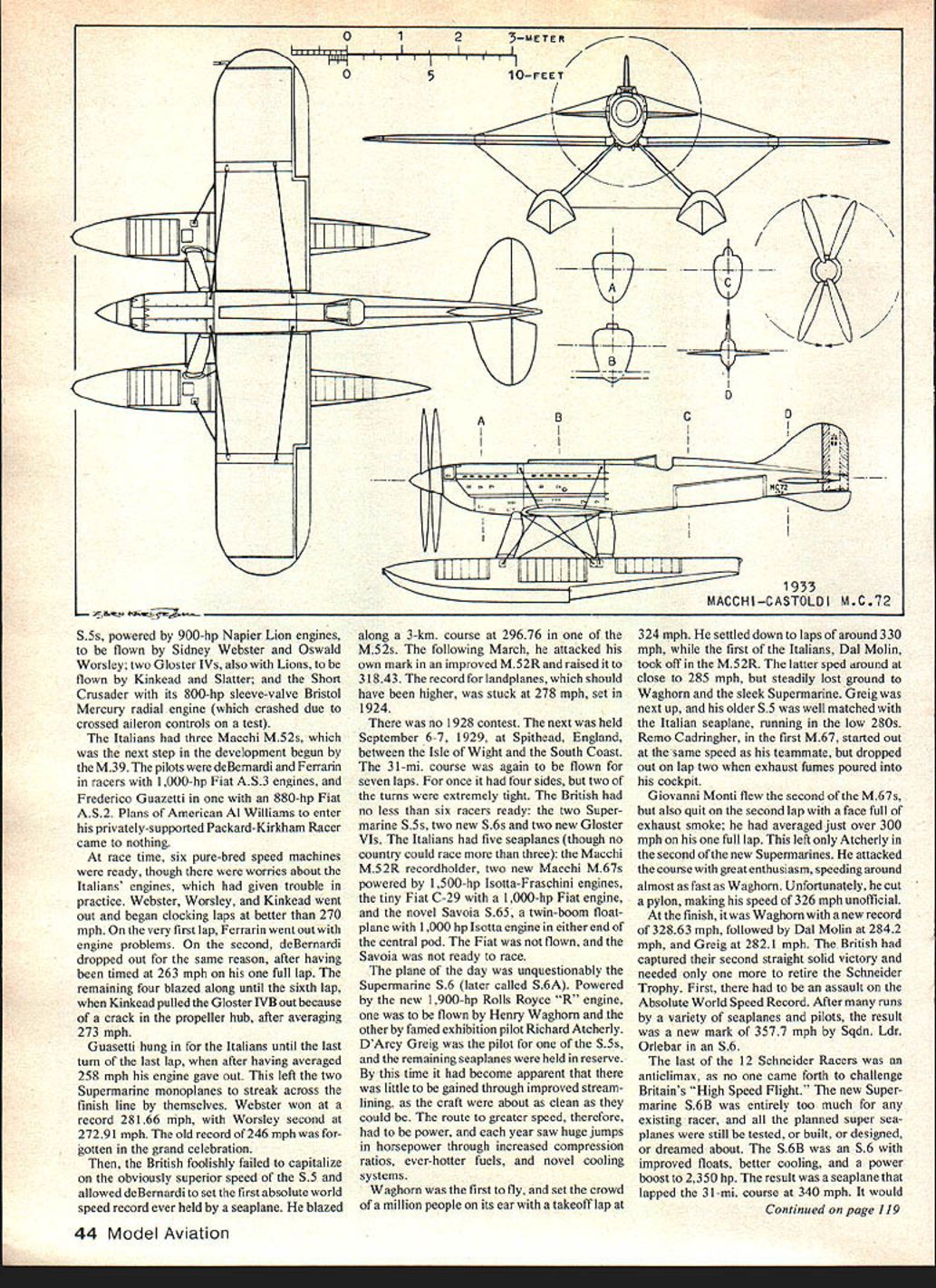
- One of the Macchi M.39s from the 1926 race is in a museum in Milan, Italy, along with one of three little Fiat C.29s and the Macchi-Castoldi MC.72 (which holds the 441‑mph record).
- The Supermarine S.6 flown by Atcherley in 1929 is in a museum in Southampton, England.
Most of the other racers were wrecked, dismantled, or lost in World War II air raids.
1924 — Cancellation and records
The 1924 Schneider was cancelled due to a lack of foreign entries to challenge the United States. Instead, the U.S. Navy allowed Lt. Ralph Oftsie to fly for FAI seaplane speed records in the 1923 runner-up CR-3. He was credited with 178.25 mph for 100 km and 200 km. Had the U.S. called this a race, it would have meant two Schneider wins in a row for America; only one more would have been needed to keep the trophy permanently.
1925 — Baltimore, MD (October 26)
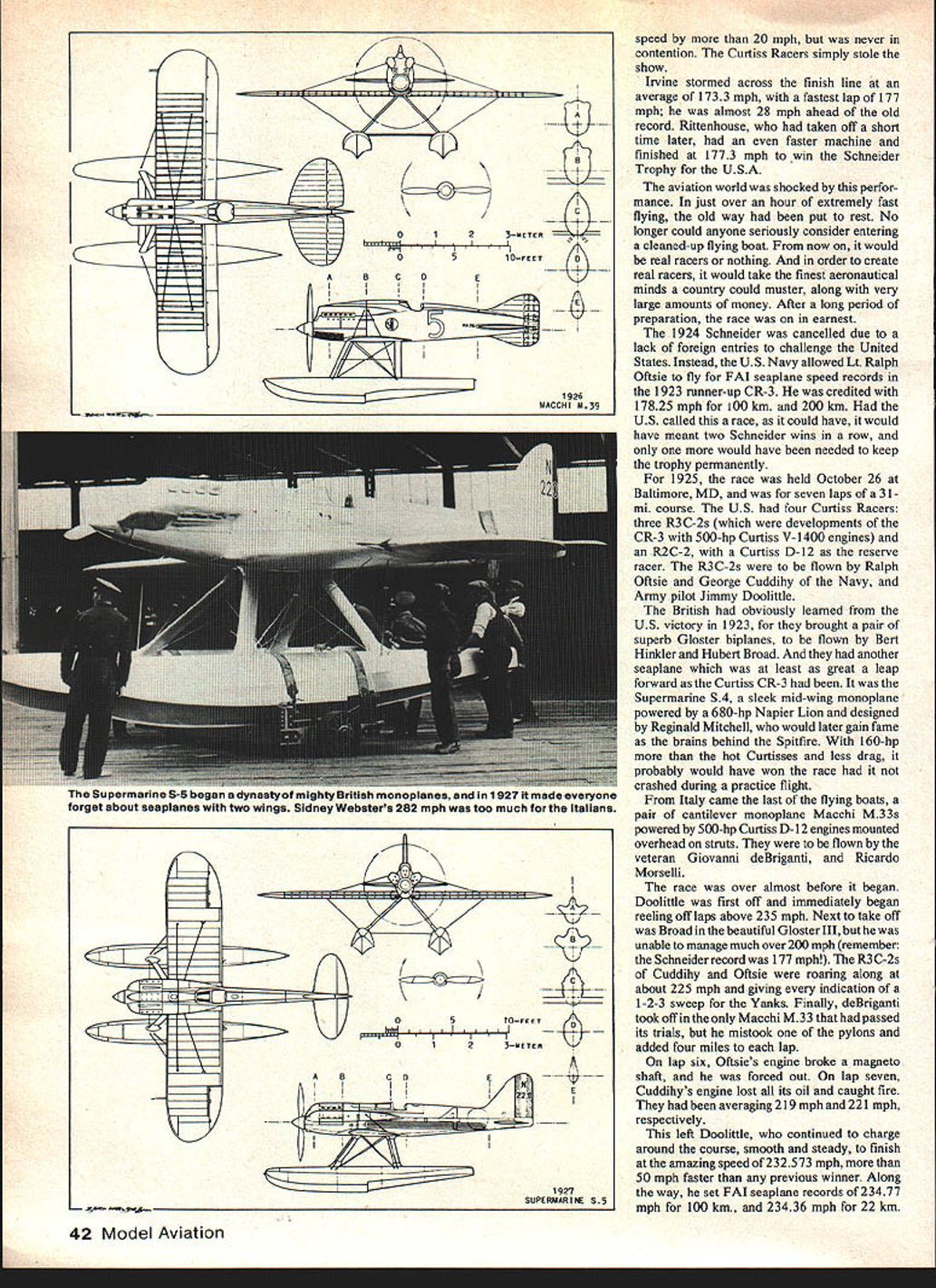
The 1925 race was seven laps of a 31‑mi. course held at Baltimore. The U.S. entered four Curtiss racers:
- Three R3C-2s (developments of the CR-3 with 500‑hp Curtiss V‑1400 engines) to be flown by Ralph Oftsie and George Cuddihy (Navy) and Jimmy Doolittle (Army).
- An R2C-2, with a Curtiss D‑12 as the reserve racer.
The British brought a pair of superb Gloster biplanes (piloted by Bert Hinkler and Hubert Broad) and the promising Supermarine S.4, a sleek mid‑wing monoplane designed by Reginald Mitchell and powered by a 680‑hp Napier Lion. The S.4 probably would have won but crashed during a practice flight.
From Italy came a pair of cantilever monoplane Macchi M.33 flying boats with 500‑hp Curtiss D‑12 engines mounted overhead on struts, to be flown by Giovanni de Briganti and Ricardo Morselli.
The race was nearly over before it began. Doolittle was first off and immediately began lapping above 235 mph. Broad in the Gloster III managed hardly more than 200 mph. The R3C-2s of Cuddihy and Oftsie were running about 225 mph and looked headed for a U.S. sweep. De Briganti took off in the only Macchi M.33 that had passed trials but mistook one of the pylons and added four miles to each lap.
- On lap six Oftsie's engine broke a magneto shaft and he was forced out.
- On lap seven Cuddihy's engine lost all its oil and caught fire. They had been averaging about 219 mph and 221 mph, respectively.
Jimmy Doolittle continued smoothly and steadily to finish at an amazing 232.573 mph — more than 50 mph faster than any previous winner. Along the way he set FAI seaplane records of 234.77 mph for 100 km and 234.36 mph for 200 km. Broad finished second in the Gloster III at 199 mph. De Briganti was the only other finisher, officially recorded at 168 mph (though he was probably doing close to 195 mph).
This was the first of several historic days for Doolittle (later famed for Cleveland 1932 and Tokyo 1942).
1926 — Norfolk, VA (November 13)
The 1926 race was seven laps around a 31‑mi. triangle. Britain waited at home for new, more powerful engines, so the contest was between the U.S. and Italy.
U.S. entries:
- Christian Schilt in the 1925-winning R3C-2.
- George Cuddihy in the Curtiss R3C-4 (modified from his 1925 racer).
- William Tomlinson in the Curtiss F6C-3 reserve seaplane (the R3C-3 with a 700‑hp geared Packard V‑12 had crashed in trials).
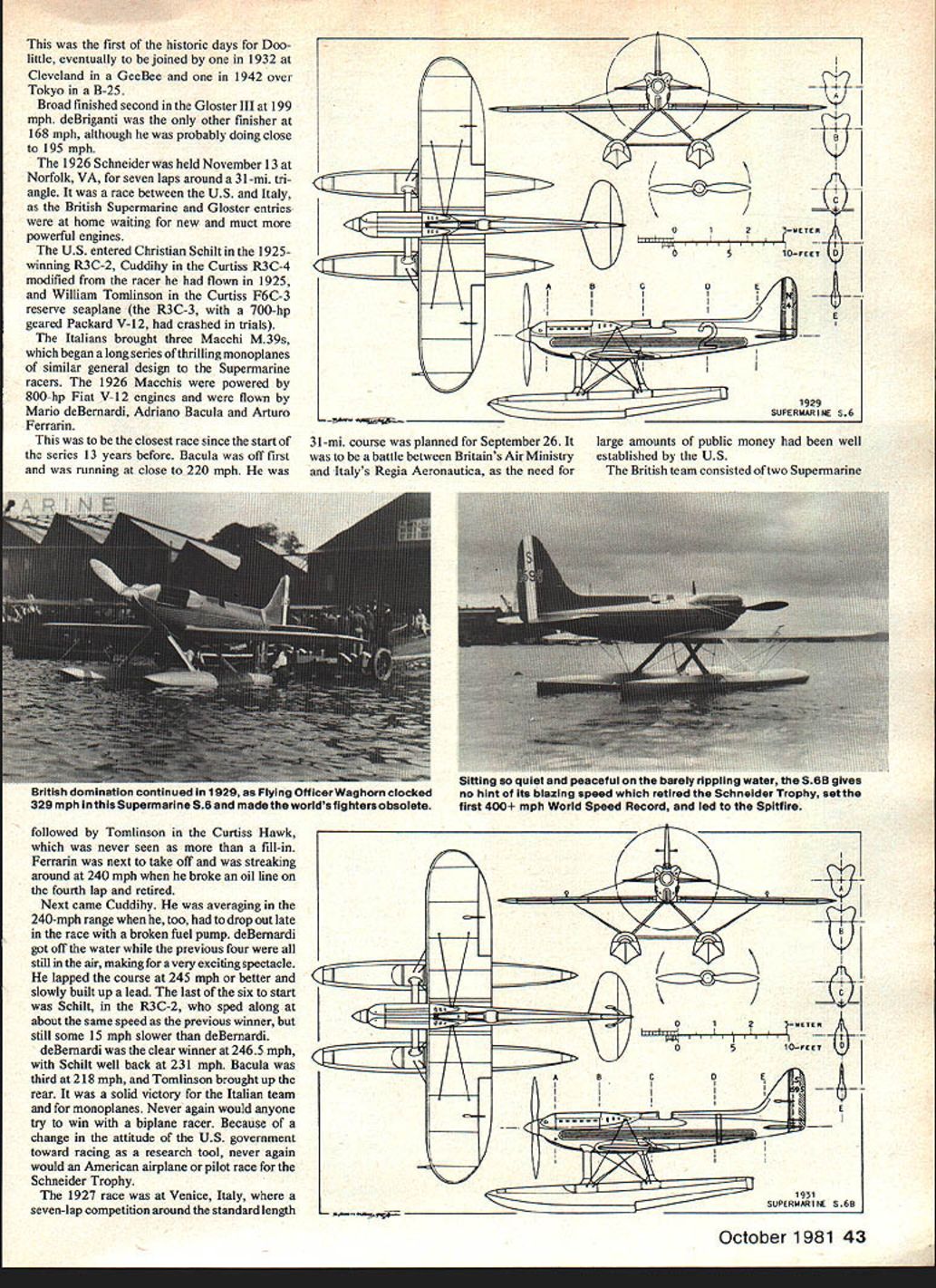
Italy entered three Macchi M.39 monoplanes powered by 800‑hp Fiat V‑12 engines, flown by Mario de Bernardi, Adriano Bacula and Arturo Ferrarin.
This race proved the closest since the series began. Bacula went off first at close to 220 mph. Tomlinson in the Curtiss Hawk was never more than a fill-in. Ferrarin streaked at about 240 mph but broke an oil line on lap four and retired. Cuddihy averaged in the 240‑mph range before a broken fuel pump forced him out late in the race.
De Bernardi got off the water while the first four were all still in the air; he lapped the course at 245 mph or better and slowly built a lead. Schilt, the last to start, flew about 15 mph slower than de Bernardi.
Final standings:
- Mario de Bernardi — winner at 246.5 mph.
- Christian Schilt — 231 mph.
- Adriano Bacula — 218 mph.
- William Tomlinson — last finisher.
It was a solid victory for the Italian team and for monoplanes. Never again would anyone try to win the Schneider with a biplane racer. Because of a change in U.S. government attitude toward racing as a research tool, American airplanes and pilots would not race for the Schneider again.
1927 — Venice, Italy (planned September 26)
The 1927 race was planned as seven laps of the 31‑mi. course. It became a battle between Britain's Air Ministry and Italy's Regia Aeronautica, with public money now accepted as necessary for top‑level competition.
British entries:
- Two Supermarine S.5s, powered by 900‑hp Napier Lion engines, to be flown by Sidney Webster and Oswald Worsley.
- Two Gloster IVs with Lion engines, to be flown by Kinkead and Slatter.
- The Short Crusader (800‑hp sleeve‑valve Bristol Mercury radial) — which crashed in tests due to crossed aileron controls.
Italian entries:
- Three Macchi M.52s (evolution of the M.39): de Bernardi and Ferrarin in racers with 1,000‑hp Fiat A.S.3 engines, and Federico Guazzetti in one with an 880‑hp Fiat A.S.2.
- Plans for American Al Williams to enter a privately supported Packard‑Kirkham racer came to nothing.
At race time six purebred speed machines were ready, though there were worries about the Italians' engines. Webster, Worsley and Kinkead clocked laps above 270 mph. On the first lap Ferrarin retired with engine trouble; on the second lap de Bernardi dropped out for the same reason after being timed at 263 mph on his one full lap. On the sixth lap Kinkead withdrew the Gloster IV because of a cracked propeller hub after averaging 273 mph.
Guazzetti hung on until the last turn of the last lap; after averaging 258 mph his engine gave out. That left the two Supermarine monoplanes to finish alone: Webster won at a record 281.66 mph, with Worsley second at 272.91 mph.
The British then failed to capitalize on the sport's momentum, and de Bernardi set the first absolute world speed record ever held by a seaplane: 296.76 mph over a 3‑km. course in an M.52. The following March he raised it to 318.43 mph in an improved M.52R. For comparison, the landplane record remained at 278 mph (set in 1924).
1929 — Spithead (September 6–7)
The 1929 race was held at Spithead between the Isle of Wight and the south coast. The 31‑mi. course (for seven laps) had become trickier — for once it had four sides with two extremely tight turns.
Entries:
- Britain had six racers: two Supermarine S.5s, two new S.6s (later called S.6A), and two new Gloster IVs.
- Italy had five seaplanes (though rules limited each country to three entrants): the Macchi M.52R recordholder, two new Macchi M.67s (1,500‑hp Isotta‑Fraschini engines), the tiny Fiat C.29 (1,000‑hp Fiat engine), and the novel Savoia S.65 (a twin‑boom floatplane with a 1,000‑hp Isotta engine in either end of the central pod). The Fiat was not flown, and the Savoia was not ready.
The Supermarine S.6 (S.6A) of the day was powered by the new 1,900‑hp Rolls‑Royce "R" engine. One example was to be flown by Henry Waghorn and the other by Richard Atcherley. D'Arcy Greig flew one of the S.5s.
Waghorn was first to fly and thrilled a crowd of around a million with a takeoff lap at 324 mph, then settled to laps around 330 mph. The first Italian, Dal Molin in the M.52R, was near 285 mph but steadily lost ground to Waghorn. Greig's older S.5 ran in the low 280s. Remo Cardingher in the first M.67 started fast but dropped out on lap two when exhaust fumes poured into his cockpit. Giovanni Monti flew the second M.67 but quit on lap two for the same reason after one full lap just over 300 mph.
That left Atcherley in the second S.6, who attacked almost as fast as Waghorn but then cut a pylon, making his 326 mph unofficial. At the finish:
- Henry Waghorn — winner with a new record of 328.63 mph.
- Dal Molin — 284.2 mph.
- D'Arcy Greig — 282.1 mph.
The British had captured their second straight win and needed only one more to retire the Schneider Trophy. The assault on the Absolute World Speed Record followed soon after: Sqdn. Ldr. Orlebar set a new mark of 357.7 mph in an S.6.
The final Schneider Races and the S.6B
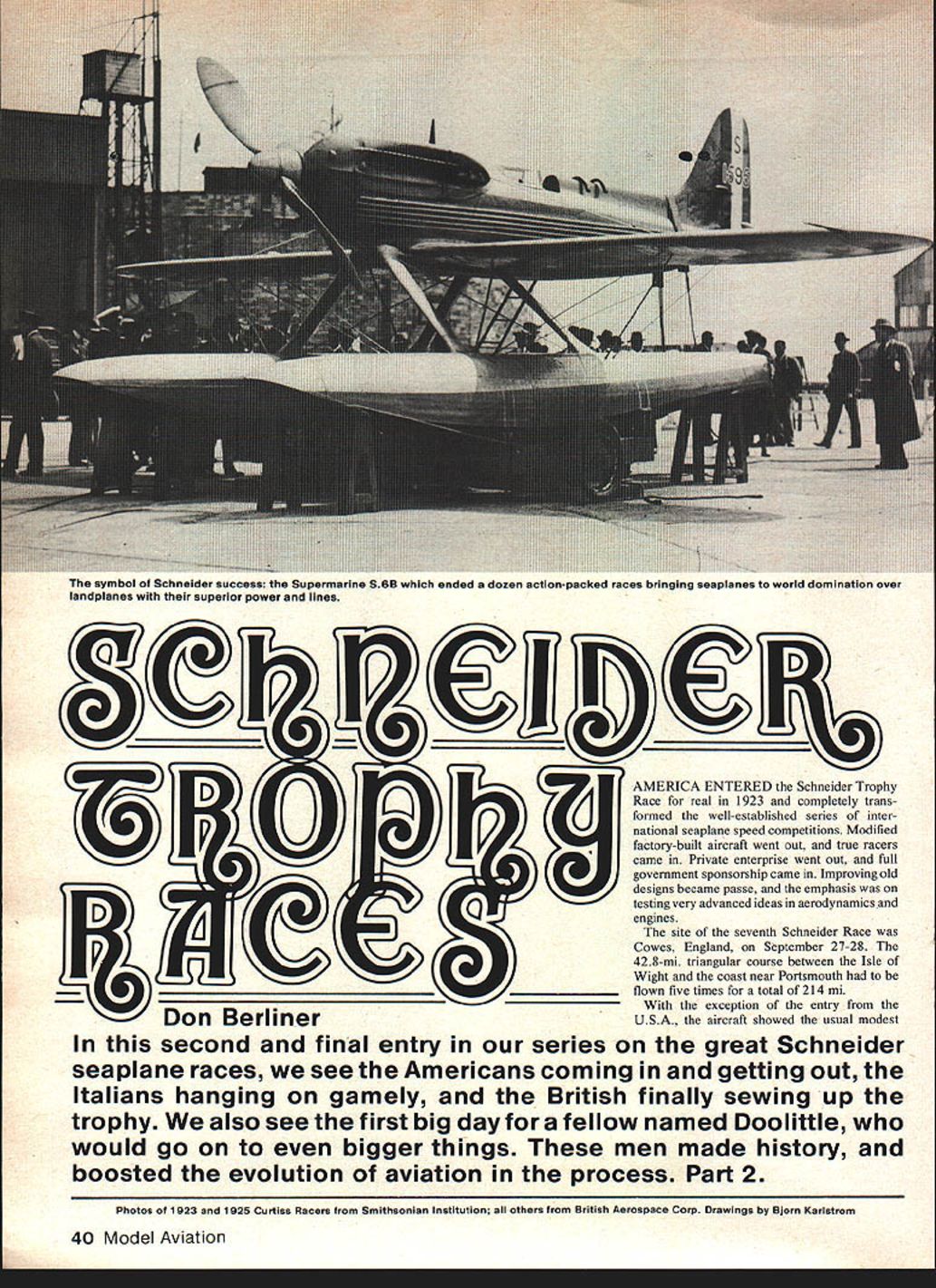
The last of the 12 Schneider Races became an anticlimax: no one came forth to challenge Britain's High Speed Flight. The new Supermarine S.6B was entirely too much for any existing racer. It was essentially an S.6 with improved floats, better cooling, and a power boost to 2,350 hp, producing a seaplane that lapped the 31‑mi. course at about 340 mph.
The S.6B program would likely never have happened if Lady Houston had not contributed £100,000 (reported in contemporary accounts as about $500,000) when the government refused to foot the bill. Two S.6Bs were built; with John Boothman as pilot, S‑1595 roared around the course to the amazement of thousands. It was a majestic demonstration of aeronautics and raised the stature of the British aircraft industry, though it wasn't very good racing.
Soon after the race, G. H. Stainforth became the first person to fly officially faster than 400 mph when he set another Absolute World Speed Record of 408.8 mph in the same S.6B.
The French were preparing several machines for a planned 1933 Schneider, including a pair of Bernard racers with new 2,000‑hp Lorraine Radium engines. The Italians were working the bugs out of the sensational Macchi‑Castoldi MC.72 with its tandem engines and counter‑rotating propellers; it later set a 3‑km. record of 441 mph, still held by pilot Francesco Agello.
Legacy
Though the cheers soon died out, the technical lessons remained:
- From the great mind of Supermarine designer Reginald Mitchell came the Spitfire (first flight 1936).
- From Napier Lion and Rolls‑Royce "R" engines came lessons that contributed toward the Merlin.
- From the Curtiss D‑12 came design ideas that influenced the Allison V‑1710 used in the P‑38, P‑39, P‑40 and early P‑51.
- From ever‑cleaner racers came a flood of knowledge about how to make airplanes go faster.
Isn't that what air racing is for?
Transcribed from original scans by AI. Minor OCR errors may remain.

