
Science Academy Flies High
By Larry Kruse
Program overview
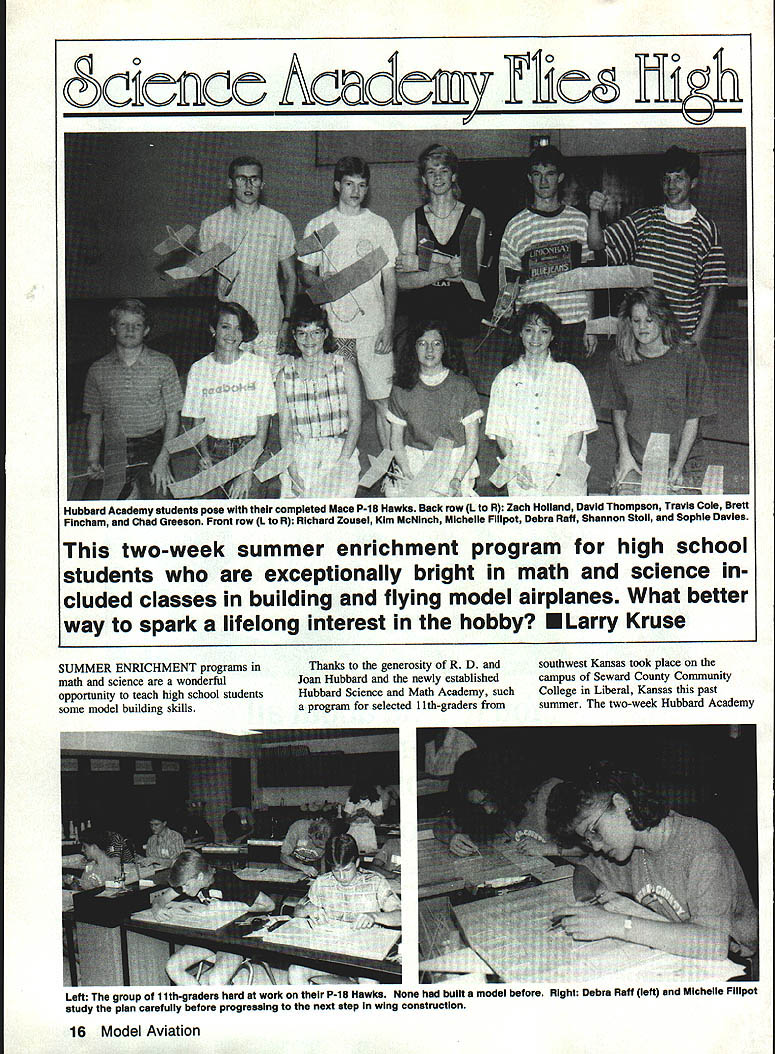
This two-week summer enrichment program for high school students who are exceptionally bright in math and science included classes in building and flying model airplanes. What better way to spark a lifelong interest in the hobby?
Thanks to the generosity of R. D. and Joan Dale Hubbard and the newly established Hubbard Science and Math Academy, such a program for selected 11th-graders from southwest Kansas took place on the campus of Seward County Community College in Liberal, Kansas this past summer. The two-week Hubbard Academy was designed both as an enrichment program in math and science and to promote teaching careers in those subjects. As one of the college's administrators, I jumped at the chance to share many years of modeling experience by teaching basic aerodynamics to a group of exceptionally bright young people.
Building and flying sessions
Of course, I immediately saw a problem: how best to give the students hands-on experience within a short time frame? A call to Don Mace, proprietor of Mace Model Aircraft in Tulsa, Oklahoma, produced a solution. Don's fine P-18 Hawk design, already pioneered with the help of over 80 engineering students at the University of Colorado, would be the teaching tool for the three evening sessions on building and flying models.
With the assistance of Charles Brownlee, Math and Science division chair on campus, a daytime laboratory classroom was converted to a modeler's workshop on each of three evenings. The college's large gymnasium was reserved for test flying and competition.
At the building sessions, I offered the students a little practical theory before they started cutting and gluing. For example, wing construction began with a discussion of how wings achieve lift and how dihedral helps in maintaining flight stability. The relationship between model flight and full-scale aerodynamics was stressed.
The students also watched a video from the AMA film library. Seeing a variety of models, from the simple to the complex, in flight encouraged them to master basic aerodynamic principles so they could "fly their own."
To say that the students adapted easily and immediately to the patience, fine motor skills, and persistence that model building demands would be overstating the case. Except for a few who had built model rockets, these bright young people had no previous exposure to the ways of modeling. I'm quite sure I learned much more than my students about teaching the modeling skills that have been with me for over three decades.
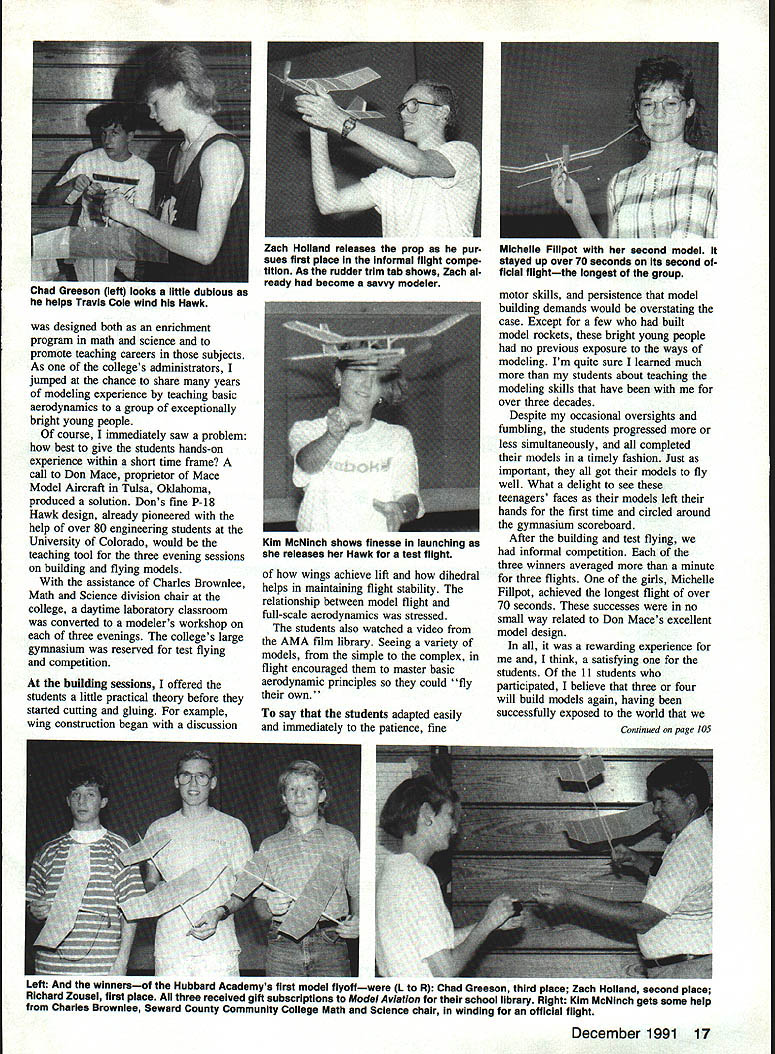
Despite my occasional oversights and fumbling, the students progressed more or less simultaneously, and all completed their models in a timely fashion. Just as important, they all got their models to fly well. What a delight to see these teenagers' faces as their models left their hands for the first time and circled around the gymnasium scoreboard.
Competition and results
After the building and test flying, we had an informal competition. Each of the three winners averaged more than a minute for three flights. One of the girls, Michelle Fillpot, achieved the longest flight of over 70 seconds. These successes were in no small way related to Don Mace's excellent model design.
In all, it was a rewarding experience for me and, I think, a satisfying one for the students. Of the 11 students who participated, I believe that three or four will build models again, having been successfully exposed to the world of the hobby — a world we find so fascinating and gratifying.
Acknowledgments
Special thanks for bringing the project to a successful conclusion go to Charles Brownlee of Seward County Community College, Jim Stoddard of the Hubbard Foundation, and R. D. and Joan Dale Hubbard, who continue to show their support of our young people by providing the funds to expand students' educational horizons.
Transcribed from original scans by AI. Minor OCR errors may remain.

