
Seen at Nurnberg
Ron Moulton The 28th International Toy Fair was Mecca for almost 31,000 merchandise buyers from 37 countries. Presented are some of the more significant aeromodeling items.
EUROPEAN SHOWCASE for the model trade is the annual February Fair at Nurnberg. Though primarily concerned with toys, this vast show is under constant pressure to expand its hobby division. Annual growth has been such that the model business is bursting at the seams in Hall E and provision has now been made for replanning next time. This will make Nurnberg unquestionably the biggest of its kind in the world.
Being based in West Germany, it is predominantly reflective of German developments. Larger corporations, Cox, AHM, Dumas, X-Acto, etc., take independent booths while almost every worthwhile import is represented by agencies. Though Nurnberg is international, it has a strong overtone of the local product, and that's good reason for taking a close look at what could be seen this year.
For Germany has built up as strong a creative trade as can be found anywhere. Helicopters and reinforced epoxy sailplanes are the best-known German introductions. Electric power, FM radio, the Wankel engine, and other original German concepts have come into the model business. Closely disciplined, self-sufficient and innovative, Germany probably exports more than it imports and has the backing of a buoyant currency. Clearly it is not going to stand still, and the area of German progress may have an effect in the U.S.
Graupner expansions — last year's sobering experience of U.S. balsa supply makes good sense in setting up an ultra-modern processing mill. As Johannes Graupner explains, the whole attitude to balsa is changing rapidly. The days of floating it down the river have gone; road construction, balsa pirates and mobile mills are part of the new picture.
The engine field also has strong investment. Webra's range expands with new .91 and .20 designs. HR has Perry directional porting, pump/throttle combinations; competition sizes and silencer problems seem at last resolved and there are several new units.
Still talking general terms, Nurnberg '77 could be said to have seen helicopters over the hill, new ones from Schluter and more sailplanes. Electric assist is increasingly evident in model aviation, the use of plastics in ARTF kits is increasing, and RC is moving upmarket into super-sophisticated so-called "Expert" sets. These last function in both last-resort and competitive roles to meet price terms of Japanese imports.
Sport RC is coming under stringent requirements from the Deutschen Bundespost; as a result almost every German manufacturer has new gear to offer for 27, 35, 40 and 43.3 MHz bands. Equipment for 32, 53 and 72 MHz is available in some cases for export. Levers, slides and trimmers will take some understanding of their functions. Needless to relate, prices are equally sophisticated.
Such a big show lends itself to highlights that can be picked out; description and photos convey new shapes but can't hope to cover the scene completely. The catalogue situation is now lush — thick, beautifully printed issues that have no equivalent elsewhere. Graupner's runs over 300 pages. Abbreviated versions have begun to appear, no doubt as cost savers. German manufacturers produce topical kit designs with glossy boxes that sell the idea through full-color page-size illustrations in promotional literature.
Highlights that caught the eye included:
- Graupner enters the .09 RC Chico, a one-meter hand-launch sportster that falls between 1/2A and club .20.
- Penny, a beginners free-flight glider.
- Beta, a power-assist RC glider.
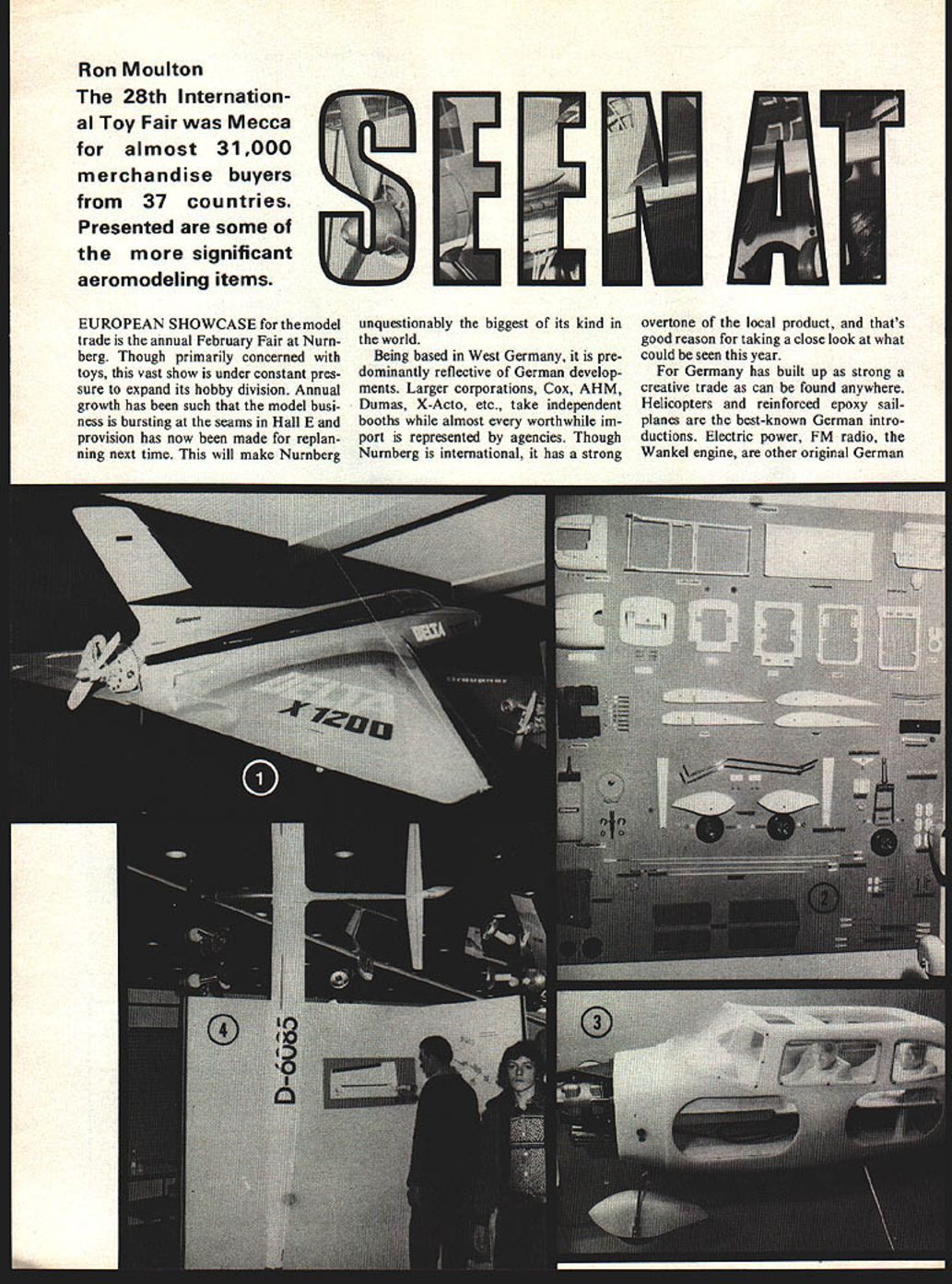
- Delta X1200, a sharp triangle (40s) using conventional controls, suits the Wankel ideally as a softer delta.
- Graupner's hang-glider with dummy pilot enclosing receiver, batteries and servo; centerspar, waggle tail-end control — a system that might turn full circle as tried with real hang gliders.
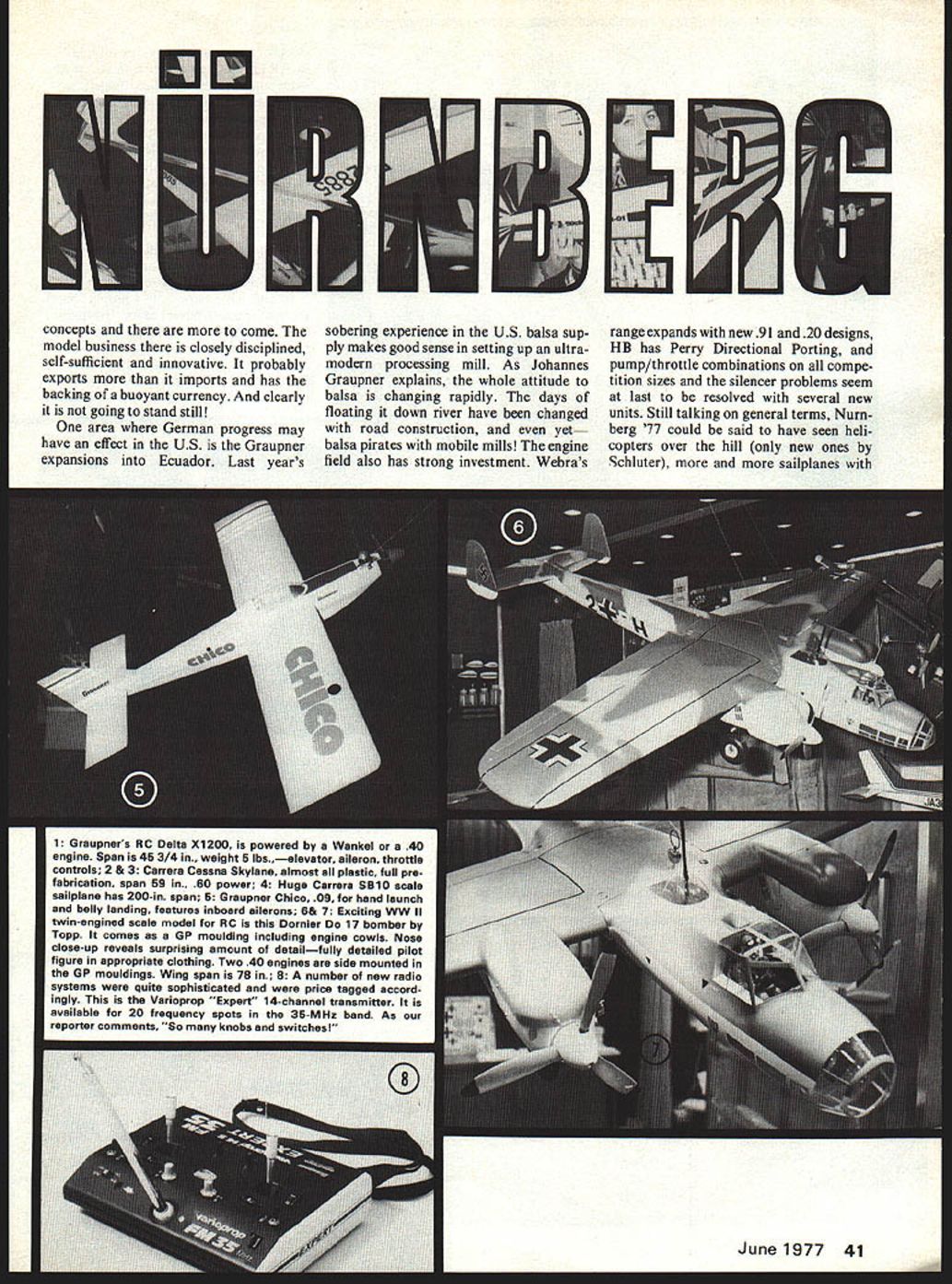
- Varioprop Expert, the latest RC transmitter with 12/14 channels, optical and audible time count-down options, FM with 10 kHz spacing.
- Graupner RC Rogallo wing hang-glider spans 83 in., weighs less than 2 lbs with RC gear inside a plastic pilot; servo in keel waggles the last few inches for keel steering (tried shifting CG — no good).
- Towline slope models.
- Carrera Optimus electric 10–20 engined power glider, span 110 in., fuselage plastic.
- Ferran 11 & 12.
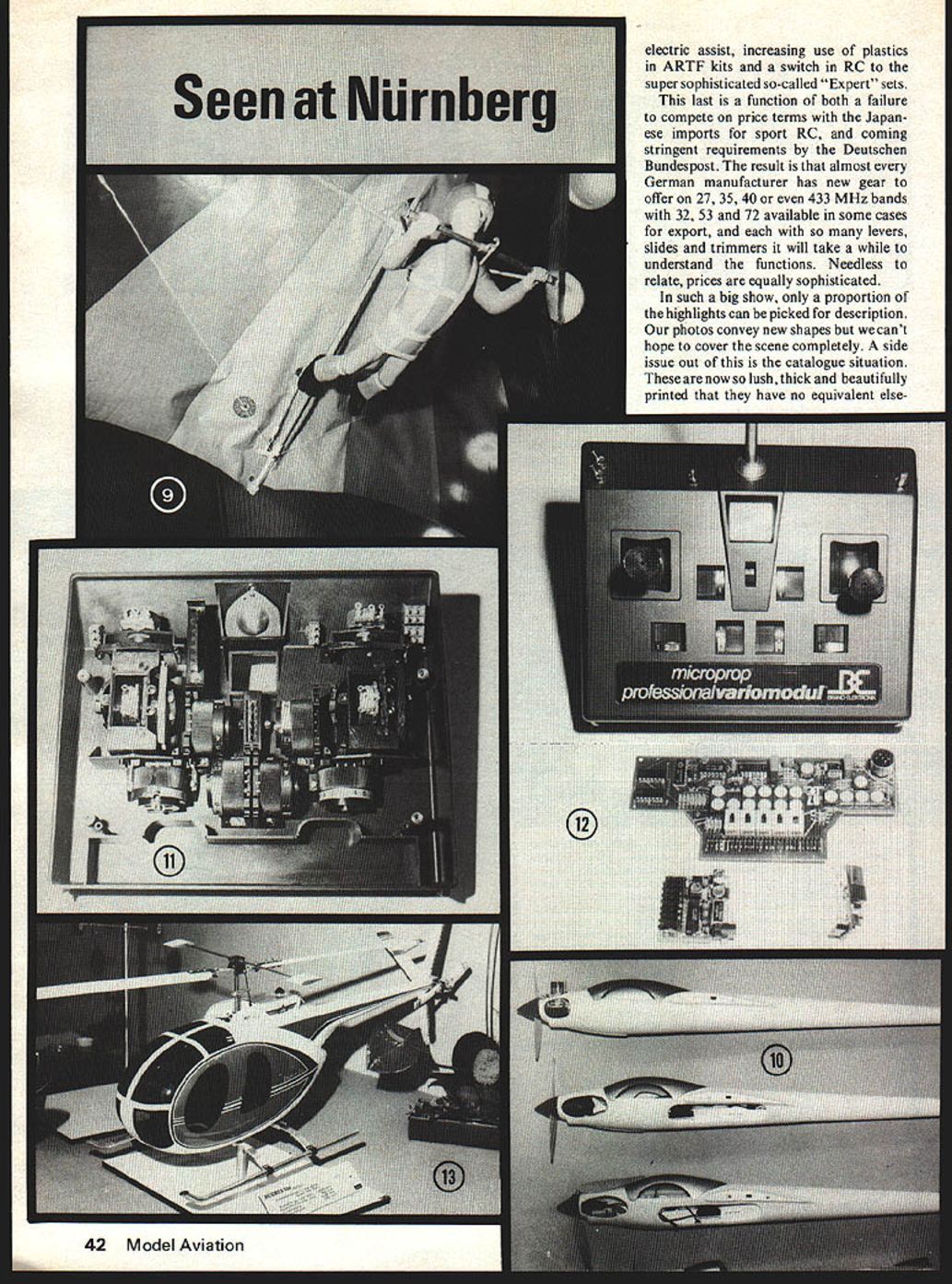
- Brandt's super-sophisticated Microprop professional modular transmitter; internal view shows physical control parts.
- New cover Schluter Hell-Baby scale Hughes 500.
- Audible signal timer Varioprop transmitter.
- Liquid crystal timer Varioprop transmitter.
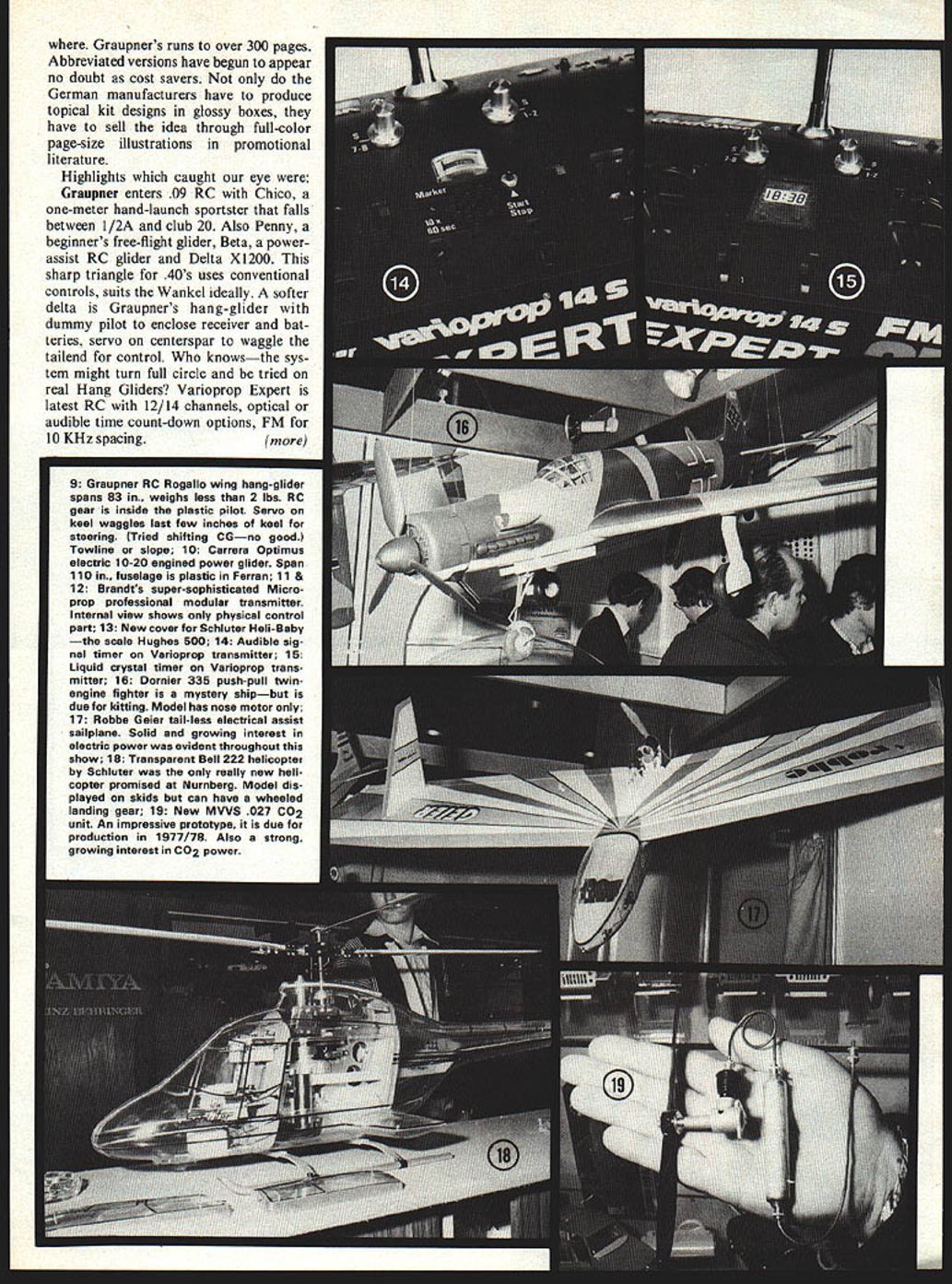
- Dornier 335 push-pull twin-engine fighter — a mystery ship but due for kitting; model has nose motor.
- Robbe Geier tailless electrical-assist sailplane.
Solid, growing interest in electric power was evident throughout the show, and items such as a transparent Bell 222 helicopter were on display. concepts and there are more to come. The model business there is closely disciplined, self-sufficient and innovative. It probably exports more than it imports and has the backing of a buoyant currency. And clearly it is not going to stand still!
One area where German progress may have an effect in the U.S. is the Graupner expansions into Ecuador. Last year's sobering experience in the U.S. balsa supply makes good sense in setting up an ultra-modern processing mill. As Johannes Graupner explains, the whole attitude to balsa is changing rapidly. The days of floating it down river have been changed with road construction, and even yet balsa pirates with mobile mills! The engine field also has strong investment. Webra's range expands with new .91 and .20 designs; HB has Perry Directional Porting, and pump/throttle combinations on all competition sizes and the silencer problems seem at last to be resolved with several new units. Still talking on general terms, Nurnberg '77 could be said to have seen helicopters over the hill (only new ones by Schluter), more and more sailplanes with electric assist, increasing use of plastics, ARTF kits, and a switch to RC super-sophisticated so-called "Expert" sets that function both as trainers and as competition gear to compete on price terms with Japanese imports.
Sport RC is coming under stringent requirements from the Deutschen Bundespost; as a result almost every German manufacturer has new gear to offer — 27, 35, 40 and 433 MHz bands; 32, 53 and 72 MHz available in some cases. Export levers, slides and trimmers will take over functions. Needless to relate, prices are equally sophisticated.
Such a big show means proportioned highlights can be picked out, but descriptions and photos can't convey new shapes and one can't hope to cover the scene completely. A side issue is the catalogue situation, now lush, thick and beautifully printed — we have no equivalent elsewhere. Graupner's catalogue runs over 300 pages. Abbreviated versions have begun to appear — no doubt cost savers. German manufacturers have produced topical kit designs; glossy boxes have to sell the idea through full-color, page-size illustrations in promotional literature.
Highlights that caught the eye included: Graupner enters the .09 RC Chico, a one-meter hand-launch sportster that falls between 1/2A and club .20; Penny, a beginner's free-flight glider; Beta, a power-assist RC glider; Delta X1200, a sharp triangular 40s that uses conventional controls and suits a Wankel ideally — a softer delta. Graupner's Rogallo hang-glider with dummy pilot encloses receiver, batteries and servo; centerspar waggle tail-end control — who knows, the system might turn full circle as tried with real hang gliders. electric assist, increasing use of plastics in ARTF kits and a switch in RC to the super sophisticated so-called "Expert" sets.
This last is a function of both a failure to compete on price terms with the Japanese imports for sport RC, and coming stringent requirements by the Deutschen Bundespost. The result is that almost every German manufacturer has new gear to offer on 27, 35, 40 or even 433 MHz bands with 32, 53 and 72 available in some cases for export, and each with so many levers, slides and trimmers it will take a while to understand the functions. Needless to relate, prices are equally sophisticated.
In such a big show, only a proportion of the highlights can be picked for description. Our photos convey new shapes but we can't hope to cover the scene completely. A side issue out of this is the catalogue situation. These are now so lush, thick and beautifully printed that they have no equivalent elsewhere.
Seen at Nurnberg
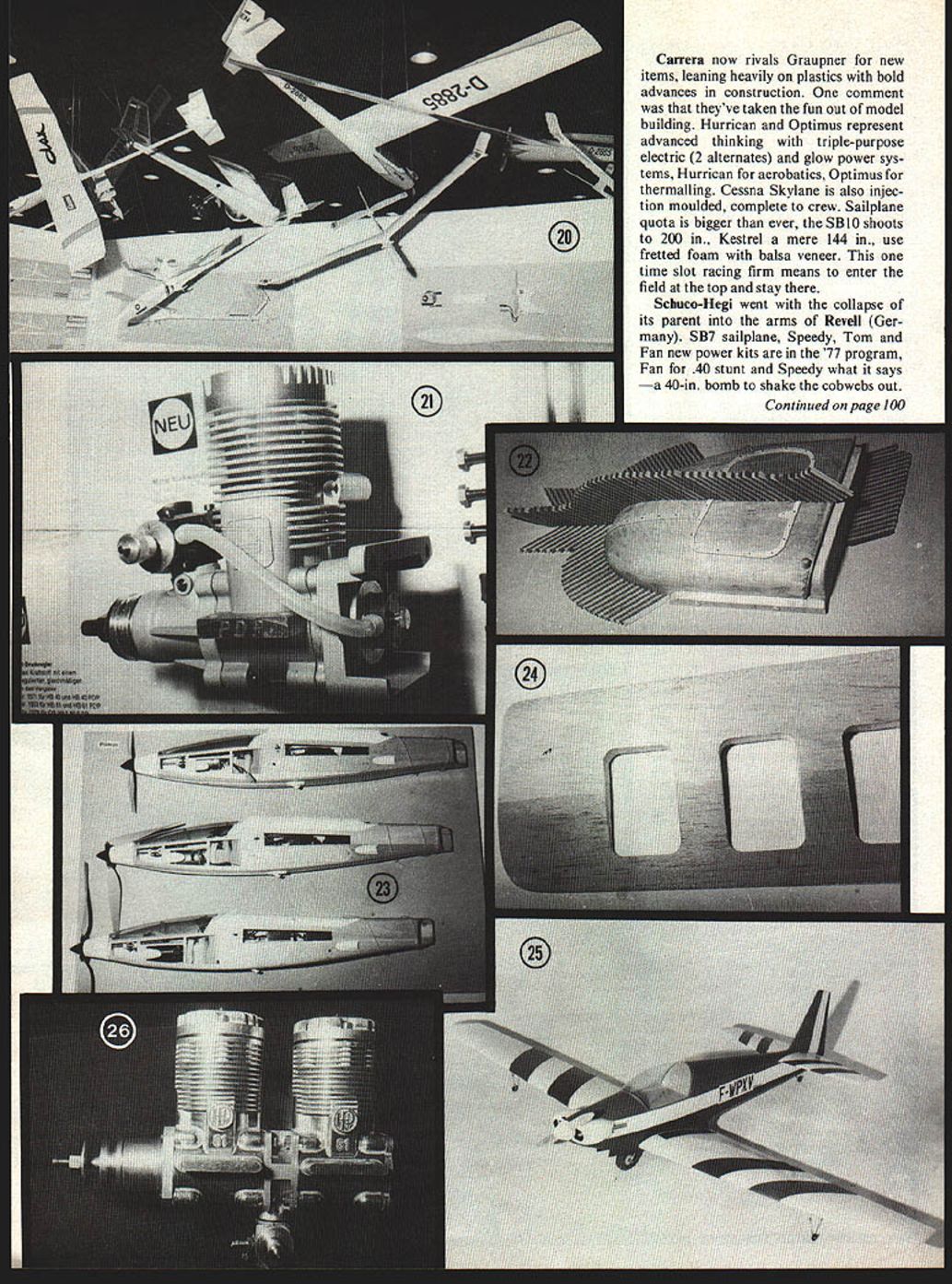
Highlights which caught our eye were: Graupner enters .09 RC with Chico, a one-meter hand-launch sportster that falls between 1/2A and club 20. Also Penny, a beginner's free-flight glider, Beta, a power-assist RC glider and Delta X1200. This sharp triangle for .40's uses conventional controls, suits the Wankel ideally. Carrera now rivals Graupner for new items, leaning heavily on plastics with bold advances in construction. One comment was that they've taken the fun out of model building. Hurrican and Optimus represent advanced thinking with triple-purpose electric (2 alternates) and glow power systems, Hurrican for aerobatics, Optimus for thermalling. Cessna Skylane is also injection moulded, complete to crew. Sailplane quota is bigger than ever, the SB10 shoots to 200 in., Kestrel a mere 144 in., use fretted foam with balsa veneer. This one-time slot racing firm means to enter the field at the top and stay there.
Schuco-Hegi went with the collapse of its parent into the arms of Revell (Germany). SB7 sailplane, Speedy, Tom and Fan new power kits are in the '77 program, Fan for .40 stunt and Speedy what it says — a 40-in. bomb to shake the cobwebs out.
Seen at Nurnberg/Moulton
Robbe have a less shattering Rasant, this racer for electric sport, plus yet another scale Piper Cub, the Super Cruiser variant, Milan and Circe sailplanes with elegant lines and the Lanzet delta which calls for mixer controls. Aeronaut have gone for Cessna 172, the ever popular and a two-way electric or glow BD5 with caricature wings. Looks good. One scale we really fell for was Udet's Flamingo, created for electric or glow—vintage pipe with late 1970's power. Krick add the latest Fournier, the RF7, to their quality scale range. Karl Heinz Benzin has done it again with an ideal combo of detail plus GF fuselage in a model that offers fun flying or strict contest prospects.
Topp is the GF specialist. Buyers get only shell and plans but what subjects—latest are DO17 Pencil Bomber and the MRCA Tornado. Strangely conventional. Topp's Tweety is yet another 2-way electro-glow, using full range of balsa/GF/foam assy to make a later day H-Ray. Rogallo Flexwing is autogiro with a sail plus tail. Be a sight to see. Thrust moments and drag factors could make Langley field blink, we're sure.
Big models continue. Bauer have a chunky Auster and Wilk the Hummel, either of which can do anything from slow cruise to glider tow or haul cameras.
Schluter represents real progress. Not only a beauty of a new case for the Heli Baby to make it a Hughes 500 but also a Bell 222 that incorporates all the ideas the maestro of rotorplanes has gleaned. Kompletta is Dieter's finished 3-meter sailplane, or if work is wanted, the Fohn is a 2-meter kit for a slope or tow-launch sailplane.
Simprop enter smaller RC with a .20 Boxfly—nuff sed; two 1/2A Minis—the Bird and Devil and an .09 Cessna 177 among other imports. The Simprop inventory is huge, though Kavan's breakaway must have some effect. Simprop are banking on the SSM contest system RC units to ring bells in that competitive sector.
Webra's tie with Becker to market 433 MHz, as well as 27, 35 and 40 equipment, drew constant dealer attention so, too, the big .91 which joins the successful .61 in new marine and aero versions. The Webra family is riding a crest, proving that high-rev noise-makers don't necessarily win in the boat game and their .8 cc (for European marine classes), plus .20, build the range even bigger. Sad news that Helmut Bernhard died in his new Cessna Stationair while testing on the eve of the show put a cloud on announcements of the HB engines with PDP, pumps and carbs. We understand Helmut's death will not affect immediate production, but must recall it was this man's genius which built up the fastest growing model manufacturing unit in Europe (to make Voco at first). This is not to be confused with HP of Austria, who played cool this year, a UC.40 saw-blasted .61, and re-appearance of .40 and .61 twins being their showpieces. OP's revived a .19 proto, coming closer to reality, and MVVS produced a new .40 plus an .027 CO2 that had all the buyers in queue—alas no production till next year! Rudi Cerny heads a Czech kit firm now and was there to feel the market; he was left with a strong impression of CO2 demand. So many more deserve mention but one last piece on the 'super' outfits by Brand, the Microprop Pro Variomodul, which is the least confusing and has the appearance of being most advanced in modular concepts, also the highest priced of the new generation. This and the Multiplex Pro FM7 which similarly represents enormous investment in chasing what can only be regarded as the extreme top end of the market, as well as the already mentioned Varioprop, Simprop, etc. These are in the bracket from 600 to 850 dollars at a time. Who buys? That's the question.
Transcribed from original scans by AI. Minor OCR errors may remain.

