
Seen at Nurnberg
NURNBERG is a magnet for the European model trade each February. New exhibition halls gave even more space for '78 but somehow the scene did not excite the pulse like before. Yet there was lots new to see; no slackening in attendance and all the personalities of the hobby world looking prosperous even after a tough 1977. So why should this year's International Hobby Fair seem a shade off-key?
First: The trend to cars is immense, and for anyone to whom the only thing to fit on a crankshaft is a propeller, this is a diversification that holds nothing for airmen. Just about everyone ran a car section on his booth, and that's the way RC is moving for sure.
Second: The new Halls confuse crafts, kiddy books and the like, with dyed-in-the-wool model hobby people. The identification wasn't clear-cut enough—even to the extent that some long-established manufacturers took a lot of hunting down. This will, of course, be cured next time!
Third: There are signs we're running out of outstanding ideas! Imaginative trendsetters are getting scarcer in the model plane field. Now we have electrics, ducted fans, engines from CO2 to .90, sailplanes all in plastic, scale types to every kind of
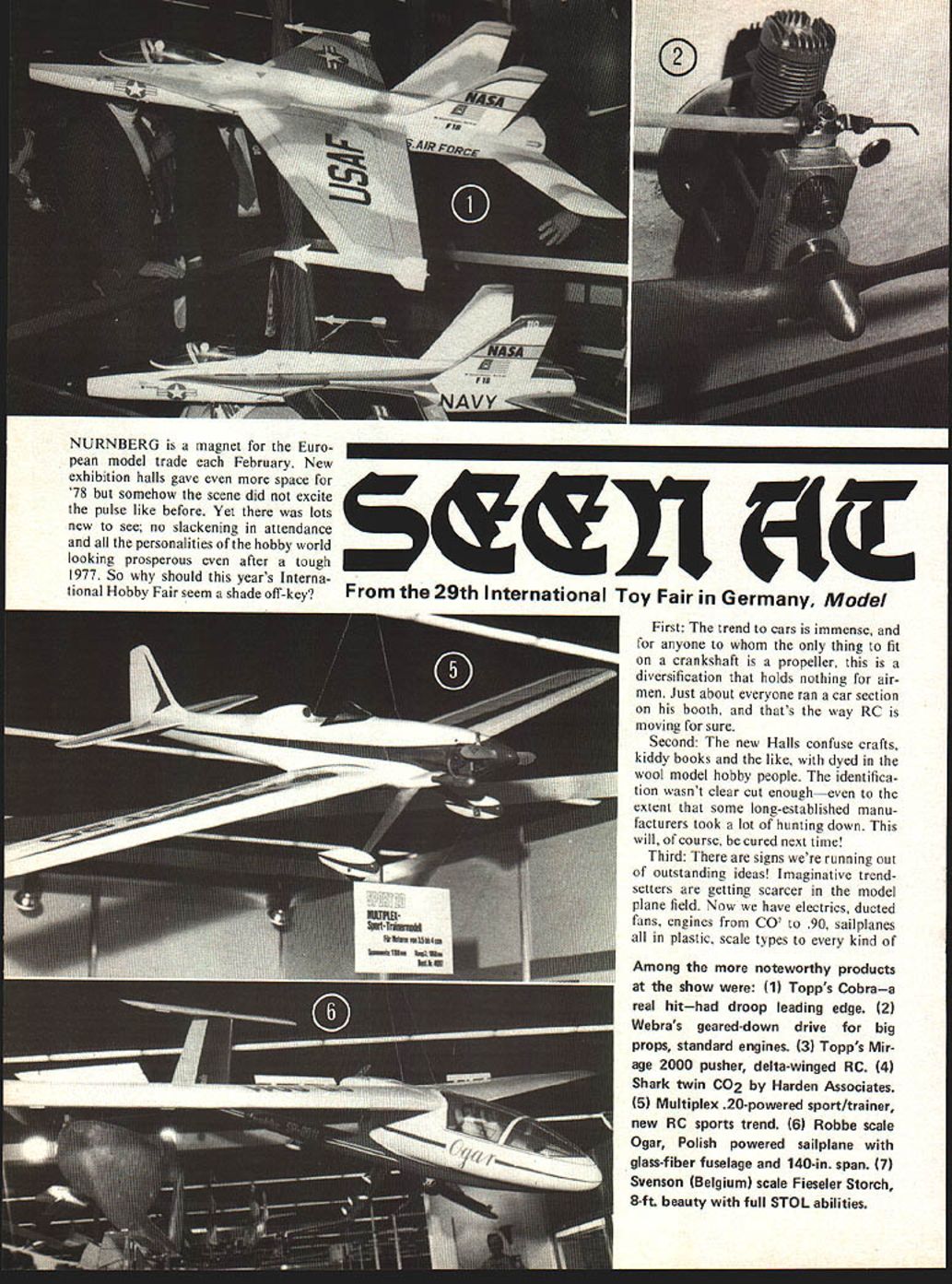
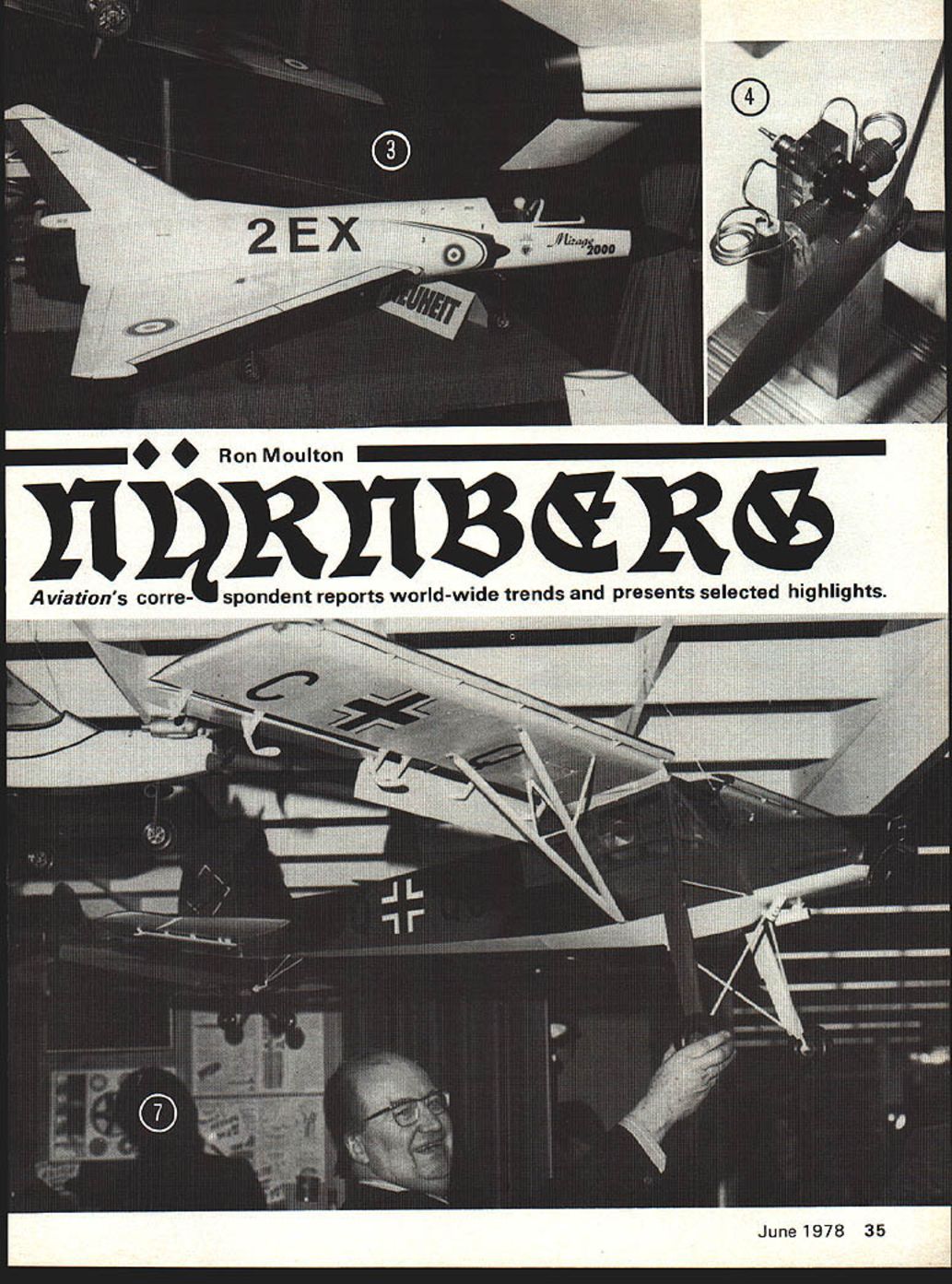
Among the more noteworthy products at the show were:
- Topps Cobra — a real hit — had droop leading edge.
- Webra's geared-down drive for big props, standard engines.
- Topps Mirage 2000 pusher, delta-winged RC.
- Shark twin CO2 by Harden Associates.
- Multiplex .20-powered sport/trainer, new RC sports trend.
- Robbe scale Ogar, Polish-powered sailplane with glass-fiber fuselage and 140-in. span.
- Svenson (Belgium) scale Fieseler Storch, 8-ft. beauty with full STOL abilities.
NURNBERG
Ron Moulton
Aviation's correspondent reports world-wide trends and presents selected highlights. fidelity, and so many kits there's no space on the shelves for all of them—it's time to think hard. The dealer could have spent a fortune in orders—and still made the wrong decisions this year, unless he had a clear understanding of the way his customers are going to be thinking. Who's to know if the sailplane is going to soar on to even greater popularity? RC thermal and slope soarers are topsellers in Europe—whether they stay that way with all the pricey sophistication is another guess.
With the Deutsche Mark at 50 cents or more, German prices are heading for the 300‑dollar glider. For that money, you get a lot of model. Like the 150‑in., 1/4‑scale Astir by Klinger (Wik), or its 1/5‑scale sister, the 143‑in. Twin Astir. Carrera's big Mistral is over 14‑ft. span, and the SB10 around 17 ft.
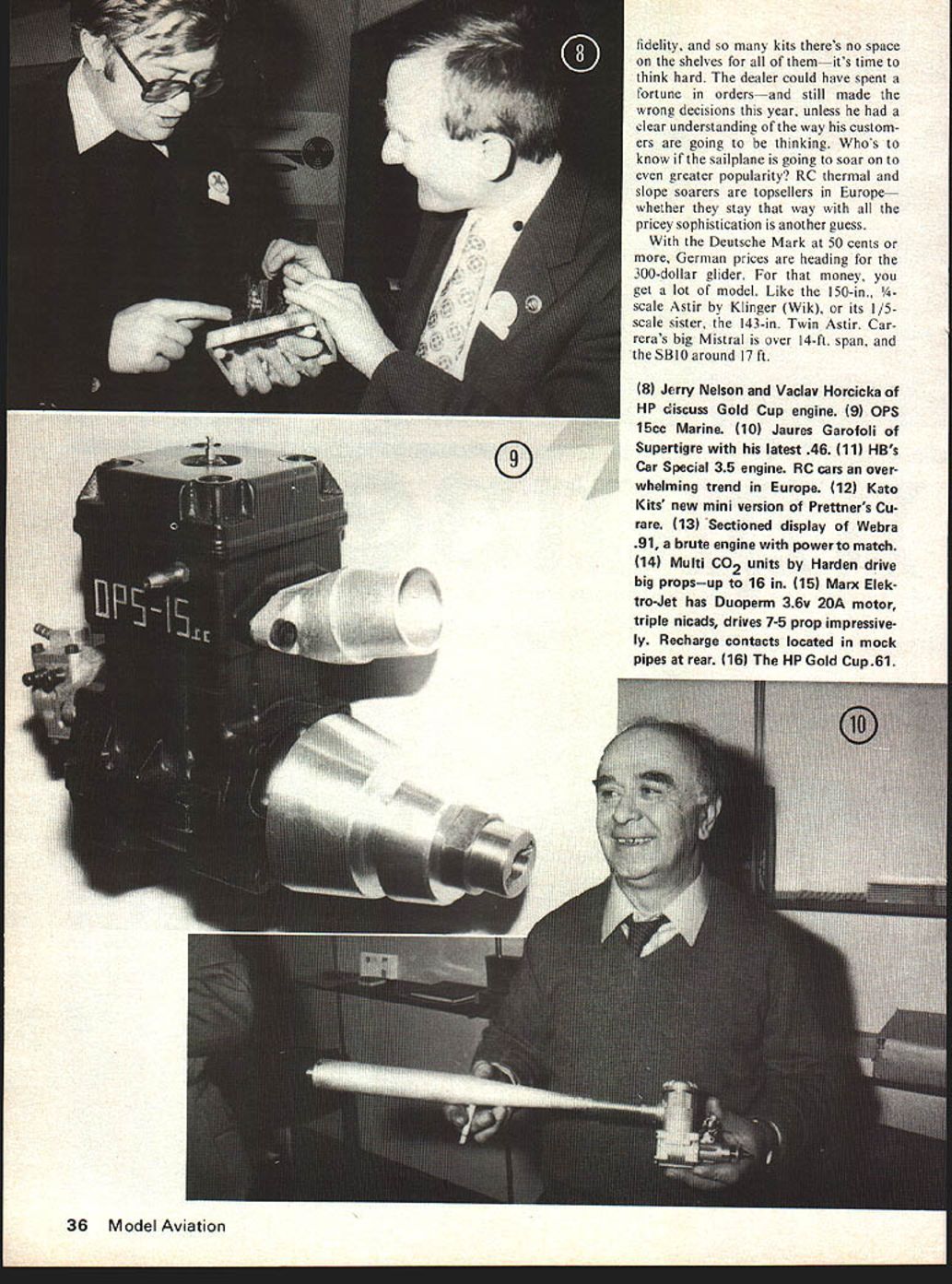
(8) Jerry Nelson and Vaclav Horcicka of HP discuss Gold Cup engine.
(9) OPS 15cc Marine.
(10) Jaures Garofoli of Supertigre with his latest .46.
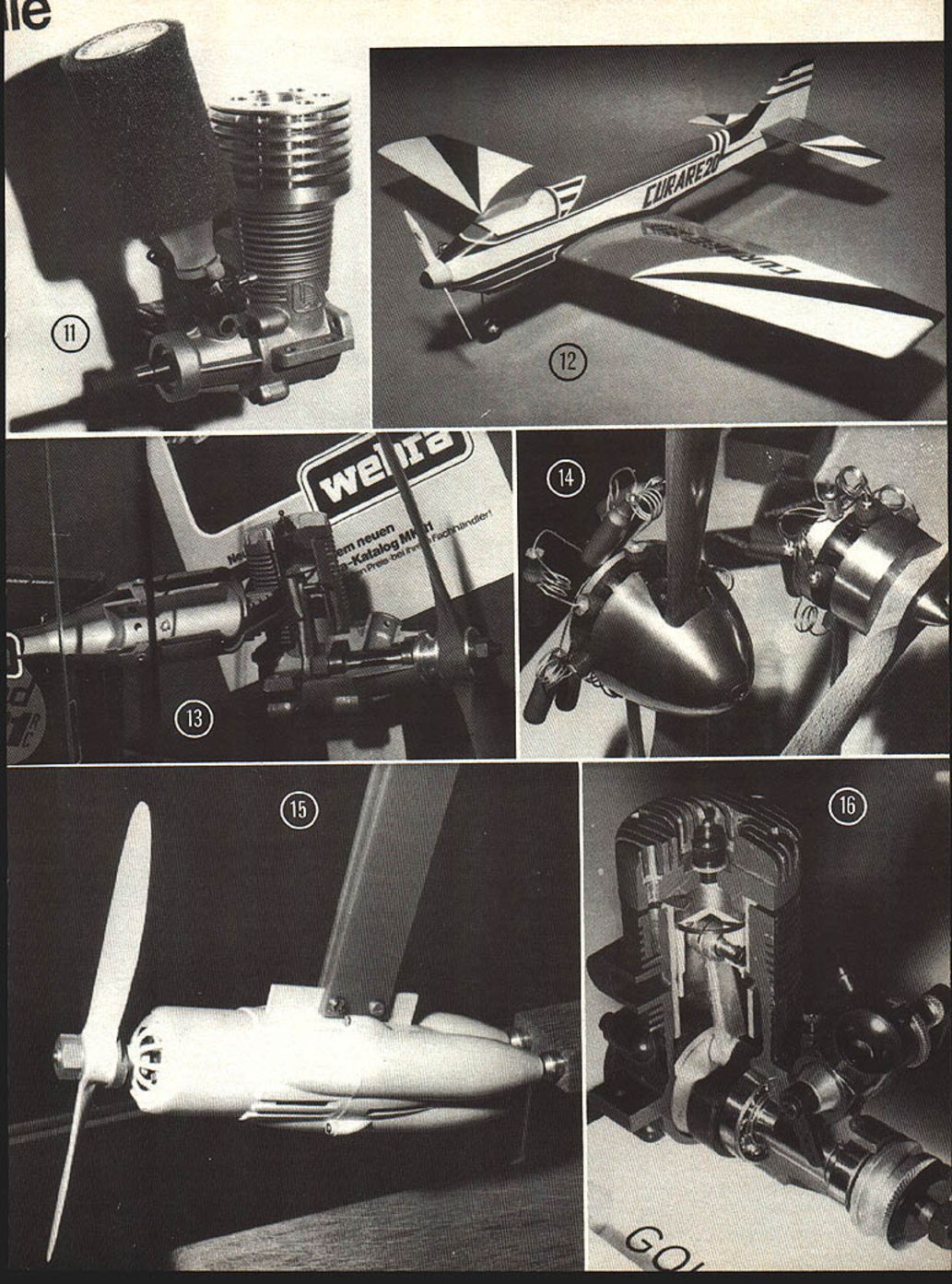
(11) HB's Car Special 3.5 engine. RC cars an overwhelming trend in Europe.
(12) Kato Kits' new mini version of Prettner's Curare.
(13) Sectioned display of Webra .91, a brute engine with power to match.
(14) Multi CO2 units by Harden drive big props—up to 16 in.
(15) Marx Elektro‑Jet has Duoperm 3.6v 20A motor, triple nicads, drives 7.5‑in. prop impressively. Recharge contacts located in mock pipes at rear.
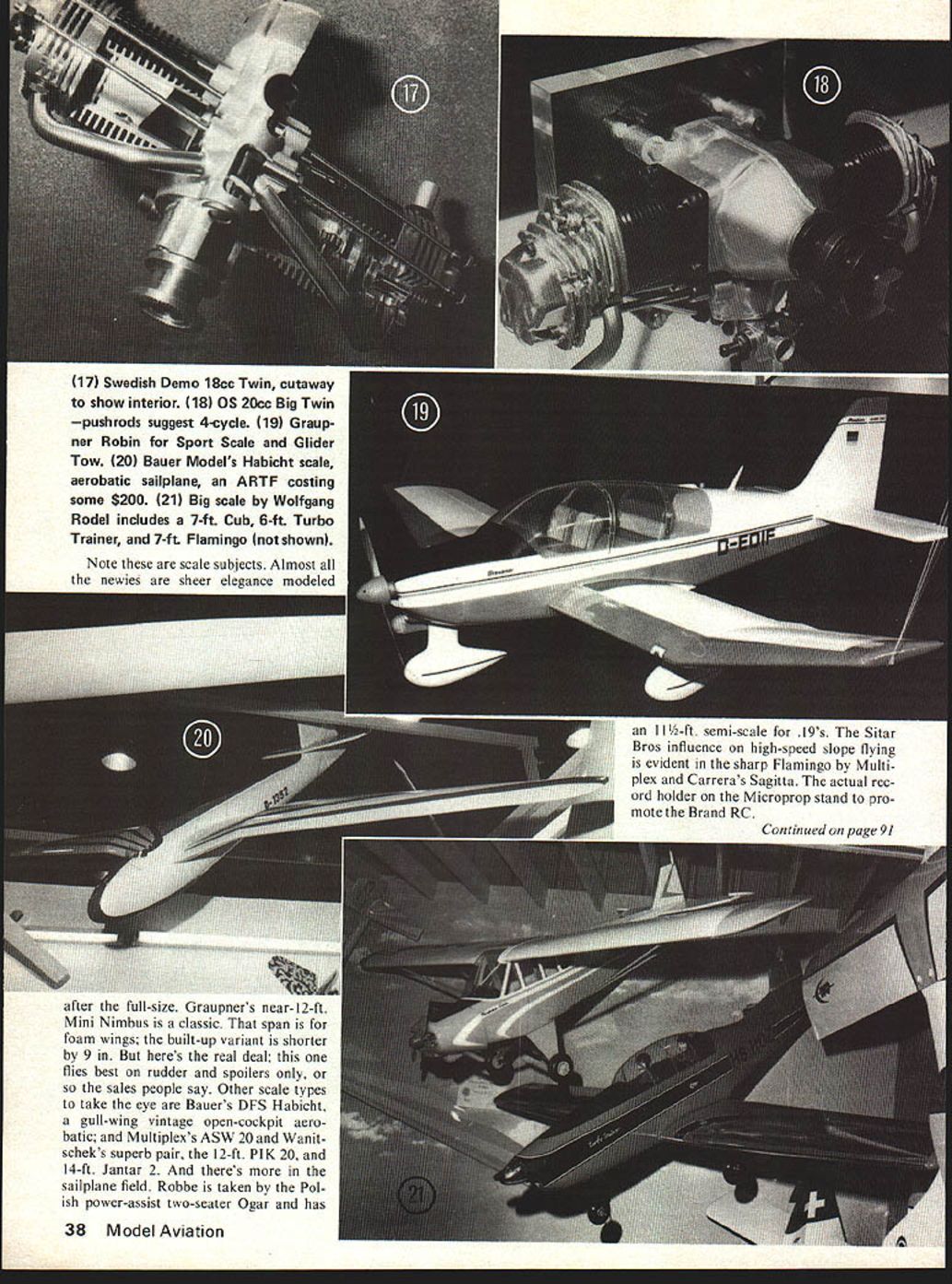
(16) The HP Gold Cup .61. (17) Swedish Demo 18cc Twin, cutaway to show interior. (18) OS 20cc Big Twin — pushrods suggest 4-cycle. (19) Graupner Robin for Sport Scale and Glider Tow. (20) Bauer Model's Habicht scale, aerobatic sailplane, an ARTF costing some $200. (21) Big scale by Wolfgang Rodel includes a 7-ft. Cub, 6-ft. Turbo Trainer, and 7-ft. Flamingo (not shown).
Note these are scale subjects. Almost all the newies are sheer elegance modeled an 11½-ft. semi-scale for .19's. The Sitar Bros influence on high-speed slope flying is evident in the sharp Flamingo by Multiplex and Carrera's Sagitta. The actual record holder on the Microprop stand to promote the Brand RC.
After the full-size. Graupner's near-12-ft. Mini Nimbus is a classic. That span is for foam wings; the built-up variant is shorter by 9 in. But here's the real deal; this one flies best on rudder and spoilers only, or so the sales people say. Other scale types to take the eye are Bauer's DFS Habicht, a gull-wing vintage open-cockpit aerobatic; and Multiplex's ASW 20 and Wanitschek's superb pair, the 12-ft. PIK 20, and 14-ft. Jantar 2. And there's more in the sailplane field. Robbe is taken by the Polish power-assist two-seater Ogar and has an 11½-ft. semi-scale for .19's. Just as the gliders were mostly scale, so were the eye-catching power kits — that is after seeing Kato's 20 & 40 versions of Prettner's Curare, and a host of electrics ranging from Aeronaut's BD-5 and Udet Flamingo, to Graupner's Elektra-fly and Elektro-Max.
The Queen of the show for this scribe was undoubtedly the 8-ft. Svenson Storch for .60's. It's big, rugged, functional and intended to fly STOL on lots of power and a big prop in fine pitch. Fixed slats, powerful flaps and tail feathers, plus a long-stroke landing gear do the rest. The wonder is no German firm did it first — Svenson is Belgian.
Cessna's abound. From the Cox RTF to Carrera's, the plastic Wichita replicas cater for a constant demand, but Graupner has gone for the Jodel Robin DR400, and in a big way. The brochures say it'll take the new OS 90, especially if used to tow sailplanes.
Other big scale kits are by Wolfgang Rodel, who has an MBB 233 "Flamingo" for .25cc, or a smaller one to suit .40's. Also, a Pilatus PC7 Turbo Trainer for .60's. Strictly "European," these big low-wings offer lots of fuselage room and ruggedness to suit grass fields. None are more rugged than Topps'.
His ARTF Class 2 scale line has been expanded by a sleek Mirage 2000 and a stunning F-18 Cobra which has droop-snoot leading edges. In latest camouflage, it looks every part a model of the '80s and sells around $160 in Germany.
Sport RC also has its share of innovations. Another flush of trainer kits include several for .20 engines. This trend is upheld in RC gear itself. Last show we saw the rash of super-sophisticated equipment with so many controls it would take an ace to handle it. This year, the same trend is perpetuated, yet toned down a shade as the modular concept becomes commonplace. Almost every manufacturer is now in the "add-a-box" state, where frequency, or even purpose, can be changed by plugging-in another module. Multiplex put a control mixer in the Tx this way, and like several other prominent German firms, have sunk their national pride into badge-engineered Japanese imports to meet the sports market they were otherwise neglecting. Thus, Futaba, Sanwa, JM, KO, etc., have a strong grip, even if they don't always appear under their own name.
Did someone say, "What about engines—helicopters?" Only Dieter Schultes's Heli-Boy aerobatic version of the Bell 222 could be claimed as new among rotary wings, and that's a sign of consolidation. Helicopter trainer pads are a coming solution to the training risk. One clever "never-leave-the-ground" device, by Helmut Fett of Cologne, is said to be selling to a generation of garden fliers who want no more than to simulate flight without risk. As for engines, the car boom has influenced which has boosted the .19 size and, at the opposite end, the big Suez 25, OS 20 and Damo 18 (see sizes), plus new OS 90 and OPS 65, show the way the trade is thinking. Only Webra has thought of the junior size and produced a 1.5 cc (.09) and there's hardly a unit on show without a throttle.
Is this the way to stimulate the young CL flier or free-flight sportster?
Transcribed from original scans by AI. Minor OCR errors may remain.

