
Self-Preservation For Model Clubs
There's no end to the benefits when you start building with kids.
Russell Ainbinder
Here's an easy way for AMA clubs to start protecting the investment they've made in their flying sites and their future membership.
The Four Strokers and I founded a Building with Kids program that addressed both our club's needs and those of our community. The program is based on any club's need for good public relations and on the community's need for recreation for neighborhood children.
The aircraft designs used in our building program can be found in various magazines and in the book Building with Kids by Dave Haught of Haught Graphics. Kits are available from AMA (Delta Darts), Peck-Polymers, and many other companies.
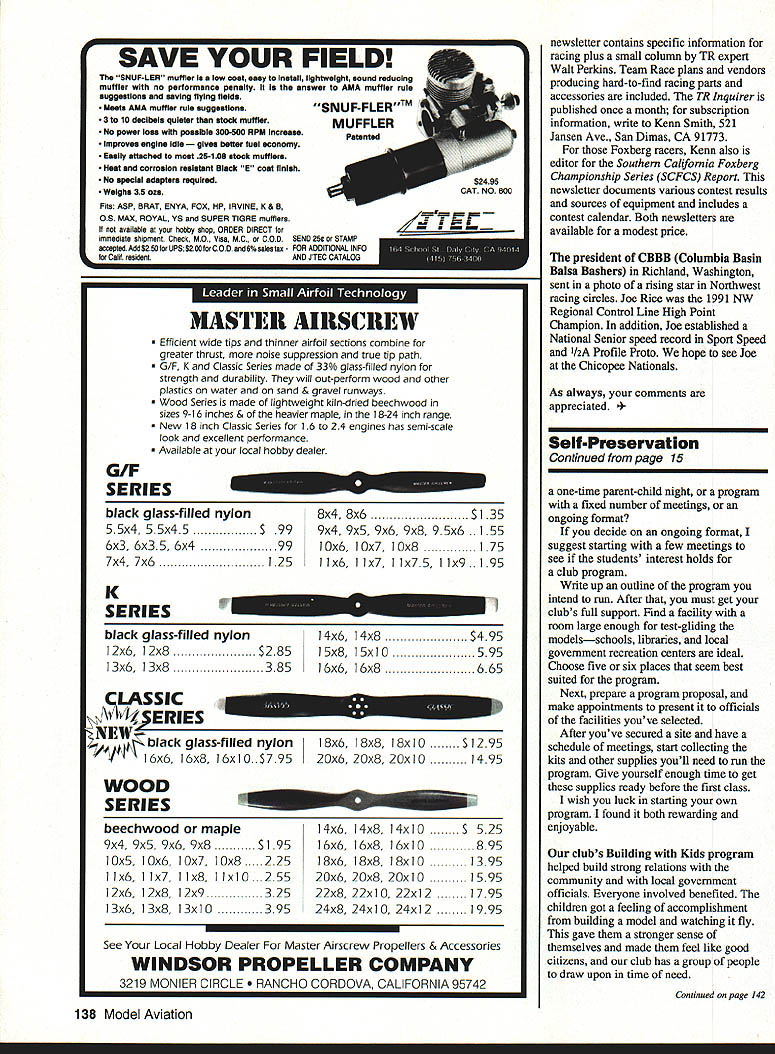
Our program began with 26 students ranging from 11 to 15 years old. Twenty students showed up for the first class. They were shown how to build an easy-to-assemble hand-launched glider—one that would fly well despite the inevitable construction mistakes. All but one of the 20 models flew; the single failure was caused when the student took his model home and added more glue—about five ounces of epoxy. The students came back weekly to enjoy our hobby.
The program involved a building day one week and a trimming-and-flying day the next. The club donated the balsa, glue, and supplies, including building boards for each student to keep. Four Stroker members precut the kits for the program. This continued for 12 weeks, including two contest days with events designed by the students.
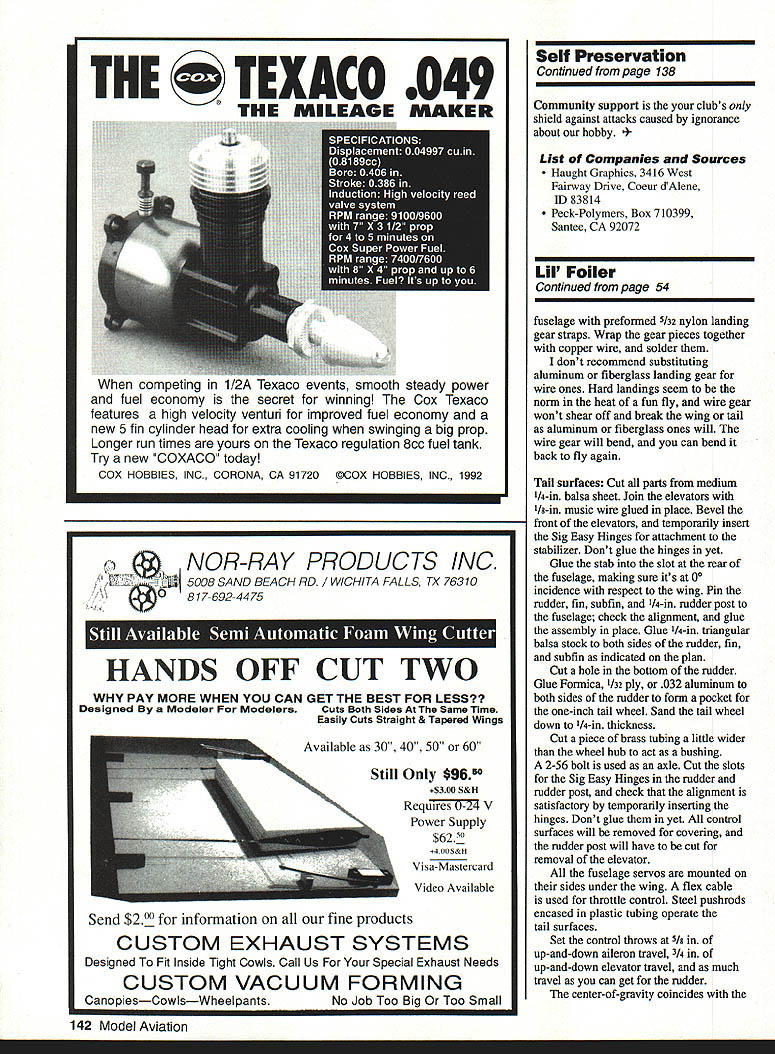
Each meeting included instruction on aircraft parts and their function. What forces act on an aircraft? How does a wing produce lift? Any questions the students asked were answered. Don't be afraid to say you don't know and will look up the answer. Make sure you remember to get answers to these sometimes insightful, sometimes humorous, always interesting questions.
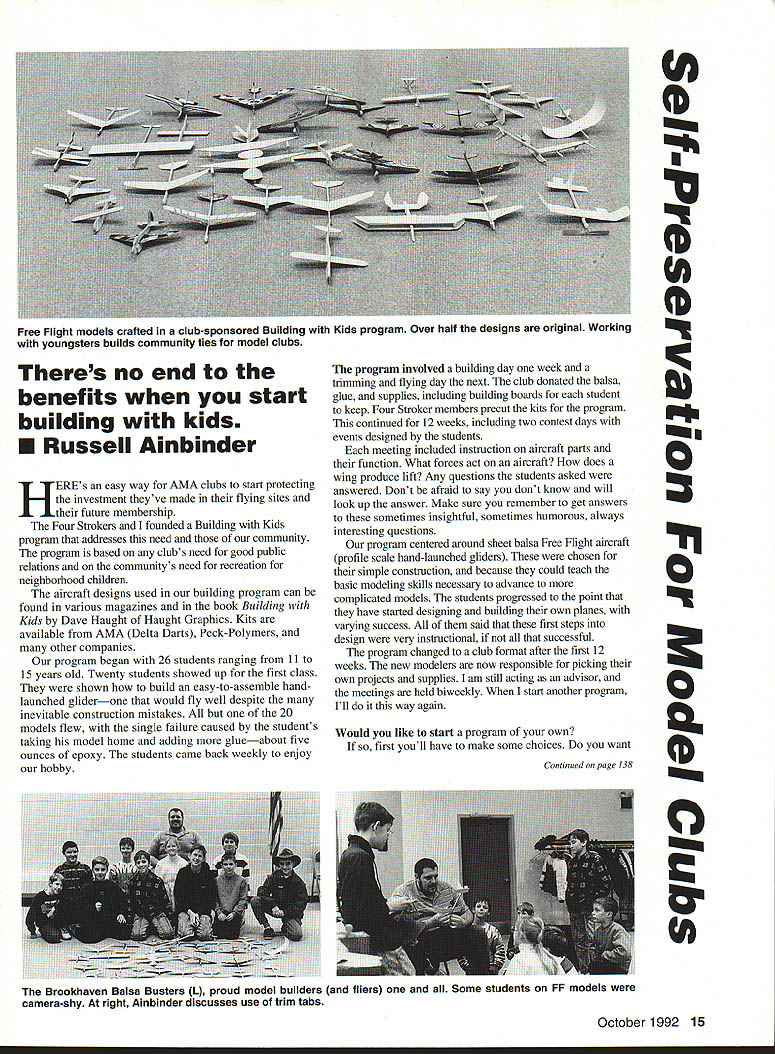
Our program centered around sheet-balsa Free Flight aircraft (profile-scale hand-launched gliders). These were chosen for their simple construction and because they teach the basic modeling skills necessary to advance to more complicated models. The students progressed to the point that they started designing and building their own planes, with varying success. All of them said that these first steps into design were very instructional, even if not all the models were successful.
After the first 12 weeks the program changed to a club format. The new modelers became responsible for picking their own projects and supplies. I continued acting as an advisor, and the meetings were held biweekly. When I start another program, I'll do it this way again.
Would you like to start a program of your own?
If so, first you'll have to make some choices. Do you want:
- a one-time parent-child night,
- a program with a fixed number of meetings, or
- an ongoing format?
If you decide on an ongoing format, I suggest starting with a few meetings to see if the students' interest holds for a club program.
Write up an outline of the program you intend to run. After that, you must get the club's full support. Find a facility with a room large enough for test-gliding the models — schools, libraries, and local government recreation centers are ideal. Choose five or six places that seem best suited for the program.
- Prepare a program proposal, and make appointments to present it to officials of the facilities you've selected.
- After you've secured a site and have a schedule of meetings, start collecting the kits and other supplies you'll need to run the program.
- Give yourself enough time to get these supplies ready before the first class.
I wish you luck in starting your own program. I found it both rewarding and enjoyable.
Our club's Building with Kids program helped build strong relations with the community and with local government officials. Everyone involved benefited. The children gained a feeling of accomplishment from building a model and watching it fly. This gave them a stronger sense of themselves, made them feel like good citizens, and provided our club with a group of people to draw upon in time of need.
Community Support
Community support is your club's only shield against attacks caused by ignorance about our hobby.
List of Companies and Sources
- Haught Graphics, 3416 West Fairway Drive, Coeur d'Alene, ID 83814
- Peck-Polymers, Box 710399, Santee, CA 92072
Transcribed from original scans by AI. Minor OCR errors may remain.

