
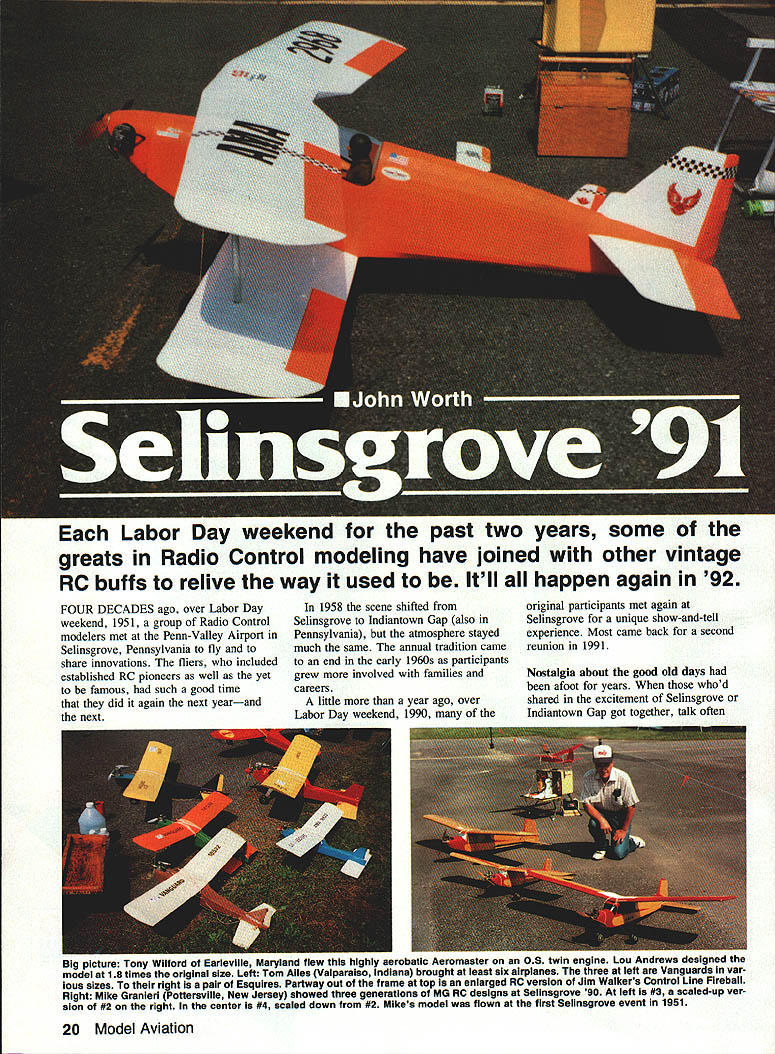
Selinsgrove '91
John Worth
Background
Each Labor Day weekend for the past two years, some of the greats in R/C modeling have joined with other vintage R/C buffs to relive the way it used to be. It'll all happen again in '92.
Four decades ago, over Labor Day weekend, 1951, a group of R/C modelers met at the Penn-Valley Airport in Selinsgrove, Pennsylvania, to fly and to share innovations. The fliers, who included established R/C pioneers as well as the yet-to-be-famous, had such a good time that they did it again the next year—and the next.
In 1958 the scene shifted from Selinsgrove to Indiantown Gap (also in Pennsylvania), but the atmosphere stayed much the same. The annual tradition came to an end in the early 1960s as participants grew more involved with families and careers.
A little more than a year ago, over Labor Day weekend, 1990, many of the original participants met again at Selinsgrove for a unique show-and-tell experience. Most came back for a second reunion in 1991.
Nostalgia about the good old days had been afoot for years. When those who'd shared in the excitement of Selinsgrove or Indiantown Gap got together, talk often turned to the idea of a reunion. Eventually such talk led to the establishment in 1989 of the Vintage R/C Society (VRCS). Part of this may have reflected a yearning—prompted by the hectic pace of high technology in the 1980s—for a return to simpler ways of doing things. Through correspondence and the society newsletter, VRCS members explored the possibility of an updated Selinsgrove reunion.
Hal DeBolt, Walt Good, Art Schroeder, Mike Granieri, Joe Beshar and others prominent in the movement saw their dream become reality. Bob Bingaman, a VRCS member who lived near Selinsgrove, told the current Penn-Valley Airport manager that he was receptive to permitting a reunion to be held at the site. Within a year the pieces came together and, on Labor Day weekend 1990, Selinsgrove became the time and place.
Recreating the Old Designs
Plans meant building new models of old designs. Fliers were asked to bring Old-Timer R/C designs typical of the '40s, '50s, and '60s. To accomplish that they might need old magazines, plans, kits, and possibly old engines. The question of R/C equipment, however, brought safety considerations that overruled nostalgia. Old-time equipment could be brought for display; fliers were expected to power antique-style models with modern, reliable radio equipment.
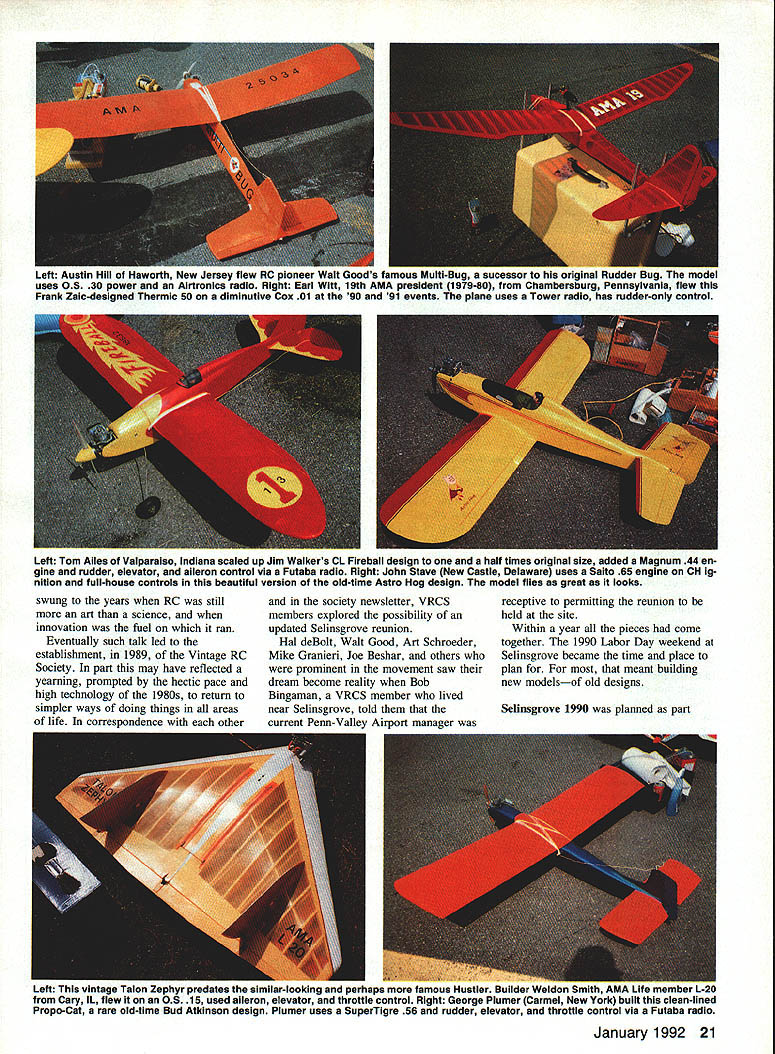
Some faced the challenge of resurrecting a model that hadn't flown in 30 years. Others took the task of building a new model the old way—no foam structure, plastic film covering, etc. Still others recreated vintage designs using modern materials and techniques. The result was a fascinating hodgepodge of old and new: original aircraft with new engines and radios; true Old-Timer veterans with thousands of flights and hundreds of hours aloft flying on their original engines; and antique designs in new electric guises. Several electric motors closely simulated early relatively low-power glow engines.
Models and Equipment
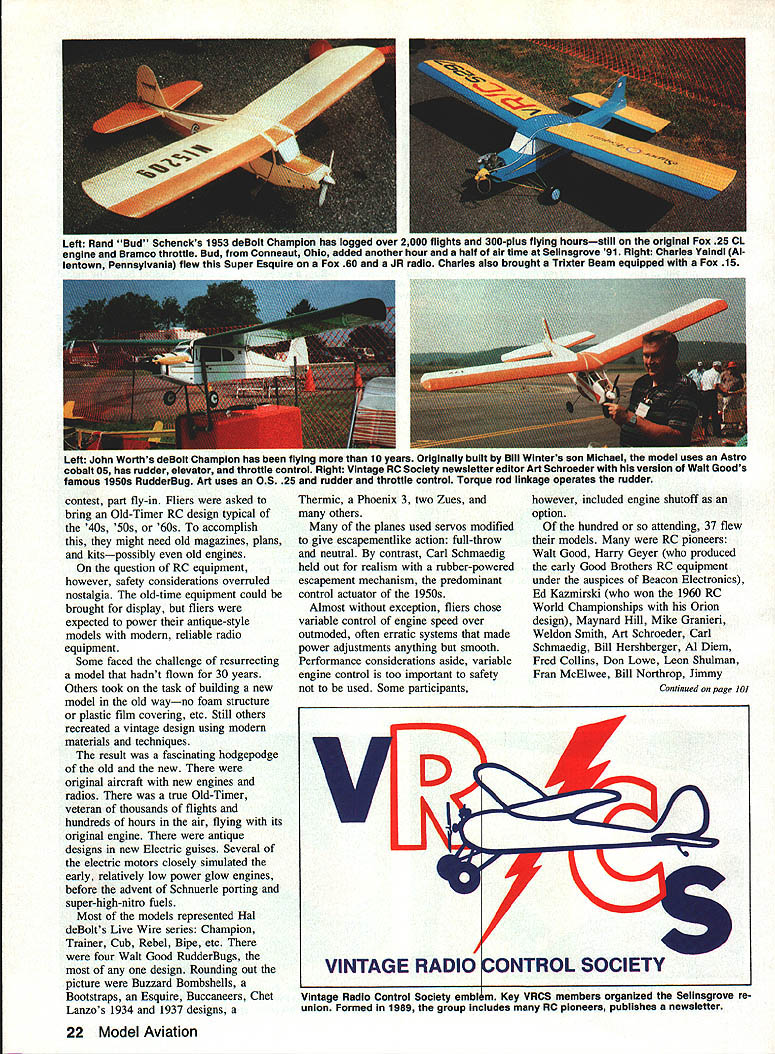
Most of the models represented Hal DeBolt's Live Wire series, including:
- Champion
- Trainer
- Cub
- Rebel
- Bipe
Other designs present included:
- Four Walt Good RudderBugs (the most of any one design)
- Buzzard Bombshells
- Bootstraps
- An Esquire
- Buccaneers
- Chet Lanzo's 1934 and 1937 designs
- A Thermic
- A Phoenix 3
- Two Zeus models
- Many others
Many of the planes used servos modified to give escapement-like action: full-throw and neutral. By contrast, Carl Schmaedig held out for realism with a rubber-powered escapement mechanism, the predominant control actuator of the 1950s.
Almost without exception, fliers chose variable control of engine speed over outmoded, often erratic systems that made power adjustments anything but smooth. Performance considerations aside, variable engine control is too important to safety not to be used. Some participants, however, included engine shutoff as an option.
Participants and Competition
Of the hundred or so attending, 37 flew their models. Many were R/C pioneers, including:
- Walt Good
- Harry Geyer (producer of early Good Brothers R/C equipment under Beacon Electronics)
- Ed Kazmarski (winner of the 1960 R/C World Championships with his Orion design)
- Maynard Hill
- Mike Granieri
- Weldon Smith
- Art Schroeder
- Carl Schmaedig
- Bill Hershberger
- Al Diem
- Fred Collins
- Don Lowe
- Leon Shulman
- Fran McElwee
- Bill Northrop
- Jimmy Grier
- Bob and Dolly Wischer
Bob Wischer dominated the Jack Port and Howard McEntee memorial competition events, flying two different Zucs. Dolly had built one in the early 1960s. Their son Bill built the other, then flew it to three consecutive National Championship wins in 1960, 1961, and 1962.
Except in the Jack Port, Howard McEntee, and Ralph Brooke memorial competition events, the flying was impromptu, with no set pattern. Those three memorial events, named after R/C pioneers no longer with us, mandated specific patterns as set forth in the 1959 AMA rules. The Port event called for single-channel radios; the McEntee event for two-channel systems; and the Brooke event for multichannel ones. Because of differences in piloting techniques and model designs, the flights were seldom similar.
The common denominator was fun.
The 1991 Reunion
Most of the 1990 attendees returned in 1991. Thirty-eight fliers, the same number as the year before, had a ball reliving the R/C of early days. The weather was perfect, and participants could fly as much as they wished. Some actually quit early to prevent running down their batteries.
As in 1990, the variety was amazing. Everywhere you looked there was something different to see. The flying ranged from aerobatics to just cruising around, long flights to short ones, fast to slow, high to low. At meets in which the flying focuses on a common goal, spectators sometimes grow bored. At Selinsgrove, that couldn't have happened.
Participants were allowed unlimited flights, and no one was under pressure to fly at a particular time. A lovely site, good weather, and a happy mood encouraged people to fly whenever and whatever they wanted.
As in 1990, the Saturday night banquet was a high spot of the weekend. Maynard Hill gave a fascinating talk and slide show on his record-setting flights and his experience making RPVs for the government.
Looking Ahead: Selinsgrove '92
Everyone who participated wanted a sequel in 1992. Planning for that probability is currently under way—with one major worry. So many said they intend to spread the word in hopes of expanding participation that the logistics for next year's event could be overwhelmed by too many people.
Strategies for minimizing potential overcrowding problems are being examined. One idea gaining momentum is to encourage the use of old-fashioned control actuators—escapements, pulse actuators, etc.—regardless of the type of radio being used. Bob Kopcsik exemplified this approach with a modernized Galloping Ghost control system that worked perfectly. Newcomers might see this as setting R/C back 30 years or more, but to really nostalgic types it's a great way to separate the serious from the frivolous.
While some such criteria may be used to determine who flies at the next R/C reunion, everyone will be welcome as spectators. So if you'd like to see and experience something of the character of early R/C, to meet and talk with many of those who pioneered the equipment we enjoy today, think Selinsgrove '92. If it duplicates the spirit of the last two, you'll remember it for years to come.
Vintage R/C Society (VRCS) and Membership
Meanwhile the Vintage R/C Society is slowly but steadily growing as word spreads about who's involved and what they're accomplishing. After starting from scratch two years ago, the group now has about 300 members. If you're interested in the history of R/C, consider joining and enjoying this branch of modeling. Members receive the VRCS newsletter six times a year as well as a red, white, and blue emblem sheet.
Membership details:
- Dues: $15 per year
- Benefits: All newsletter issues for the year joined and the emblem sheet
- Make checks payable to: VRCS
- Mail to: Joe Beshar, 198 Merritt Drive, Oradell, NJ 07649
It's not too late to join for 1991; or you can sign up now for 1992. Or you can do both.
Acknowledgments
Special thanks for providing the excellent flying site for the '91 and '92 events go to Airport Manager John Bickhart and the Penn-Valley Airport board of directors. Thanks also to the Susquehanna Valley RC Club for hosting and providing the basic personnel for the meet, and to Dorothy Granieri and Lani Willeford for handling the paperwork, registration, and souvenir sales. All of you helped make both Selinsgrove events happy successes.
Transcribed from original scans by AI. Minor OCR errors may remain.

