
Senior Slow Motion
Bill Evans
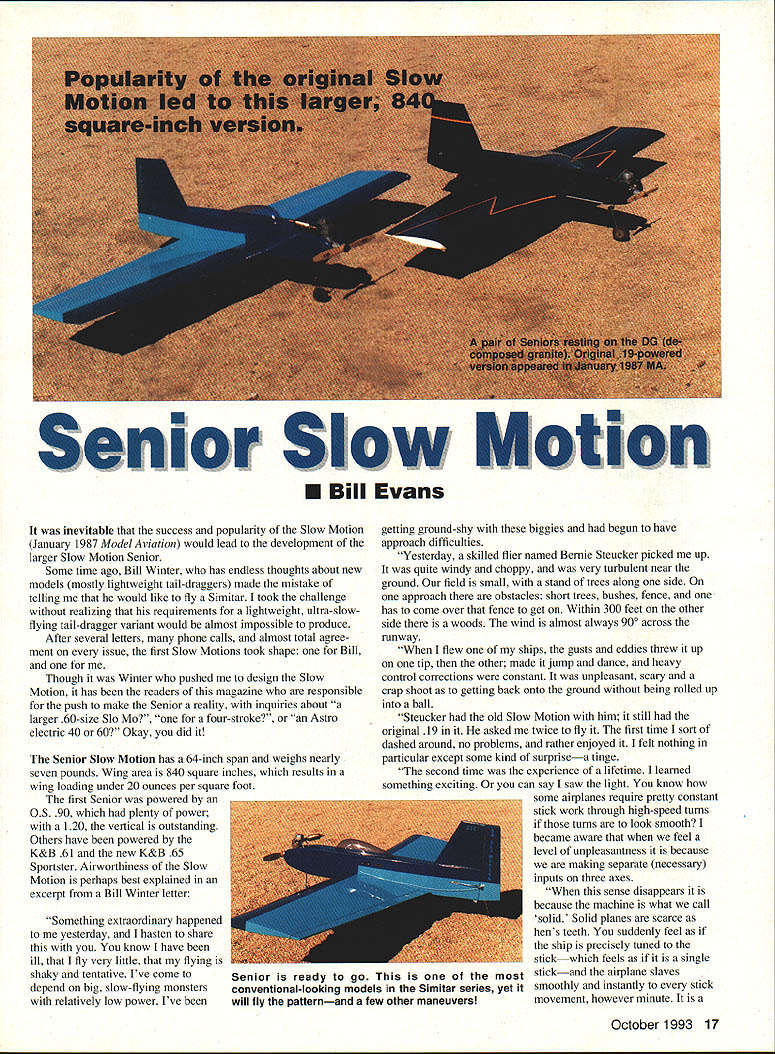
It was inevitable that the success and popularity of the Slow Motion (January 1987 Model Aviation) would lead to the development of the larger Slow Motion Senior.
Some time ago, Bill Winter, who has endless thoughts about new models (mostly lightweight tail-draggers), made the mistake of telling me that he would like to fly a Simitar. I took the challenge without realizing that his requirements for a lightweight, ultra-slow-flying tail-dragger variant would be almost impossible to produce.
After several letters, many phone calls, and almost total agreement on every issue, the first Slow Motions took shape: one for Bill, and one for me.
Though it was Winter who pushed me to design the Slow Motion, it has been the readers of this magazine who are responsible for the push to make the Senior a reality, with inquiries about "a larger .60-size Slow Motion?", "one for a four-stroke?", or "an Astro electric 40 or 60?" Okay, you did it!
The Senior Slow Motion has a 64-inch span and weighs nearly seven pounds. Wing area is 840 square inches, which results in a wing loading under 20 ounces per square foot.
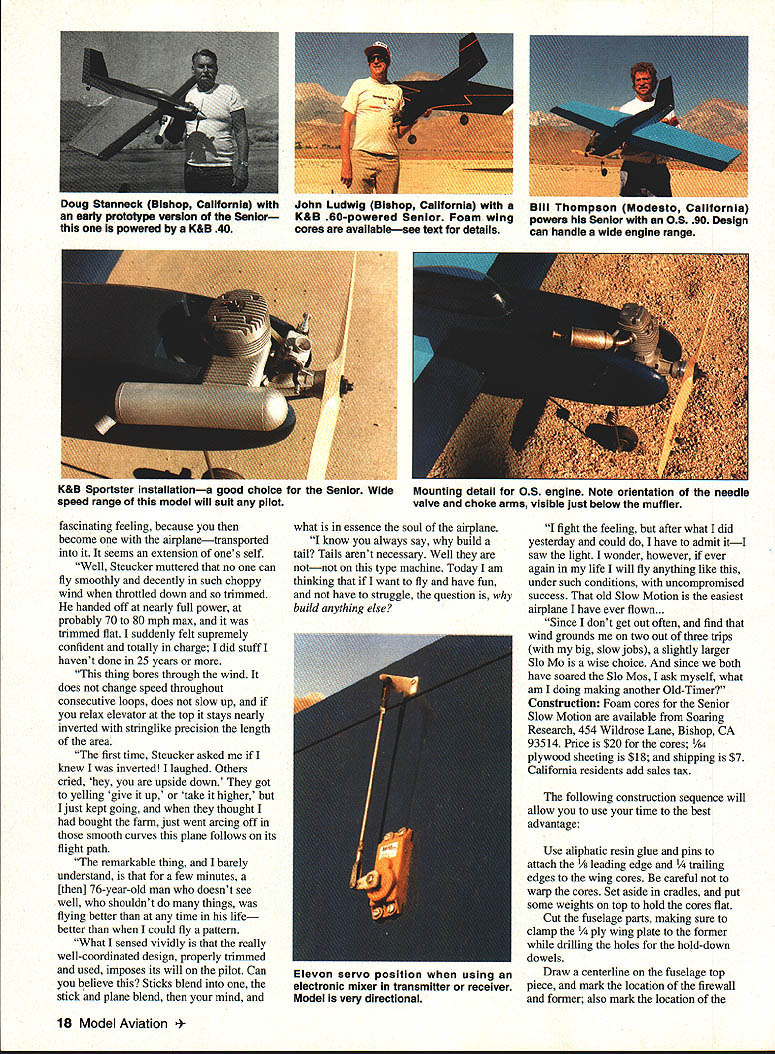
The first Senior was powered by an O.S. .90, which had plenty of power; with a .120, the vertical is outstanding. Others have been powered by the K&B .61 and the new K&B .65 Sportster. Airworthiness of the Slow Motion is perhaps best explained in an excerpt from a Bill Winter letter:
"Something extraordinary happened to me yesterday, and I hasten to share this with you. You know I have been ill, that I fly very little, that my flying is shaky and tentative. I've come to depend on big, slow-flying monsters with relatively low power. I've been getting ground-shy with these biggies and had begun to have approach difficulties.
"Yesterday, a skilled flier named Bernie Steucker picked me up. It was quite windy and choppy, and was very turbulent near the ground. Our field is small, with a stand of trees along one side. On one approach there are obstacles: short trees, bushes, fence, and one has to come over the fence to get to the field. Within 300 feet on the other side there is a woods. The wind is almost always 90° across the runway.
"When I flew one of my ships, the gusts and eddies threw it up on one tip, then the other; made it jump and dance, and heavy control corrections were constant. It was unpleasant, scary and a crap shoot as to getting back onto the ground without being rolled up into a ball.
"Steucker had the old Slow Motion with him; it still had the original .19 in it. He asked me twice to fly it. The first time I sort of dashed around, no problems, and rather enjoyed it. I felt nothing in particular except some kind of surprise — a tinge.
"The second time was the experience of a lifetime. I learned something exciting. Or you can say I saw the light. You know how some airplanes require pretty constant stick work through high-speed turns if those turns are to look smooth? I became aware that when we feel a level of unpleasantness it is because we are making separate (necessary) inputs on three axes.
"When this sense disappears it is because the machine is what we call 'solid.' Solid planes are scarce as hens' teeth. You suddenly feel as if the ship is precisely tuned to the stick — which feels as if it is a single stick — and the airplane slaves smoothly and instantly to every stick movement, however minute. It is a fascinating feeling because you become the airplane; transported, it seems an extension of one's self.
"Well, Steucker muttered, 'No one can fly smoothly in such choppy stuff.' He throttled down, trimmed, handed it off at nearly full power — probably 70 to 80 percent. Trimmed flat, I suddenly felt supremely confident and totally in charge. I did things I haven't done in 25 years. The thing bores through wind, does changes of speed throughout consecutive loops, does slow up and relax at the top, and stays nearly inverted with stringlike precision.
"The plane follows its flight path. The remarkable thing is that a 76-year-old man who doesn't see well shouldn't be flying better than he has in his life, yet he flew the pattern better than he ever had.
"What I sensed vividly was a really well-coordinated design, properly trimmed and used, that imposes its will on the pilot. I can believe that sticks, plane, and pilot blend; that the essence, the soul of the airplane is revealed. I always say build tail... Tails aren't necessary? Well, not — not on that type of machine. Today I am thinking I want to fly, have fun, and not have to struggle. After what I did yesterday, I could hardly admit it — I saw the light. I wonder, however, if ever again in my life I will fly anything like it under such conditions. The uncompromised success of the old Slow Motion makes it the easiest airplane I have ever flown."
Since I don't get out often, and find that wind grounds me on two out of three trips (with my big, slow jobs), a slightly larger Slo Mo is a wise choice. And since we both have soared the Slo Mos, I ask myself, what am I doing making another Old-Timer?
Construction
Foam cores for the Senior Slow Motion are available from Soaring Research, 454 Wildrose Lane, Bishop, CA 93514. Price is $20 for the cores; 1/8" plywood sheeting is $18; and shipping is $7. California residents add sales tax.
The following construction sequence will allow you to use your time to the best advantage:
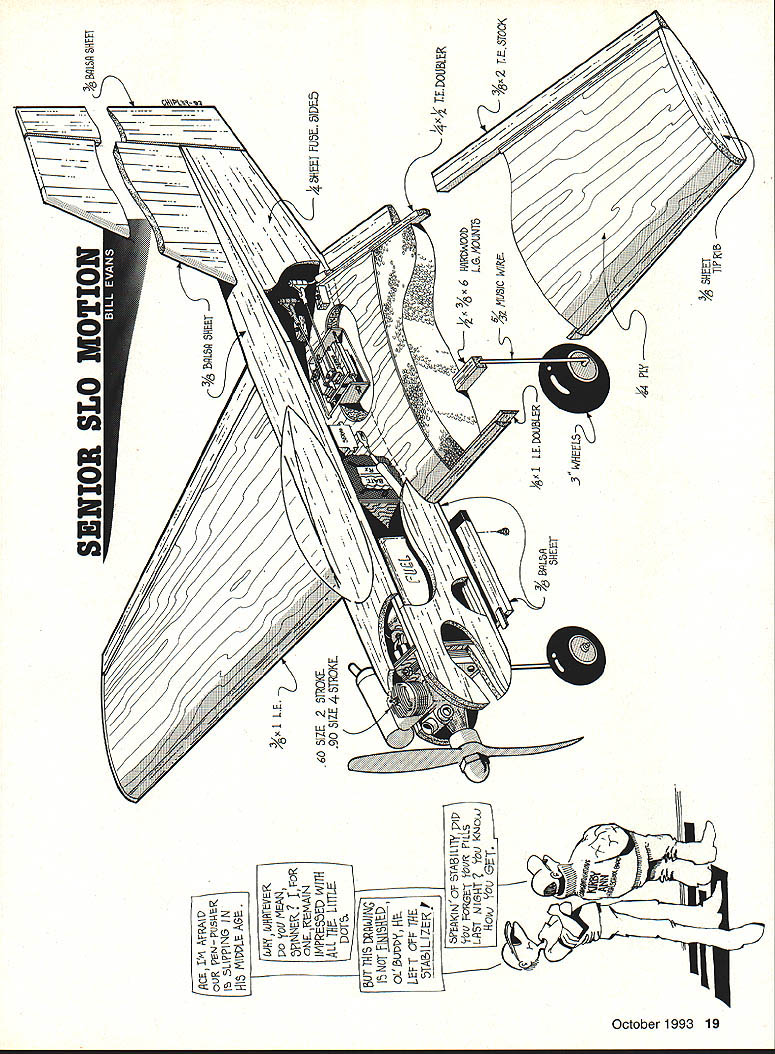
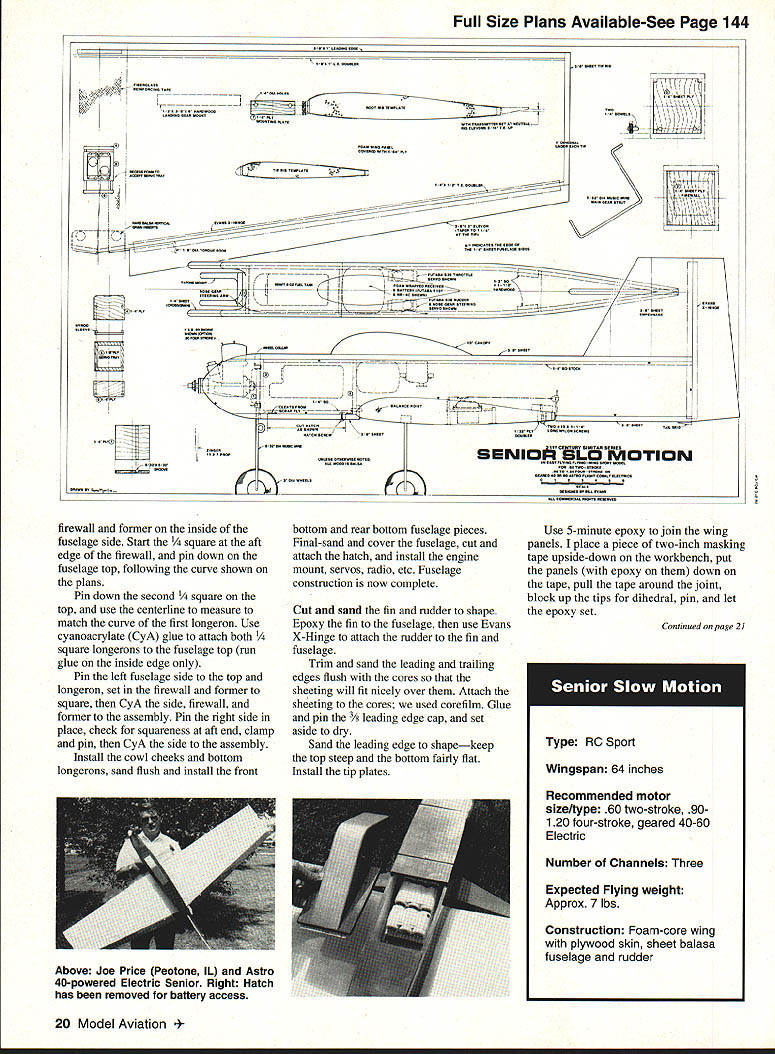
- Use aliphatic resin glue and pins to attach the 1/8" leading edge and 1/4" trailing edges to the wing cores. Be careful not to warp the cores. Set aside in cradles, and put some weights on top to hold the cores flat.
- Cut the fuselage parts, making sure to clamp the 1/4" ply wing plate to the former while drilling the holes for the hold-down dowels.
- Draw a centerline on the fuselage top piece, and mark the location of the firewall and former; also mark the location of the firewall and former on the inside of the fuselage side.
- Start the 1/4" square longeron at the aft edge of the firewall, and pin it down on the fuselage top, following the curve shown on the plans.
- Pin down the second 1/4" square on the top, and use the centerline to measure to match the curve of the first longeron. Use cyanoacrylate (CyA) glue to attach both 1/4" square longerons to the fuselage top (run glue on the inside edge only).
- Pin the left fuselage side to the top and longeron, set in the firewall and former to square, then CyA the side, firewall, and former to the assembly. Pin the right side in place, check for squareness at the aft end, clamp and pin, then CyA the side to the assembly.
- Install the cowl cheeks and bottom longerons, sand flush and install the front bottom and rear bottom fuselage pieces. Final-sand and cover the fuselage, cut and attach the hatch, and install the engine mount, servos, radio, etc. Fuselage construction is now complete.
- Cut and sand the fin and rudder to shape. Epoxy the fin to the fuselage, then use Evans X-Hinge to attach the rudder to the fin and fuselage.
- Trim and sand the leading and trailing edges flush with the cores so that the sheeting will fit nicely over them. Attach the sheeting to the cores; corefilm was used on the prototype. Glue and pin the 3/8" leading edge cap, and set aside to dry.
- Sand the leading edge to shape—keep the top steep and the bottom fairly flat. Install the tip plates.
- Use 5-minute epoxy to join the wing panels. Place a piece of two-inch masking tape upside-down on the workbench, put the panels (with epoxy on them) down on the tape, pull the tape around the joint, block up the tips for dihedral, pin, and let the epoxy set.
Specifications
- Type: RC Sport
- Wingspan: 64 inches
- Recommended motor size/type: .60 two-stroke; .90–1.20 four-stroke; geared 40–60 electric
- Number of channels: Three
- Expected flying weight: Approx. 7 lbs.
- Construction: Foam-core wing with plywood skin; sheet balsa fuselage and rudder
Come join the Simitar pilots and fly into the 21st century.
Transcribed from original scans by AI. Minor OCR errors may remain.

