
Setting an RC Helicopter Speed Record
Hubert E. Bitner Jr.
A speed of 34.3 mph may not sound like much, but flying through the traps at the ends of a 200-meter course, and fulfilling all requirements, proved to be a considerable challenge.
BACK IN October, 1976, I attended a meeting at the Manned Spacecraft Center Radio Control Club of which I am a member. At this meeting Lars Giertz announced that there would be radio-controlled aircraft speed trials held at Ellington Air Force Base on the 17th of that month. When he said that no official speed record had been set by a helicopter as of that date, I was all attention. Without any further encouragement I made every effort to be at the trials. After all, setting a record is a lot easier than breaking one. At least that's what I thought, until I got there early Sunday morning.
I am going to be a good sport and tell you how to break that lightning record of 34.3 mph. I don't mean to just show up and fly, which is probably all it will take. There are some important facts to be brought to your attention that I will cover in this article, such as modifications to your machine, the course lay-out, limitations on equipment and flying techniques, the timing procedure, and last but not least, how to prepare your dossier.
Having very little time to get ready for the speed trials prevented me from building a new machine, so I proceeded to do some minor modifications to my scratch-built helicopter. There are a few major areas where changes can create increased speed. First of all, rotor rpm is very important. The Revolution and the Helibaby have a very high rpm rotor blade, which is one of the reasons they are so fast. To increase rpm try decreasing pitch until copter lifts off just over 3/4 throttle. A practical procedure for everyday flying and getting speed will work. Also the rotor head has lots of teetering; little or no resistance—springs or rubber will help hold speed. Pitching up the nose can give good maneuverability but produce too much drag at speed. A lot of nose weight will counteract the helicopter's tendency to flatten nose-up in forward flight. A horizontal stabilizer and down elevator will also help in achieving speed by holding the nose down.
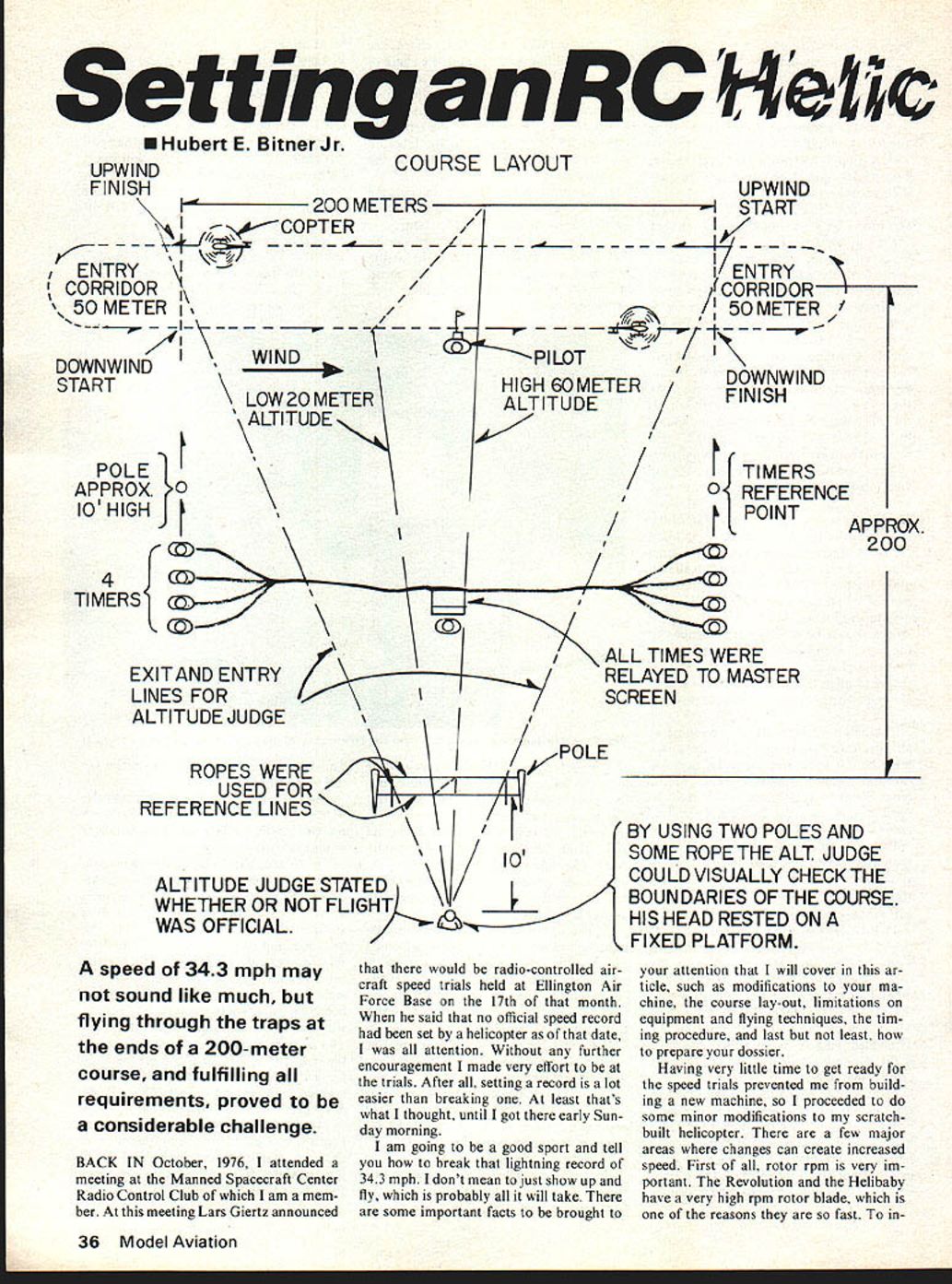
I discovered the course was 200 meters in length with a 100-meter entry corridor. At first I visually checked it out and decided it was going to be an easy task. After further thought, racing full throttle with full forward cyclic turned out to be a poor attempt to get to the end of the course. Another piece that added to the problem was a 30-degree wind blowing about 20 knots, gusting up to about 25 knots. The course was set up north-south so I had to fly both directions. We completed flights both downwind and upwind; the times were calculated to give an average speed. Fortunately, John Burkam has been proposing a new set of rules that would cut the course from 200 meters to 200 feet. This would be about the right proportion, considering airplane speeds versus helicopter speeds. One point I would like to make is that an airplane can build up enough speed in a dive, and pretty much hold that speed the whole length of the 200-meter course, but a helicopter cannot. A 200-foot course would also help in this aspect. The course must be accurately measured and checked by the directing official.
There are some limitations involved in setting a speed record. You can't fly the copter from a truck or car or any other vehicle, so be sure to check the range of your radio. The machine you are flying must be a true helicopter, which is explained in the FAI rules. It must not weigh over 5 kg., or roughly 11 lbs. You also have an altitude of 20-60 meters to stay within as you fly the course from start to finish. All of these procedures must be checked by a directing official.
Timing the flight can be done several ways, but I will tell you what method we used. There were four timers located at the south end, and four more at the north end of the course. Using this method, two timers are used for each run (entry and exit) and the times are recorded on a master sheet. The timers operated electronically, and with the stopwatch method the times were accurate to 0.1 sec. Each timer was given a number, and the helicopter pilot was given time cards so each timer would know which run was being recorded. Alternate timing methods could be used, but this seemed to be a simple, accurate method.
All times for exit and entry were relayed to the master lines for scoring. An altitude judge used ropes for reference lines. By using two poles and some rope the altitude judge could visually check the altitude. The judge would state whether or not a flight was within the boundaries of the course. His head rested on a fixed platform.
A speed of 343 mph may sound like much when flying through the traps at the ends of a 200-meter course, but fulfilling the requirements proved a considerable challenge. Back in October 1976 I attended a meeting of the Manned Spacecraft Center Radio Control Club. At a member meeting, Lars Giertz announced that there would be radio-controlled aircraft speed trials held at Ellington Air Force Base on the 17th of the month. He said no official speed record had been set for helicopters to date, and this caught my attention. Without further encouragement I made every effort to enter the trials.
After setting the record, it was a lot easier breaking it — at least that's what I thought — until I got to the early Sunday morning attempt. Saying I could break the lightning-fast record of 343 mph doesn't mean you can just show up and fly; it probably will take some important preparation. I will bring to your attention, and will cover in this article, such modifications to the machine, course layout, limitations, equipment, flying techniques, timing procedure, and, last but not least, how to prepare a dossier.
Having very little time to get ready for the speed trials prevented building a new machine, so I proceeded with some minor modifications to my scratch-built helicopter. There are a few major areas where changes can create increased speed. First, rotor RPM is very important.
To increase RPM, try decreasing pitch until the copter lifts off at just over 3/4 throttle. This is a practical procedure; everyday flying and practice will work. Also, the rotor head should have lots of teetering with little or no resistance — springs or rubber will help hold the rotor at speed. Pitching the nose up can give good maneuverability but will produce too much drag. Adding nose weight will counteract the helicopter's tendency to flatten nose-up in forward flight. A horizontal stabilizer or a down-trimmed elevator will also help achieve and hold the nose-down attitude needed for speed.
The course was 200 meters in length with a 100-meter entry corridor. I had visually checked it out and had decided it would be an easy task, but after thinking of racing at full throttle with full forward cyclic, the attempt to get to the end of the course proved difficult. Another piece that added to the problem was a 30-degree wind blowing about 20 knots, gusting up to about 25 knots. The course was set up north–south so I had to fly both directions. We completed flights both downwind and upwind; the times were calculated to give an average speed.
Fortunately, John Burkam has been proposing a new set of rules that would cut the course from 200 meters to 200 feet. This would be about the right proportion, considering airplane speeds versus helicopter speeds. One point I would like to make is that an airplane can build up enough speed in a dive and pretty much hold that speed the whole length of a 200-meter course, but a helicopter cannot. A 200-foot course would also help in this aspect. The course must be accurately measured and checked by the directing official.
There are some limitations involved in setting a speed record. You can't fly the copter from a truck, car, or other vehicle—be sure to check the range of your radio. The machine you are flying must be a true helicopter, as explained in the FAI rules. It must not weigh over 5 kg, roughly 11 lbs. of the course. They were positioned on a line perpendicular to the start and finish of the course. Between their line of sight and the course ends was a vertical pole which they used for a reference point. As the model passed this point they would activate their stopwatches. The times were electronically relayed back to a master screen manned by a directing official. When the numbers hit the screen, he would vocally report them into a cassette recorder to avoid confusion and error. After the flight was finished, the times were then transferred from the recorder to paper, along with information concerning whether each run was official. In order for a speed run to be accepted on timing there cannot be more than 2/100 of a second difference at each end of the course in the watches of two timers. In other words, the more timers, the more chance of them hitting within this range. The times are then converted into speed.
Now I will explain what official means on a speed run. First of all, to improve our communications we used citizen-band radios to converse from point to point. These points being at the course itself, the master screen, the timers, and also the altitude judge. As the copter flew the course, the altitude judge informed the directing official whether the altitude was between 20 and 60 meters. If the model enters the course correctly and stays within the boundaries of the course, it will be stated as official. Be prepared to repeat your flight over and over, because this will increase your chance of a good flight.
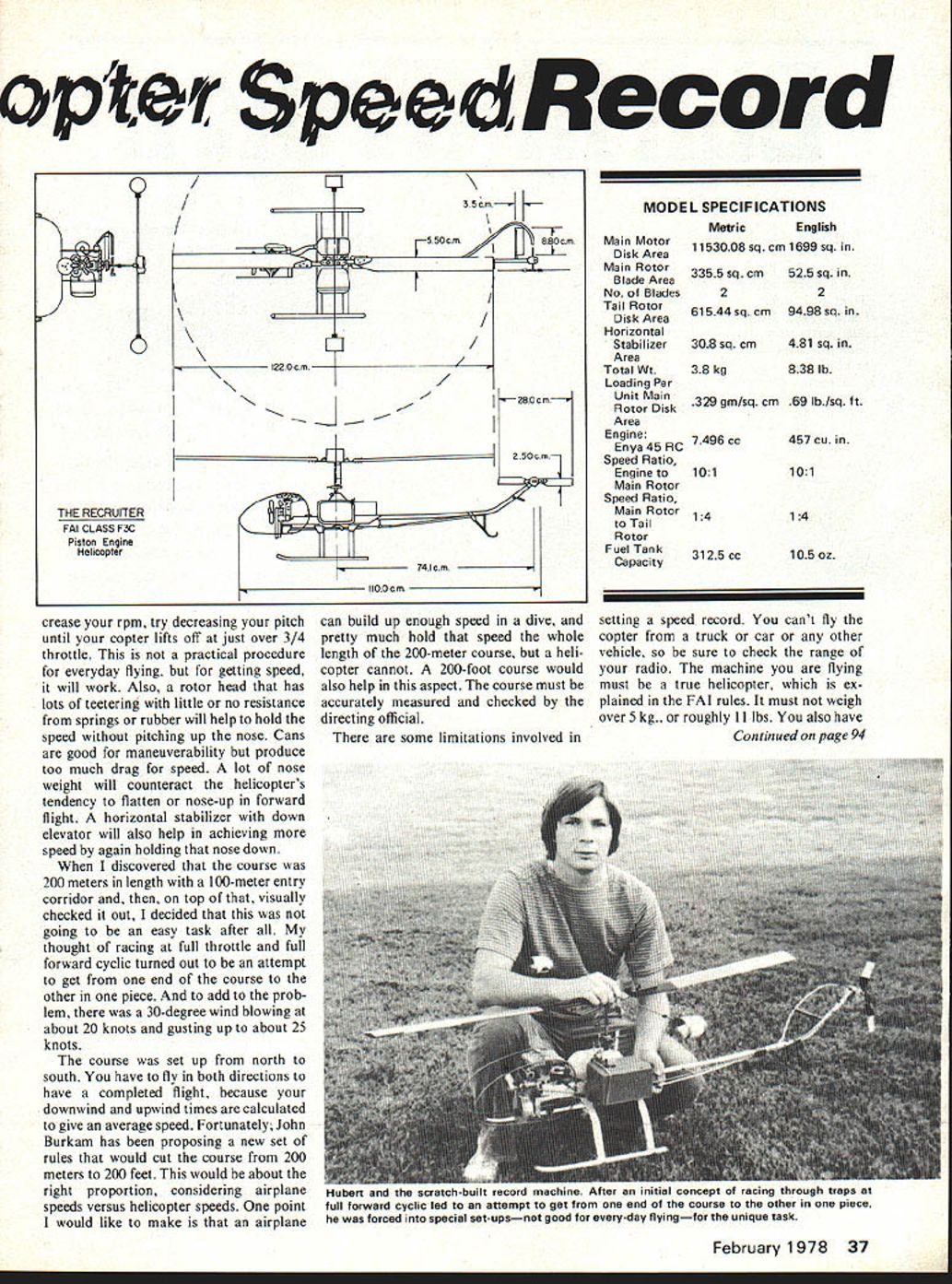
If you get a chance to go for a record be prepared to obtain a lot of signatures; when it comes time to fill out the paperwork, just about everything requires a paper. Photographs and a three-view drawing of your model will also be needed to complete the dossier. You will also be asked to explain how the course was measured, how the altitude was checked, and the method of timing used. They will require some technical data concerning your helicopter, such as weight, overall size, rotor blade area, disc area, power used, tail-blade span, mechanical ratios, and fuel capacity. I must admit there is a lot of work involved in a record but, if I had to do it all over again, I would do so. Believe me, you will know three times more about your machine afterwards than you did before.
There is no excuse for a person not to break this record. Just don't break it too badly because I'm going to give it another shot someday.
I want to acknowledge the Manned Spacecraft Center Radio Control Club for the organizing of this speed trial, because I couldn't have done it without them.
Transcribed from original scans by AI. Minor OCR errors may remain.

