
Chris Schanzle
Seventh-Grade Project!
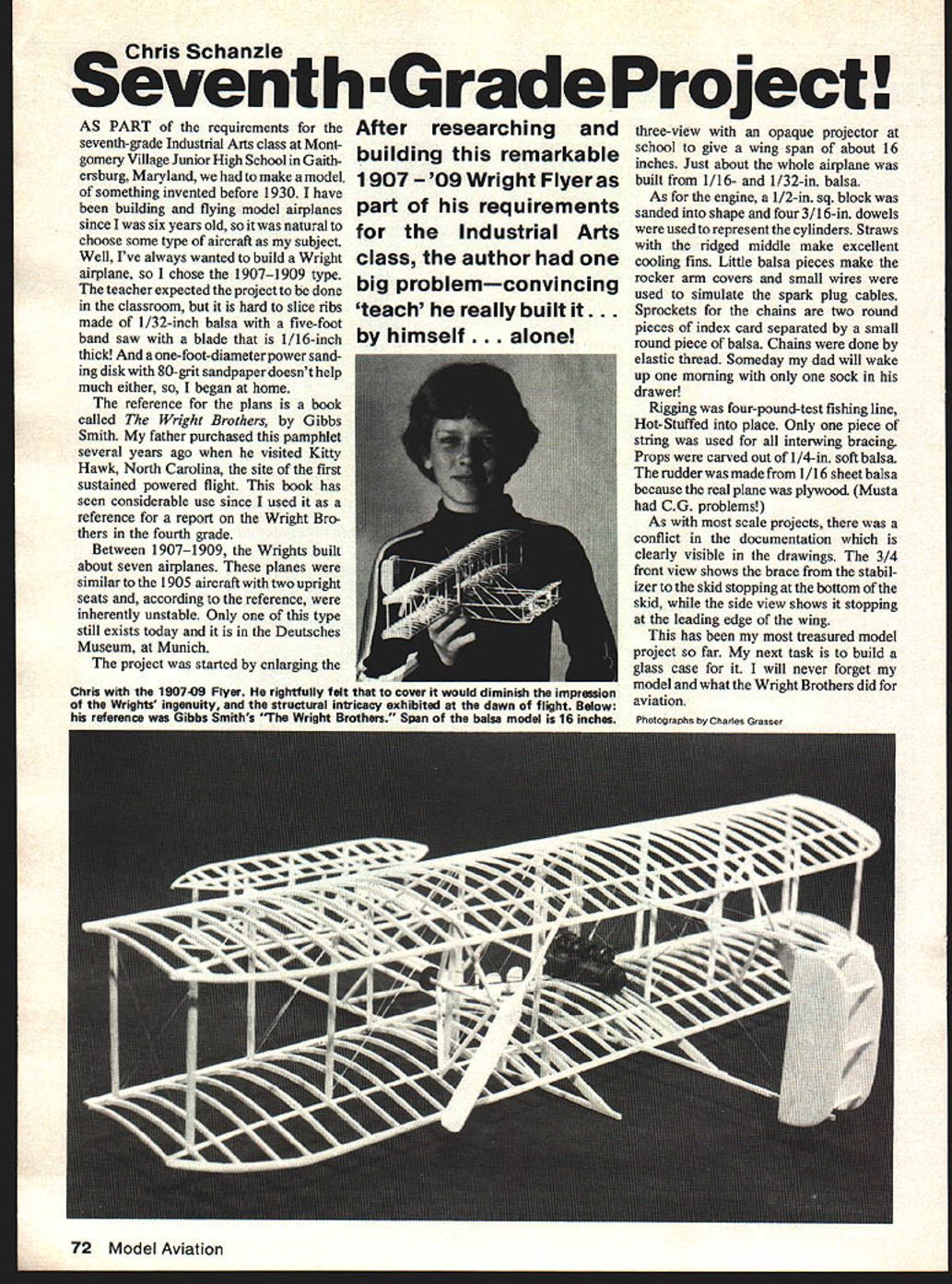
As part of the requirements for the seventh-grade Industrial Arts class at Montgomery Village Junior High School in Gaithersburg, Maryland, we had to make a model of something invented before 1930. I have been building and flying model airplanes since I was six years old, so it was natural to choose some type of aircraft as my subject. I've always wanted to build a Wright airplane, so I chose the 1907–1909 type.
The teacher expected the project to be done in the classroom, but it is hard to slice ribs made of 1/32‑inch balsa with a five-foot band saw with a blade that is 1/16‑inch thick! A one-foot-diameter power sanding disk with 80‑grit sandpaper didn't help much either, so I began at home.
Reference
The reference for the plans is a book called The Wright Brothers, by Gibbs Smith. My father purchased this pamphlet several years ago when he visited Kitty Hawk, North Carolina, the site of the first sustained powered flight. This book has seen considerable use since I used it as a reference for a report on the Wright Brothers in the fourth grade.
Between 1907 and 1909 the Wrights built about seven airplanes. These planes were similar to the 1905 aircraft with two upright seats and, according to the reference, were inherently unstable. Only one of this type still exists today, and it is in the Deutsches Museum in Munich.
After researching and building this remarkable 1907–1909 Wright Flyer as part of my Industrial Arts requirement, I had one big problem — convincing the teacher I really built it... by myself... alone!
Project start and scale
The project was started by enlarging the three-view with an opaque projector at school to give a wingspan of about 16 inches. Just about the whole airplane was built from 1/16‑ and 1/32‑in. balsa.
Materials and construction details
- Wing and structure: 1/16‑ and 1/32‑in. balsa for most of the airframe.
- Engine: a 1/2‑in. square block sanded into shape; four 3/16‑in. dowels used to represent the cylinders.
- Cooling fins: ridged middle sections of drinking straws make excellent cooling fins.
- Rocker arm covers: small balsa pieces; spark plug cables simulated with small wire.
- Sprockets: two round pieces of index card separated by a small round piece of balsa.
- Chains: elastic thread (Someday my dad will wake up one morning with only one sock in his drawer!)
Props were carved out of 1/4‑in. soft balsa.
Rigging and surfaces
Rigging was four-pound-test fishing line, hot-stuffed into place. Only one piece of string was used for all interwing bracing. The rudder was made from 1/16‑inch sheet balsa because the real plane was plywood — must've had C.G. (center-of-gravity) problems!
Documentation conflict
As with most scale projects, there was a conflict in the documentation which is clearly visible in the drawings. The three-quarter front view shows the brace from the stabilizer to the skid stopping at the bottom of the skid, while the side view shows it stopping at the leading edge of the wing.
Conclusion
This has been my most treasured model project so far. My next task is to build a glass case for it. I will never forget my model and what the Wright Brothers did for aviation.
Transcribed from original scans by AI. Minor OCR errors may remain.

